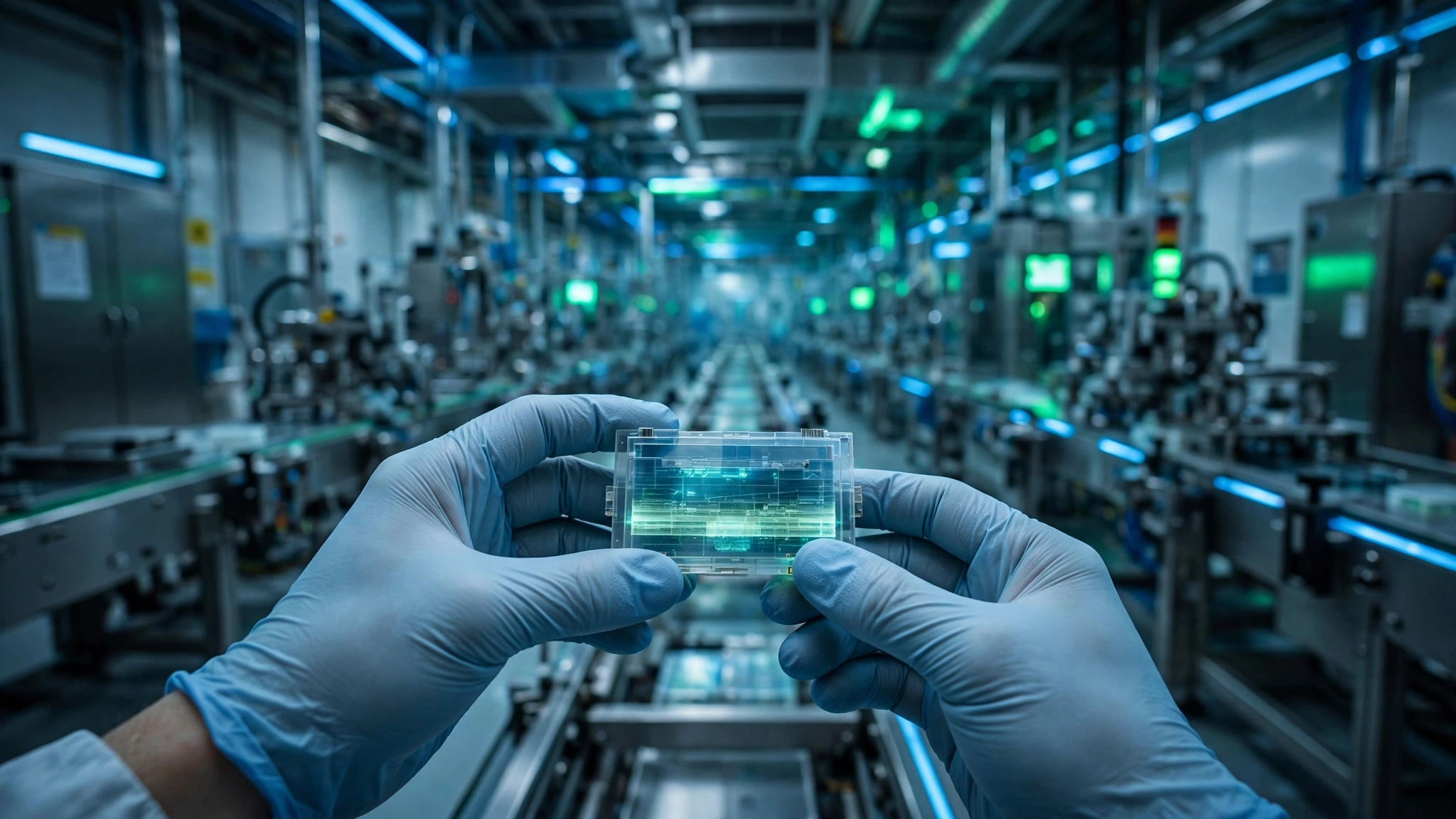
Forty-nine tonnes. That is the entire global production of sulfide solid electrolyte for the first half of 2026, according to Shanghai Metals Market's comprehensive H1 review, and this single number defines the material constraint standing between the most promising battery technology in a generation and the cars you can actually buy. To grasp how small that volume truly is, consider that the world produced roughly 2.6 million tonnes of LFP cathode material over the same period. Put another way, sulfide electrolyte versus mainstream cathode runs about 53,000 to 1.
This matters because the demos have never looked better, and the gap between what engineers can build in a lab and what factories can ship to dealerships has never been wider. Earlier this year, a Mercedes-Benz EQS prototype equipped with Factorial Energy's semi-solid-state battery traveled 749 miles on a single charge with an estimated 84 miles of range still in the tank, bringing the available total to 833 miles on a platform that normally tops out at 390 miles with its standard 118-kWh lithium-ion pack. Stellantis has the same cells running in a prototype Dodge Charger Daytona. Toyota claims more than 1,000 patents and a 745-mile target for its all-solid-state vehicle, expected in 2027 or 2028, partnering with Idemitsu on sulfide electrolyte development and Sumitomo Metal Mining on cathode durability. China's Chery showed a prototype cell at the Beijing Auto Show claiming 600 watt-hours per kilogram, more than double the energy density of conventional NMC chemistry, while BYD debuted its own sulfide all-solid-state prototype vehicle at the same event.
The prototypes work. The supply chain doesn't.
The Bottleneck Nobody's Quantifying
A sulfide solid-state battery cell typically uses 15 to 20 percent solid electrolyte by weight, and at an energy density of 400 Wh/kg, roughly the midpoint of what current prototypes achieve, a 75-kWh battery pack requires about 187.5 kilograms of cells with approximately 37.5 kilograms of that mass being solid electrolyte.
Divide the 49 tonnes of global H1 sulfide electrolyte production by 37.5 kilograms per pack. You get 1,307 vehicles. From the entire planet's output. In six months.
SMM forecasts full-year 2026 sulfide electrolyte production at 130 to 170 tonnes, and even at the upper bound that is material for about 4,500 EVs against global production of roughly 18 to 20 million units this year, meaning current sulfide electrolyte output can supply approximately 0.025 percent of global demand.
| Metric | H1 2026 | Full-Year 2026 (Est.) |
|---|---|---|
| Sulfide electrolyte produced | 49 tonnes | 130–170 tonnes |
| EVs equippable (at 37.5 kg/pack) | ~1,307 | ~3,500–4,500 |
| Share of global EV production | ~0.014% | ~0.025% |
| Oxide electrolyte produced | 1,380 tonnes | 3,400–3,900 tonnes |
| Li₂S (sulfide precursor) produced | 37 tonnes | ~150 tonnes |
The oxide electrolyte picture is less dire, with 1,380 tonnes in H1 representing 28 times the sulfide volume, but oxide chemistry delivers lower ionic conductivity and carries persistent manufacturing challenges around sintering temperatures and the brittleness that comes with ceramic materials pressed into thin layers at industrial scale. The highest-performance prototypes, including Factorial's demonstration vehicle and Toyota's target platform, rely on sulfide pathways because sulfide electrolytes achieve ionic conductivities comparable to liquid electrolytes while enabling the lithium-metal anodes that unlock 400-plus Wh/kg energy density, which is the reason the 28× production gap exists: sulfide is harder to synthesize, harder to handle without producing toxic hydrogen sulfide gas on contact with moisture, and harder to stabilize across the thousands of charge-discharge cycles an EV demands.
What 833 Miles Is Actually Worth
Here is a calculation that has not appeared anywhere in the coverage of Factorial's Mercedes demonstration, and it reframes the economics of solid-state batteries from "too expensive" to "expensive but converging faster than you think."
A production Mercedes EQS with its 118-kWh lithium-ion pack delivers 390 miles of EPA range at an efficiency of about 3.31 miles per kWh. BloombergNEF's 2025 annual survey pegged average BEV battery pack prices at $99 per kWh, putting the EQS pack cost around $11,682 and yielding a cost per mile of range of $29.95.
Now apply the density advantage. Solid-state cells at 400 Wh/kg deliver 1.6 times the energy density of conventional NMC at roughly 250 Wh/kg, which means that for the same vehicle range an SSB pack needs only 62.5 percent as much capacity, inverting the cost equation in a way the industry has not fully absorbed: SSB cells can be 1.6 times more expensive per kWh than lithium-ion and still deliver the same cost per mile of range to the consumer because the pack itself is physically smaller.
That calculation puts the break-even threshold at $158 per kWh for solid-state cells. Above that number, SSBs are more expensive per mile of range than lithium-ion despite their density advantage; below it, they win on economics alone, independent of any safety or charging-speed premium the market might additionally reward.
Current SSB cell costs sit at industry estimates of ¥3 to ¥5 per watt-hour. At mid-July exchange rates that translates to $410 to $690 per kWh, about 2.6 to 4.4 times above the break-even point. That gap is large.
But trajectory matters more than any single snapshot, and the trajectory is steep. Sulfide electrolyte (Li₂S) prices fell 23.5 percent in H1 2026, dropping from ¥2,000 to ¥1,530 per kilogram, and SMM forecasts another 13 to 22 percent decline in H2 as production lines scale from tens of tonnes to hundreds. LPSC compound electrolyte dropped from ¥10,200 to ¥7,280 per kilogram. If cell costs follow the electrolyte price curve and sustain a 30 to 40 percent annual decline, SSBs cross the $158/kWh threshold somewhere around 2029 to 2031, which aligns remarkably well with the timelines that Toyota, Samsung SDI, and LG Energy Solution have independently stated for mass commercialization.
China's Gotion High-Tech is more aggressive, publicly targeting ¥1 per watt-hour for its semi-solid batteries by 2027, roughly $140 per kWh. If Gotion hits that number, its packs would clear the break-even threshold with room to spare and deliver more range per dollar than today's best lithium-ion chemistry. Gotion's target covers semi-solid cells, which still contain some liquid electrolyte and do not achieve the full energy-density advantages of a pure sulfide architecture.
China Is Playing a Different Game
The geographic concentration of solid-state battery production is more lopsided than most observers realize, and the numbers tell a story that press releases about "global partnerships" tend to obscure. In H1 2026, Chinese companies commissioned or brought online roughly 10.7 GWh of solid-state battery production capacity across five facilities: Taizhou Qingtao at 3.5 GWh, Xinjie Energy at 2 GWh for lithium-metal solid-state cells, Jinyu New Energy at 1.2 GWh, Enli Power in Anhui at 2 GWh, and Heyuan Lichuang as Central China's first SSB line. An additional 53-plus GWh is signed or under construction, including Guoxiang Century's ¥10 billion complex in Shanghai Jiading and Qingtao's ¥5 billion, 20 GWh project in Hohhot.
Outside China, the picture is pilot lines and investor presentations. QuantumScape inaugurated its EagleLine process in the U.S. and is sending pre-production samples to Volkswagen's PowerCo, but the company has pivoted its business model toward IP licensing rather than direct manufacturing, sitting on $970 million in cash intended to last through 2029 while it finds licensees willing to assume manufacturing risk. SolidPower is installing a continuous electrolyte pilot line with completion expected by year-end. ProLogium broke ground on its Dunkirk factory with Emmanuel Macron in attendance, targeting production in 2028 at the earliest with a $3.8 billion SPAC valuation hinging on a 48 GWh ultimate build-out that has never produced a commercial cell. Toyota is "accelerating" its Aichi pilot line without disclosing capacity or timeline specifics. Nissan completed a 23-layer cell stack and targets its first solid-state EV in fiscal year 2028.
None of these represent GWh-scale production. SMM's assessment is blunt: overseas firms "lag Chinese leaders by 1 to 2 years in volume production."
The mobilization on the Chinese side is tangible. BYD is testing 60Ah all-solid-state cell stability on production lines. CATL is ramping a 5 GWh pilot with yield targets that will determine whether it ships to OEM design wins in 2027. Dongfeng already has a demo fleet running oxide-polymer composite cells at 350 Wh/kg with over 3.2 million accumulated kilometers and has completed extreme-cold testing. SAIC and Qingtao have started delivering semi-solid MG4X models to actual consumers in the ¥100,000 segment at about $13,800, making it the world's cheapest semi-solid EV and the first to prove that the technology can be manufactured at a price point that doesn't require a luxury buyer.
In July 2026, China published a national standard (GB/T) defining "all-solid-state" as a weight-loss rate of 0.5 percent or less, stricter than the prior industry-group threshold of 1 percent, and banning marketing terms like "quasi-solid" and "pseudo-solid." When a country standardizes terminology at the national level, it is planning for volume production. Not demonstrations.
The Strongest Case Against Urgency
The sulfide bottleneck is real, but sulfide is not the only path to a solid-state battery, and there is a strong argument that it may not even be the most commercially relevant path for the next five years. Oxide electrolyte production is 28 times larger than sulfide. Semi-solid batteries, which blend solid electrolyte with a small volume of liquid, are already in commercial vehicles today. SAIC's MG4X delivers real range to real customers using oxide-polymer composite chemistry, Dongfeng's 350 Wh/kg cells have passed extreme-cold validation, and Sunwoda already has semi-solid cells in production smartphones.
The argument goes deeper: sulfide electrolyte's degradation on contact with moisture and its production of toxic hydrogen sulfide gas may represent a permanent manufacturing tax rather than a temporary scaling problem that engineering can eliminate. Oxide chemistry does not share this vulnerability. If the market needs solid-state performance at scale, oxide and semi-solid chemistries may constitute the 80-percent solution that arrives years before sulfide achieves the same outcome with higher theoretical performance but intractable production complexity, and 80 percent of the benefit at 20 percent of the cost has a long history of winning in technology markets.
SMM's own forecast supports this reading with striking clarity. By 2028, the firm projects 160 GWh of semi-solid battery shipments versus just 3.5 GWh of all-solid-state, a ratio of 46 to 1 in favor of the compromise technology. True all-solid-state penetration of the global battery market won't reach even 0.15 percent by 2030, according to SMM's modeling against a projected 6 TWh market. That 0.15 percent figure rises to about 10 percent by 2035, representing roughly 1,000 GWh of a 10 TWh total, but that timeline puts mainstream solid-state adoption nearly a decade away and rests on assumptions about manufacturing yield rates and cost compression that remain unproven at anything resembling the scale of the current lithium-ion industry.
What We Don't Know
This analysis relies on SMM's production data, which is the most granular publicly available source but is weighted toward Chinese market participants; Western production volumes may be modestly underreported, though the pilot-stage status of every major US, European, Japanese, and Korean program suggests the omission is small. The 833-mile Mercedes prototype likely benefited from aerodynamic and efficiency optimizations beyond the battery swap alone, since Factorial has not disclosed the pack's exact capacity and the per-kWh improvement cannot be isolated from vehicle-level gains. SSB cell cost estimates of ¥3 to ¥5/Wh are industry survey midpoints rather than audited production costs and may not reflect yields achievable at commercial scale. The $158/kWh break-even threshold assumes SSB packs require no additional thermal management or manufacturing overhead versus lithium-ion, a simplification that could push the true break-even 10 to 20 percent higher. "Semi-solid" covers a spectrum where some products contain 5 percent liquid electrolyte and others use 40 percent, and the performance, safety, and cost profiles differ substantially across that range.
The Bottom Line
Solid-state batteries are real, they work, and a car drove 833 miles on one. But the supply chain to produce them at any meaningful scale does not yet exist. Every factory on earth produced enough sulfide electrolyte to build 1,300 EV batteries in six months, and at the current cost structure all-solid-state cells remain 2.6 to 4.4 times too expensive to compete with lithium-ion when measured on a per-mile-of-range basis.
China is closer to solving this than anyone else, with 10.7 GWh of commissioned capacity and 50-plus GWh under construction while the rest of the world operates pilot lines and files SPAC paperwork. Even so, China's own forecasters do not see all-solid-state penetration exceeding 0.15 percent of the global battery market by 2030.
If you are buying an EV in the next three years, buy it now; the solid-state battery the supply chain can actually deliver at scale is at least four years away. If you are investing in the battery supply chain, watch the sulfide electrolyte precursor market, specifically Li₂S and P₂S₅ production, because that is where the physical bottleneck lives and where returns will concentrate when production scales from hundreds of tonnes to thousands. If you work in battery procurement for an automaker, your 2027 and 2028 model years will run on semi-solid or conventional lithium-ion; plan supplier contracts accordingly. And if you are a policymaker watching the global battery race: China has published its national SSB standard, commissioned 10 GWh of capacity, and has 50 GWh breaking ground. Western governments have so far responded with pilot lines, IP licensing pivots, and SPAC listings. That gap is widening, and the sulfide price curve is declining at 23.5 percent per half-year, compressing the window during which policy intervention could still change the outcome.