Shield AI's Drones Crash at 170× the Pentagon's Own UAS Rate. Its Valuation Just Doubled to $12.7 Billion.
A Reuters investigation revealed that Shield AI destroyed at least 50 V-BAT drones in 18 months from a fleet of roughly 200. We benchmarked that destruction rate against two decades of Department of Defense unmanned aircraft mishap data. The result: 278 airframes lost per 100,000 flight hours, versus 1.61 for the MQ-9 Reaper. The same Hivemind flight control software now powers the company's next-generation X-BAT jet, a $30 million airframe.
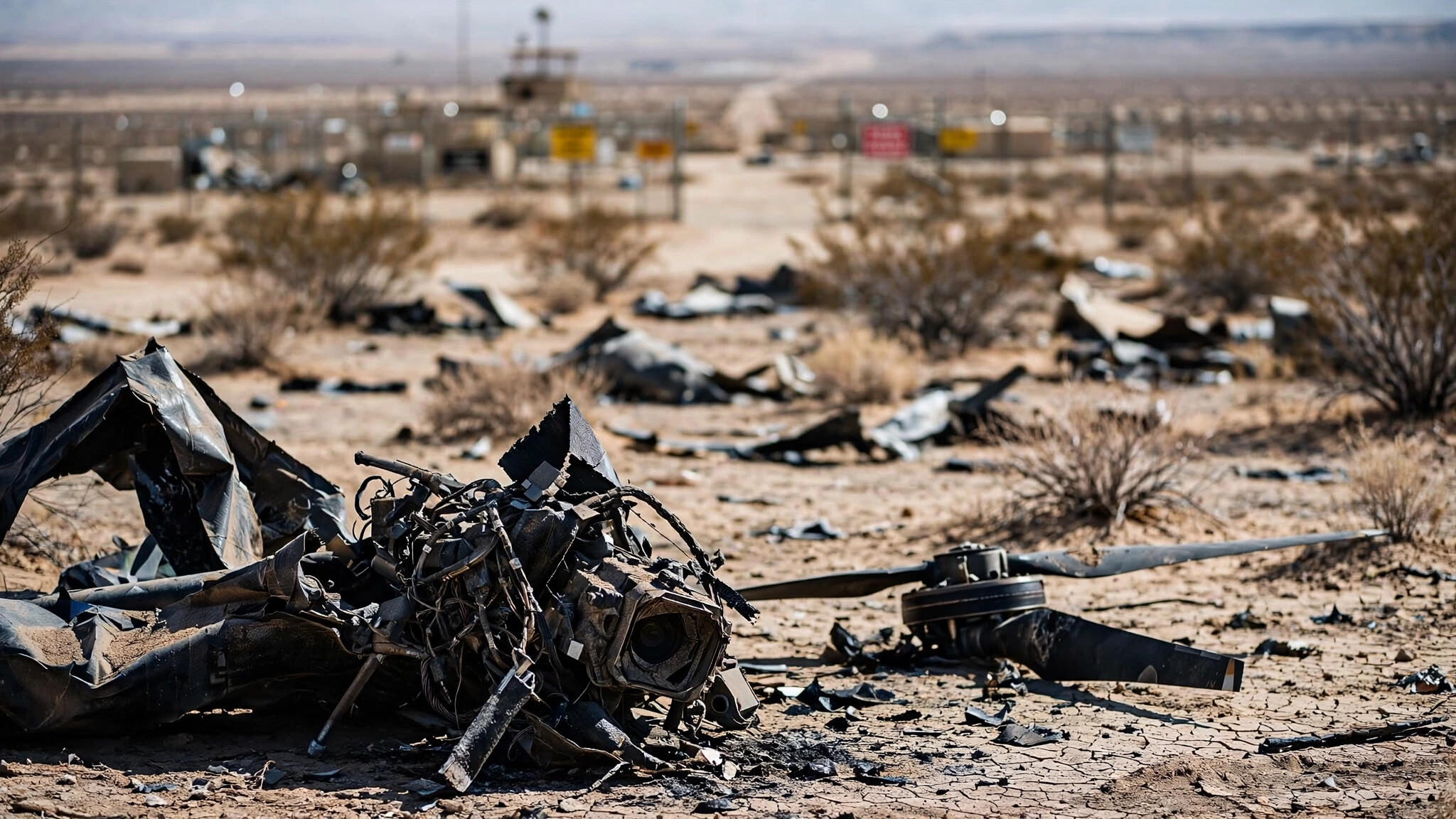
Two hundred seventy-eight. That is the number of V-BAT airframes Shield AI destroys per 100,000 flight hours, calculated from the company's own stated total of 18,000 hours and the 50-plus crashes documented by Reuters on June 5, 2026. For comparison, the MQ-9 Reaper, the workhorse of American drone warfare for two decades, loses 1.61 airframes per 100,000 hours across its operational lifetime, according to Congressional Research Service data drawn from the Air Force Safety Center. The ratio is 173 to 1.
That number is conservative, and it is almost certainly too kind.
The 50 crashes occurred over just 18 months, but the 18,000 flight hours span six years of operations beginning in 2019, including an older, smaller fleet that logged thousands of hours before the upgraded V-BAT entered service. If the upgraded fleet accounts for even half the total hours, the destruction rate doubles to 556 per 100,000 hours, and the Reaper comparison balloons to 345 to 1. Shield AI's response to these figures, delivered through Reuters, was to draw a distinction: customers experienced only 10 "operational mishaps" since early 2025, and "operational mishaps are common" for drones like V-BAT.
The Math Nobody Ran
The Department of Defense has tracked unmanned aircraft mishaps with actuarial precision since the late 1990s, classifying any incident causing $2.5 million or more in damage, total airframe destruction, or fatality as a Class A mishap under DoDI 6055.07. The Air Force Safety Center publishes cumulative rates per 100,000 flight hours, offering the closest thing defense aviation has to a universal safety benchmark.
| Platform | Airframes Destroyed / 100K hrs | Ratio to V-BAT |
|---|---|---|
| MQ-1 Predator | 5.54 | 1:50 |
| MQ-9 Reaper | 1.61 | 1:173 |
| RQ-4 Global Hawk | 2.25 | 1:124 |
| All DoD Unmanned | 3.26 | 1:85 |
| All DoD Manned | 1.33 | 1:209 |
| V-BAT (conservative) | 278 | baseline |
Even the MQ-1 Predator, the platform with the worst destruction rate in DoD's unmanned fleet, loses airframes at a pace 50 times lower than the V-BAT, and the V-BAT's conservative rate exceeds the entire DoD manned aviation fleet by a factor of 209. These are not comparable failure modes; they are different orders of magnitude.
Fifty Versus Ten
Shield AI's public response hinges on a definitional gap that deserves scrutiny. The company told Reuters that customers experienced 10 operational mishaps since early 2025. Reuters' sources, including former product manager Jacob Miller, who filed a whistleblower complaint with the Department of Labor in May 2026, documented 50-plus destroyed airframes from Shield AI's internal fleet over 18 months. Both statements can be simultaneously true if "customer operational mishap" excludes internal testing, development flights, and demonstration crashes.
The gap matters enormously, because of what allegedly happened with the data between those two numbers. Miller's complaint alleges that Shield AI "falsified or scrubbed data in mishap reports" to produce a "falsely favorable narrative," and that revised data was used to secure contracts with NAVAIR, the Greek military, Japan, Norway, Taiwan, and Ukraine. According to the Reuters investigation, Shield AI told the Greek military that the V-BAT was flying autonomously during a demonstration when it was actually being manually piloted. At least three employees who raised safety concerns about the V-BAT's flight performance, including engineers who had witnessed crashes firsthand, were fired or departed the company under circumstances that the whistleblower complaint characterizes as retaliatory.
Shield AI hired Littler Mendelson, the nation's largest employment law firm, to investigate internal claims of a hostile work environment and air safety violations. The firm's findings, which could determine whether the company's internal safety culture matches its public narrative about V-BAT reliability, have not been made public.
Two Fingers, Twice
The V-BAT has severed fingers on two separate occasions, an unusual distinction for a drone weighing roughly 120 pounds.
In April 2024, a U.S. Navy servicemember rushed to catch a tipping V-BAT during a recovery operation, grabbed its propeller, and had three fingers partially severed. It took 45 minutes to reach emergency services due to poor cellular signal at the test site. The Navy grounded the entire V-BAT fleet for two weeks. Its investigation found Shield AI's preflight briefing "lacked sufficient emergency procedures." Shield AI's fix: new landing gear and warning stickers near the propeller. CEO Ryan Tseng told Forbes the redesigned aircraft was "tip to tail, just a radically better airplane."
On May 12, 2026, a Romanian Naval Forces official caught his hand in a V-BAT propeller during a training exercise on a boat off the Texas coast. Two fingers severed and one fractured, followed by surgery at University Medical Center New Orleans on May 12 and again on May 16. His condition deteriorated, and he was transferred to Walter Reed National Military Medical Center. Romania's $30 million V-BAT contract, for which it is paying roughly $1 million per drone for an aircraft that has now injured two of its operator countries' servicemembers, remains in effect. The Romanian defence ministry called it "premature to draw conclusions."
The X-BAT Inheritance Problem
Here is where the crash rate stops being a startup growing-pains story and becomes a procurement risk of a different magnitude entirely. It scales.
Shield AI's X-BAT is a jet-powered "loyal wingman" drone designed to fly alongside manned fighter jets. It costs approximately $27 to $30 million per unit, carries weapons, and operates at combat speeds. In an April 2025 presentation to the Indian government, Shield AI confirmed that X-BAT uses the same Hivemind flight control software as the V-BAT. The Pentagon's Defense Innovation Unit has awarded a previously unreported contract for the program. An April 2026 pitch deck requested $500 million for four prototypes by 2029, with the total program estimated at $1.3 billion.
Run the inheritance math: if V-BAT flight controls carry even a fraction of their current failure rate to the X-BAT platform, the consequences scale with the airframe price. At V-BAT destruction rates applied to a hypothetical 50-unit X-BAT fleet, 12 to 13 aircraft would be destroyed in 18 months. At $30 million each, that is $375 million in destroyed hardware, or 29% of the entire X-BAT development budget consumed in twisted metal and scorched runway. The Pentagon spokesperson's response to questions about technology inheritance risk: "We recognize that risk is inherent to technology development and innovation, viewing it as a critical learning process essential to fulfilling our Department's mandate to embrace risk, break things, and deliver capabilities at speed and scale."
Break things — those are the actual words from a Pentagon spokesperson about a program that shares its flight controls with a $30 million jet drone.
The Valuation Paradox
Shield AI closed its Series G in March 2026, raising $2 billion at a $12.7 billion post-money valuation led by Advent International and co-led by JPMorgan Chase, with Blackstone providing $500 million in preferred equity and a $250 million delayed draw facility. Total funding to date: $3.52 billion across 17 rounds, with projected 2026 revenue of $540 million, placing the company at a 23.5 times revenue multiple.
For context: Lockheed Martin, maker of the F-35, trades at roughly 1.8 times revenue. RTX, parent of Raytheon and Pratt & Whitney, sits at 2.1 times. Even Palantir, the most aggressively valued defense-adjacent software company, commands about 30 times. Shield AI's multiple is closer to Salesforce than to any company that has ever built something that flies and crashes.
Divide the valuation by the surviving fleet. Approximately 200 V-BATs were built; 50-plus destroyed leaves roughly 150 operational airframes, though the exact number is unverified. At $12.7 billion, each surviving drone carries an implied value of $84.7 million. Each one costs about $1 million to manufacture. The remaining $83.7 million per drone, 99% of the implied value, is the market's bet on Hivemind, the autonomous flight software platform. That same software is what keeps crashing the drones.
The Anduril Parallel
Shield AI is not alone in this pattern. Anduril Industries, valued at $30.5 billion, has experienced its own cascade of field failures. Two Altius drones nosedived during Eglin Air Force Base tests in November 2025, one falling 8,000 feet; the Pentagon announced a $50 million Altius contract the same day. In Ukraine, Ghost drones achieved 10 to 15 percent hit rates under Russian electronic warfare, and Ukrainian forces stopped using the Altius entirely by 2024. A Navy exercise off the California coast in May 2025 saw 12-plus Anduril drone boats fail. An Anvil counter-drone system caused a 22-acre fire in Oregon in August 2025.
Palmer Luckey, Anduril's founder, has claimed the Altius has "taken out hundreds of millions of dollars worth of Russian targets." Perhaps. But the defense tech sector is developing a pattern, and it is a troubling one: spectacular fundraising rounds followed by field performance that legacy defense primes would never tolerate from their own programs, procurement officials who look the other way because speed matters more than reliability, and a media cycle that celebrates valuations while burying crash reports.
The Strongest Case for Shield AI
Every new military aircraft crashes more in its early years than at maturity. The F-35's early Class A mishap rate hit 3.11 per 100,000 hours. The MQ-1 Predator's first years were brutal. Comparing a developmental VTOL drone in its first 18 months of upgraded operations against the MQ-9 Reaper's 20-year track record is, fairly, apples to oranges in terms of program maturity.
More importantly, the V-BAT has demonstrated something no legacy DoD drone can claim. It has logged 130-plus combat sorties in Ukraine's GPS-denied, EW-saturated battlespace, precisely the environment where traditional unmanned systems lose link and crash. That operational proof point does not appear in any CRS data table. If the Pentagon's strategic priority is fielding autonomous capability fast enough to matter in the next conflict, some developmental attrition is the cost of speed, and the alternative, decade-long acquisition programs that deliver capability after the threat has evolved, has its own body count.
The question is not whether crashes happen during development. They always do. The question is whether 25% fleet destruction in 18 months represents acceptable developmental attrition or a fundamental reliability problem in the autonomy stack that will scale with every new platform Hivemind touches.
What This Analysis Cannot Prove
Reuters' 50-plus crash count comes from two sources. Shield AI contests it. The true number may be higher or lower. We cannot independently verify Shield AI's claimed 18,000 total flight hours; if the actual number is significantly higher, the per-hour destruction rate drops proportionally, though even at 36,000 hours the rate would still be 139 per 100,000, or 86 times the Reaper's. The DoD benchmark data covers mature operational programs across their full lifespans; early-year rates for legacy platforms were higher than lifetime averages, though no program in the CRS dataset experienced 25% fleet destruction in any 18-month window. Some fraction of the 50-plus internal crashes may include intentional tests-to-failure or deliberate envelope expansion flights. Miller's whistleblower allegations are unproven; discovery in his lawsuit against Shield AI and senior director Trey Lindsey will determine their veracity.
The Bottom Line
The defense tech boom has produced a valuation regime in which a company can destroy one in four of its drones in a year and a half, sever the fingers of two allied servicemembers on two continents, face a whistleblower complaint alleging data falsification in safety reports used to win foreign military contracts, and still double its valuation to $12.7 billion, because the autonomous software driving the crashes is the same autonomous software driving the valuation.
If you invest in defense tech, demand destruction rates per 100,000 flight hours, not cumulative flight hour totals. A company can log 18,000 hours and still be destroying airframes at 278 per 100K. If you procure military drones, require DoD-standard mishap classification from defense startups, not company-defined "operational mishap" categories that exclude internal fleet losses. The gap between Shield AI's 10 and Reuters' 50 exists because no reporting standard forces consistency. If you sit on a defense appropriations committee, note that the Pentagon's "break things" language from DIU explicitly conflicts with the aviation safety culture the Department built over 70 years of Class A mishap tracking. If non-traditional acquisition pathways bypass developmental testing and evaluation, Congress should mandate equivalent safety reporting. And if you are watching the X-BAT program, the shared Hivemind flight control stack is the single most consequential technical detail in this story. At $30 million per airframe, V-BAT-class reliability is not a growing pain. It is a procurement catastrophe.