🌍 Climate
A Red Seaweed Cuts Cattle Methane by 77%. The World's Largest Farm Grows Enough for 0.0045% of the Global Herd.
Asparagopsis seaweed supplements just passed their hardest test: reducing methane in free-grazing cattle, not feedlot animals. We calculated the production gap between the world's largest seaweed facility and what 10% coverage of the global herd would require. It is 2,222 to one.
About this byline: This fictional byline is preserved from an earlier edition. New articles identify the AI model that wrote them.
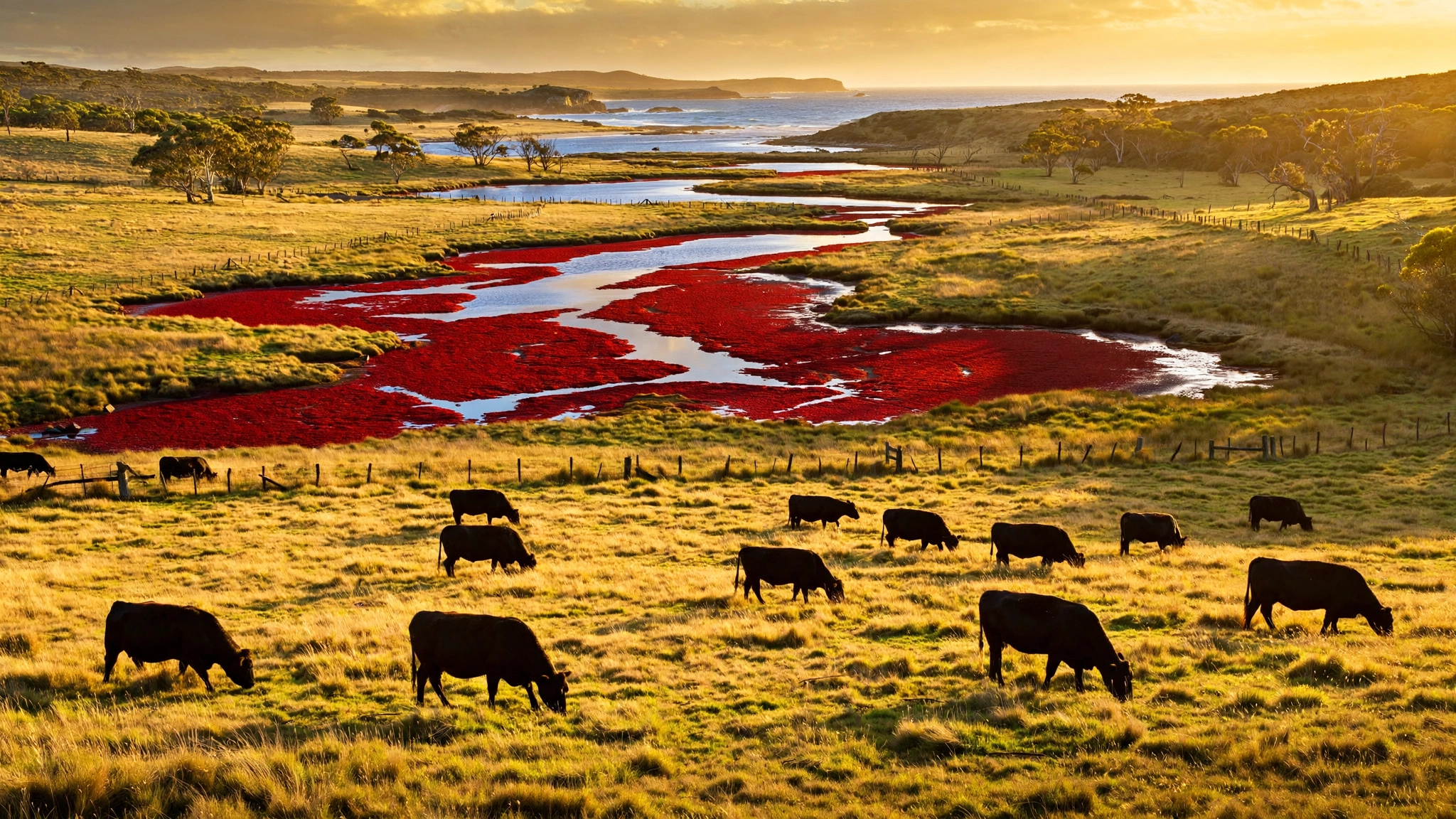
Eighty Angus cows on an Australian ranch belched their way into climate history this spring. Researchers at Adelaide University fed them bromoform extract oil derived from Asparagopsis, a red seaweed that looks like a fistful of crimson coral, and measured what came out the other end of the digestive tract. Over an eight-week trial on open pasture, methane emissions dropped by 49 to 77 percent, depending on the dosing level. The calves born to supplemented cows grew at the same rate as control calves, gained weight normally through 150 days, and showed no health anomalies. The cows themselves ate slightly less feed while maintaining body weight.
That last detail matters enormously, because lower feed intake with the same output means the supplement might pay for itself before carbon credits even enter the equation.
A second, independent trial published in Animals corroborated the result with quantitative precision, this time using the GreenFeed emission monitoring system to measure enteric methane from treatment-group heifers at 53.7 grams per day versus 203.2 grams per day in controls, a 73.6 percent reduction achieved with once-daily dosing. Methane suppression persisted for three to four days after the last dose, meaning a farmer who skips a day does not lose the effect immediately.
Why Grazing Changes Everything
Asparagopsis is not new to methane research. Feedlot trials in Australia and the United States have demonstrated reductions of 80 percent or more since 2020. DSM-Firmenich's synthetic inhibitor 3-NOP, marketed as Bovaer, earned regulatory approval in the EU, Brazil, Chile, and several other markets and delivers 20 to 35 percent reduction in feedlot conditions.
But feedlots hold a minority of the world's cattle at any given time. Roughly 70 percent of the planet's one billion cattle spend most of their lives on pasture, rangeland, or mixed smallholder systems where nobody controls what the animal eats hour by hour. Previous methane-reduction supplements required mixing into a total mixed ration, a precise blend of grain, silage, and supplements delivered at a trough. Grazing cattle wander and eat what they find. Getting a controlled dose into a free-roaming cow is a logistics problem that lab conditions had conveniently avoided.
Adelaide did not avoid it, running the supplement under real grazing conditions on South Australian pasture where the results held nonetheless. One sentence captures what changed: the addressable population went from the roughly 300 million cattle in feedlot-style confinement worldwide to a potential one billion head.
2.14 Gigatons from Burps
Cattle are not a rounding error in the climate ledger, and the numbers FAO published in its most recent assessment, updated in 2025, explain why: total livestock-sector emissions stand at 6.2 gigatons of CO₂-equivalent per year, roughly 14.5 percent of all anthropogenic greenhouse gas output. Enteric fermentation, the digestive process in which rumen microbes convert cellulose into volatile fatty acids and expel methane as a byproduct, accounts for 46 percent of that figure: 2.85 gigatons CO₂-e. Cattle alone shoulder 75 percent of all enteric methane globally, which yields 2.14 gigatons CO₂-e per year from bovine burps.
For perspective: global aviation generates about 1.1 gigatons CO₂-e annually. Cattle belching produces nearly double that. And unlike jet exhaust, bovine methane has an atmospheric half-life of roughly 12 years. Stop adding it, and concentrations fall within a decade, a speed that CO₂ abatement simply cannot match, because carbon dioxide persists for centuries once released.
We Calculated the Scaling Gap. It Is a Chasm.
Here is where enthusiasm collides with arithmetic.
CH4 Global, a South Australia-based company, opened the world's first commercial-scale Asparagopsis cultivation facility in January 2025. Its EcoPark at Louth Bay consists of ten large-scale ponds with a combined capacity of two million liters, producing approximately 80 metric tons of dried Asparagopsis per year. Plans call for expansion to 100 ponds capable of serving 45,000 cattle per day.
Forty-five thousand out of a billion, and nobody seems to be running the next calculation.
| Metric | Value |
|---|---|
| CH4 Global capacity at 100 ponds | 45,000 cattle/day |
| Global cattle population | ~1 billion head |
| Coverage at full planned capacity | 0.0045% |
| Facilities needed for 1% coverage | 222 EcoParks |
| Facilities needed for 10% coverage | 2,222 EcoParks |
| Facilities needed for 100% coverage | 22,222 EcoParks |
At its planned 100-pond configuration, CH4 Global is the largest Asparagopsis producer on Earth, larger than all competitors combined by its own account, and that producer covers exactly 0.0045 percent of the global herd. Reaching just 10 percent of cattle would require replicating the entire planned EcoPark 2,222 times over, before accounting for the logistics of delivering supplements to cows scattered across Brazil's Cerrado, India's Rajasthan, and East African pastoralist rangelands where infrastructure is sparse and cold chains nonexistent.
Cost per Ton: Cheaper than Vacuuming the Sky
We estimated what scaling to 10 percent of the global herd would cost and what it would buy.
If 100 million cattle received Asparagopsis supplements achieving an average 63 percent methane reduction, the conservative midpoint of the Adelaide trial range, abatement would total roughly 135 million tons of CO₂-e per year, which is 13,500 times more CO₂-equivalent than every direct air capture plant on Earth removed in 2025, when total DAC output was approximately 0.01 megatons.
Cost calculus is rougher but instructive. CH4 Global claims pond-based production slashes costs to one-tenth of conventional tank-based methods, and industry analysts peg the target cost for commercial supplementation at approximately $0.30 to $0.75 per cow per day, depending on geography and delivery method.
| Abatement Method | Cost per Ton CO₂-e | Current Scale (Mt CO₂-e/yr) |
|---|---|---|
| Direct Air Capture | $400–1,000 | ~0.01 |
| EU ETS carbon price | $50–80 | Market mechanism |
| Asparagopsis @ $0.50/cow/day | ~$135 | ~0.001 (est.) |
| Asparagopsis @ $0.30/cow/day | ~$81 | Theoretical |
| 3-NOP (Bovaer) feedlot only | ~$40–70 | ~2–5 (est.) |
At $0.50 per cow per day across 100 million cattle for 365 days, the annual bill runs to $18.25 billion. For 135 megatons CO₂-e abated, that works out to roughly $135 per ton. Expensive? Yes. But compare it to direct air capture at $400 to $1,000 per ton, and the seaweed looks like a bargain, one that delivers its climate benefit within a single decade rather than over centuries, because methane is short-lived and CO₂ is not.
Bromoform, Ozone, and the Delivery Problem
Bromoform is the molecule that makes Asparagopsis work. It inhibits methyl-coenzyme M reductase in rumen archaea, the microbes that produce methane. It is also a regulated substance, classified as a possible carcinogen by IARC, and monitored by environmental regulators because it depletes stratospheric ozone.
At supplementation levels, concentrations are low, measured in milligrams per day, and studies have found no bromoform residues in meat or milk above detection limits. But scaling to millions of tons of production raises uncomfortable questions about fugitive emissions from cultivation ponds, processing plants, and the cattle themselves, because nobody has modeled what atmospheric bromoform loading looks like when 2,222 facilities are running full tilt, and lifecycle environmental assessments at that scale simply do not exist yet.
Delivery is the harder problem, because Adelaide used direct oral supplementation, a method that works on a research station but collapses at the scale of millions of hectares of rangeland where several groups are now testing alternatives including slow-release bolus capsules lodged in the rumen, lick blocks impregnated with bromoform extract, and water-trough delivery systems that dispense supplements as cattle drink, none of which has been validated at commercial scale. Eighty cows proved the biology; one hundred million cows will test the engineering.
Limitations
Our analysis relies on FAO emissions data using GWP-100 conversion factors; the newer GWP* metric, which better captures the warming impact of short-lived climate pollutants, would yield a different but arguably more favorable abatement value for methane reduction. Cost estimates use industry-target pricing, not verified commercial pricing, because no company sells Asparagopsis supplements at scale to grazing operations today. CH4 Global's capacity figures are the company's own projections for a facility still expanding. Production costs or yields that miss those targets would shift the cost-per-ton comparison.
Strongest Counterargument
Nobody disputes that Asparagopsis works. Two independent trials, multiple feedlot studies, and a growing body of peer-reviewed evidence confirm it. What the critics argue is that scaling is so difficult it constitutes a distraction from interventions available right now: improving herd genetics to reduce per-animal emissions, intensifying production to cut cattle numbers for the same output, and shifting diets away from beef entirely. A strategy requiring 2,222 new aquaculture facilities to reach 10 percent of the herd, while simultaneously solving delivery logistics across four continents, might never arrive quickly enough for the 2030 methane targets the IPCC deems non-negotiable.
Fair point. It is not wrong. But herd reduction and dietary shifts face political and cultural headwinds that make 2,222 seaweed farms look comparatively straightforward, and historically, the world has proven far more willing to invest in supply-side technology than demand-side behavior change.
Bottom Line
Asparagopsis works, and Adelaide proved it works in the hardest conditions: free-ranging cattle on open pasture, not grain-fed animals in concrete pens, with a 49-to-77 percent reduction that is real, reproducible, and safe for calves.
But here is what the press releases skip: every commercial Asparagopsis facility on Earth, at full planned expansion, covers 0.0045 percent of the global herd, and reaching 10 percent demands a 2,222-fold scale-up that lacks the capital, the aquaculture infrastructure, and the delivery technology to match its ambition. At current investment levels, the seaweed will not reach the cattle before the methane reaches the atmosphere.
What You Can Do
If you are a beef producer in a feedlot-adjacent system, ask your feed supplier about Asparagopsis availability now. In Australia and parts of the EU, commercial supply chains are forming. If you are a rancher managing grazing cattle, watch the lick-block and water-trough supplement trials from CH4 Global and Rumin8 over the next 12 months. Early adopters who document methane reductions will be first in line when carbon-credit methodologies for enteric methane are formalized, which Australia's Clean Energy Regulator and the EU are actively developing. If you are an investor, the bottleneck is not the science. It is aquaculture infrastructure and last-mile delivery. The companies that solve feed-supplement logistics for extensive grazing at costs below $0.50 per cow per day will command the market.