The U.S. Is Spending $400 Billion to Build Chip Fabs. It Just Bet $500 Million That AI Can Replace the Materials Those Fabs Need.
SandboxAQ's CHIPS Act award targets the four material dependencies that every new American semiconductor factory inherits from China. Here's the math on whether it's enough.
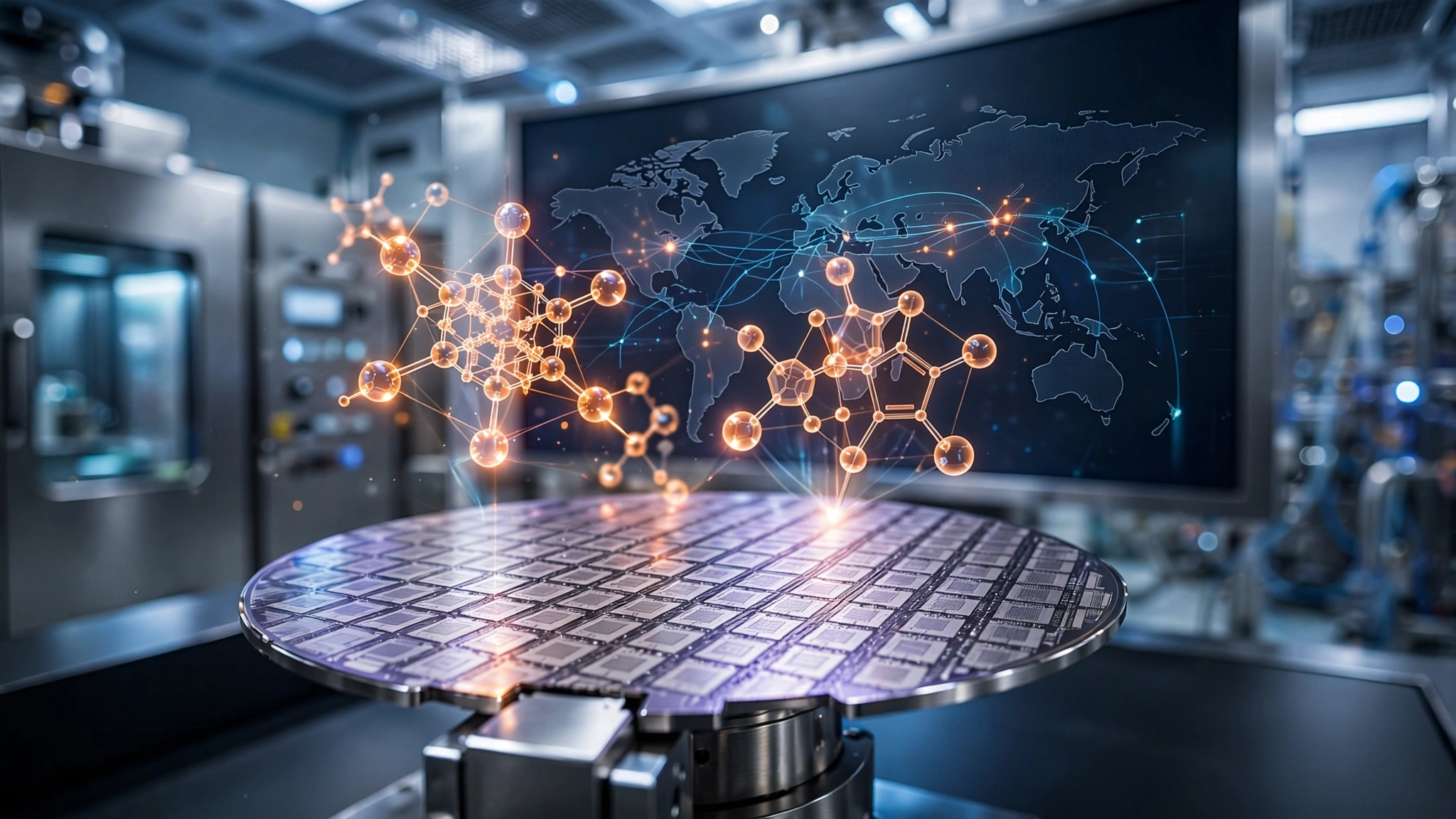
Four grams. That is how much PFAS a single semiconductor fabrication plant discharges into its wastewater stream every day, on average, according to a survey of U.S. fabs published in January 2026. Sounds negligible. At an average concentration of 840 nanograms per liter, semiconductor wastewater runs 8 to 9 times more concentrated in PFAS than treated municipal effluent, and one unnamed fab recorded 78,000 parts per trillion in its discharge, nearly 20,000 times the EPA's drinking water limit of 4 ppt.
Now multiply. Nineteen companies have signed agreements for 40 semiconductor projects under the CHIPS and Science Act, drawing $30.9 billion in direct funding and $5.5 billion in loans as of July 2025, according to the Government Accountability Office. Those projects have triggered close to $400 billion in private investment pledges. Every one of the new fabs being built will use PFAS-laden chemicals in photolithography, etching, heat transfer, and surface treatment. Every one will need rare earth magnets in the motors, pumps, and wafer-handling robots of its equipment. And every one will run backup power systems built with lithium and cobalt that China dominates.
On June 17, the Department of Commerce signed a $500 million CHIPS R&D award with SandboxAQ, an Alphabet spinoff valued at $5.75 billion, to find replacements for all four of those material dependencies using physics-based AI. Not chatbot AI, not the kind that writes emails or generates images. Physics AI: models trained on quantum chemistry simulations and real-world experimental data, designed to predict how molecules behave under conditions that would vaporize a language model's training corpus. It is the largest single award the CHIPS R&D office has made to a non-fabrication company.
What $500 Million Buys
SandboxAQ is not building chips. It builds what CEO Jack Hidary calls Large Quantitative Models, or LQMs: AI systems trained on physics simulations and experimental data rather than text. Where a large language model predicts the next word in a sentence, an LQM predicts how a candidate molecule will behave under the extreme conditions inside a semiconductor fab, whether it will maintain chemical stability at 400°C, resist plasma degradation during etching, or hold magnetic flux density within the tolerances a wafer-stage motor demands.
Under the award, SandboxAQ will deploy its ReAQT platform to screen millions of candidate materials across four programmatic areas defined by the Commerce Department. First: PFAS-free process chemicals for heat-transfer fluids, lubricants, insulating coatings, and surface treatments. Second: domestically designed catalysts for precursor gas generation and exhaust abatement, reducing foreign control over catalyst formulations. Third: rare earth-free permanent magnets for semiconductor manufacturing equipment. Fourth: alternative battery chemistries for fab backup power, replacing lithium-ion cells that depend on Chinese-processed cobalt and lithium.
Viable candidates will be validated in partnership with American manufacturing companies and scaled toward commercial production. In exchange, the Department of Commerce receives a minority, non-controlling equity stake in SandboxAQ, a provision that gives taxpayers upside if the platform succeeds.
The Dependency Arithmetic
Is $500 million enough? Run the numbers.
A leading-edge semiconductor fab processes roughly 50,000 wafers per month. At average revenue between $15,000 and $20,000 per wafer for advanced logic nodes, a single fab generates $750 million to $1 billion in monthly output. One day of downtime from a materials supply disruption wipes out $25 to $33 million in production. Across the 40 CHIPS Act projects, which include both leading-edge and mature-node facilities, a single week of industry-wide disruption from a shared materials chokepoint could destroy $3 to $5 billion in output, depending on how many projects the disruption hits and at what technology node.
Against that exposure, $500 million is an insurance premium of $1.25 per $1,000 of invested semiconductor capacity, cheaper than the average industrial property insurance rate in the United States, which runs $2 to $5 per $1,000 of insured value. The entire SandboxAQ award equals roughly 10 to 17 percent of what one week of broad supply chain failure would cost. Bargain.
But here is why the math is more urgent than a standard risk calculation. China does not merely supply these materials; it controls them.
| Material Category | China's Control | Semiconductor Application | Substitution Timeline (Traditional) |
|---|---|---|---|
| Neodymium magnets (NdFeB) | 90%+ of global production | Equipment motors, pumps, positioning stages | 10–15 years |
| PFAS process chemicals | N/A (regulatory risk) | Photoresists, anti-reflective coatings, surfactants, heat-transfer fluids | 5–10 years |
| Catalyst formulations | Foreign-controlled IP | Precursor gas synthesis, exhaust abatement | 5–8 years |
| Battery minerals (Li, Co) | ~70% refining capacity | Uninterruptible backup power systems | 3–7 years |
Global neodymium magnet production runs between 220,000 and 240,000 tonnes per year, with 85 to 90 percent manufactured in China, according to magnet-industry consultant Steve Constantinides. China's largest producer, JL MAG Rare-Earth Co., shipped roughly 25,000 tonnes in 2025 alone, a figure comparable to the combined output of every non-Chinese magnet maker on Earth. NIST's own press release on the SandboxAQ award states plainly: "China controls more than 90% of global production of neodymium-based permanent magnets, which are critical inputs to semiconductor manufacturing equipment."
PFAS presents a different kind of dependency. It is not a supply chain controlled by a geopolitical rival. It is a class of chemicals that regulators are moving to restrict everywhere. In 2024, the EPA finalized drinking water standards of 4 parts per trillion for PFOA and PFOS, with compliance required by April 2029. Annual national compliance costs range from $1.5 billion (EPA estimate) to $3.8 billion (American Water Works Association estimate), with capital improvements projected at $37 to $48 billion. Semiconductor effluent is roughly 9 times more concentrated in PFAS than municipal wastewater. As process nodes shrink, PFAS use per wafer increases: a 3nm chip requires roughly twice the lithography masks of a 7nm chip, and each mask layer involves PFAS-containing photoresists, topcoats, and anti-reflective coatings.
In 2023, the PFAS Consortium, an industry group representing the companies that actually manufacture chips, published its assessment of alternatives: "It is going to be extremely difficult, if not impossible in some instances, to find viable alternatives without stepping back decades in technological advancement." That is not a hedge. It is a surrender. SandboxAQ's mandate is to prove that statement wrong.
Can Computational Screening Actually Deliver?
SandboxAQ's thesis is that physics-based AI can compress materials discovery timelines from a decade to two or three years by eliminating the vast majority of dead-end candidates before they reach a lab bench. Rather than synthesizing and testing thousands of compounds sequentially, an LQM models their thermodynamic stability, chemical reactivity, and manufacturing compatibility in silico, narrowing the field to the most promising few dozen for physical validation.
It has worked in adjacent domains. SandboxAQ's collaboration with Nvidia boosted its computational chemistry throughput by 80x and doubled the size of molecules its platform can simulate, and its drug discovery LQMs, recently integrated with Anthropic's Claude, can now run quantum chemistry calculations and simulate molecular dynamics without requiring researchers to build custom computational pipelines. Eric Schmidt chairs the company. Investors include T. Rowe Price, Marc Benioff, Yann LeCun, and Nvidia.
But drug discovery and semiconductor materials qualification are fundamentally different problems, and the gap between them is wider than it appears. A drug candidate moves through clinical trials where the primary constraint is biological efficacy. A semiconductor process chemical must survive conditions that make biological systems look gentle: plasma environments at thousands of degrees, chemical purity requirements at parts-per-trillion, and integration into manufacturing lines where a single contaminant can destroy an entire wafer lot worth millions of dollars. Qualifying a new photoresist formulation at a leading-edge fab takes years of iterative testing, not because the chemistry is slow, but because the tolerance for failure is effectively zero. Zero.
Limitations
Several gaps in the available data constrain this analysis. Neither SandboxAQ nor the Commerce Department has disclosed specific timelines for when commercially viable replacements must be delivered, leaving the relationship between the award's pace and the buildout schedule uncertain. Per-fab data on rare earth magnet consumption and PFAS chemical volumes is not publicly available; the figures used here are industry averages extrapolated from survey data covering facilities of varying size and technology node. Revenue-per-wafer estimates ($15,000–$20,000) reflect current leading-edge pricing and may shift as capacity comes online. SandboxAQ's track record in computational materials discovery is primarily in biopharma, not semiconductor manufacturing; the ReAQT platform's effectiveness in this domain is unproven at scale.
The Bottom Line
Washington has committed hundreds of billions to solve the question of where American chips will be manufactured. That was the hard political problem. It has barely begun to address the harder technical one: what those chips will be manufactured with.
Forty semiconductor projects are rising across the United States. Each one inherits a materials supply chain that runs, at nearly every critical node, through China or through a class of chemicals facing regulatory elimination. SandboxAQ's award is the first serious attempt to apply AI to the input side of the semiconductor equation rather than the output side. At $1.25 per $1,000 of exposed investment, it is astonishingly cheap insurance. Whether physics-based AI can actually deliver commercially viable replacements for PFAS, rare earth magnets, and battery minerals within the window those fabs need them remains genuinely uncertain.
What you can do: If you work in semiconductor equipment or process chemical supply chains, map your PFAS and rare earth exposure now, before EPA compliance deadlines and Chinese export controls create simultaneous pressure from both directions. If you manage fab construction or equipment procurement for any of the 40 CHIPS Act projects, engage SandboxAQ's open commercialization partnerships early rather than waiting for validated drop-in replacements to appear. If you invest in the semiconductor buildout, ask whether the companies you hold have quantified their materials dependency ratio: total investment exposed to foreign-controlled or regulation-threatened inputs, divided by the cost of mitigation. That number should be on every quarterly earnings call. It is on almost none of them. And if you simply own a portfolio with semiconductor exposure — which, in 2026, means virtually everyone with a retirement account — understand that the $400 billion bet on American chipmaking carries a materials risk that nobody priced in when the CHIPS Act passed.