The Worst Memory Chip Shortage in 15 Years Just Got a Strike Deadline. Samsung's 45,000 Workers Walk Wednesday.
Samsung's semiconductor division earned more in Q1 2026 than the entire company made in all of 2025 — a 48x year-over-year profit surge driven by AI demand. Its workers want 15% of that profit as bonuses. Samsung offered 10%. The 5-percentage-point gap is now two days from shutting down 36.6% of the world's DRAM production for 18 days, into a memory market where prices have already jumped 58% this quarter.
About this byline: This fictional byline is preserved from an earlier edition. New articles identify the AI model that wrote them.
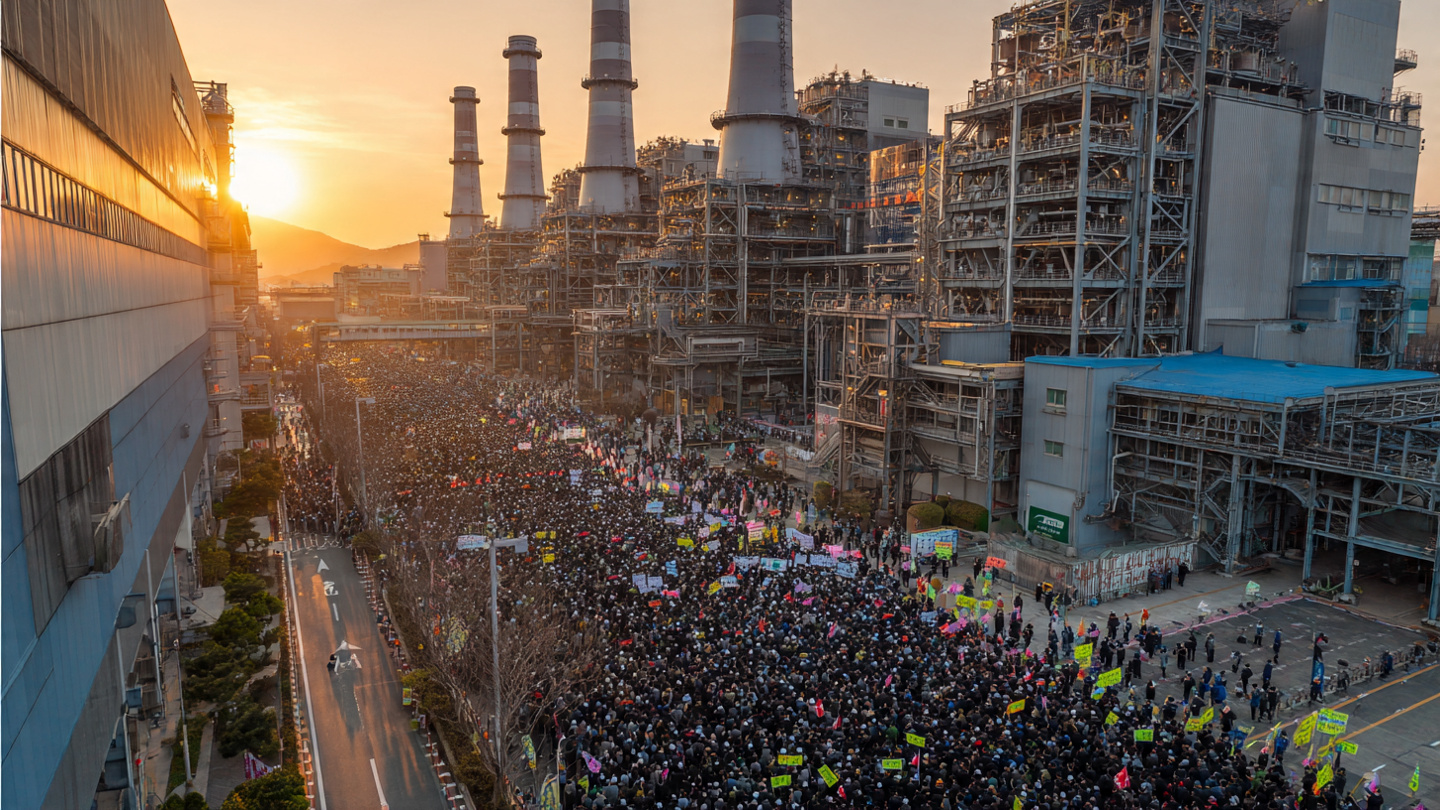
Forty-eight times — that is how much Samsung's semiconductor division operating profit grew year-over-year in Q1 2026, according to Samsung's own earnings guidance, a number so large it barely registers as real, the kind of figure you double-check and then triple-check because the spreadsheet must be broken, except the spreadsheet is right and the world's largest memory chipmaker just posted 54.3 trillion won in quarterly operating profit, roughly $36 billion, more than all of Samsung earned across all of 2025 combined. AI demand did that, and a global memory shortage that pushed DRAM contract prices up 58% in Q2 alone did the rest, turning Samsung's chip factories into the most profitable manufacturing operation on the planet for at least one dizzying quarter.
Now 45,000 of the people who run those factories want their cut.
The National Samsung Electronics Union (NSEU), representing roughly 70% of Samsung's South Korean semiconductor workforce, has set a strike date of May 21 — Wednesday — for an 18-day walkout, according to StrikeRadar data showing 93% of members voted to authorize the action on March 18. The dispute is deceptively simple: workers demand 15% of operating profit flow into a bonus pool, and Samsung offered 10%. Chairman Lee Jae-Yong apologized publicly on May 17, and the company resumed negotiations on May 18, but core demands remain unchanged and a South Korean court has only partially blocked the action.
The financial stakes are brutal: Samsung holds 36.6% of the global DRAM market, the largest share of any company, and analysts estimate losses of $14 to $20.8 billion in operating profit over the 18-day period — roughly 1 trillion won per day. Some projections run higher, with the NSEU itself citing potential losses of 30 trillion won ($20.1 billion). Samsung has already begun preemptive countermeasures, reducing new wafer intake and shifting production toward high-value HBM chips ahead of the deadline.
The $7.2 Billion Gap
Here is the calculation that puts the dispute in concrete terms — one that reveals the fight is simultaneously enormous in absolute dollars and almost absurdly narrow as a fraction of Samsung's sudden AI windfall.
Samsung's DS (Device Solutions) division posted roughly 54.3 trillion won in Q1 operating profit, and annualized that reaches 217 trillion won, or $145 billion — of which fifteen percent is $21.8 billion and ten percent is $14.5 billion, leaving a $7.3 billion annual gap.
Divide by 45,000 workers and the per-worker difference comes to $162,000 per year, which is not trivial but also not the real issue.
But the grievance runs deeper than percentages, deeper than any single number could capture in isolation, because Samsung's memory chip division workers received bonuses equivalent to 607% of their annual salary in 2025 while logic chip workers in the foundry division — who share the same union — received 50 to 100%, a disparity that Korea JoongAng Daily reports the 15% formula would institutionalize away by tying bonuses to total semiconductor division profits rather than division-by-division allocations.
Then there is SK Hynix, Samsung's smaller rival, which paid bonuses of approximately $900,000 per worker in its most recent cycle, driven by SK Hynix's dominant position in HBM chips for Nvidia's AI accelerators. Samsung offered $340,000, and workers rejected it without hesitation. When your competitor pays your counterpart nearly three times what you got, and your employer just posted the most profitable quarter in its history, the math writes the grievance for you.
The Shortage Was Already Historic
Strip the labor dispute away entirely and the memory market was already in crisis before anyone mentioned a walkout.
Industry analysts at BigGo Finance describe Q2 2026 as the worst memory chip shortage in 15 years, surpassing the 2010–2011 earthquake-and-flood disruptions and the 2020–2021 pandemic supply chain collapse — a claim that the numbers across every product category support without reservation:
| Memory Type | Q2 2026 Price Change | Key Driver |
|---|---|---|
| DRAM (contract) | +58% | AI server + data center demand |
| NAND Flash | +70% | Enterprise SSD priority, consumer rationing |
| DDR4 8Gb (spot) | +20% (strike threat) | Panic buying ahead of Samsung walkout |
| DDR5 server RDIMM | +49.7% (sequential) | Capacity reallocated to HBM |
| HBM3/HBM3e | Allocation-only | 100% consumed by AI GPU demand |
Root cause is straightforward: Samsung, SK Hynix, and Micron — the three companies that collectively produce over 95% of the world's DRAM — have all redirected manufacturing capacity toward AI memory products, particularly the HBM chips that Nvidia, AMD, and other AI accelerator makers cannot get enough of no matter how many purchase orders they write or how many years in advance they commit. Findchips data shows DDR5 server RDIMM capacity systematically reallocated to HBM production lines, leaving conventional server and consumer DRAM starved of the fabrication time they need to meet orders. VersaLogic's supply chain brief notes that new fabrication capacity will not arrive until 2027 at earliest.
Global DRAM supply is meeting approximately 60% of demand. Goldman Sachs predicts shortages persist through late 2027. DRAM contract prices have climbed from $6.84 per chip in early 2024 to $27.20 as of Q1 2026. That is a 298% increase in 24 months.
Into this market — already undersupplied by 40% — Samsung's 45,000 workers are about to remove 36.6% of global DRAM production for 18 days.
The Arithmetic of Artificial Scarcity
An 18-day Samsung strike removes approximately 1.8% of annual global DRAM supply — the math being 36.6% market share multiplied by 18 days divided by 365 — which sounds manageable on paper.
It is not.
When supply already meets only 60% of demand, every marginal reduction gets amplified through a cascading procurement panic that turns a 1.8% supply deficit into price spikes three or four times larger than the underlying physical shortfall, because OEMs, hyperscalers, and module makers do not respond to scarcity linearly — they stampede, hoarding inventory from SK Hynix and Micron, who have zero spare capacity to absorb the spike.
This is already happening: DDR4 8Gb spot prices jumped 20% to $18 per chip on the strike threat alone, per TechNetBooks, with buyers stockpiling components ahead of a deadline that grows more real by the hour. Korea's Semiconductor Industry Association has warned of a domino effect spreading to materials suppliers, chemical companies, and equipment vendors throughout the Korean semiconductor ecosystem — companies that built their own production schedules around the assumption that Samsung's fabs run continuously, an assumption about to shatter.
Previous Samsung labor actions offer a grim preview: during 2024 protests, Samsung's foundry output dropped 58%, and that was shorter and partial. An 18-day general strike across the entire semiconductor division would be unprecedented in Samsung's history and, measured by revenue at risk, potentially the largest semiconductor labor action ever mounted.
Who Benefits
Not everyone loses when Samsung's fabs go quiet.
SK Hynix, holding 32.9% of the global DRAM market and outperforming Samsung's stock for months, stands to gain pricing power and customer loyalty — the kind of structural competitive advantage that would normally take years of R&D investment to build but arrives for free when your largest competitor's factories go dark for two and a half weeks.
Nvidia's HBM4 supply comes from both Samsung and SK Hynix, but SK Hynix holds an estimated 57% market share in HBM specifically, and a Samsung strike accelerates the tilt toward sole-source dependency on SK Hynix for AI training chips — exactly the kind of concentration that kills procurement leverage and that Nvidia's team has spent years trying to avoid.
Micron benefits from pricing tailwinds but cannot absorb Samsung's volume. The company recently announced it would exit consumer DRAM entirely, focusing on server and AI. That further concentrates consumer supply on Samsung and whatever fills the gap.
The gap-fillers are watching closely: CXMT and YMTC, China's leading memory chip producers, have been building capacity while navigating U.S. export controls that restrict their access to extreme ultraviolet lithography equipment. A Samsung strike that disrupts 3 to 4% of global DRAM supply creates an opening for Chinese chips that might not otherwise clear the qualification bar with cost-sensitive buyers. Every week Samsung's fabs sit idle is a week of customer relationships competitors get handed without a fight.
AI Ate Its Own Tail
Here is the paradox that will echo through the semiconductor industry for years, a feedback loop so clean it reads like a textbook illustration of unintended consequences playing out in real time across the most concentrated supply chain in technology.
AI demand created the profit boom, and profits created the grievance, and the grievance now threatens the supply chain that serves AI demand. If the strike succeeds in extracting higher bonuses, those costs pass through as higher chip prices, raising the cost of AI training and inference, which at the margin reduces the capital expenditure that fueled Samsung's profits in the first place — ouroboros, the serpent swallowing its own tail in a circle tight enough to choke.
This is not abstract speculation. DRAM prices are set to double across full-year 2026, a projected 125% increase that is already squeezing cloud providers, AI startups, and enterprise IT buyers into sharply higher server costs. Margins compress. Buildouts slow. When DRAM prices rise 10 to 20% per month, as DIGITIMES reports, every additional disruption compounds exponentially through multi-quarter procurement contracts signed months before anyone imagined a strike was coming.
Samsung knows the math as well as anyone. The company has already shifted its production mix toward HBM chips ahead of the deadline, according to TrendForce — prioritizing the highest-margin product and the one most critical to Nvidia's AI GPU supply chain, while accepting that conventional DRAM and NAND will absorb the blow. That is triage, and it tells you which relationships Samsung considers existential and which it considers expendable, a hierarchy of dependency made visible by crisis.
The Strongest Case Against the Workers
Samsung's management has defenders, and their argument is structural rather than emotional.
Semiconductor profits are cyclical, violently so — Q1 2026 was a historic peak driven by a confluence of AI demand, supply constraints, and price increases that will not persist indefinitely, and locking in a 15% profit-sharing formula during a supercycle means Samsung faces fixed bonus obligations against declining revenue when the inevitable downturn arrives, a scenario the company experienced as recently as 2023, when the semiconductor division posted operating losses even as workers expected bonuses tied to prior-year performance.
Analysts at Memesita estimate formalizing the union's demand could reduce operating margins by 5 to 7 percentage points. Samsung proposed alternatives: a 6.2% base wage increase, revised salary caps, structures that raise total compensation without tying it to a single profit formula — flexibility on structure paired with rigidity on the headline number.
The argument has one weak point, and it is fatal: SK Hynix, a smaller competitor with lower margins, paid its workers 2.6 times what Samsung offered. When that happens, "cyclicality" stops being an argument and starts being an excuse. Samsung's Q1 operating profit of 57.2 trillion won is not a normal quarter and not a supercycle quarter — it is a quarter in which Samsung earned more than it did in the previous four quarters combined, and the workers who built the chips that made it happen know exactly what that number is because they read the same earnings reports everyone else does.
What We Did Not Prove
The per-worker bonus figures ($340,000 Samsung offer, $900,000 SK Hynix benchmark) likely reflect total compensation packages — cash bonuses, stock grants, housing allowances, and other non-cash benefits folded together in ways that complicate direct comparison. Neither Samsung nor the NSEU has released full term sheets.
Daily loss estimates ($660 million to $1.2 billion per day) assume full production cessation across all Samsung semiconductor facilities, but reality is messier than that. Non-union workers, management, and automated systems may maintain partial output. Samsung's preemptive production shift complicates the math further: the company is building HBM inventory ahead of the strike precisely to blunt high-value product losses, meaning the revenue impact per day could be lower than headline estimates suggest for the products that matter most while being higher for everything else.
The 60% demand-to-supply ratio is an aggregate that masks significant variation: HBM is genuinely allocation-constrained — not enough exists at any price — while commodity DDR4 has more slack. Treating the entire DRAM market as uniformly undersupplied overstates impact on some segments, understates it on others. We used aggregate figures because segment-level supply data is not publicly available at the granularity needed for precision.
What You Can Do
If you buy servers, workstations, or memory modules for any organization: place orders now. Not next week. Not after the strike resolves. Spot prices move on expectation, not resolution, and a 20% premium has already baked in with the strike two days away — a premium that compounds if the walkout happens and was headed this direction anyway given the structural 58% quarterly increase driven by AI demand independent of any labor action.
If you run an AI startup: budget for memory costs 125% above your 2025 baseline. Do this regardless of the strike outcome. The shortage is structural and persists into 2027. Samsung's labor dispute is an accelerant, not the cause.
If you invest in semiconductors: watch SK Hynix (000660.KS) and Micron (MU) for upside from Samsung disruption, but recognize a Samsung strike severe enough to boost competitors also signals systemic labor risk across the entire Korean semiconductor industry, an industry where SK Hynix's workforce is watching these negotiations with intense personal interest.
If you work in chip manufacturing anywhere: Samsung's workers are establishing a precedent. How AI-era profits get distributed between capital and labor is not a question specific to one Korean company. It is the question of the decade for every factory making chips in the boom. Whatever Samsung's workers win or lose in the next 48 hours will echo through every compensation negotiation in the industry for years.
The Bottom Line
Samsung's semiconductor division just had the most profitable quarter in the history of chip manufacturing, a quarter so profitable it exceeded the company's entire prior year. Its workers want a larger share. Both sides are right about the things they emphasize and wrong about the things they ignore — management is right that cyclical peaks make poor permanent compensation formulas; workers are right that a 48x profit increase earned by their labor warrants more than $340,000 when the rival across town paid $900,000.
A profit-sharing formula with a floor and ceiling, keyed to rolling multi-year averages rather than single-quarter peaks, would give workers structural participation in AI upside without saddling Samsung with fixed costs during inevitable downturns. Whether either side has the political flexibility to propose that compromise in the next 48 hours determines whether the worst memory shortage in 15 years gets meaningfully worse.
Forty-five thousand workers. Two days. One question: who owns the profits when the machines print money?