Seven Companies Just Announced Robotaxi Fleets for 2027. The U.S. Has Room for Maybe Three.
In 72 hours this week, Mobileye launched its own robotaxi service in direct competition with its customers, Uber-Nuro-Lucid named Houston as their second city, and the total announced fleet commitments for U.S. autonomous ride-hailing crossed 100,000 vehicles. The capital math says most of these companies will fail.
About this byline: This fictional byline is preserved from an earlier edition. New articles identify the AI model that wrote them.
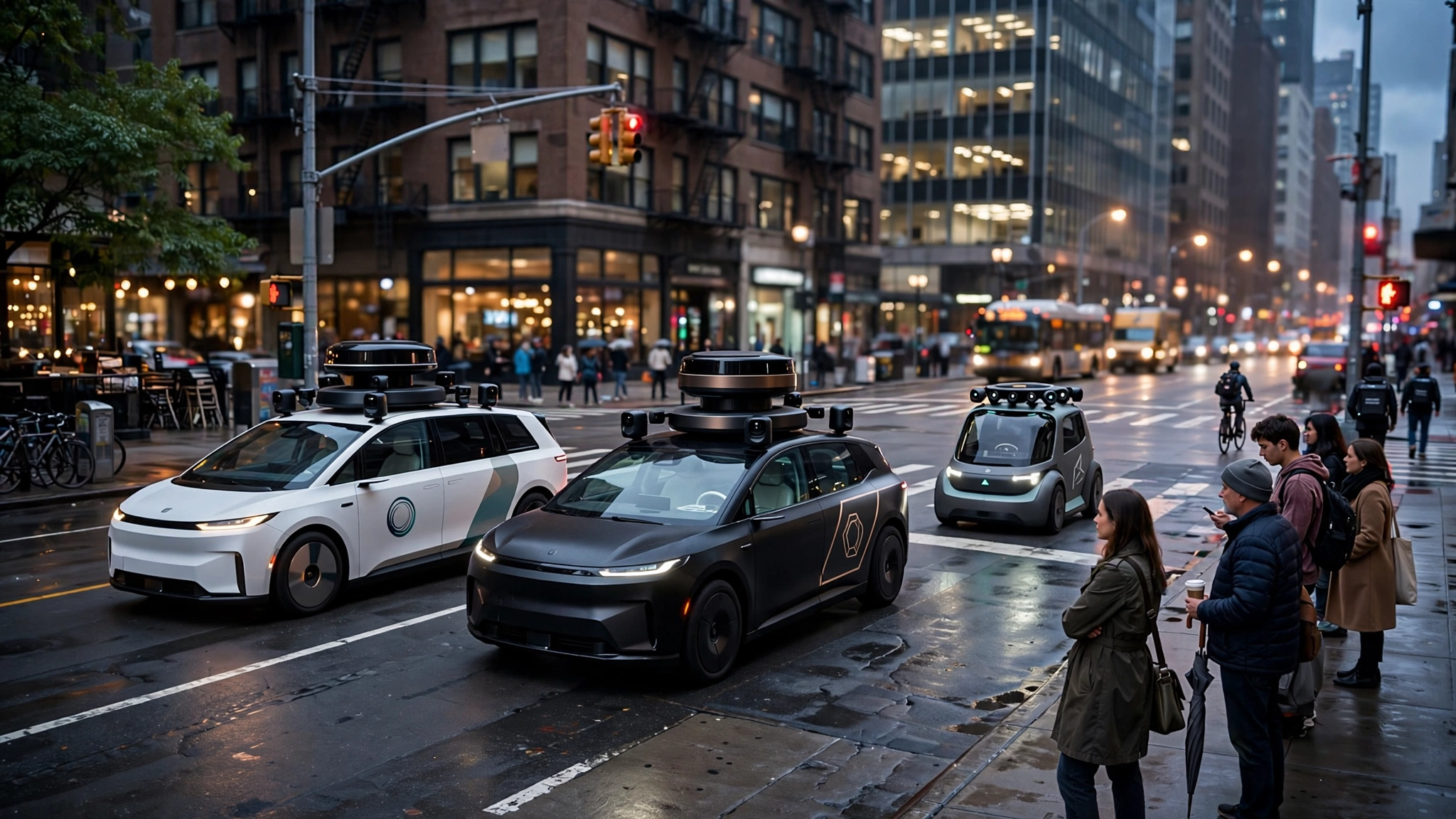
One hundred thousand vehicles. That is the combined fleet commitment now on the books from seven companies racing to launch autonomous ride-hailing services in American cities, most of them targeting the same 2027 window, most of them burning cash at rates that would make a venture capitalist's eye twitch. In a single 72-hour stretch this week, the robotaxi industry didn't just accelerate. It fragmented.
On Monday, Mobileye announced it would launch its own vertically integrated robotaxi service, deploying 100 fully driverless vehicles in an unnamed U.S. city in 2027, with plans to scale to 17,000 over five years. This is not a technology partnership. It is the ADAS supplier that has spent 25 years selling self-driving components to automakers now launching a ride-hailing business that competes directly with those same automakers. Volkswagen's MOIA subsidiary, which runs Mobileye Drive in its ID. Buzz robotaxis, learned that its technology vendor is now also its competitor.
On Wednesday, Uber, Nuro, and Lucid named Houston as the second market for their joint robotaxi program, following a San Francisco Bay Area launch planned for later this year. Their engineering fleet already includes nearly 100 vehicles running 24/7 across California and Texas. Uber secured a 50,000-square-foot depot in Houston. The consortium's target: at least 35,000 vehicles globally.
Add these to Waymo's 3,000-vehicle fleet already operating across ten cities, Tesla's Cybercab launching in Austin, Amazon's Zoox testing its purpose-built pods, Aurora's struggling autonomous trucking operation, and a handful of smaller players, and you get a competitive field that has roughly doubled in six months.
The problem is simple: there aren't enough riders to sustain all of them.
The Architecture War
What makes this moment unusual isn't just the number of entrants. It's that each company has made fundamentally different bets about how the robotaxi business should be structured, and those bets are now colliding in the same cities at the same time.
| Company | Model | Sensor Stack | Fleet Target | 2027 Status |
|---|---|---|---|---|
| Waymo (Alphabet) | Full vertical | Lidar + camera + radar | 10,000-15,000 | Operating in 10+ cities |
| Tesla | Manufacturing-first | Vision-only (cameras) | Undisclosed | Cybercab launching Austin |
| Mobileye (Intel) | Supplier-turned-operator | Camera + lidar + radar | 17,000 (5-yr) | 100 vehicles in unnamed city |
| Uber/Nuro/Lucid | Horizontal consortium | Camera + lidar + radar | 35,000+ global | SF Bay Area + Houston |
| Zoox (Amazon) | Purpose-built pod | Lidar + camera + radar | Undisclosed | Testing, no public date |
| Aurora | Trucking-first | Lidar + camera + radar | N/A (retreating) | Safety driver reinstated |
| May Mobility + others | Shuttle/transit niche | Varies | <1,000 | Limited deployments |
Each architecture implies a different theory about where value accrues. Waymo believes you must own everything. Tesla believes manufacturing cost is the moat. Mobileye is betting that a supplier with a global install base can pivot to operations faster than pure operators can build technology. And the Uber/Nuro/Lucid consortium represents the opposite thesis entirely: that the winning model is horizontal specialization, with each partner doing what it does best.
These are not reconcilable strategies, and they cannot all be right, because each assumes a different answer to the same question: where does value accrue in a world where cars drive themselves?
The Mobileye Problem
Mobileye's announcement deserves particular scrutiny because it creates a structural conflict that the autonomous vehicle industry has never confronted. For 25 years, Mobileye has operated as the Intel Inside of driver assistance, supplying EyeQ chips and ADAS algorithms to BMW, Volkswagen, Ford, and dozens of other automakers. Its Mobileye Drive system powers VW's MOIA robotaxi fleet in Los Angeles. CEO Amnon Shashua framed the move carefully: "This initiative is not a replacement for our existing partnerships; it is an extension of them."
That framing will be tested immediately, because if you are Volkswagen, and your autonomous driving supplier just launched a service that competes for the same riders in the same cities, you face an uncomfortable question about how much proprietary fleet data to continue sharing with that supplier. The analogy isn't perfect, but it rhymes with Google launching the Pixel phone while continuing to license Android to Samsung. Samsung's response was instructive: it invested billions to reduce its Google dependence, eventually building its own AI assistant, its own app store, and its own chip design team, a multiyear effort that fundamentally restructured the relationship even as the partnership nominally survived.
Mobileye's market cap sits at roughly $7.4 billion, a fraction of Waymo's $126 billion valuation. It doesn't manufacture vehicles. It will partner with unnamed "external vehicle platforms and fleet managers" to acquire and maintain its fleet. In practice, this means Mobileye is attempting to be the operator, the software provider, and the hardware supplier simultaneously, serving both its own interests and those of the competitors it supplies. That's not unprecedented in tech. But in an industry where safety data is the most valuable asset and sharing it creates competitive exposure, the tension is structural, not just optical.
The Capital Math
Here is the calculation nobody in these press releases wants to confront.
The total U.S. taxi and for-hire vehicle fleet numbers roughly 200,000 to 300,000 vehicles. Uber and Lyft together have approximately 1.4 million active drivers, though the overlap and part-time participation make the effective vehicle count harder to pin down. A reasonable estimate of the total U.S. ride-hailing and taxi market is $50 to $60 billion in annual gross bookings.
The seven companies listed above have collectively committed to deploying, conservatively, 75,000 to 100,000 robotaxi vehicles by the early 2030s. That would represent roughly 25 to 50 percent of the current for-hire fleet, which sounds enormous until you realize each company's business plan assumes it will capture a dominant share of a market that is supposed to grow dramatically. Waymo's $126 billion valuation implies the market believes robotaxis will eventually generate hundreds of billions in annual revenue, not $50 billion.
The gap between today's market and those projections is where the capital gets burned. Each new city launch requires significant infrastructure investment: high-definition mapping (which degrades and must be continuously updated), depot facilities for charging and maintenance, teleoperation centers for remote assistance, regulatory and legal teams, and the vehicles themselves. Waymo's ten-city footprint is estimated to have consumed north of $5 billion in cumulative capital. It completed 10 million paid rides in roughly 18 months of aggressive scaling. But Waymo has not publicly disclosed per-ride profitability, and analysts who have attempted the calculation consistently arrive at unit economics that are negative at current scale.
Now multiply that infrastructure burden by seven competitors, many targeting the same high-value cities. San Francisco, Los Angeles, Houston, Phoenix, Austin, Atlanta, Miami, Dallas. These are the obvious launch markets because they have favorable regulatory frameworks, warm weather (which reduces sensor degradation and operational complexity), and large populations. They are also the markets where every competitor will converge, creating a density problem: too many robotaxis chasing too few riders in the same metro areas, while vast swaths of the country remain unserved.
Why the Market Probably Can't Support Seven
Ride-hailing has network effects, but they are weaker than people assume and operate at a city level, not a national one. Uber's dominance over Lyft comes primarily from driver density: more drivers means shorter wait times means more riders means more drivers. But robotaxis eliminate the driver from the equation, which means the network effect shifts to fleet density and geographic coverage. A company with 500 robotaxis covering 400 square miles of Houston has a meaningful advantage over one with 100 vehicles covering 50 square miles, because it can serve more trip requests with lower wait times. But a company with 5,000 vehicles in Houston has diminishing returns over one with 2,000, because at some point every reasonable trip request can be served within five minutes regardless.
This suggests that the robotaxi market will tend toward regional oligopoly: two or three competitors per city, each with enough fleet density to offer competitive service levels. It does not suggest a single global winner. And it emphatically does not suggest room for seven.
The historical parallel is not the smartphone market (where software platform effects created a duopoly) or the search market (where data flywheel effects created a monopoly). It is the airline industry. Airlines have massive capital requirements, city-by-city operational footprints, thin margins, and a product that is largely undifferentiated at the consumer level. The U.S. airline industry consolidated from dozens of carriers to essentially four over sixty years of mergers, bankruptcies, and exits. The robotaxi industry appears to be speedrunning that consolidation arc, compressing it into the 2027-to-2032 window when capital runs out.
The Aurora Warning
If you want to see what the early stages of that consolidation look like, watch Aurora. The autonomous trucking company went driver-out on commercial freight routes in April 2026 and was forced by its OEM partner PACCAR to reinstate safety drivers within weeks. The reasons were not primarily technological. They were about liability allocation, insurance gaps, and the operational complexity of maintaining a fleet of vehicles that no human is steering through construction zones, weather events, and mechanical failures on Interstate highways.
Aurora's retreat is instructive because it reveals how quickly the gap between "technically capable of autonomous driving" and "commercially operating autonomous vehicles at scale" can swallow a company whole. The technology worked; the business didn't. Capital markets noticed. And the same dynamic will play out in passenger robotaxis as companies discover that a vehicle capable of driving itself in a geofenced area is not the same thing as a profitable ride-hailing service.
The Bull Case Against Consolidation
The strongest argument against the thesis that seven is too many goes like this: robotaxis won't merely replace existing rideshare trips. They will create entirely new demand. McKinsey's most recent mobility forecast projects the global autonomous mobility market at $1.5 trillion by 2030, which would represent roughly a 15x expansion over today's U.S. ride-hailing market. If a robotaxi ride costs $0.50 per mile instead of $2.00 per mile, millions of people who currently drive themselves will switch, because the economics flip: owning a car that sits parked 95% of the time becomes irrational when autonomy makes the per-mile cost of hailed transport cheaper than depreciation plus insurance plus parking. In that scenario, the total addressable market expands so dramatically that even seven competitors could find profitable niches.
Take that seriously. It is not obviously wrong. But it contains a timing assumption that the current capital commitments do not survive. The $0.50-per-mile future requires scale that none of these companies have achieved, and achieving it requires surviving on negative unit economics long enough for costs to decline, which requires capital, which requires investor patience, which requires evidence of progress toward profitability. The last time an industry asked investors to fund years of losses on the promise of transformative market expansion, it was the dot-com era. Some of those bets paid off spectacularly. Most didn't.
Limitations
This analysis uses publicly available fleet commitments and analyst cost estimates. No robotaxi operator has disclosed audited per-ride unit economics. Tesla's and Zoox's fleet targets are inferred from public statements and infrastructure investments, not confirmed production plans. The Chinese robotaxi market, which is larger in absolute terms and further along in regulatory permissiveness, is not analyzed here. Infrastructure cost per city varies enormously by geography, regulatory environment, and mapping complexity. And the autonomous vehicle industry has a well-documented history of missing timelines by years, so the 2027 targets cited throughout this analysis should be understood as aspirational rather than firm.
The Bottom Line
Something genuinely important happened this week, and it wasn't that another company announced a robotaxi fleet. It was that an ADAS supplier announced it would compete with its own customers, and no one blinked. The industry has entered the phase where the architecture wars are no longer theoretical. Seven companies are now building physical infrastructure, signing depot leases, manufacturing vehicles, and hiring teleoperators for the same 2027 deadline. The combined capital commitment exceeds anything the autonomous vehicle industry has previously attempted.
The market will not support all of them. History says it will support two or three. The question that matters now is which two or three, and what happens to the billions of dollars already committed by the other four.
What You Can Do
If you invest in autonomous vehicle companies, map each investment to one of the seven architectures above and stress-test it against the airline analogy: high capital, city-by-city, thin margins, consolidation inevitable. If you are considering a robotaxi ride, try Waymo first where available, because it is the only service with multi-year, multi-city operational data. If you work in urban transportation planning, start preparing for the scenario where three robotaxi operators each request 50,000-square-foot depot permits in your city simultaneously, because that application wave is roughly 18 months away. And if you are a Mobileye customer, call your account manager and ask how your fleet data will be firewalled from the company's new ride-hailing operation. The answer will tell you everything you need to know about whether the partnership survives.