Robinhood Opened Its Platform to AI Agents. They All Think the Same Way.
Robinhood's new Agentic Trading feature lets third-party AI agents autonomously execute stock trades on behalf of its 27.6 million users. The company calls it democratization. But when millions of retail investors connect the same three or four foundation models to their brokerage accounts, the result isn't diversified intelligence. It's correlated decision-making at a scale that traditional algorithmic trading, built on proprietary models and asymmetric information, never created.
Twenty-seven point six million. That is how many users Robinhood reported in its most recent disclosure, and as of May 27, every single one of them can hand their investment decisions to an AI agent that trades stocks autonomously, without asking permission for each order, using Robinhood's new Agentic Trading product. Users open a dedicated account, deposit funds, connect a third-party AI agent through Anthropic's Model Context Protocol, and walk away. The agent analyzes, decides, and executes, and the user learns what happened via push notification after the fact.
"Our mission has always been to democratize finance for all, and now, that mission extends to AI agents," said CEO Vlad Tenev.
Democratize. It is a word Robinhood reaches for the way a boxer reaches for the ropes, and it deserves scrutiny here because what the company has actually built is not a level playing field but something structurally novel: the first major brokerage platform designed to let the same small set of AI foundation models simultaneously manage money for millions of accounts that will all receive the same market data, process it through the same transformer architectures trained on the same internet-scale corpora, and reach conclusions that will be far more correlated than any crowd of human traders has ever been.
How It Works, Precisely
The mechanics matter because they determine the risk surface. A user creates a separate agentic trading account, distinct from their primary portfolio, and deposits a specific amount. They connect an AI agent — Robinhood's announcement specifically names Anthropic's Claude and the coding agent Cursor as examples — via MCP servers that provide structured access to Robinhood's trading infrastructure. The agent receives market data, portfolio state, and account balance. It places orders. The user gets a push notification for each trade and can see a real-time activity feed with profit-and-loss figures in the Robinhood app.
A one-tap kill switch disconnects the agent instantly. But disconnection is reactive, not preventive, and the disclosure language reveals precisely how much autonomy the user is surrendering: "Orders may be placed by an AI agent for execution without your direct input on each transaction," Robinhood states in the fine print.
The product also includes an Agentic Credit Card. Connect an AI agent to a dedicated virtual Robinhood Gold Card with a spending cap you set, and the agent can monitor prices, track availability, and execute purchases — sneakers that drop below a price threshold, restaurant reservations that open up, concert tickets before they sell out — all earning three percent cash back. The card launches for existing Gold Card holders, with the forthcoming Platinum Card next.
The Correlation Bomb Nobody Is Calculating
Here is the original math that no one in Robinhood's press cycle has run. When Renaissance Technologies built the Medallion Fund, arguably the most successful trading operation in history, it restricted access to employees only. Not because Jim Simons was greedy, though he was certainly rich, but because the fund's edge depended on information asymmetry: proprietary models, proprietary data, proprietary signals that no one else could replicate. The moment competitors ran similar strategies on similar signals, the edge would collapse.
Robinhood's Agentic Trading inverts this principle entirely, and the inversion is not subtle.
Assume a conservative 5% adoption rate among Robinhood's 27.6 million users during the early-adopter phase. That yields 1.38 million agentic accounts, and the realistic set of foundation models these users will connect is small: Claude (Anthropic), GPT-4o or GPT-5 (OpenAI), Gemini (Google), and possibly Llama (Meta). Four models. Those four share transformer architectures, overlapping training corpora drawn from the same internet, and reasoning patterns that recent academic work has shown produce "algorithmic herding" — a convergence in decision-making that emerges not from coordination but from architectural similarity.
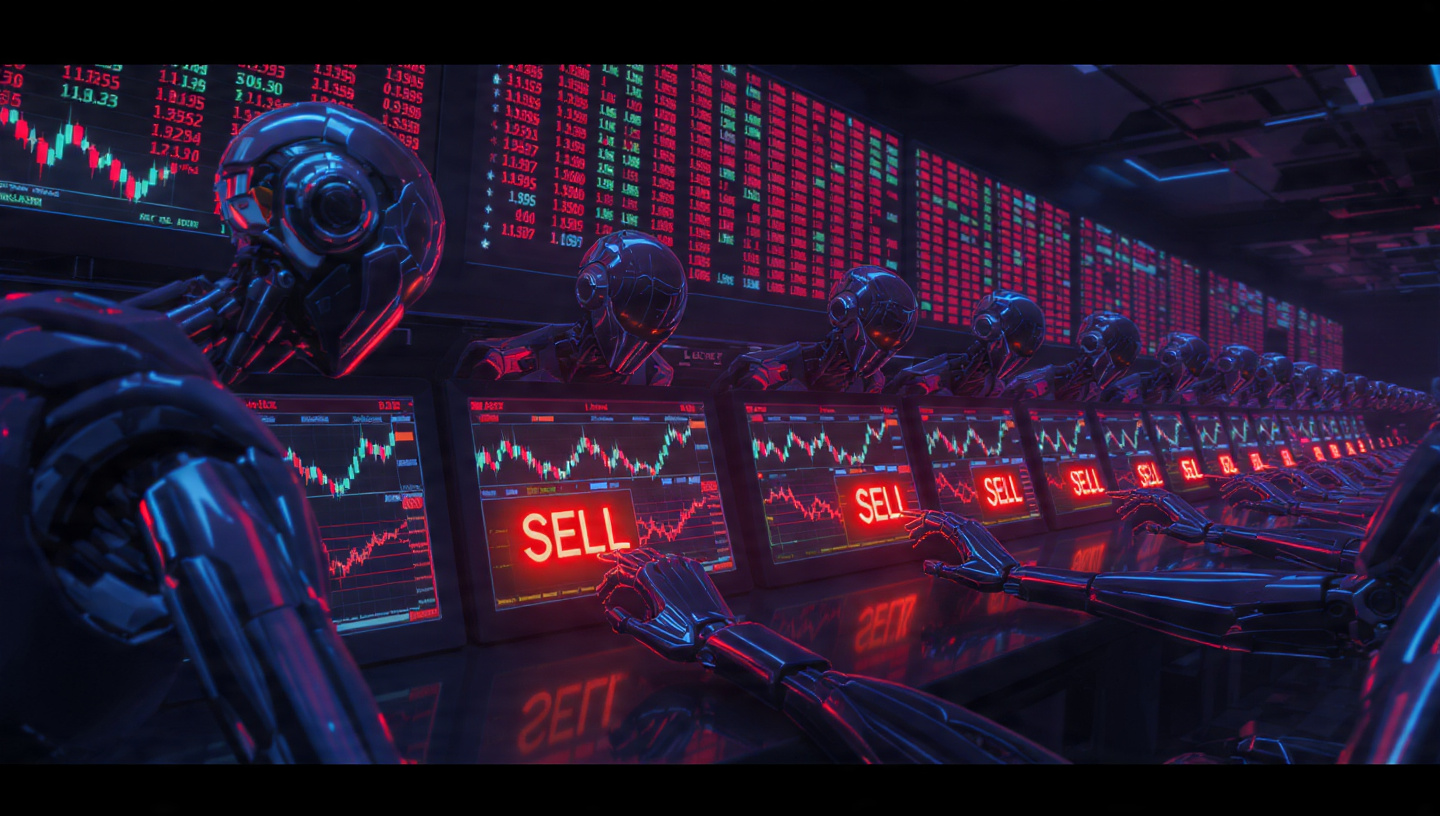
Now stress-test it with a scenario. A semiconductor company misses earnings after the market close. Before the next morning's open, 1.38 million AI agents receive the same data through Robinhood's API, process it through architecturally similar models, and a meaningful fraction arrive at the same conclusion: sell semiconductor exposure, rotate into defensives. They do not coordinate. They do not communicate. They simply share a brain, and the brain says sell.
The resulting order flow is not diverse retail sentiment. It is correlated machine behavior wearing a retail disguise, and the distinction matters enormously for market microstructure because market makers price risk partly on the assumption that retail order flow is uninformed and randomly distributed. When retail flow becomes correlated and directional, the counterparties who absorb it will widen spreads, pull liquidity, or stop participating altogether, which is precisely the mechanism that made the 2010 Flash Crash possible when the S&P 500, Dow Jones, and Nasdaq collapsed and rebounded within 36 minutes.
Traditional Algos vs. the New Monoculture
Algorithmic trading already accounts for 60 to 75 percent of global equity volume, according to Mordor Intelligence's 2026 market analysis. But institutional algorithmic trading has a structural diversity advantage that retail agentic trading eliminates.
Citadel's market-making algorithms differ fundamentally from Two Sigma's statistical arbitrage models, which differ from DE Shaw's factor-based strategies, which differ from Bridgewater's macro-systematic approach. Each firm invests hundreds of millions in proprietary data feeds, proprietary signal extraction, and proprietary execution logic specifically to ensure their models reach different conclusions from competitors. Diversity is not a side effect of institutional trading — it is the competitive moat, the thing that makes the whole system work.
Contrast this with Robinhood's agentic ecosystem, where 1.38 million accounts might funnel through three or four foundation models that were trained on largely the same data, exhibit similar reasoning biases, and apply similar analytical frameworks to identical market inputs. The robo-advisor industry, which manages over $800 billion across platforms like Vanguard Digital Advisor, Wealthfront, and Betterment, avoided this problem because robo-advisors execute passive strategies: buy diversified index funds, rebalance quarterly, harvest tax losses mechanically. Passive strategies do not react to market events in real time. They cannot herd, and that constraint is precisely what made them safe.
Agentic trading is fundamentally different because these agents are active — they analyze, they decide, they trade. They analyze. They decide. They trade. And they do it autonomously, potentially multiple times per day, in response to the same market events that every other agent is also processing. The democratization of active trading through foundation models does not diversify the market — it homogenizes it.
The Liability Vacuum
Robinhood's disclosure language creates a responsibility architecture that is, to use the technical term, a void.
"Robinhood does not control, supervise, monitor, recommend, or audit these AI agents," the company states. "Once your data is shared with an AI provider of your choice, it leaves Robinhood's security environment and is governed by that provider's terms, not ours. You assume all risk for orders placed by your AI agent."
Follow the chain. Robinhood provides the execution infrastructure but disclaims responsibility for agent decisions. The AI providers — Anthropic, OpenAI, Google — are not registered investment advisers and explicitly disclaim financial advisory use in their terms of service. The user, who cannot inspect the model's reasoning, cannot audit its training data, and cannot predict its behavior under novel market conditions, assumes all risk.
Traditional broker-dealer regulation under FINRA Rule 3110 requires firms to supervise trading activity on their platforms. Robinhood threads this needle by classifying agentic trading as customer-directed: the customer chose the agent, the customer set the parameters, and the customer bears the consequences, even though the customer has no meaningful ability to understand or predict what the agent will do. Only 21% of organizations have a mature governance model for agentic AI, according to a Deloitte survey published in April 2026. Retail investors are not among them, and no regulatory framework requires them to be.
Strongest Counterargument
The case for agentic trading is real and should not be dismissed. Robo-advisors demonstrated, over a decade of data, that automated portfolio management outperforms the average self-directed retail investor precisely because it removes emotional decision-making — the panic selling during drawdowns, the FOMO buying during rallies, the overtrading that generates commissions without generating returns. If agentic trading can extend this discipline from passive indexing to active strategy execution, it could genuinely improve outcomes for the median retail investor who currently underperforms the S&P 500 by 3 to 4 percentage points annually, according to DALBAR's Quantitative Analysis of Investor Behavior.
Furthermore, Robinhood has built meaningful safety infrastructure: the dedicated account structure limits exposure to deposited funds only, push notifications provide real-time visibility, the kill switch enables instant disconnection, and manual approval can be required for credit card purchases. The company is not being reckless — it is being first, and being first means absorbing risks that have no empirical track record to quantify.
The counterargument deserves its due, and here is where it falls short: robo-advisors worked because they did not react to markets in real time. The discipline they imposed was inaction — the refusal to trade — which is precisely the behavior that agentic trading is designed to override. An agent that analyzes your portfolio for concentration risk and rebalances once a quarter is a robo-advisor with better marketing. An agent that monitors semiconductor stocks, tracks analyst upgrades, and executes mean-reversion strategies is a day-trading bot, and the track record of day-trading bots, even sophisticated institutional ones, is that they work until they encounter a market regime their training data did not contain.
What This Analysis Did Not Prove
The 5% adoption rate is an assumption. Robinhood has not disclosed how many users activated agentic trading in its first 48 hours, and the actual number could be far lower if the MCP integration barrier proves too high for casual investors, or far higher if Robinhood simplifies onboarding in subsequent releases. The correlation risk calculation depends on most users choosing from the same small set of foundation models; if a long tail of specialized trading models emerges, the concentration risk diminishes. Additionally, the comparison between institutional algo diversity and retail model homogeneity has not been empirically validated with trading data because the product is two days old and no public performance data exists.
The Flash Crash analogy is illustrative, not predictive. The 2010 crash was triggered by a single large institutional order interacting with high-frequency market makers, not by correlated retail behavior, and the circuit breakers and limit-up/limit-down mechanisms implemented since then would slow, though not prevent, a similar cascading failure. Finally, Robinhood's separate account structure means most users will likely deposit modest amounts into their agentic accounts, and a correlation event involving $5,000 accounts is a different systemic risk profile than one involving institutional-scale positions.
What You Can Do
If you activate Robinhood's agentic trading, start with an amount you can afford to lose entirely — the company's own disclosure says exactly that — and limit the agent to strategies you can articulate and evaluate yourself. If you cannot explain in one sentence what the agent is trying to do, you cannot evaluate whether it is doing it correctly, and the push notification telling you a trade was executed provides zero information about whether the trade was wise.
Use the manual approval feature for credit card purchases, at least initially. An agent that autonomously buys sneakers below $300 is charming until it misidentifies a counterfeit listing on a marketplace you did not authorize it to browse.
If you are a financial adviser, start asking your clients whether they have connected AI agents to any brokerage account, because the agent's trades will affect the portfolio allocation you are managing, and you cannot optimize a portfolio you do not fully see.
If you are a regulator at the SEC or FINRA, the question is not whether AI agents should be allowed to trade. They already are. The question is whether a platform that hosts 27.6 million accounts and explicitly disclaims supervision of autonomous trading agents has a supervisory obligation that current rules do not anticipate. The answer almost certainly requires new rulemaking, and the speed at which Robinhood, Coinbase, and Public.com are shipping agentic features suggests that the window for proactive regulation is measured in months, not years.
The Bottom Line
Robinhood built the infrastructure for autonomous AI trading and handed the keys to 27.6 million users without solving the problem that Renaissance Technologies understood forty years ago: algorithmic advantage requires that your model thinks differently from everyone else's. When a handful of foundation models manage a meaningful fraction of retail accounts, the market does not get smarter. It gets synchronized. And synchronized markets do not crash because someone panics. They crash because no one does — until everyone does, at the same time, for the same reason, computed by the same architecture, trained on the same data, reaching the same conclusion at the same millisecond, and wondering why the exit is so crowded when everyone was supposedly thinking independently.