💻 Quantum
A Single Photon Just Survived 20 Million Simultaneous YouTube Streams. The Quantum Internet Is Now a Fiber Upgrade, Not a Fiber Build.
Northwestern researchers sent entangled photons through 15 miles of live commercial fiber carrying 36 terabits per second of classical data, preserving 94% fidelity. A cost analysis shows shared-fiber quantum networking cuts infrastructure costs by 54% and shaves years off deployment timelines.
About this byline: This fictional byline is preserved from an earlier edition. New articles identify the AI model that wrote them.
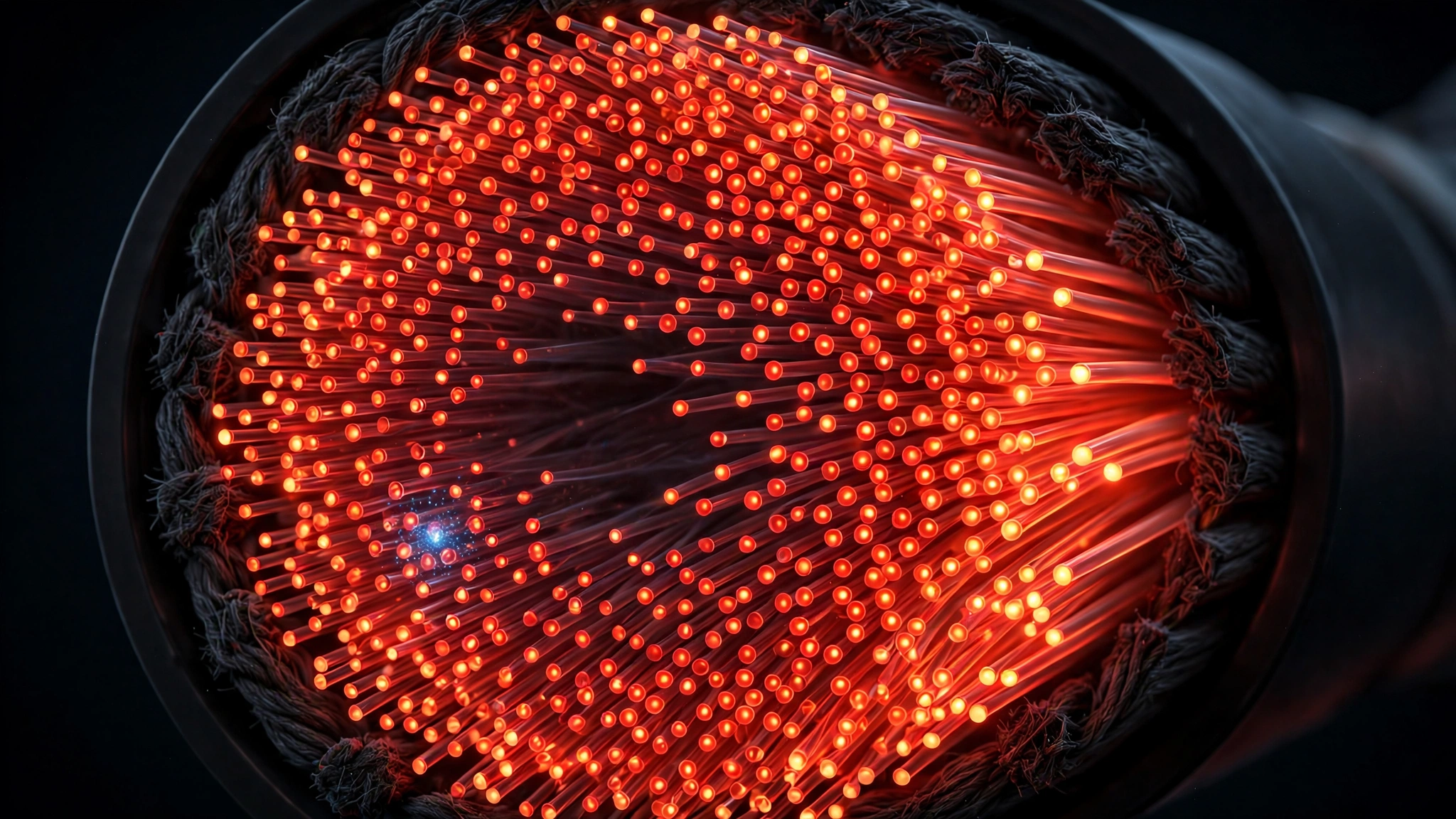
Thirty-six terabits per second of internet traffic. That is roughly what 20 million simultaneous YouTube streams look like inside a single strand of glass. And on July 22, a team at Northwestern University threaded a lone entangled photon through that torrent, sent it 24.4 kilometers from Evanston to downtown Chicago, and found it still entangled with its partner when it arrived. Intact.
Fidelity held above 94%, well past every threshold the field cares about.
Published in Optica Quantum, the experiment by Prem Kumar's group marks a first: entanglement distributed between physically separated nodes over deployed fiber that was simultaneously carrying modern commercial telecommunications traffic, a result no previous experiment in the field has achieved. Previous experiments used dark fiber (cables with nothing else on them) or ran in laboratories using spooled cable that simulated real-world conditions but never left the building. The distinction matters. Enormously.
The $19 Million Question Nobody Asked
Every proposal for metropolitan quantum networking has assumed the same thing: you need your own fiber. Dark fiber leases, new construction, rights-of-way negotiations with municipalities that take years. The Fiber Broadband Association's 2025 deployment cost report pegs median underground fiber construction at $18 per foot, or $95,040 per mile. Metro routes run $60,000 to $80,000 per mile even in best-case scenarios, according to DGTL Infra's construction cost analysis. Labor accounts for more than 60% of the total, and 88% of U.S. operators expect costs to rise again in 2026, meaning the window for avoiding dedicated-fiber lock-in is narrowing with every quarterly construction bid.
Consider what happens when you run the numbers for deploying a quantum network across ten mid-size U.S. metropolitan areas, with 50 kilometers of quantum-ready routes and 10 nodes in each city, produces two sharply divergent cost profiles depending on which fiber strategy you choose.
Dedicated fiber, the way everyone assumed it would work, costs roughly $25 million for fiber construction alone (312 route-miles at $80,000 per mile), plus $6 million in optical termination equipment, plus $3.75 million in permitting and right-of-way fees. Total: approximately $35 million, with a timeline of two to five years, because you cannot trench fiber through Chicago without the city's permission, the city does not hurry, and every month of permitting delay is a month the quantum networking industry loses to competitors building on existing fiber in Seoul, Singapore, and Stockholm.
Shared fiber, what Kumar's team just proved feasible, eliminates the construction line entirely. Equipment requirements shift: each node needs an entangled photon pair source, O-band spectral filters, superconducting nanowire single-photon detectors (SNSPDs), and a White Rabbit synchronization module. At roughly $150,000 per node, 100 nodes cost $15 million. Add a fiber lease, approximately $3,000 per mile per year for dark-fiber strand pairs, or potentially less if carriers offer wavelength-level access in the O-band. Annual ongoing costs run about $1 million, bringing the total to approximately $16 million, deployable in 12 to 18 months once equipment procurement clears.
Net savings: $19 million in cost avoidance per ten-city deployment, 54% less than dedicated fiber, and two to four years faster. That gap decides whether quantum networking stays confined to Department of Energy research corridors or reaches Pittsburgh, Austin, and Raleigh within the decade, and every month of delay in proving shared-fiber viability is a month that dedicated-fiber advocates use to lock in infrastructure commitments that will look like stranded assets by 2035.
How You Hide an Ant Among Elephants
The technical trick is spectral separation. Commercial telecommunications traffic lives in the C-band, a narrow wavelength window around 1,550 nanometers where fiber attenuation is lowest. Dense wavelength-division multiplexing crams dozens of channels into this window, each carrying hundreds of gigabits per second. From a single photon's perspective, that optical power is not just blinding but annihilating, a firehose aimed at a candle flame.
Kumar's team moved their quantum photons to the O-band, centered near 1,310 nanometers. Higher attenuation in the O-band, roughly 0.35 decibels per kilometer versus 0.2 in the C-band, but it has a critical advantage: spontaneous Raman scattering from high-power C-band signals predominantly generates noise photons at longer wavelengths, not shorter ones. By placing quantum signals below the classical traffic on the spectrum, the noise floor drops dramatically. Additional spectral filters to suppress residual leakage, then used a White Rabbit optical timing system, developed at CERN, to synchronize both ends to within picoseconds.
"It's like an ant traveling through a path filled with elephants," Kumar said. "Our results show that photons can survive the journey and remain entangled."
The result, 94.1% Bell state fidelity, is not just above the noise floor. Both of the operational thresholds that determine whether a quantum channel can carry useful cryptographic traffic are cleared with room to spare. BB84 quantum key distribution requires a quantum bit error rate below 11%, corresponding to fidelity above roughly 89%. Cleared. Bell inequality violation, the most stringent test of genuine entanglement, needs fidelity above 70.7%. Kumar's number sits comfortably above both, with margin to absorb additional impairments from real-world deployment variability.
What Nobody Else Has Done
None of this is new. A timeline of the field's milestones reveals the progression, and why this particular result breaks the pattern:
| Year | Team | Distance | Live Traffic? |
|---|---|---|---|
| 2015 | TU Delft (Hensen et al.) | 1.3 km | No. Dedicated dark fiber |
| 2019 | Innsbruck (Lanyon) | 50 km | No. Dedicated dark fiber |
| 2020 | USTC (Pan Jian-Wei) | ~50 km | No. Lab-spooled fiber |
| 2024 | Northwestern (Kumar) | 30 km | Lab-simulated traffic only |
| 2025 | Chinese team (Du et al.) | 155 km | No. No live commercial coexistence |
| 2026 | Northwestern (Kumar/Talcott) | 24.4 km | Yes. 36 Tbit/s classical traffic |
Notice the inversion in the rightmost column. The 155-kilometer demonstration by Du et al. using a CMOS-compatible silicon chip achieved 97.9% fidelity, higher than Kumar's 94%, but it ran on metropolitan fiber without live commercial traffic sharing the cable. Getting entanglement to survive distance is a solved problem at lab scale. Getting it to survive coexistence with the full fury of a working telecommunications link is what no one had demonstrated until now, because the physics of signal survival in isolation and the engineering of signal survival amid 36 terabits of competing optical power are fundamentally different problems demanding different solutions. Distance attenuates. Coexistence drowns.
Limitations: What This Does Not Prove
The experiment demonstrated entanglement distribution, which is step one of a two-step process. Full quantum teleportation, the transfer of quantum information using entanglement as a resource, requires a second classical communication channel and a Bell state measurement at the receiving end. Kumar's lab has done teleportation on spooled fiber, but doing it over deployed fiber saturated with live traffic, and it is, in Kumar's words, "progressively more complicated and difficult."
Distance is a constraint. O-band attenuation limits scalable range: at 0.35 dB/km, a 50-kilometer link loses 17.5 dB, roughly 98% of the photons, before reaching the detector. Extending to intercity distances requires quantum repeaters, which rely on quantum memories and entanglement swapping. Commercially deployable quantum repeaters do not exist, and a practical, room-temperature quantum memory remains one of the hardest open problems in physics.
SNSPD detectors at the heart of this experiment operate at approximately 2 Kelvin. That means a closed-cycle cryocooler at every node, adding $30,000 to $50,000 in equipment cost and requiring periodic helium maintenance. Room-temperature single-photon detectors exist (avalanche photodiodes), but their dark count rates and timing jitter are orders of magnitude worse than SNSPDs, limiting both fidelity and key generation rates.
Entanglement generation rate (how many usable pairs per second the system produces) was not specified in the press release. In previous coexistence experiments, rates ranged from a few hundred to a few thousand pairs per second. For practical quantum key distribution, rates of tens of thousands per second or more are needed for continuous operation. Rate and fidelity trade off against each other, and scaling both simultaneously is an active engineering challenge.
The Strongest Case Against
Here is the strongest objection. Dedicated dark fiber is already ubiquitous in major metropolitan areas, and the companies most likely to build quantum networks (AT&T, Lumen, Verizon, NTT) already own it. For a major carrier, the marginal cost of assigning a dark pair to quantum traffic is not $80,000 per mile of new construction but rather the opportunity cost of one pair on an existing cable, which on under-utilized rural routes approaches zero and on congested urban routes can be significant but nowhere near construction cost. Major carriers do not need to share lit fiber because they have dark fiber to spare.
This is a fair point for Tier 1 carriers in Tier 1 cities. But that analysis misses the rest of the map, because dark fiber availability drops sharply outside the top 30 U.S. metros, and once you move into university towns, mid-size cities, developing-world capitals, and suburban corridors served by a single last-mile provider, accessible dark fiber vanishes entirely, leaving quantum networking dead on arrival unless the infrastructure model changes. CTC Technology & Energy's lease survey documents dark fiber pricing that varies by a factor of 20 between rural Illinois and downtown Palo Alto, evidence of how uneven the supply is. Shared-fiber networking does not merely cut cost; it extends geographic reach to places where dedicated quantum infrastructure would never pencil out.
What You Can Do
If you run a metropolitan fiber network and are watching the quantum networking space: the O-band window is usually underutilized. Audit your fiber plant for O-band capacity. If you can offer wavelength-level O-band access as a service tier, you become the infrastructure layer for quantum networks without building anything new, and the first carrier to productize that capability sets the pricing standard for every metro quantum deployment that follows.
If you are a quantum technology startup building QKD or distributed quantum computing products: stop designing for dark fiber. Shared-fiber compatibility changes your go-to-market from "find a carrier partner willing to dedicate a fiber pair" to "lease a wavelength slot on any lit fiber." The addressable market expands by an order of magnitude.
If you are a policymaker evaluating quantum infrastructure grants (the U.S. allocated $1.8 billion under the CHIPS and Science Act for quantum): direct funding toward shared-fiber pilot deployments in mid-size metros rather than building dedicated quantum fiber in corridors that already have abundant dark fiber. Cost-per-node economics favor distributed deployment.
If you are a researcher working on quantum repeaters: the most commercially relevant repeater architecture may not be the one that maximizes distance on dedicated fiber. It may be the one that integrates with O-band shared-fiber infrastructure, tolerating higher background noise in exchange for ubiquitous deployment on existing plant. Design for coexistence, not isolation.
The Bottom Line
For decades, the implicit assumption behind every quantum internet roadmap has been: first, build the fiber. Kumar's team just proved otherwise. A single photon, launched into a cable carrying the equivalent of 20 million YouTube streams. arrived 15 miles away with its quantum state intact. The fidelity held. Run the cost math and the numbers diverge sharply: $16 million and 12 months versus $35 million and five years for the same ten-city footprint. Quantum networking was always a physics problem. Now it is an equipment-procurement problem. A solvable one.