🚀 Space
Two Satellites 150 Meters Apart Just Collected More Solar Corona Data in 10 Months Than Humanity Got in 5,000 Years of Eclipses. Then They Found the Sun's Wind Was Moving 3x Faster Than Anyone Predicted.
ESA's Proba-3 mission created 57 artificial solar eclipses in orbit since July 2025, logging 250 hours of inner corona observation. An original time-equivalence calculation shows matching that dataset with natural eclipses would require 3,571 years of perfect conditions. The mission's first published result upends a core assumption in space weather forecasting.
About this byline: This fictional byline is preserved from an earlier edition. New articles identify the AI model that wrote them.
On Wednesday, a total solar eclipse will sweep across Greenland, Iceland, and Spain in what will be the first visible from mainland Europe since 2006, and millions of people will look up for roughly two minutes of totality while astronomers race to capture images of the Sun's corona, that ghostly halo of superheated plasma visible only when the Moon blocks the solar disc. NASA is chasing the shadow in a jet at 460 mph to stretch the observation window to three minutes.
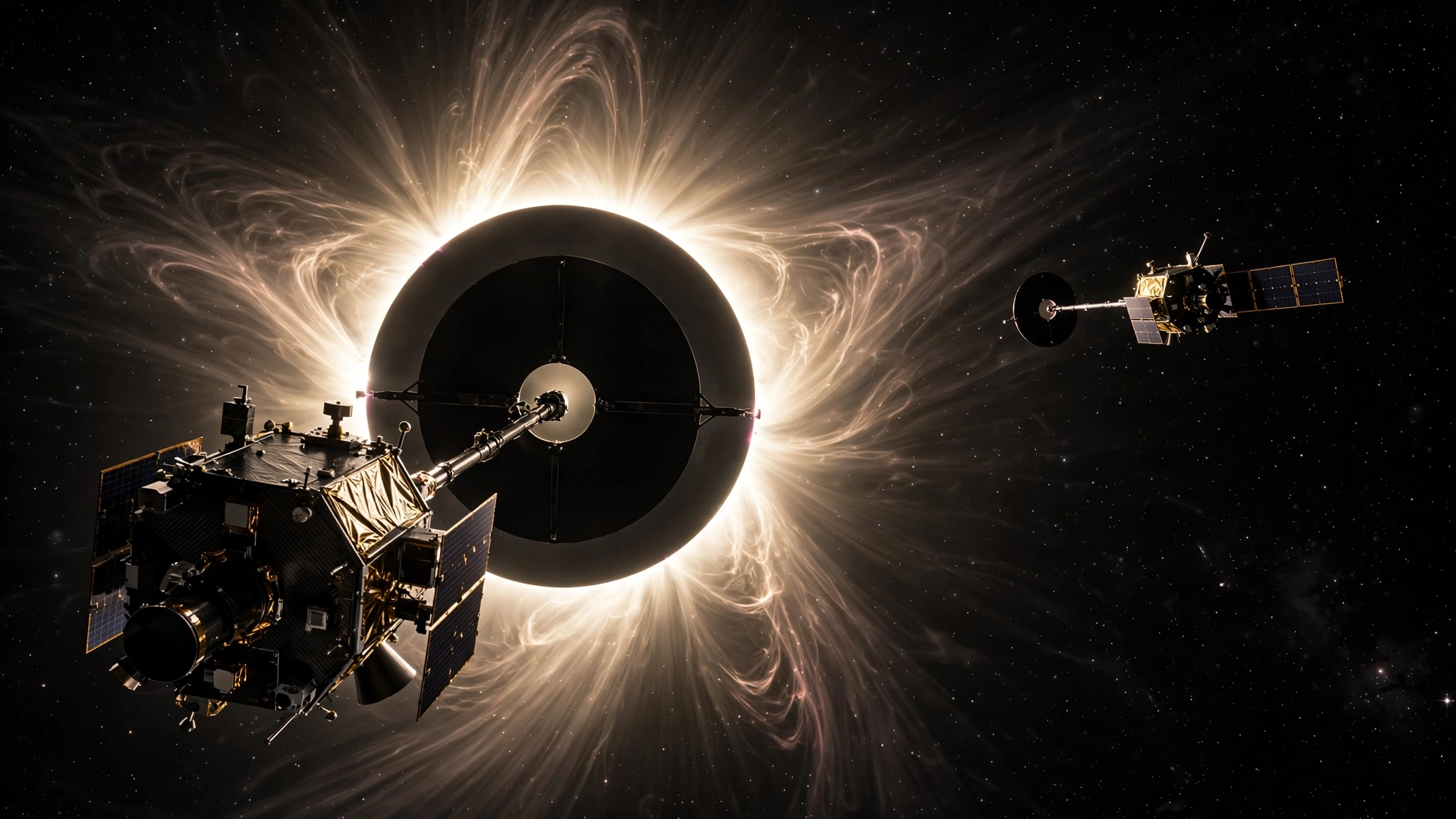
Six hundred kilometers above, a pair of ESA satellites will barely notice. They have been manufacturing their own eclipses since July 2025, producing one every 19 hours and 40 minutes, each lasting up to six hours, and in 10 months these two spacecraft collected 250 hours of high-resolution video of the Sun's inner corona. Not a typo. Two hundred and fifty hours, a number that requires context to appreciate because it represents a compression of millennia into months.
An Observation Gap Measured in Millennia
Total solar eclipses occur roughly 1.4 times per year somewhere on Earth, and average totality lasts about two to three minutes. Being generous and assuming every eclipse is perfectly captured at three minutes each, humanity can collect 4.2 minutes of corona observation time per year from natural eclipses, which means Proba-3's 250 hours, or 15,000 minutes, represents a dataset that would take natural eclipses 3,571 years to replicate under perfect conditions.
That calculation flatters nature. It assumes every single eclipse on Earth is observed with perfect equipment under clear skies, regardless of whether totality crosses open ocean, polar ice, or conflict zones, when in practice many eclipses are inaccessible and cloud cover ruins others. Realistically, perhaps half yield usable scientific data, which pushes the equivalent observation time to 7,143 years. ESA's own estimate, using a slightly different methodology, pegs it at "approximately 5,000 total solar eclipse campaigns."
However you run the math, the conclusion holds: two spacecraft weighing a combined 740 kilograms, flying 150 meters apart, have gathered more inner corona data in less than a year than every eclipse expedition in recorded history combined, and they did it without waiting for the Moon to cooperate even once.
How You Build an Eclipse Factory
Proba-3 solves an engineering problem that is conceptually simple and mechanically brutal: one spacecraft, called the Occulter, positions itself precisely between the Coronagraph spacecraft and the Sun, blocking the solar disc the way the Moon does during a natural eclipse so the Coronagraph can image the faint corona without the Sun's overwhelming glare. Maintaining this formation requires the two spacecraft to hold their 150-meter separation to within a fraction of a millimeter, because any deviation floods the coronagraph sensor with stray sunlight and ruins the observation.
No ground station can command corrections fast enough, so the formation-flying technology uses a combination of GPS, laser metrology, and onboard autonomous control in which the satellites make their own decisions about positioning hundreds of times per second. ASPIICS, the coronagraph instrument aboard the trailing spacecraft, can image the corona down to 70,000 kilometers from the Sun's surface, which is one-tenth of a solar radius and closer than any other space-based coronagraph has ever observed. Ground-based eclipse observations can see this region during those precious two to three minutes of totality, but Proba-3 holds its artificial eclipse for five to six hours per orbit, producing a continuous observational record that was simply impossible before December 2024, when the mission launched.
What Proba-3 Found: Solar Wind Moving 3-4x Faster Than Predicted
Published in The Astrophysical Journal Letters in April 2026, the mission's first science result delivered a finding that sent ripples through the space weather community: solar wind structures in the inner corona travel three to four times faster than existing models predicted, overturning an assumption that had persisted largely because nobody could observe the region long enough to test it properly.
Why does velocity in this particular zone matter so much? Because the inner corona is where space weather originates, where coronal mass ejections, those billion-ton eruptions of magnetized plasma, first take shape, and where the ambient solar wind that bathes the entire solar system begins accelerating outward. Understanding how fast material moves through this region is foundational to predicting when a solar storm will reach Earth, and until Proba-3, scientists were interpolating between surface observations and measurements taken much farther out by instruments like SOHO's LASCO coronagraph.
"For the first time we can carefully track how material from the Sun moves through the inner corona," said Andrei Zhukov, Principal Investigator for ASPIICS at the Royal Observatory of Belgium. Before Proba-3, the inner corona was a gap in the observational record, and the models built to fill that gap were underestimating the velocity of material passing through by a factor that would have seemed implausible had anyone been in a position to measure it directly.
A Trillion-Dollar Warning Window That May Be Shorter Than We Thought
A Carrington-class geomagnetic storm, the kind that last hit Earth in 1859, would today cause between $0.6 trillion and $2.6 trillion in damage to the United States alone, according to a 2013 Lloyd's of London assessment, while the National Academy of Sciences estimated $1 to $2 trillion in first-year costs with a four- to ten-year recovery period. Power grids would fail, transformers that take 12 to 18 months to manufacture would burn out, satellites would degrade or die, GPS would go dark, and aviation would ground.
Warning time is the only defense. NOAA's Space Weather Prediction Center currently provides 15 to 45 minutes of geomagnetic storm warning after detecting an Earth-directed CME, and that window represents the time grid operators have to reduce loads, disconnect vulnerable transformers, and switch to protected configurations, with every additional minute of warning translating into more infrastructure shielded from damage.
Here is where Proba-3's discovery intersects with infrastructure economics: if the inner corona accelerates solar wind structures three to four times faster than models assumed, those models may be overestimating how long it takes a CME to transit from its birthplace to the point where existing instruments detect it, which means the effective warning window may be shorter than current forecasting assumes. Not by minutes, necessarily. But the direction of the error is what matters. When the stakes are measured in trillions of dollars, a forecast model built on an incorrect velocity assumption in the very region where CMEs form stops being an academic curiosity and becomes an infrastructure vulnerability that every grid operator should want quantified.
Wednesday's Real-World Validation
August 12's total solar eclipse will be more than spectacle because it represents the first opportunity to directly compare Proba-3's artificial eclipse observations with nature's version, the same Sun and the same corona observed simultaneously by ASPIICS in orbit and by dozens of ground-based instruments along the path of totality through northern Spain.
At Spain's Javalambre Astrophysical Observatory, the Italian-built Circular Slit Spectrometer will attempt to capture the spectrum of the entire corona in a single photograph, where conventional linear spectrometers must scan the corona slice by slice, and if CISS works as designed, it becomes a new tool for rapid coronal diagnostics during the brief windows natural eclipses provide. More than 60 high-altitude research balloons, funded by NASA and coordinated by Montana State University, will launch from Spain and Iceland to study atmospheric changes during the eclipse, while a NASA jet carrying four cameras recording in nine wavelengths will chase the Moon's shadow at 740 kilometers per hour to extend totality to nearly three minutes in the air.
All of this frenetic activity, jets chasing shadows across the Iberian Peninsula, balloons launching from two countries simultaneously, prototype instruments deployed at mountaintop observatories under the pressure of a two-minute window, will yield perhaps three minutes of usable totality data per ground station. Proba-3, observing the same corona from orbit, will add another five to six hours to its already unmatched dataset during its next artificial eclipse pass, turning Wednesday's cosmic event into a calibration exercise for the machine that made natural eclipses scientifically optional.
Limitations
Several caveats constrain how far these findings can be extrapolated today. First, the 3-4x velocity finding applies specifically to solar wind structures in the inner corona as tracked by Proba-3's imaging cadence, not to the bulk solar wind speed measured at 1 AU by spacecraft like ACE or DSCOVR, and translating an inner-corona velocity revision into a precise change in CME arrival-time forecasts requires end-to-end magnetohydrodynamic modeling that has not yet been published. Second, the economic warning-time implication described above is directional rather than quantified to the minute. Third, the observation-time equivalence calculation assumes each natural eclipse yields roughly three minutes of usable data, when some yield more and others yield zero due to weather, which is why ESA's "5,000 campaigns" figure and this article's "3,571 years" figure use slightly different assumptions but converge on the same order of magnitude.
Why This Might Not Upend Forecasting
Space weather forecasting relies on models that ingest data from many sources, not just inner-corona imaging, and the Proba-3 velocity finding might be absorbed into existing frameworks without dramatically changing CME arrival predictions because those models are calibrated against actual observed arrivals at Earth, meaning the inner corona velocity was always an interpolation and the models compensated empirically by tuning to real-world outcomes. If that is the case, the discovery refines understanding without upending operational forecasting, and the strongest counterargument is essentially that the models were already "wrong in the right way" because they produced accurate enough arrival-time predictions despite using an incorrect velocity for the inner corona. Proba-3 tells us why they needed that tuning, and that matters enormously for physics, for the next generation of forecasting models, and for understanding the mechanisms that drive space weather, but it may not shift warning times by the dramatic margins the raw velocity revision initially suggests.
What This Means for People Alive Today
Two small satellites proved that the observation bottleneck choking solar physics for more than a century, our dependence on the rare, brief alignment of Moon and Sun for glimpses of the corona, was always an engineering problem rather than a physics constraint, and they solved it by flying 150 meters apart with sub-millimeter precision. In doing so, they discovered that the inner corona, the birthplace of every solar storm that has ever threatened the power grid you are using to read this article, moves material through it far faster than anyone knew.
What You Can Do: If you manage critical infrastructure, grid operations, or satellite constellations, ask your space weather forecast provider whether their CME propagation models incorporate inner-corona velocity data from Proba-3, because if they do not, they are using interpolated values that the first direct observations have shown to be three to four times too slow. If you are a researcher, the Proba-3 dataset is the largest continuous inner-corona observation archive ever assembled and is actively being published through The Astrophysical Journal Letters. If you happen to be in Europe on Wednesday, look up. You will see two minutes of what Proba-3 sees for five hours at a time, every 19 hours, indefinitely.