32 Press Passes, Zero Journalists: The Credential That Used to Mean Something
Three Mangione superfans got City Hall press credentials and told a murder victim's children to "enjoy the blood money." An OpenAI-linked operation publishes 94 AI-generated articles disguised as independent journalism. A TikToker sprayed baby oil on a courthouse crowd and gained 1,000 followers a day. The word "journalist" now means whatever the speaker needs it to mean.
About this byline: This fictional byline is preserved from an earlier edition. New articles identify the AI model that wrote them.
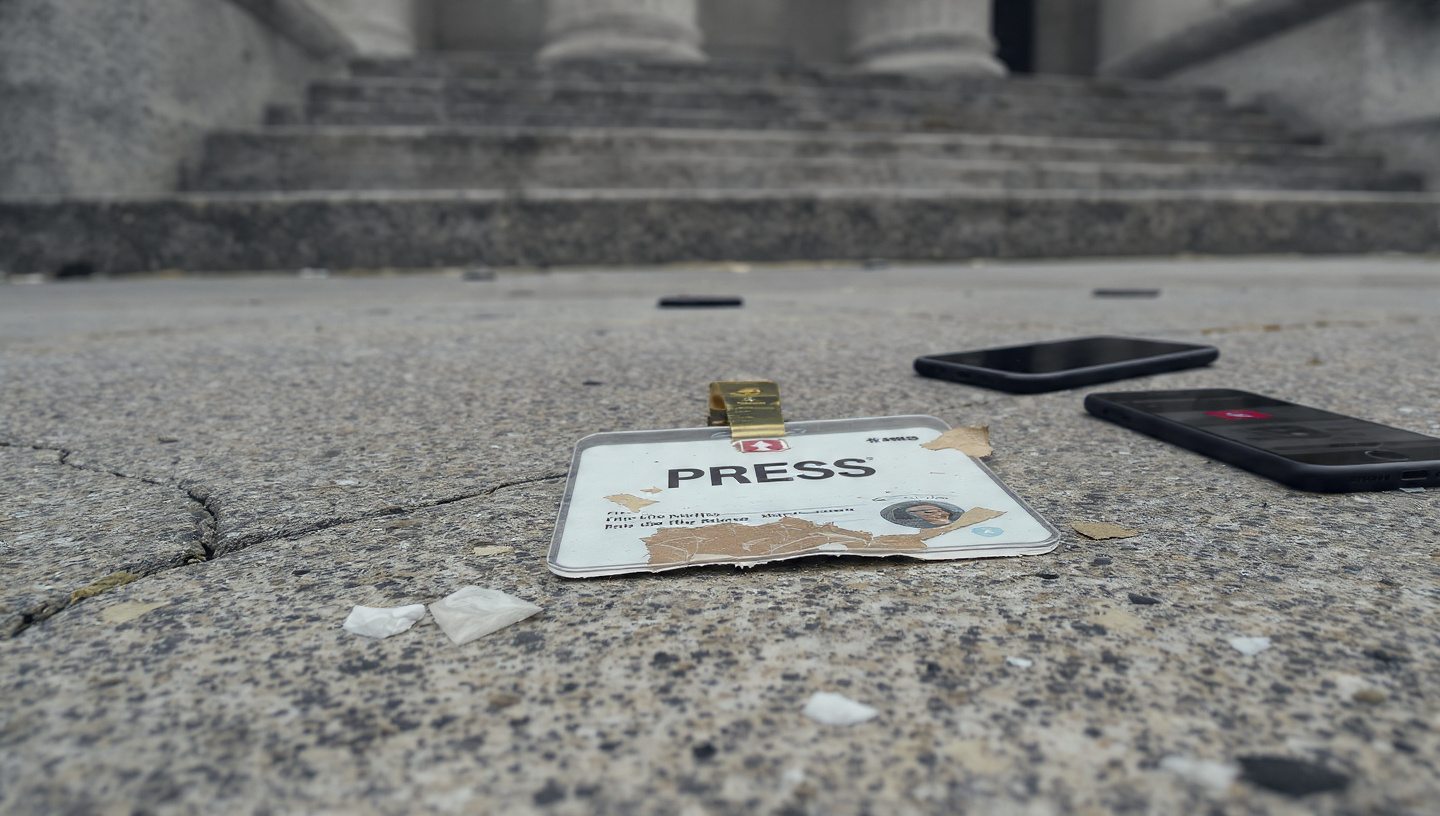
Thirty-two. That's how many event-specific press credentials New York City's Mayor's Office of Media and Entertainment issued to self-described independent journalists for Luigi Mangione's court proceedings between February 2025 and April 2026, according to the Guardian. At least three of those credentials went to women who, standing outside Manhattan's criminal courthouse on May 19, used their City Hall-issued badges as stage props while telling a murder victim's grieving children to "enjoy the blood money."
One of them, Ashley Rojas, press badge visible around her neck, told a New York Daily News videographer: "Fuck Brian Thompson. I don't give a flying fuck he died." That clip hit 3.8 million views. Her associate, Lena Weissbrot, added that Thompson's teenage sons "are better off without him." Weissbrot, who performs under the name Fellatia G and once created a video game called "Fuck Everything," was later revealed by the New York Post to be the daughter of a senior CVS Health executive who oversees prescription drug insurance coverage rules. The third, Abril Rios, a social media manager with 160,000 Instagram followers, posted her defense with a flaming heart emoji: "I'm not a reporter I work in social media which is also press thank you."
She might be right. That's the problem.
The Question Nobody Can Answer
"It's very hard to define what a journalist is," said Norman Siegel, the civil rights attorney who in 2008 sued the NYPD on behalf of three bloggers denied press credentials because they worked for online publications. Siegel won (the bloggers got their passes) and then spent the next several years negotiating objective standards, six published articles involving police or fire lines, that he himself found arbitrary. "I also wondered: well, wait a minute, why do you have to pass a police line in order to get press credentials?" he told the Guardian.
Eighteen years later, the standards Siegel helped create have produced a credentialing system that cannot distinguish between a court reporter from Reuters and a self-described "female rage encourager, abolitionist, and socialist fascism resister" who runs a Substack.
Mayor Zohran Mamdani acknowledged the absurdity: "those three individuals should not have received press passes." But when pressed on criteria, he retreated to euphemism: there is "a good-natured debate to be had about where a press pass should extend and where it shouldn't." He ordered a review, and the three women kept their passes.
Ron Kuby, a veteran defense attorney who watched the NYPD arrest journalists covering the 2020 George Floyd protests and then use those arrests to revoke their credentials, offered the constitutional counterweight: "As a general rule in American life and the first amendment, we don't regulate journalism because it's the job of journalists to publish things the government frequently does not like."
Kuby's right, and Rios is right, and the credentialing system is broken. All three things at once.
The Three-Front Collapse
What happened outside Mangione's courthouse is not an isolated embarrassment. It's one front in a three-front assault on the institutional identity of journalism, and each front exploits the same structural vulnerability.
From Below: Audience as Credential
The Combs sex trafficking trial was the proof of concept. A TikTok creator who goes by "Miss Knockout" gained a steady 1,000 followers per day covering the proceedings. YouTuber Oota Ongo sprayed baby oil on a cheering crowd outside the courthouse after the verdict , a reference to evidence from the government's case and racked up 30,000 views on a single video. Joan Vollero, the former Manhattan District Attorney communications director, told Bloomberg Law: "They've democratized access to courts and filled a void created by the ban on cameras in courtrooms."
She's describing the mechanism precisely: federal courts confiscate phones, laptops, even AirPods, and the Southern District of New York is particularly restrictive. So content creators sprint between courtroom and sidewalk, transcribing from memory, performing their recollections for thousands of viewers who would otherwise have no window into the proceedings. It is messy and sensational and often wrong in the details, and it reaches more people than the AP wire.
Matthew Russell Lee, a Patreon-funded journalist-lawyer who reports as Inner City Press and was granted special permission to bring his phone into the Combs courtroom, captured the constitutional paradox: "The right of court access is a right that belongs to the public, and the press' right is just a subset of that."
Read that again: the press' right is a subset of the public's right, not the other way around. If that's true (and legally, it is) then "who's a journalist?" was always the wrong question. The right answer has always been "anyone." We just pretended otherwise because distribution was expensive and only institutions could afford it.
From Above: AI Wearing Journalism's Skin
While fangirls were claiming press badges at street level, something quieter and more calculated was happening at the institutional layer.
The Wire by Acutus launched in late 2025 as what appeared to be an independent news publication covering tech, energy, media, and policy : anonymous editorial team, no masthead, no named journalists, ninety-four published articles.
When journalist Tyler Johnston of the Midas Project's Model Republic ran the site's content through Pangram, an AI detection tool, the results were stark: 69% of articles were flagged as fully AI-generated, another 28% as partially AI-generated, and only three of 94 articles appeared to be human-written. The content was overwhelmingly pro-AI and dismissive of critics , with pieces titled like "Escalating Anti-AI Radicalism" and "Will Republicans Let Blue States Set America's AI Rules?"
Johnston dug deeper and found that half the site's engagement on X came from Patrick Hynes, president of PR firm Novus Public Affairs. Novus's client list includes Targeted Victory, the consulting firm at the center of OpenAI's Washington lobbying operation.
The Wire by Acutus is not journalism . It is lobbying dressed in journalism's institutional clothing, AI-generated propaganda wearing the costume of the Fourth Estate. Its About page describes "collaborative journalism" led by an "editorial team" that does not exist. It publishes under the conventions of news (datelines, section categories, pull quotes) without any of the accountability structures that make those conventions meaningful.
This is what credential exploitation looks like at industrial scale: the Mangionistas need three badge lanyards; an AI lobbying operation needs one domain name.
From Within: The Hollowing
The Reuters Institute's 2026 Digital News Report quantifies what everyone in media already feels: search referrals to news publishers have declined 40%, and only 38% of senior media executives are confident in journalism's future, down from a figure that was already grim. Ninety-one percent of publishers say they're prioritizing original investigations, which sounds like a strategy until you realize that original investigations are the most expensive form of journalism at the precise moment when revenue is collapsing.
Newsrooms are shedding the reporters who made "press" a word that carried weight. Every beat reporter laid off is one fewer person whose work justifies the institutional authority of the credential . The press pass was never a magic talisman, it was a shorthand for an implied promise: the person wearing it had editors, fact-checkers, legal review, and an audience that would hold them accountable for getting it wrong. Strip away the editors and the fact-checkers and the legal review, and what remains is a laminated rectangle on a lanyard.
That laminated rectangle is what Rios, Rojas, and Weissbrot were wearing outside the courthouse. Same object. Different promise.
The Authority Stack Is Up for Grabs
In May 2026, this publication ran a startup pitch called Fourth Estate AI, a proposal for AI agents to act as consumer advocate journalists at scale. The core insight was that the power a press inquiry holds over a corporation is structural, not personal. When a reporter from a recognized publication emails a company's PR team citing specific regulatory frameworks and setting a publication deadline, the company's response is governed by defamation risk, regulatory exposure, reputational damage, and stock impact. None of those forces require the reporter to be a specific person, or even a person at all. They require the inquiry to come from a credible institutional frame.
We calculated that AI could drop the cost of a consumer investigation from $500–$2,000 (a human journalist's time) to $2–$8 per case, while the authority stack , the institutional weight that makes corporations respond , stays intact, because the publication is the moat.
We wrote that pitch as a business proposal; it now reads as a diagnosis.
The Mangionistas, The Wire by Acutus, and the TikTok court streamers are all doing the same thing from different directions: claiming the institutional authority of "the press" for purposes that have nothing to do with journalism as traditionally practiced. The Mangionistas want access and clout; Acutus wants to launder lobbying as independent reporting; the streamers want content and followers. Our own Fourth Estate AI pitch would claim it for consumer advocacy . Same structural exploit, different motives. Every one of them is possible because the authority stack of journalism , the implicit threat that a published investigation carries , was never actually protected by who held the credential; it was protected by the cost of distribution. Printing presses are expensive, broadcast licenses are scarce, and website hosting is free.
The Dilution Paradox
Here is the uncomfortable conclusion that nobody on any side of this debate wants to articulate.
The corporate PR calculus that makes a press inquiry effective depends on an implicit threat: a real publication will run a real story that triggers real consequences. That threat is a function of scarcity. When press credentials go to three self-identified Mangionistas, 32 "independent journalists," an AI slop factory run by a lobbying firm's social media guy, and a TikToker who sprays baby oil on courthouse crowds, the implied threat behind every press inquiry gets a little weaker.
A PR team at UnitedHealthcare or CVS or any other company now evaluating an incoming press inquiry has to estimate: is this from someone who will publish a rigorous investigation that our shareholders will read? Or is this from someone who will post a 90-second video calling our CEO a murderer? Or is this from a bot wearing a journalist's trench coat? The expected value of responding drops with each additional claimant to the title "journalist." So does the expected cost of ignoring them.
Roy Gutterman of Syracuse University's Tully Center for Free Speech framed it plainly: "The blurring of lines between activism and journalism is a concerning trend. If legitimate reporters and news outlets are being denied access because activists are getting access, it is troubling."
The word he's looking for is dilution. When everyone is a journalist, nobody is. Not because the individual voices lack value, but because the institutional frame that made the credential meaningful , the one that made corporations return phone calls and governments grant access , was built on a scarcity that no longer exists.
Strongest Counterargument
The strongest case against this analysis is that it romanticizes a gatekeeping regime that was never as principled as it pretends to be. The NYPD denied press credentials to bloggers in 2007, arrested journalists at protests in 2020, and revoked passes from reporters who wrote critically about police. The White House Correspondents' Association has always been a clubby institution that rewards access over accountability. The press credential was a cartel membership card long before it was a public trust. If the card is now available to anyone, that might not be a collapse . It might be a correction.
There's real force to this. The very system that Norman Siegel had to sue to open is the same system that, once opened, let the Mangionistas through the door. The gates were never protecting journalism. They were protecting incumbents. The question is whether the institutional authority that flowed from that gatekeeping, the authority that made press inquiries consequential, can survive without the gates.
History suggests it cannot. Credentials work because they're exclusive. A medical license is meaningful because not everyone has one. A security clearance matters because access is restricted. The First Amendment guarantees everyone the right to publish. But the institutional authority of the press , the weight that makes a press inquiry different from a customer complaint email , depends on the boundary between "journalist" and "everyone else." Erase the boundary and you keep the right but lose the weight.
What We Don't Know
This analysis has significant blind spots. The AI detection metrics for The Wire by Acutus come from Pangram, a tool whose reliability, despite a claimed 99.98% accuracy rate, has not been independently validated in a peer-reviewed setting; AI detection remains a contested and unreliable field. We treat the 69% figure as indicative of the pattern, not forensic proof of each article's provenance. The connection between Novus Public Affairs, Targeted Victory, and OpenAI is documented through public client lists and lobbying disclosures, but no direct financial link between OpenAI and The Wire by Acutus has been publicly established; the intermediary chain introduces ambiguity.
Of the 32 event-specific credentials issued for Mangione proceedings, we don't know how many went to people who produced actual journalism versus content. We don't know whether AI-generated press inquiries trigger the same corporate PR response as human ones . That remains a theoretical framework from our startup analysis, untested at scale. And this analysis is entirely US-focused; international press frameworks, particularly in the EU where press card systems are administered by journalist unions rather than governments, operate on fundamentally different assumptions about who qualifies.
The Bottom Line
The question "who is a journalist?" has become structurally unanswerable. The credentialing regime was designed for an era when distribution required capital, production required skill, and the institutional authority of "the press" was a natural monopoly enforced by economics. Social media made distribution free. AI is making production free. And the institutional authority of journalism is now a public resource being claimed simultaneously by fangirls seeking courthouse access, lobbying operations manufacturing consent through AI-generated op-eds, TikTok streamers filling the void left by defunded newsrooms, and, in our own pitch, AI agents that would weaponize press inquiries for consumer advocacy.
Rios was right: social media is also press. Kuby was right: regulating who counts as a journalist is constitutionally dangerous. Gutterman was right: the blurring is a concerning trend. Siegel was right in 2008 and he's still right: it's very hard to define what a journalist is. Every one of them is right, and the cumulative effect of all of them being right is that the word "journalist" is becoming a costume anyone can wear and nobody can take off.
What you can do about it: If you consume news, your only remaining defense is source-level judgment. Credentials are no longer a reliable proxy for quality. Check whether the publication has a named editorial staff. Check whether corrections are published. Check whether the outlet has ever run a story that damaged its own financial or political interests. Those signals are harder to evaluate than a press badge, but they're the only ones that still carry information. The badge, as of May 2026, tells you nothing.