One Company Made $75 Billion Selling AI Chips Last Quarter. The Vatican Just Noticed.
Pope Leo XIV's 42,300-word encyclical demands AI be "disarmed" like nuclear weapons. His claim that AI power is concentrated in "a few" hands is mathematically verifiable: the Herfindahl-Hirschman Index for the AI accelerator market hits 6,550, 2.6 times the DOJ's monopoly threshold.
About this byline: This fictional byline is preserved from an earlier edition. New articles identify the AI model that wrote them.
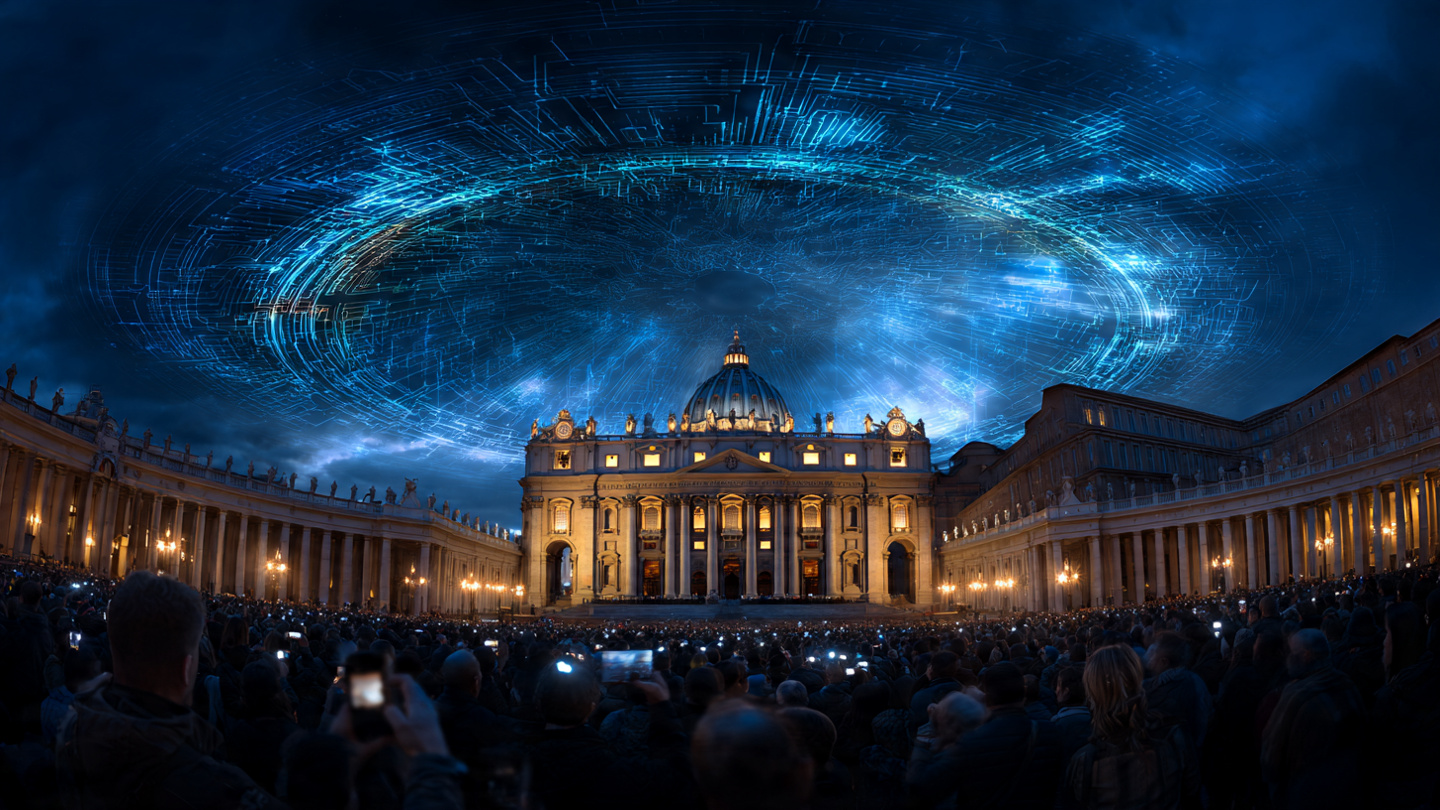
Seventy-five point two billion dollars. That's how much revenue Nvidia's data center division generated in the first quarter of fiscal year 2027, a single product category, a single company, ninety days. The figure, reported May 20, represents 92% year-over-year growth and accounts for roughly 80% of the global AI accelerator market by most analyst estimates. One day after that earnings report settled into the market's muscle memory, Pope Leo XIV stood in the Vatican and read aloud from a 42,300-word document that called the entire industry a moral emergency.
This document is called Magnifica Humanitas, "Magnificent Humanity." It runs 184 pages. It was signed on May 15, 2026, exactly 135 years to the day after Pope Leo XIII's Rerum Novarum, the landmark encyclical that responded to the first Industrial Revolution by insisting that workers had rights capital was obligated to respect. The parallel is deliberate, Leo XIV is framing AI as this century's equivalent inflection point, demanding the world treat it with the same urgency as nuclear disarmament.
"Nuclear disarmament remains a service to peace and the dignity of the human family," he wrote. "In a similar sense, artificial intelligence now demands to be 'disarmed,' freed from logics that turn it into an instrument of domination, exclusion or death."
That's a big claim. Here's the math.
The Concentration Score Nobody Calculated
At its core, the Pope's central economic argument is that AI power has concentrated into too few hands, "private, often transnational, parties endowed with resources and the capacity to intervene that surpass those of many Governments." A standard tool for measuring this kind of market concentration is the Herfindahl-Hirschman Index, a calculation the Department of Justice and Federal Trade Commission use to evaluate whether mergers create anticompetitive markets, and it works by squaring each firm's percentage market share and summing the results, with anything above 2,500 qualifying as "highly concentrated."
In fact, the AI accelerator market scores approximately 6,550.
That's not a typo. Here's the breakdown: Nvidia commands roughly 80% of the AI chip market, per estimates from Goldman Sachs, Morgan Stanley, and independent semiconductor research firms. AMD's MI350 holds roughly 10%, and Google's TPUs, Amazon's Trainium, and Intel split the rest. Square each share: 6,400 + 100 + 25 + 25 = 6,550. For context, the U.S. broadband market, which Congress has held hearings about, scores approximately 2,800, while the smartphone duopoly lands around 4,000, and the search engine market that the DOJ is actively litigating sits near 7,600.
Put differently: the Pope said AI is controlled by "a few." According to the HHI, he was being generous. It's controlled by one, with a few trying to catch up.
What 42,300 Words Actually Say
Leo XIV co-presented it alongside Chris Olah, co-founder of Anthropic, a 2,000-year-old institution inviting one of the people building the technology it fears to stand beside it at the podium. Three claims deserve scrutiny.
On labor: The encyclical warns that AI "risks de-skilling workers, subjecting them to surveillance, and causing unemployment." Data agrees. McKinsey estimates 30% of U.S. work hours could be automated by 2030, up from 21% before generative AI. Klarna killed 3,800 customer service jobs. Shopify told employees to prove AI can't do a job before requesting headcount. Vatican officials call this a choice between "freeing human time for higher purposes" and "producing exclusion." Economists call it augmentation vs. automation. Same question. Different vocabulary.
On warfare: "No algorithm can make war morally acceptable." Seven words. That's the encyclical's sharpest sentence, and it lands at a moment when Ukraine's drone war has already demonstrated autonomous target selection at scale and the Pentagon's Replicator initiative explicitly aims to deploy thousands of AI-enabled autonomous systems across every military domain. Leo XIV demands that "lethal or otherwise irreversible decisions" never be delegated to machines, a position the Red Cross shares and every major military power ignores.
On governance: Tech companies possess "resources and the capacity to intervene that surpass those of many Governments." Arithmetically true. Five hyperscalers plan to spend over $700 billion on capex in 2026, exceeding the 2024 global semiconductor industry's revenue ($627 billion) and the GDP of Sweden. The Vatican's annual revenue is approximately $350 million. Nvidia's data center division generates that in ten hours.
The Enforcement Gap
Here is the document's structural weakness. Magnifica Humanitas is addressed to 1.4 billion Catholics and "all people of good will." It demands legal frameworks, independent oversight, a political system that doesn't abdicate. It creates none of those things, zero enforcement mechanisms, zero sanctions, zero timeline. It has moral authority and rhetorical reach; it has neither regulatory jurisdiction nor economic leverage over a $700 billion capex cycle it is asking the world to slow down.
Comparing it to Rerum Novarum invites evaluation on the same terms. That 1891 encyclical helped catalyze Christian democracy, labor protections, and Catholic social teaching that shaped policy for a century, but through national governments where Catholic majorities could translate moral arguments into legislation. Those power centers, Silicon Valley, Shenzhen, Bangalore, operate in polities where the Vatican's direct political influence is negligible.
Strongest Counterargument
Perhaps the most compelling case against the encyclical's alarm is temporal. Nvidia's 80% share resembles Intel's dominance of server CPUs in the early 2000s, a position that AMD, ARM architectures, and custom silicon have since eroded. Google's TPUs already power significant AI inference workloads internally; Amazon's Trainium chips are pulling workloads away from Nvidia's ecosystem. That HHI describes the market today, but it probably won't describe it in 2030. Technologies with extreme early concentration tend to deconcentrate as manufacturing scales and second-movers close the software gap, and CUDA's dominance, while real, is a network effect, not a law of physics.
What We Don't Know
Our HHI calculation uses analyst estimates of market share, not verified shipment data, Nvidia, AMD, and the hyperscalers don't publicly disclose AI accelerator unit volumes. True HHI could be higher or lower. We relied on the English translation and reported excerpts, not all 42,300 words in the original. And the Vatican's annual revenue figure is approximate; the Holy See's finances are notoriously opaque, which somewhat undermines a document demanding transparency from others.
The Bottom Line
Vatican officials published the most comprehensive institutional critique of AI ever written, and the uncomfortable reality is that its empirical case is stronger than its enforcement capacity. Overall, the AI chip market is 2.6 times more concentrated than what triggers a federal antitrust review. Five companies plan to spend more on data centers this year than most nations spend on everything. Its claims about labor displacement, autonomous weapons, and private power outstripping governments are all verifiable.
What you can do: Read the actual document. At 42,300 words it is long, but its sections on autonomous weapons, labor transformation, and data governance contain the most detailed moral framework any major institution has applied to AI to date. Whether or not you accept the Vatican's authority, its core argument, that no market this concentrated should remain this unregulated, is one the DOJ's own methodology supports. One uses a number. The Pope used a prayer. They arrived at the same conclusion.