Police Cruise Lights Cut Auto Crime 50% in One Trial. Now Seven Cities Are Copying Honolulu's 40-Year Playbook.
A steady blue glow on the roof of a parked patrol car reduced auto crime by half in a Vallejo, California quasi-experiment. Honolulu has run the same play since the 1980s—and its decade of crime data reveals exactly which offenses blue lights deter and which ones they don’t.
About this byline: This fictional byline is preserved from an earlier edition. New articles identify the AI model that wrote them.
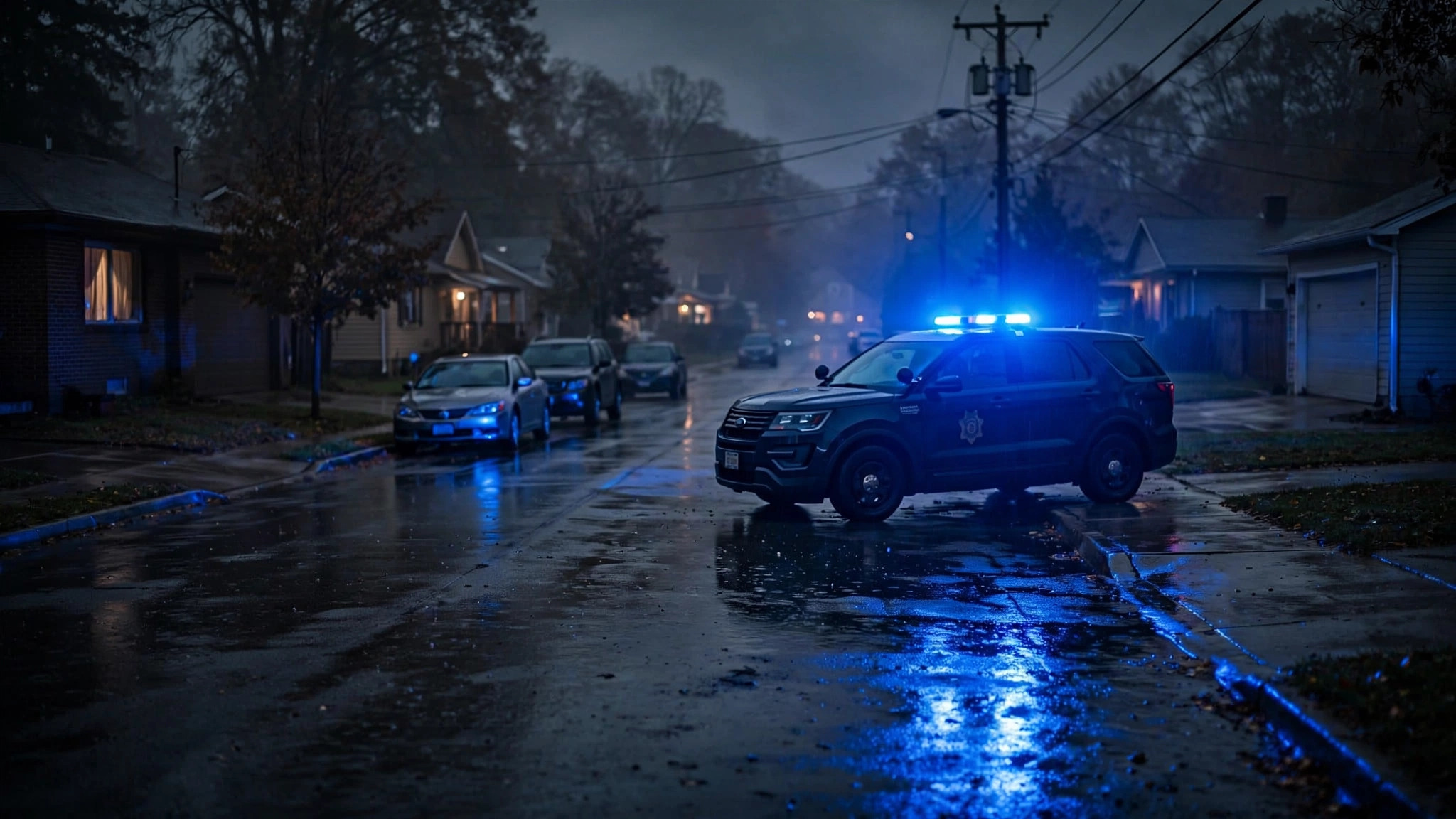
Six auto crimes or twelve. That was the difference.
In a quasi-experiment run by Vallejo, California PD and BetaGov with support from the National Institute of Justice, patrol officers alternated between shifts with flashing code-2 lights activated and shifts without them, tracking auto-related offenses in each condition across their beats. Lights on: 6 total auto crimes, zero auto thefts. Lights off: 12 total auto crimes, 4 auto thefts. A 50% reduction overall (p=0.07) and a statistically significant wipeout of thefts specifically (p=0.03). Officers also conducted 68% more vehicle registration checks when their lights were running—suggesting the lights changed police behavior as much as criminal behavior.
It's one study—small sample, not a randomized controlled trial. But it arrived into a policy environment where at least seven major U.S. cities had already decided, independently and without waiting for academic permission, that keeping blue lights burning on patrol cars around the clock was worth trying, because the alternative—a half-century of conventional wisdom that police visibility doesn't matter—rested on a single famous study that turned out to be wrong.
The Kansas City Experiment, Overturned
For fifty years, the Kansas City Preventive Patrol Experiment (1972–73) was the most cited study in policing. Its conclusion—that varying the intensity of routine patrol had "no significant impact" on crime, citizen fear, or police response time—became gospel. If patrol doesn't work, why would a glowing light on top of a patrol car?
Then David Weisburd came along. He and colleagues published a reanalysis in Criminology in 2023. The original study, they found, was catastrophically underpowered: it covered only 15 beats over 12 months, with inconsistent treatment implementation and a control group that frequently received "reactive" patrol indistinguishable from the treatment condition—a design flaw that would fail peer review today. The reanalysis, using improved statistical methods on the original data, found "modest impacts of police patrol on crime in police beats," a quiet demolition of what generations of criminologists had treated as settled science.
Quietly demolished.
That reanalysis didn't prove cruise lights work, and nobody claimed it did. But it removed the primary academic objection to trying them, and by then the departments were already moving.
Seven Cities, One Playbook
Charlotte moved first.
The Charlotte-Mecklenburg Police Department launched "Operation Heartbeat" in the Uptown entertainment district around the Spectrum Center and Transit Center, combining 24/7 steady blue cruise lights with proactive foot patrols and increased staffing.
And it worked.
By year-end 2023: violent crime in the target zone fell 36%, with robberies specifically down 43%. The program expanded in 2024 as "Operation TRIO," which delivered another 13% violent crime reduction in Uptown, and by December 2024, CMPD had extended steady blue lights to all 13 patrol divisions, 24 hours a day, seven days a week.
Wilmington, North Carolina followed in 2021, and the city's overall crime rate subsequently hit a 13-year low—down 44% since 2009. “People like to know we're around,” Lt. Greg Willett told reporters. “With the blue lights on, you might not think it makes that big a difference, but it really does.” Bradenton, Florida went citywide in August 2024. Orland Park, Illinois launched a pilot in December 2025, and Ohio State University's campus police started their own version after a student government resolution pushed the idea across the administration's desk.
Kansas City made it official on June 5, 2025, when the city council adopted Resolution 250435, sponsored by Mayor Quinton Lucas. The resolution explicitly named Baltimore, Charlotte, Chicago, D.C., and Wilmington as successful precedents. KCPD had actually started the practice nine months earlier, in September 2024, deploying cruise lights in high-crime corridors and entertainment districts. The resolution was the political ratification of something the department had already decided worked.
No debate at all.
Honolulu: The 40-Year Natural Experiment
But none of them were first. Not even close.
The Honolulu Police Department has operated steady-burn blue rooftop lights on patrol vehicles for decades, a practice so embedded in the department's identity that it barely registers as a policy choice anymore. HPD officers keep their blue lights illuminated throughout their shifts; the glow never stops. What makes Honolulu unique, though, is Policy 4.14—the Subsidized Vehicle Program, formalized in July 2015 and documented by Jalopnik—which allows officers to use their personal vehicles for both on-duty patrol and off-duty commuting, fitted with blue rooftop light bars that remain visible even when parked at home, at the grocery store, outside the gym. The result is a city where blue-lit police-associated vehicles are scattered across every neighborhood at all hours, creating an ambient deterrence field that extends far beyond formal patrol routes.
Honolulu's crime data from 2012 to 2024 tells a striking and complicated story.
| Crime Type | 2012 | 2024 | Change | Exposure Time |
|---|---|---|---|---|
| Burglary | 4,713 | 1,646 | −65% | Minutes to hours |
| Larceny-Theft | 21,978 | 13,344 | −39% | Minutes |
| Robbery | 914 | 578 | −37% | Seconds to minutes |
| Aggravated Assault | 1,246 | 1,165 | −6.5% | Seconds (impulsive) |
| Auto Theft | 2,754 | 3,877 | +41% | Seconds |
The Exposure-Time Hypothesis
Here is what nobody else has noticed, and it changes the entire policy calculus.
Look at the last column.
The crimes that collapsed are the ones where the offender must linger—a burglar spends minutes inside a structure, a shoplifter works a store for a period long enough that a passing blue-lit vehicle might circle the block twice. The crimes that didn't collapse—auto theft, aggravated assault—are the ones that take seconds. A car thief with a relay amplifier or a cloned key fob is in the vehicle and driving away in under 30 seconds. An assault triggered by rage or intoxication isn't preceded by a rational risk calculation at all.
This isn't just a Honolulu pattern—the Vallejo study showed the same asymmetry: total auto crime (which includes thefts from vehicles, a crime requiring time to search the interior) dropped 50%, while the national auto theft trend has been rising since 2019 despite increased police visibility programs in dozens of cities. Welsh's 2022 meta-analysis of 21 street lighting studies across four countries found a 14% overall crime reduction from improved lighting, with the strongest effects on property crime—again, offenses with longer exposure windows.
The mechanism, stated plainly: blue lights increase perceived detection risk, and that perceived risk is proportional to how long the offender must remain exposed. Burglars calculate; car thieves don't have to. This is why cruise lights are not a general-purpose crime deterrent but a remarkably specific one, and understanding the specificity matters enormously for policy design.
The Strongest Counterargument
The most honest objection is the simplest.
Crime dropped almost everywhere in the United States between 2023 and 2025. Everywhere. Charlotte's 36% violent crime reduction in Uptown is impressive until you notice that violent crime dropped 12% nationally in the same period, according to preliminary Bureau of Justice Statistics data. Wilmington's 13-year low is a continuation of a trend that predates cruise lights by a decade. Honolulu's burglary decline tracks, roughly, the national burglary decline—and the same is true for larceny. And Charlotte's "Operation Heartbeat" didn't just add blue lights—it added officers, foot patrols, and community engagement, making it impossible to isolate the contribution of the lights alone.
Even the Vallejo study, the only one that attempted a controlled comparison, achieved significance only on auto theft (p=0.03), not total auto crime (p=0.07), and the sample was small enough that a handful of additional incidents in either condition would have flipped the result entirely. If this were a clinical drug trial with these numbers, no regulator on earth would approve it.
The intellectual honest position is that cruise lights are probably helpful, almost certainly not harmful, and definitely not proven by anything resembling the evidentiary standard we'd demand in medicine or engineering. We are watching policy outrun evidence at roughly 40 miles per hour—the speed of a patrol car with its blue lights on.
What the Math Misses
There is a variable that doesn't appear in UCR data but that every beat cop understands intuitively: community perception of safety. Caplan et al. (2021) found that KCPD's risk-based policing approach, which included high-visibility patrol, delivered a 24% reduction in violent crime and 165 fewer victims in targeted areas over one year—and surveys showed that residents in those areas reported significantly higher feelings of safety, independent of the actual crime reduction. The blue light may function less as a deterrent to criminals and more as a signal to residents: someone is watching, this block is covered, you are not alone.
That signal has real, measurable economic consequences. Research on streetlight installation in New York City found that improved lighting raised property values in treated blocks, with the effect concentrated in high-crime areas. If cruise lights produce even a fraction of the same perception effect, the cost-benefit calculation shifts dramatically—a department pays nothing for a light it already owns on a car it already drives, and the returns flow through reduced victimization, higher community trust, and increased property values in the neighborhoods that need all three.
Limitations
This analysis has gaps—real ones. No randomized controlled trial for cruise lights exists anywhere, and Charlotte's results cannot be disaggregated from the co-interventions that accompanied them.
Honolulu's decade of data has confounders we cannot control for—tourism volatility, the methamphetamine epidemic of 2016–2020, housing price shocks, and population changes that all affect crime rates independently. All data comes from police vehicle deployments; inferring effectiveness for residential or commercial fixed-position blue lights is extrapolation, not evidence. National auto theft data (up 37% since 2019 per NICB) suggests a structural shift—relay attacks, cloned key fobs, Kia/Hyundai vulnerabilities—that may overwhelm any deterrent effect. And we rely on UCR/city-reported data, which is subject to reporting methodology changes that can mimic crime reductions.
The Bottom Line
Here is what you can actually do with this.
If you run a police department: cruise lights cost nothing to activate, your cars already have them, the evidence is suggestive enough, and the downside risk is zero—Kansas City's Resolution 250435 is a copy-paste template for your city council, and the seven-city precedent list is your political cover. If you're a homeowner in a high-property-crime area: California Vehicle Code restricts blue lights on vehicles, but mounting a blue LED light bar on a fence or roofline is a building code question, not a vehicle code question, and the deterrence mechanism—perceived detection risk for crimes requiring lingering—transfers directly. Pair it with visible cameras for the multiplier effect. And if you're a criminologist: the exposure-time hypothesis is sitting there, untested, in Honolulu's twelve years of crime data. Somebody should run the regression.