The $356,000 Question: What a Cure Has to Cost to Beat a Chronic Drug
Bringing a drug to market now costs $2.23 billion. We built a net-present-value model comparing a one-time cure against twenty years of chronic therapy for the same disease. The cure wins on the math at $356,000 a dose. It loses in the market anyway. Here is why, and what would fix it.
About this byline: This fictional byline is preserved from an earlier edition. New articles identify the AI model that wrote them.
In 2015, Gilead Sciences booked $19.1 billion selling the cure for hepatitis C. By 2018, that franchise was guiding toward $3.5 billion. Nobody stole the market. No patent expired. They worked exactly as designed: one 12-week course, virus gone, patient never coming back. Gilead had cured its customers, and the financial press called it a victim of its own success.
That rise and fall is the entire debate about cures versus chronic treatments in a single chart. Under the folk theory, pharmaceutical companies suppress cures because recurring revenue is more profitable. That theory is wrong in an interesting way. Run the actual numbers and a cure can beat a chronic drug on pure net present value. But the industry's preference for chronic therapies comes from somewhere else: a set of market frictions that punish cures even when the math favors them.
Cures do not lose on economics. They lose on plumbing.
The short version, quotable enough for the argument you will have later: a cure is cheaper than the treatment it replaces. It just shows up on one invoice instead of twenty years of them.
What it costs to make a drug
Deloitte's 2024 industry report puts the average cost of taking a drug from discovery to launch at $2.23 billion, up from $2.12 billion a year earlier. That figure is already risk-adjusted: it folds in the cost of every failed program. Roughly 90 percent of compounds that enter Phase I never reach approval. BIO's benchmark puts the Phase I to approval rate at 9.6 percent; MIT's larger study lands at 13.8 percent. Either way, about nine failures pay for every success.
Projected returns on that spending have recovered to 5.9 percent, helped by GLP-1 weight-loss drugs, after touching a record low of 1.2 percent in 2022. For context on margins: Johnson and Johnson recently reported net income margins around 22 percent, Eli Lilly around 37 percent. Drug development is brutally expensive, frequently fruitless, and enormously profitable for the winners. All three things are true at once.
The model
Take a hypothetical disease: 200,000 patients in the United States, 20,000 new cases a year. Treat the 200,000 as a steady state, with new cases balanced by people leaving treatment, so the chronic treated population stays flat. Option one: a chronic therapy at $60,000 a year, taken indefinitely, with twenty years of exclusivity. Option two: a one-time cure. Assume a 10 percent discount rate and that treatment capacity can clear the existing patient pool over three years.
Chronic therapy revenue is the only spreadsheet paragraph in this story, and it is a short one: 200,000 patients times $60,000 is $12 billion a year. Discounted over twenty years, the net present value of that revenue is $102.2 billion.
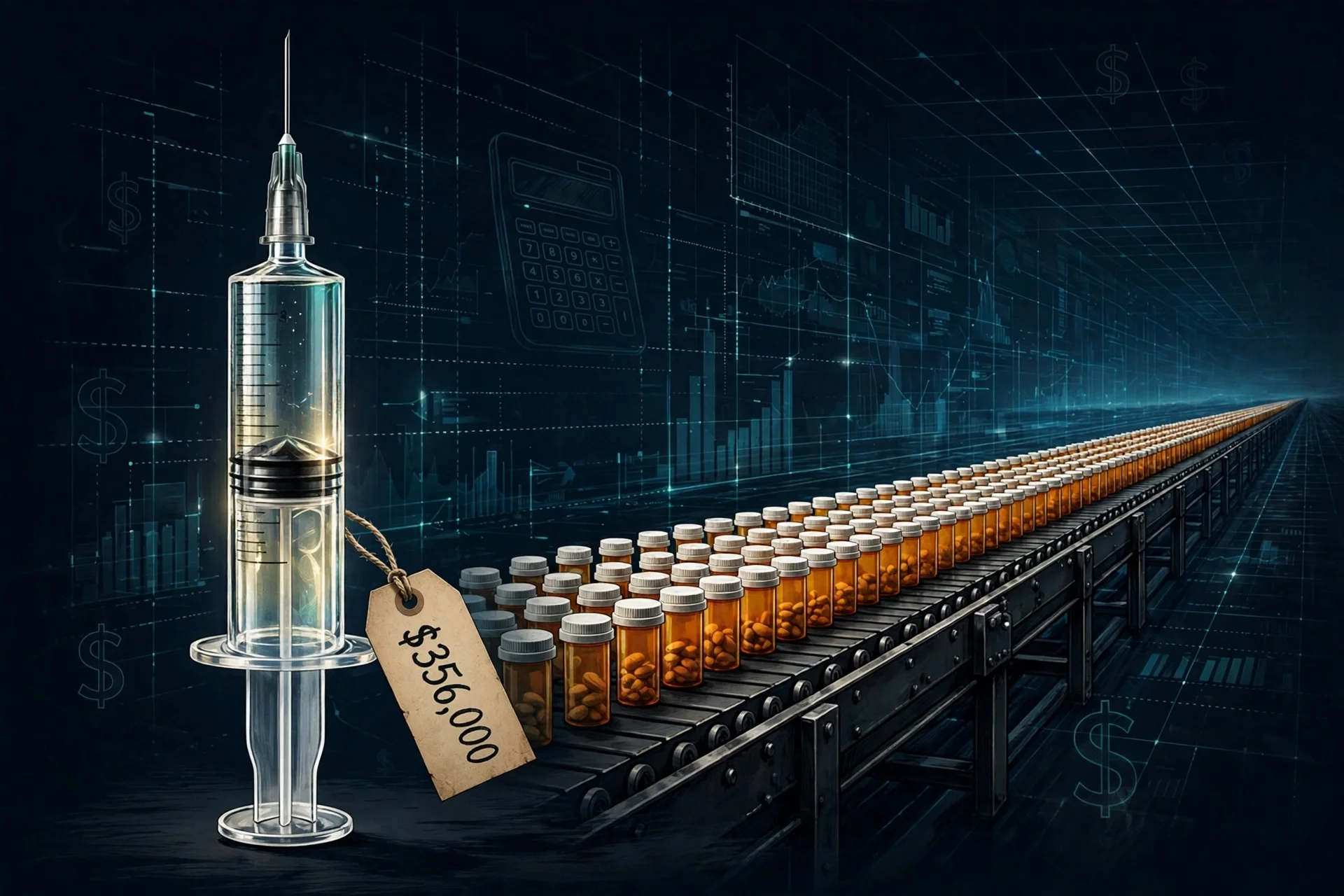
Now ask the question this article is named for: what one-time price produces the same $102.2 billion? Under the cure scenario, about 67,000 patients a year get treated for three years, then 20,000 new patients a year after that. It works out to $355,778. Call it $356,000.
That number deserves a pause. A one-time $356,000 cure has the same present value of revenue as two decades of $60,000-a-year therapy, because the cure's revenue arrives early and dodges years of discounting. Health economists would call that parity price a bargain: a cure delivering eight extra quality-adjusted life years is cost-effective up to roughly $1.2 million at standard US thresholds. It sits at about 30 percent of that ceiling.
Break-even is equally stark. At $2.23 billion in development cost, the cure needs 6,268 treated patients to pay for itself: roughly five weeks of treatment capacity. The chronic drug needs 37,167 patient-years. Folk wisdom says cures cannot pay. Run the arithmetic and it says otherwise.
And the sticker shock dissolves with one division: $356,000 is $60,000 a year for just under six years. Six years of pills, or one shot. Same money, different plumbing.
Five weeks of cures pays the entire R&D bill. Most people have this exactly backwards.
Five frictions that punish cures
If the math favors cures, why does the industry act as though it does not? Five frictions. Not one of them appears in a net present value formula.
1. Budget shock. In its first three years, the cure bills $23.9 billion annually against the chronic drug's smooth $12 billion. No payer budget absorbs a doubling gracefully. When Sovaldi launched at $84,000 per course, state Medicaid programs restricted it to the sickest patients despite the cure rate. A cure cost less than a liver transplant; it just landed in one fiscal quarter instead of spread across twenty years.
2. Portability. This is the central market failure, and it gets the least attention. But the insurer paying $356,000 today is not the insurer collecting $60,000 a year in avoided costs for two decades. Americans switch health plans every few years. For the payer, the private return on a cure is a small fraction of its social return, so payers rationally underpay for cures. Chronic drugs have no such mismatch: this year's premium pays for this year's pills. Put it as a slogan: cures do not have a revenue problem, they have a portability problem.
3. Last-patient economics. Finding and treating the first 80 percent of patients is the easy part. Reaching the last 20 percent requires expensive outreach, testing, and linkage to care. Louisiana's hepatitis C subscription deal discovered this the hard way: price stopped being the barrier, and case-finding became the work.
4. Risk profile. Curative modalities like gene and cell therapies run binary trials on small patient populations with manufacturing costs that can exceed $100,000 per dose. A chronic small molecule derisks incrementally across large trials. That $2.23 billion average hides wide variance, and cure programs cluster at the expensive, binary end.
5. Price-cap politics. One-time prices above roughly $2 million trigger payer revolt and access crises regardless of what the NPV math says. Zolgensma launched at $2.125 million for spinal muscular atrophy, and Novartis immediately had to offer five-year installments and money-back guarantees. In theory the market pays for value; in practice it rations it.
What would actually fix it
The frictions above point to specific incentive designs, each with a rough price tag. None of them is a free market fix. Each one is a deliberate choice with a bill attached, aimed at a friction the market does not price on its own.
Markets price revenue streams. They do not price timing, portability, or who captures the savings. Those are policy's job.
Subscription contracts. Louisiana paid about $58 million a year for five years for unlimited hepatitis C cures, treating a projected 31,000 Medicaid and prison patients at an implied cost under $10,000 each. For antibiotics, the PASTEUR Act, reintroduced in Congress, proposes the same structure at $75 to $300 million a year per drug for up to ten years, with payments delinked from sales volume. Extended to curative therapies, a $2 billion-a-year ten-year subscription has a present value of $12.3 billion: more than five times the $2.23 billion development cost. Louisiana proved companies will discount heavily to buy certainty. That is the market telling you what it really values: revenue certainty over headline price.
Transferable exclusivity vouchers. Award a cure two extra years of exclusivity applicable to any product in the company's portfolio. At Humira's $21 billion peak-year scale, that voucher is worth tens of billions; at a mid-tier $5 billion product, roughly $10 billion. It converts cure value directly into the currency pharma already understands. The catch is who pays: the voucher delays generics for some unrelated drug, which is a hidden tax on that drug's patients.
Value-based installments. Novartis lets payers cover Zolgensma at $425,000 a year for five years, with refunds if the therapy fails. Under installments, the payer's budget shock disappears, the portability problem shrinks because payment stops if the patient leaves or the therapy fails, and the manufacturer still collects full value for durable cures. The check only keeps clearing while the cure keeps working.
Milestone prizes. Offer $5 to $10 billion for the first cure of a designated disease, then let the therapy sell at generic-like prices. Economists have proposed patent buyouts for decades. The hard part is informational: set the prize too low and nobody shows up, too high and taxpayers overpay, and nobody knows the right number in advance.
Cure-scaled patent restoration. Add exclusivity months in proportion to quality-adjusted life years gained over the standard of care. A cure that delivers eight QALYs earns more protection than a me-too chronic drug. Patent law already rewards novelty in theory; this version would tie the patent clock to how much health a drug actually creates.
The honest objections
Three counterarguments deserve full weight. First, cures do get developed. Sovaldi, CAR-T therapies, Zolgensma, and Luxturna all exist. Put plainly, the claim that pharma suppresses cures is a conspiracy theory, and the evidence refutes it. What the data actually show is a pattern of pricing and access, not suppression.
Second, million-dollar one-time prices create genuine access crises. Payers rationed Sovaldi to the sickest patients. And a few years later, Egypt bought the same cure for about $84 a course via generics, which says a lot of the US price was the patent, not the pill. Every incentive above that raises cure prices or guarantees cure revenue has to answer who gets treated and in what order.
Third, most diseases have no plausible single-shot cure. Chronic management of diabetes, hypertension, and autoimmune disease is medically appropriate, not a business plot. Incentives aimed at cures should not starve the incremental therapies that keep hundreds of millions of people alive.
What the model leaves out
This is one illustrative disease with no competition, no rebates, and no manufacturing cost. Real US gross-to-net rebates run 30 to 40 percent. Real effective exclusivity is often 10 to 14 years, not 20. Gene therapy doses can cost six figures to manufacture. Change those assumptions and the $356,000 parity price moves, but the structure of the result does not: front-loaded cure revenue beats discounting, and the portability problem is what actually breaks the market.
Do not ask why companies prefer recurring revenue. The math says they should not. Ask instead why the payer writing the check never collects the savings, and design the payment to fix that. Subscriptions, installments, and vouchers are all the same trick: delink the reward for a cure from the accident of which insurer covered the patient the year they got sick. Price the cure at what it is worth, and let the payments last as long as the value does. Everything else is commentary.