Peak Energy’s Real Innovation Isn’t Sodium. It’s the $88/kWh Refrigeration Tax Nobody Calculated.
America’s first sodium-ion grid battery factory claims 20% cost savings. Run the full 20-year lifecycle math and the real number is $88 per kilowatt-hour in eliminated refrigeration costs, upfront and operational combined. That closes 60% of the $146/kWh gap between American and Chinese battery systems. Not from a new chemistry. From removing the air conditioning.
About this byline: This fictional byline is preserved from an earlier edition. New articles identify the AI model that wrote them.
Everyone led with the chemistry. When Peak Energy announced it had selected Sacramento for America’s first dedicated sodium-ion grid battery factory, the coverage followed a familiar script: sodium replaces lithium, supply chains decouple from China, 239 workers in Metro Air Park build the batteries that free the grid from Beijing’s mineral chokehold. All of that is true, and none of it is the interesting number.
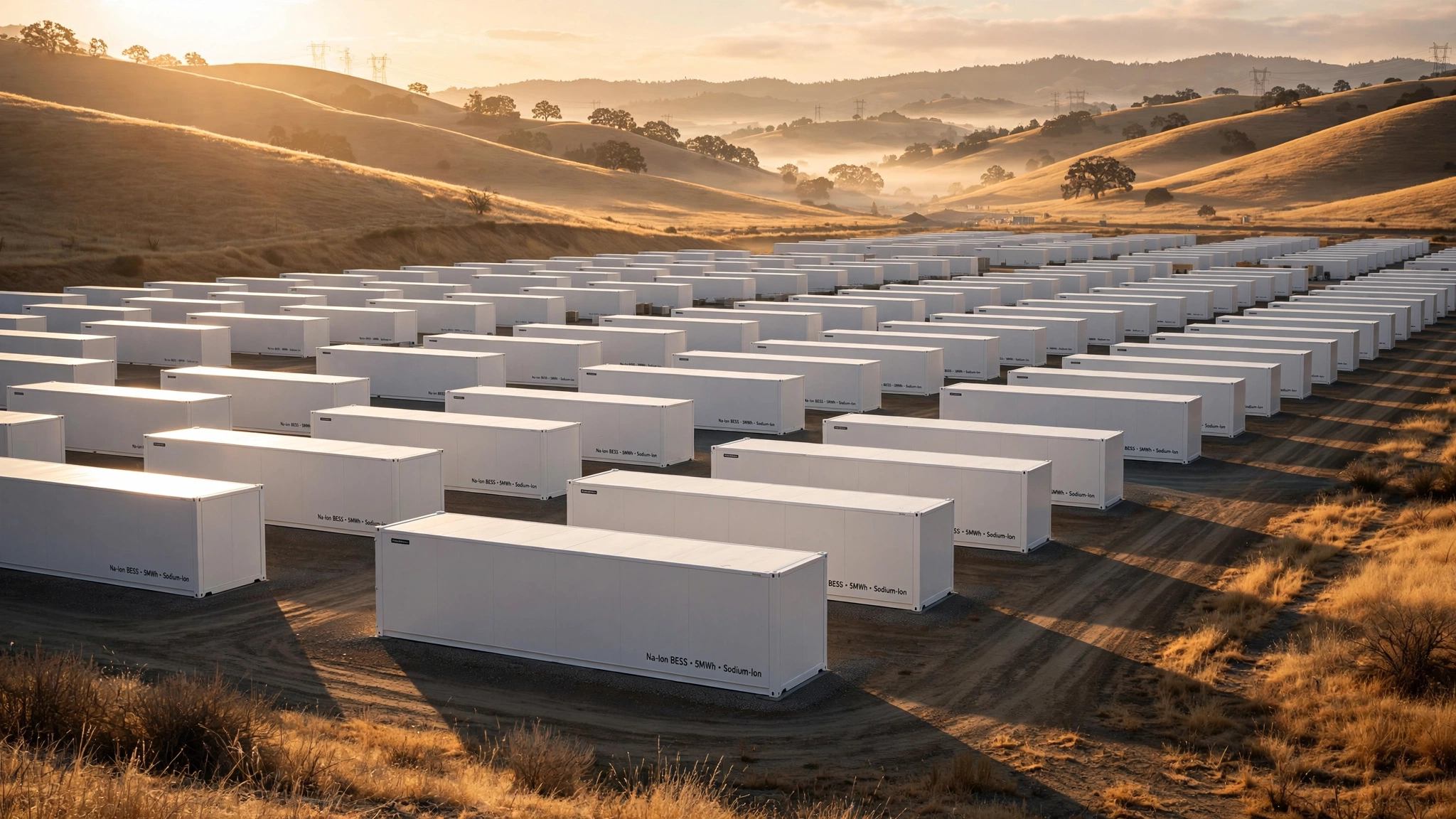
Peak’s 183,000-square-foot factory will produce 4 gigawatt-hours of battery systems annually, backed by $71 million in capital investment, a $10.5 million CalCompetes tax credit, and a GM Ventures strategic partnership that pairs GM’s next-generation sodium-ion cells with Peak’s proprietary storage platform. First shipments begin Q1 2027, and customer commitments already exceed factory capacity at 6 GWh, with deals signed with Jupiter Power, Energy Vault, and RWE Americas.
Buried in Peak’s press release is a claim that deserves more scrutiny than it received: their passively cooled systems “reduce the cost of energy storage by 20%.” In an industry where the US-China cost gap runs $146 per kilowatt-hour, that percentage hides something far more revealing once you extend it across a battery’s full operational life.
The 20% Claim in Actual Dollars
BloombergNEF’s 2024 Energy Storage System Cost Survey pegged US turnkey battery system prices at $219 per kilowatt-hour, compared to $73 in China and $177 in Europe, capturing the fully installed, grid-connected cost that includes inverters, enclosures, wiring, commissioning, and thermal management. Apply Peak’s 20% to the American number and you get $43.80 per kilowatt-hour shaved off the upfront cost, which for a utility deploying a standard 100 MW / 400 MWh project translates to $17.5 million in day-one savings before the first electron cycles through. A solid procurement win, but one that measures only what you pay when the system arrives on a truck.
The Refrigeration Tax
Grid-scale lithium-ion batteries generate substantial heat when they charge and discharge, and keeping cells outside their thermal window degrades capacity, shortens cycle life, and multiplies warranty claims. Every utility-scale installation in America runs industrial HVAC, fan arrays, liquid cooling loops, or some combination of the three, continuously, for the full 20-year operational life of the asset.
Peak’s press release includes a second figure that sailed past most coverage: “In California alone, eliminating battery refrigeration costs could save ratepayers an average of $100 million annually.” California’s battery storage fleet has reached approximately 11.4 GW on the CAISO grid, concentrated in 4-hour duration systems totaling roughly 45.6 GWh of installed capacity. Divide $100 million by 45.6 million kilowatt-hours and you get $2.19 per kilowatt-hour per year in HVAC operating costs: electricity to run compressors, maintenance contracts on cooling loops, filter replacements, refrigerant charges, and technician truck rolls, every year, for two decades.
Multiply $2.19 by 20 years: $43.86 per kilowatt-hour in lifetime refrigeration expenses that a passively cooled system never incurs.
The Full Lifecycle Math
| Cost Component | Savings ($/kWh) |
|---|---|
| Upfront system cost reduction (20% of $219) | $43.80 |
| Lifetime HVAC operating cost elimination (20 yrs × $2.19) | $43.86 |
| Total lifecycle savings from passive cooling | $87.66 |
Call it $88 per kilowatt-hour, earned not by switching lithium to sodium (which at current cell prices is roughly a wash) nor by tariffs, subsidies, or trade policy, but by removing the air conditioning. Frame that against the chasm separating American and Chinese battery manufacturing: $219/kWh versus $73/kWh, a gap of $146/kWh. Passive cooling closes 60% of that gap over a 20-year lifecycle, meaning more than half the cost advantage that makes Chinese batteries cheaper than American ones traces, at its thermal root, to a refrigeration tax that American grid operators have been paying without ever isolating it as a line item.
The Counterargument Is Already Shipping
CATL’s TENER sodium-ion system, unveiled at Intersolar Munich in June, already achieves 1% auxiliary power consumption through a top-discharge airflow architecture that cuts internal heat generation by 30%. Chinese domestic deliveries started in late 2025, and global shipments begin in 2027, the same quarter Peak’s Sacramento factory plans to ship its first units.
If China adopts passive cooling across its fleet, the relative cost gap between American and Chinese systems does not narrow; it stays exactly where it was, because passive cooling is an engineering approach, not a patent, and any manufacturer with competent thermal engineers can replicate it. But the absolute savings from passive cooling are larger in the US, where electricity costs $0.12 to $0.18 per kilowatt-hour for commercial users versus roughly $0.08 in Guangdong, and where HVAC maintenance labor runs two to three times the Chinese rate. Over 20 years, a US operator saves approximately $44/kWh in eliminated cooling costs while a comparable Chinese facility saves closer to $28/kWh, which means passive cooling closes the gap asymmetrically even if both sides adopt it simultaneously.
4 GWh Against a 338 GW Pipeline
Peak’s factory produces 4 GWh per year at full capacity, against a global data center project pipeline that Bernstein pegged at 338 GW in June, with US capacity projected to reach 110 GW by 2030 from 24 GW today according to Wood Mackenzie. Even if only 10% of new capacity requires co-located battery storage at 4-hour duration, that represents 34.4 GWh of demand, requiring more than eight Peak-sized factories running simultaneously just to serve the data center slice of the market.
For the broader US grid storage buildout, the country needs 30 to 50 Peak-sized factories — $2.1 to $3.6 billion in investment. Whether manufacturing can scale from one factory to thirty before Chinese sodium-ion imports fill the gap is what $71 million in Sacramento does not answer.
What $88 Per Kilowatt-Hour Means
Peak Energy’s announcement matters, but not for the reason headlines suggest. Sodium-ion chemistry is necessary for supply chain independence from China’s mineral refining dominance — 70% of lithium processing, 96% of graphite, 78% of cobalt — and without it there is no domestic battery supply chain that avoids Chinese refineries. But the cost story is simpler: American grid batteries are expensive in part because they are air-conditioned, with compressors running in the desert, coolant circulating through modules that heat up every cycle, and technicians maintaining systems that a passive design eliminates.
At $88 per kilowatt-hour over a battery’s operational life, the refrigeration tax accounts for 60% of the reason Chinese systems are cheaper. It does not require a new element on the periodic table to fix.
If you are evaluating grid storage bids, demand lifecycle cooling cost projections alongside sticker price. BNEF system cost benchmarks do not separate HVAC from total installed cost, defaulting comparison to the wrong metric. State regulators writing procurement standards should require LCOS disclosure rather than $/kWh alone. For investors, thermal design is now a cost differentiator: ask whether the system requires active cooling and what the 20-year HVAC budget is.
Limitations: Peak’s 20% cost reduction and $100 million California savings figures are company claims not independently verified at commercial scale. That 20% may encompass savings beyond HVAC elimination, including reduced system complexity. If Peak’s 20% already incorporates discounted lifetime cooling costs, the upfront and operational savings calculated here may partially overlap. BNEF system-level cost data is from 2024. CATL’s TENER already incorporates partial passive cooling. Actual per-project HVAC costs vary by climate zone, system design, and utilization rate.
Sources
- Peak Energy, “Peak Energy Selects Sacramento to Build America’s First Sodium-Ion Grid Storage Factory,” PRNewswire, July 8, 2026.
- BloombergNEF, “Lithium-Ion Battery Pack Prices Fall to $108 Per Kilowatt-Hour,” December 2025.
- BloombergNEF, “2H 2024 Energy Storage System Cost Survey,” via Energy-Storage.News, December 2024.
- Zaremba, H., “Can Sodium-Ion Batteries Help the U.S. Close the Gap With China?” OilPrice.com, July 12, 2026.
- Visual Capitalist / IEA, “Charted: China’s Grip on Critical Mineral Refining,” May 2026.
- Bernstein Research, Data Center Pipeline Survey, June 2026, via Investors.com.
- Reuters, “US power companies scramble to secure equipment,” July 9, 2026 (Wood Mackenzie data).
- CATL, “TENER Sodium-Ion BESS” launch, Intersolar Europe, June 22, 2026.