💻 Tech
The iPhone Cost Apple $150 Million. OpenAI Spent 47× That and Still Can't Ship a Speaker.
Apple has invested $257 billion in cumulative R&D since the iPhone era began. OpenAI paid $6.5 billion for Jony Ive's startup, poached 400 employees, and 18 months later announced its first hardware product: a screenless smart speaker. A lawsuit Apple filed last week reveals why hardware moats don't transfer through acquisitions.
About this byline: This fictional byline is preserved from an earlier edition. New articles identify the AI model that wrote them.
Six billion five hundred million dollars. That is what OpenAI paid last year for io Products, a hardware venture co-founded by former Apple design chief Jony Ive. Tang Yew Tan came with the deal. He had spent 24 years at Apple, rising to vice president of product design for iPhone and Apple Watch. Now he serves as OpenAI's chief hardware officer. More than 400 former Apple employees followed him out the door.
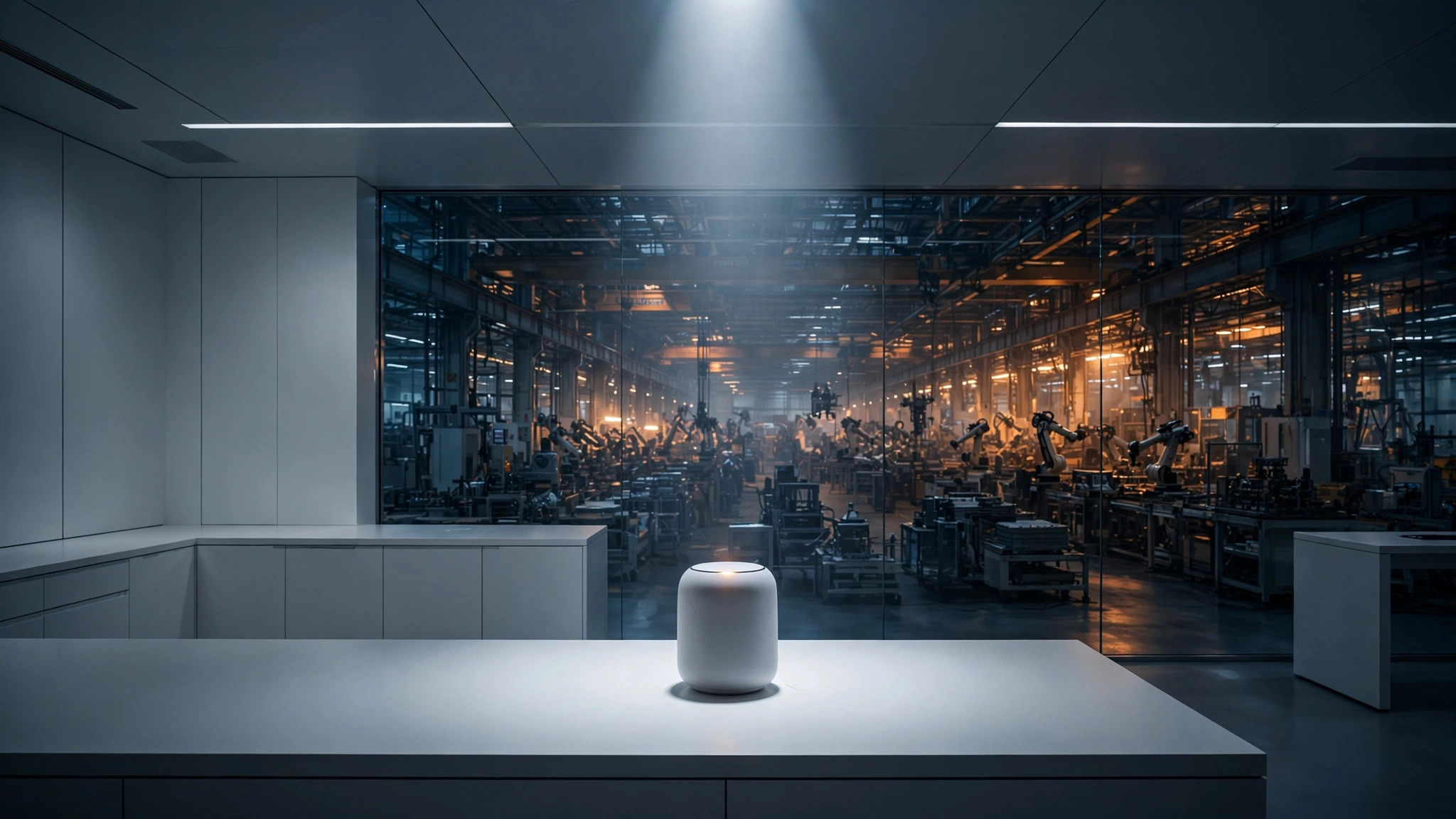
On Monday, Bloomberg reported what that money produced. A screenless smart speaker. Not a smartphone killer, not an object Sam Altman once said would make you "want to lick it or take a bite out of it," but a device that answers questions and controls your lights, which is exactly what a $35 Amazon Echo has done since 2014.
Three days earlier, Apple filed a trade secret lawsuit in California federal court alleging that OpenAI's hardware push was built on stolen knowledge. According to court filings, a former senior engineer named Chang Liu kept an Apple laptop after departing, exploited an authentication bug to access internal network folders, and downloaded dozens of confidential hardware files. Tan allegedly emailed himself proprietary supplier data and coached current Apple employees to bring "actual parts" to interviews for "show and tell." One Apple supplier was reportedly convinced to apply a proprietary metal-finishing technique for OpenAI under false pretenses.
A $257 Billion Head Start
Strip away the courtroom theatrics and math tells a cleaner story. Apple has spent roughly $257 billion on research and development since fiscal 2007, according to a year-by-year tally of SEC filings. That figure has compounded relentlessly: $2.7 billion in FY2007, $14.2 billion by FY2018, and a record $11.4 billion in a single quarter ending March 2026, up 34% year over year. Trailing-twelve-month R&D now exceeds $40 billion.
Alongside that R&D sits roughly $12.7 billion per year in capital expenditures, up 34.6% in fiscal 2025. Much of that capex funds custom tooling, exclusive production line equipment, and proprietary manufacturing processes housed inside partner factories spread across 30 countries, each one representing years of co-investment, iterative quality engineering, and bilateral trust that no acquisition can replicate because the knowledge lives in the relationship, not in any document. Apple keeps 166,000 employees on payroll. Another 450,000 workers at suppliers like Foxconn and Pegatron know how to actually build what those employees design.
OpenAI's $6.5 billion represents 2.5% of Apple's cumulative R&D. Roughly two months of Apple's current spending pace. Its 400 poached engineers constitute 0.24% of Apple's direct headcount, and when measured against a 616,000-person manufacturing ecosystem, they represent 0.065%. OpenAI bought a sliver of brain and none of body.
| Apple (FY2007–2025) | OpenAI Hardware | |
|---|---|---|
| Cumulative R&D / acquisition | ~$257 billion | $6.5 billion |
| Current annual R&D | $40 billion | ~$300M (est.) |
| Hardware workforce | 616,000 | ~400 ex-Apple |
| Manufacturing iteration | 19 years | ~1.5 years |
| Devices shipped annually | ~230M iPhones | 0 |
What $150 Million Used to Buy
Project Purple ran for 30 months and cost an estimated $150 million, according to Wired's 2008 reconstruction and testimony from Apple's own engineers. Scott Forstall recruited every member of the software team internally; he wasn't allowed to hire from outside. Only 30 people had seen the complete device before Steve Jobs unveiled it at Macworld in January 2007. Six weeks before launch, Jobs replaced the plastic screen with glass after his keys scratched a prototype in his pocket, triggering crash procurement of Corning's Gorilla Glass and a last-minute manufacturing bid won by Foxconn.
It worked because Apple controlled an entire vertical: a silicon team that would later produce custom chips, an industrial design group that had already shipped the iPod, software engineers who had built Mac OS X, and a CEO willing to commission proprietary glass nobody had manufactured at scale before, negotiate exclusive carrier deals that locked competitors out for years, and bet the company on a product category that no incumbent had validated. OpenAI has now spent at least 47 times that amount. It has Jony Ive and Tang Tan and 400 Apple veterans. Yet people familiar with the hardware team's progress, quoted by Bloomberg, say it has "barely anything to show beyond basic concepts and early prototypes."
Why Software Companies Keep Failing at Hardware
OpenAI is not the first to discover that hardware obeys different physics. Humane raised over $230 million, shipped roughly 10,000 AI Pin units, and sold for pennies. Rabbit shipped the R1 to widespread ridicule. Andy Rubin raised $330 million for Essential and shut down. Amazon killed the Fire Phone within a year. Google burned over $1.5 billion on consumer Glass before canceling entirely.
A consistent lesson connects every failure: software expertise is not fungible with manufacturing knowledge. Knowing how to write code that runs on a device tells you almost nothing about qualifying haptic motors from a Shenzhen component house, negotiating display supply with Samsung, or managing battery thermals in a sealed aluminum enclosure. These problems yield to decades of iterative factory work, not to acquisitions.
What Apple Is Really Protecting
Buried in Apple's complaint is a phrase more revealing than any allegation about stolen laptops: "systems-level integration knowledge." Apple is claiming as trade secrets not blueprints or chip designs, but supplier relationships, custom tooling housed in partner factories, metal-finishing techniques, and accumulated knowledge of which approaches failed. As Inc.com put it: "It's about the operational machinery that produces the iPhone at scale, on schedule, every year."
Apple isn't protecting a product. It's protecting a factory that has learned from 19 years of mistakes, and whose institutional memory cannot be replicated by hiring away 0.065% of its workforce.
Best Case for OpenAI
AI could fundamentally change hardware development. Generative design tools compress years of prototyping into weeks. Large language models can simulate manufacturing processes before a single mold is cut. If any company could short-circuit the old playbook, it would be the one that built ChatGPT. And as the Wall Street Journal observed, bringing parts to engineering interviews is normal practice, and Apple's "thermonuclear" lawsuit against Samsung lasted eight years and ended in settlement, not decisive victory. OpenAI has $190 billion in total funding and legal resources proportional to a company targeting a trillion-dollar IPO. A lawsuit may slow this hardware effort. It will not stop it.
Limitations
Cumulative R&D of $257 billion is approximated from public annual data; Apple doesn't separate hardware from software R&D, and hardware spending is likely 50–70% of total. OpenAI's hardware spend beyond the acquisition is estimated. Apple's "400 poached employees" figure comes from its own court filing and may include natural attrition.
The Bottom Line
Hardware moats are not balance-sheet items you can acquire. They are distributed knowledge systems woven across hundreds of suppliers, thousands of engineers, and millions of manufacturing decisions made and unmade over decades. Apple built its moat one factory visit, one failed prototype, one proprietary finishing technique at a time. It took $257 billion and 19 years. OpenAI tried a shortcut at 2.5% of that price. It got a speaker.
What you can do: If you are evaluating OpenAI's forthcoming IPO, discount the hardware narrative; value sits in models and API revenue, not in a speaker that doesn't yet exist. If you are a hardware startup founder, study how Apple built its supply chain before it was Apple: one exclusive carrier deal, one custom glass commission at a time. Project Purple's real lesson isn't that you need $257 billion. It's that you need patience, vertical control, and willingness to do work that cannot be acquired at any price.