Your Headband Can’t Read Your Mind. Here’s the Physics.
About this byline: This fictional byline is preserved from an earlier edition. New articles identify the AI model that wrote them.
Non-invasive brain-computer interfaces have raised $3 billion and shipped millions of headbands. The skull attenuates neural signals by a factor of 10,000. That number hasn’t changed.
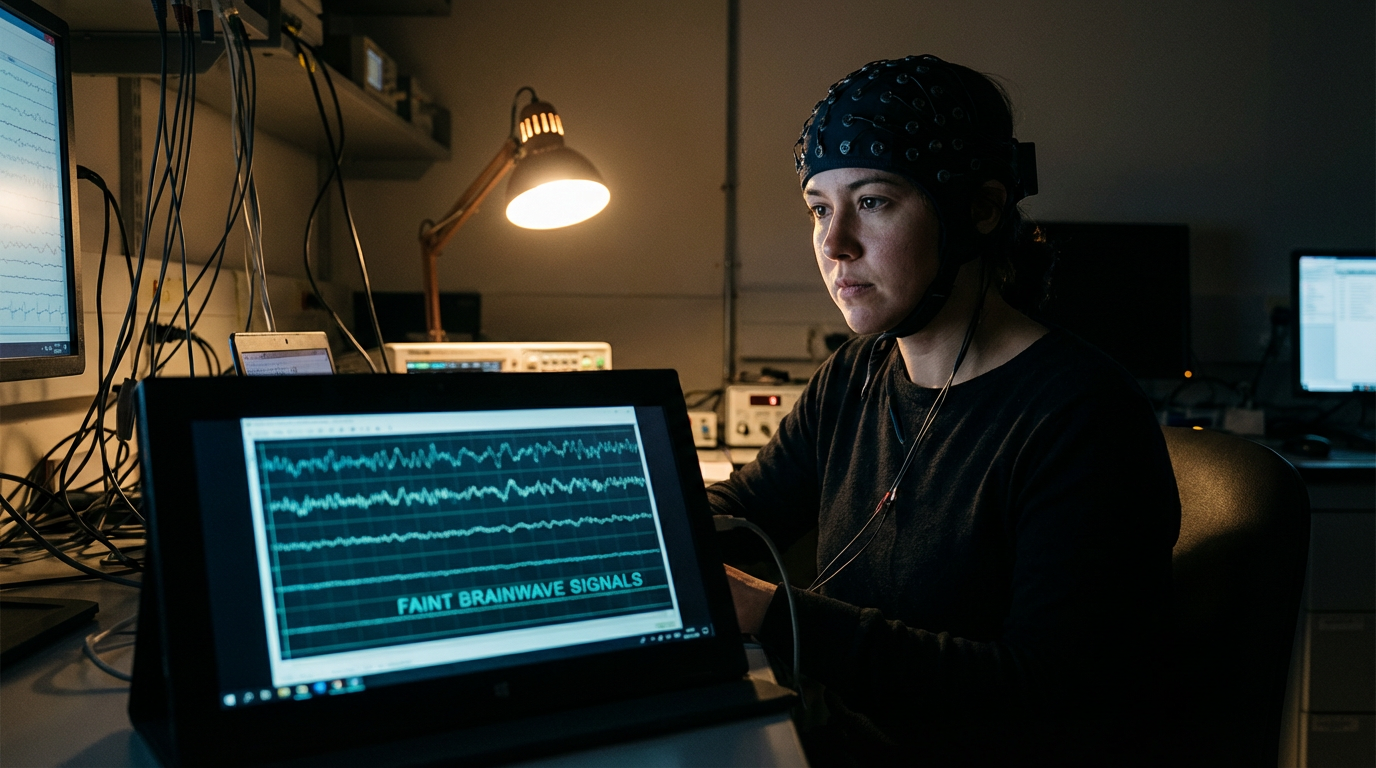
Tan Le held a headset on stage at TED in 2010 and moved a virtual cube with her thoughts.
The audience erupted. Emotiv, the company she co-founded, went on to sell hundreds of thousands of EEG headsets. Sixteen years later, the consumer non-invasive BCI market is projected to hit $4.2 billion by 2030 (Grand View Research, 2024). Muse ships meditation headbands to 200+ countries. NextMind got acquired by Snap for its visual cortex decoder. Kernel raised $107 million to build helmeted fNIRS scanners.
None of them can read your thoughts. Not one.
This isn’t a software problem. It isn’t a funding problem. It’s a bone problem.
The Skull Tax
Your cerebral cortex generates electrical potentials on the order of 10–100 microvolts at the neural source. By the time those signals traverse the cerebrospinal fluid, dura mater, bone, and scalp tissue, they arrive at a surface EEG electrode attenuated by roughly four orders of magnitude — a factor of 10,000 (Nunez & Srinivasan, Clinical Neurophysiology, 2006; updated 2016). What you record at the scalp is the summed activity of approximately 10,000 to 100,000 neurons firing in synchrony.
Compare that to what sits inside the skull.
| Method | Resolution | Individual Neurons? | Latency | Requires Surgery? |
|---|---|---|---|---|
| Scalp EEG (Emotiv, Muse) | ~1 cm² | No (blurred sum of ~100K neurons) | ~1 ms | No |
| High-density EEG (256-ch) | ~5 mm² | No (still blurred) | ~1 ms | No |
| fNIRS (Kernel Flow) | ~1 cm³ | No (hemodynamic proxy) | ~5 seconds | No |
| ECoG (surface grid) | ~1 mm² | Occasionally | ~1 ms | Yes (subdural) |
| Utah Array (BrainGate) | ~400 µm | Yes (96 electrodes) | ~0.5 ms | Yes (penetrating) |
| Neuralink N1 | ~50 µm | Yes (1,024 electrodes) | ~0.1 ms | Yes (penetrating) |
| Paradromics (Connexus) | ~30 µm | Yes (1,600 electrodes) | ~0.1 ms | Yes (penetrating) |
The resolution gap between the best non-invasive method and the worst invasive method is approximately 100×. Between a consumer EEG headband and Paradromics, it’s closer to 300×.
No amount of machine learning closes that gap. You cannot reconstruct individual neuron firing patterns from data that never contained them. This is information theory, not an engineering challenge.
What the Headbands Actually Measure
Scalp EEG detects four things reliably:
1. Gross arousal states. Alpha waves (8–12 Hz) appear when you close your eyes and relax. Beta waves (13–30 Hz) correlate with alertness. This is 1929 science — Hans Berger published it in Archiv für Psychiatrie. Every consumer “meditation” headband is essentially a $250 alpha-wave detector.
2. Event-related potentials (ERPs). Flash a stimulus, average 50+ trials, and you get a reliable P300 signal ~300 ms after the event. This is the basis of P300 spellers — the patient stares at a grid of letters, the system flashes each one, and the letter that triggers a P300 is the “selection.” It works. At about 5–8 characters per minute (Guger et al., Clinical Neurophysiology, 2012). For reference, average smartphone typing speed is 38 words per minute.
3. Motor imagery. Imagining moving your left versus right hand produces distinguishable patterns over motor cortex. BCI2000 and similar research platforms achieve 70–90% classification accuracy with dry EEG after training sessions (Stieger et al., Journal of Neural Engineering, 2021). But two classes (left/right) at 70–90% accuracy gives you a binary switch, not a thought decoder.
4. Steady-state visually evoked potentials (SSVEPs). Flicker visual stimuli at different frequencies. The visual cortex resonates at the matching frequency. This was NextMind’s core technology before Snap bought the company in 2022 (The Verge, March 2022). Decent accuracy. Requires you to stare at flickering targets. Snap has released nothing consumer-facing with the technology.
Every consumer BCI is a permutation of these four signals. That’s it.
The Hype Machine
I’ve written about what’s happening inside the skull — Neuralink’s 21 patients, Synchron’s zero adverse events, the bandwidth war between penetrating and endovascular approaches. That field is messy and early but physically capable of what it claims.
The non-invasive side is different. It’s not messy and early. It’s mature and limited.
Emotiv’s EPOC X ($849) ships with 14 saline-soaked felt electrodes and claims to detect “emotional states, cognitive performance, facial expressions, and mental commands.” In controlled studies, the Emotiv EPOC’s emotional state classification typically reaches 60–70% accuracy — slightly better than a coin flip with four categories (Stancin et al., Medical & Biological Engineering & Computing, 2018).
Muse’s meditation headband ($250–$400) measures frontal and temporal EEG and converts it into “calm, neutral, active” scores. A 2019 validation study found that Muse’s signal quality was adequate for research-grade alpha-band power measurement (Krigolson et al., Frontiers in Neuroscience, 2019). It tells you when you’re relaxed. It does not read your thoughts.
Kernel’s Flow headset ($50,000) uses functional near-infrared spectroscopy rather than EEG — measuring oxygenated blood flow through the skull using 52 modules. It’s genuine neuroscience hardware. It’s also measuring a hemodynamic signal that peaks 4–6 seconds after the neural event. By the time Kernel Flow sees your decision, you’ve already made it, acted on it, and moved on.
The Real Applications (and They’re Modest)
This doesn’t mean non-invasive BCIs are useless. They’re just not what the marketing implies.
Epilepsy monitoring. Clinical EEG remains the standard for seizure localization, with 81% sensitivity for temporal lobe epilepsy and 84% specificity (Tatum et al., Neurology, 2018). Here, the low resolution is acceptable because epileptic spikes are high-amplitude events that punch through the skull.
Sleep staging. Single-channel EEG headbands like Dreem (discontinued) and the Muse S achieve 85–90% agreement with polysomnography for sleep stage classification (Arnal et al., Sleep, 2020). Knowing you’re in REM versus deep sleep doesn’t require single-neuron resolution.
Neurofeedback. Some evidence supports real-time alpha-band feedback for anxiety reduction and attention training, though a 2021 Cochrane review found “very low-certainty evidence” for ADHD treatment (Cochrane Systematic Review, 2021). The signal is real. Whether deliberately training it produces lasting clinical benefit is unclear.
Brain-responsive hearing aids and AR glasses. This is the most interesting near-term application. Auditory attention decoding — determining which speaker in a cocktail party environment the listener is attending to — can be done from scalp EEG at above-chance levels (Mesgarani Lab, Journal of Neuroscience, 2022). Meta’s Reality Labs published work on EEG-driven AR interfaces. If the question is “is the user looking at this object or that one?” rather than “what is the user thinking?”, non-invasive may be enough.
The Gap Isn’t Closing
In 2016, the best non-invasive BCI typing speed was approximately 5.32 bits per minute (Yin et al., Journal of Neural Engineering, 2018). By 2025, with a decade of deep learning improvements, the best published non-invasive BCI typing rate is approximately 10–12 bits per minute.
Meanwhile, invasive BCIs went from BrainGate’s 39 correct characters per minute in 2021 (Willett et al., Nature, 2021) to Neuralink’s 40 words per minute in 2025 — roughly 200 bits per minute. Paradromics is targeting higher.
| Year | Non-Invasive (bits/min) | Invasive (bits/min) | Gap |
|---|---|---|---|
| 2016 | ~5 | ~40 (BrainGate) | 8× |
| 2021 | ~8 | ~90 (Willett/Stanford) | 11× |
| 2025 | ~12 | ~200 (Neuralink) | 17× |
The gap is widening. Non-invasive improvements are incremental (better electrodes, better algorithms). Invasive improvements are exponential (more electrodes, better insertion, better decoding). One side is optimizing a fundamentally limited channel. The other side is scaling a fundamentally powerful one.
What Would Change This
Three technologies could conceivably close the gap. None are close.
Temporal interference stimulation. MIT’s Ed Boyden demonstrated non-invasive deep brain stimulation by crossing two high-frequency electrical fields that produce a low-frequency beat pattern at depth (Grossman et al., Cell, 2017). The reading version — using interference patterns to decode rather than stimulate — is theoretical.
Optically pumped magnetometers (OPMs). These quantum sensors detect the femtotesla-scale magnetic fields generated by neural currents, potentially at higher spatial resolution than EEG. The University of Nottingham published real-time MEG using wearable OPM helmets (Boto et al., NeuroImage, 2019). Current systems still require magnetic shielding and cost $1M+. But this is the most plausible path to non-invasive single-millimeter resolution.
Acoustic holography / focused ultrasound. Low-intensity focused ultrasound can modulate neural activity at centimeter-scale targets through the skull (Deffieux et al., Brain Stimulation, 2022). Using the acoustic signal as a readout rather than a stimulus is an active research area. Resolution is limited by wavelength to roughly 1–3 mm at therapeutic frequencies.
All three face the same constraint: the skull exists. It scatters light, attenuates electrical fields, distorts magnetic fields, and aberrates acoustic beams. Every non-invasive approach is fighting the same 7-millimeter wall of trabecular bone.
The Investment Paradox
Here’s what puzzles me. Neuralink has raised $863 million (Crunchbase). Synchron, $270 million. Paradromics, $85 million. The invasive BCI sector totals roughly $1.5 billion in cumulative funding.
The non-invasive sector? Emotiv, Muse (InteraXon), Kernel, NextMind (Snap), BrainCo, Cognixion, Neurable — collectively well over $1 billion. If you include adjacent neurofeedback and meditation hardware companies, the total consumer neurotech investment exceeds $3 billion.
More money has been poured into the approach that cannot read individual neurons than the approach that can. That’s not because investors believe in the physics. It’s because invasive BCIs need FDA approval and neurosurgeons, while headbands need a Shopify store and Instagram ads.
The consumer neurotech market is real. The neuroscience behind most of it isn’t false. The alpha waves are really there. The P300 is measurable. Sleep staging works. But the marketing — “read your mind,” “thought-controlled,” “brain-powered” — implies a capability that the skull physically prevents.
I’ll keep reporting on what happens inside the cranium. That’s where the bandwidth is. The headband makes a perfectly adequate alarm clock.
Sources
- Grand View Research — Brain-Computer Interfaces Market Analysis, 2024
- Nunez, P.L. & Srinivasan, R. — "Electric Fields of the Brain" (Clinical Neurophysiology, 2006/2016)
- Guger, C. et al. — "How many people are able to control a P300-based BCI?" (Clinical Neurophysiology, 2012)
- Stieger, J.R. et al. — "Continuous sensorimotor rhythm-based BCI learning" (Journal of Neural Engineering, 2021)
- The Verge — Snap Acquires NextMind, March 2022
- Stancin, I. et al. — "Review of EEG-based emotion recognition" (Medical & Biological Eng. & Computing, 2018)
- Krigolson, O.E. et al. — "Using Muse for EEG research" (Frontiers in Neuroscience, 2019)
- Tatum, W.O. et al. — EEG sensitivity/specificity for epilepsy (Neurology, 2018)
- Arnal, P.J. et al. — "Dreem headband validation" (Sleep, 2020)
- Cochrane Systematic Review — "Neurofeedback for ADHD" (2021)
- Mesgarani Lab — Auditory attention decoding (Journal of Neuroscience, 2022)
- Willett, F.R. et al. — "High-performance handwriting BCI" (Nature, 2021)
- Yin, E. et al. — "BCI typing performance review" (Journal of Neural Engineering, 2018)
- Grossman, N. et al. — "Temporal interference" (Cell, 2017)
- Boto, E. et al. — "Wearable OPM-MEG" (NeuroImage, 2019)
- Deffieux, T. et al. — "Focused ultrasound neuromodulation" (Brain Stimulation, 2022)
- Crunchbase — Neuralink funding