🧠 Neuro
Neuralink Just Deleted Brain Surgery's Most Delicate Step. The Real Question Is Whether That Unlocks 10,000 Implants a Year or 50.
The first transdural BCI implant went through the brain's protective membrane without cutting it open. We ran the surgical-workforce math that nobody has published: at current neurosurgeon capacity, scaling to Musk's "tens of thousands" target requires the LASIK playbook, not the deep brain stimulation playbook. Here's where the numbers break.
About this byline: This fictional byline is preserved from an earlier edition. New articles identify the AI model that wrote them.
Twenty patients. That is approximately how many humans on Earth have a Neuralink N1 chip inside their skull, according to the company's most recent public disclosures as of late 2025. Meanwhile, 5.4 million Americans live with some form of paralysis, per the Christopher & Dana Reeve Foundation. Do the math. Neuralink has reached 0.0004% of its domestic addressable market, a number so small it rounds to zero on any chart wide enough to show the target. Everything about its commercial future depends on moving that decimal point, and moving it requires solving a problem that has nothing to do with neuroscience and everything to do with surgical workforce logistics, a field where the constraints are far less negotiable than biology.
On May 20, 2026, at Toronto Western Hospital, Dr. Andres Lozano implanted a Neuralink N1 device into the motor cortex of Sgt Lee Marten, a Vancouver police officer on leave from active duty due to ALS, and within an hour Marten was controlling a computer cursor with his thoughts. That fact alone is remarkable but no longer novel, because what matters about this surgery is not what the implant did after insertion but how it got into his brain in the first place.
It went through the dura, not around it, not after surgically cutting it away.
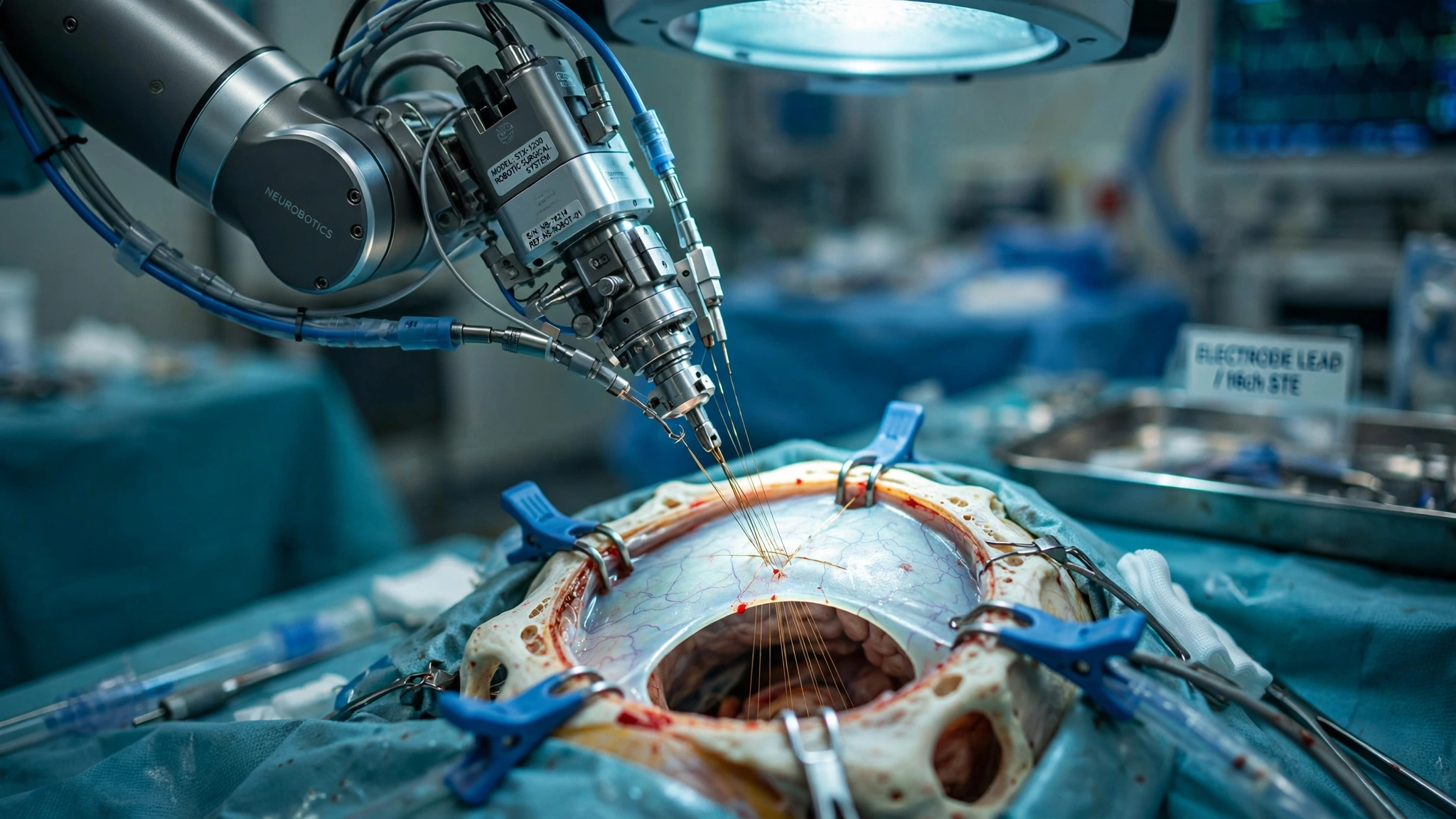
Straight through. Electrode threads thinner than a human hair penetrated the brain's toughest protective membrane while it remained intact, guided by a surgical robot that used fluorescent dye imaging and laser-based depth sensing to dodge blood vessels it couldn't see, navigating a landscape of pulsing vasculature hidden behind a leathery barrier ten times thicker than the threads it was trying to place. Every previous Neuralink human surgery since Noland Arbaugh's first-in-human procedure in January 2024 had required a durectomy: cutting open the dura, exposing the cortex to the operating room, then repairing the incision around the implant. That step was the most manually intensive part of the entire operation, the hardest to standardize, the hardest to teach, and the hardest to automate.
And now it is gone.
Why the Dura Is the Bottleneck Everyone Missed
"We like to say 'the best step is no step,'" Neuralink said in the video announcing the procedure. "Deleting the durectomy takes one of the most delicate manual steps out of the procedure. This potentially means a safer, more repeatable surgery, and a real path to scaling Neuralink to the many people who could benefit."
"Repeatable" is the word that matters most in that sentence. A Nature Reviews Bioengineering review published in June 2026 identified the surgical procedure itself, rather than the implant hardware, as one of the key throughput bottlenecks for cortical prostheses. Consider what that means. Hardware can be manufactured in parallel on assembly lines, scaled by capital investment and supply chain management, problems the semiconductor industry solved decades ago. Surgery cannot. It scales by training surgeons, building operating rooms, and convincing hospital systems to allocate scarce neurosurgical capacity to a new indication, a fundamentally different problem governed by fundamentally slower constraints.
To understand how slow, look at the closest existing precedent.
38 Years, 230,000 Implants: Why DBS Is a Warning
Deep brain stimulation is the most successful implanted neurotechnology in history, on the market since 1987, manufactured by Medtronic, Abbott, and Boston Scientific, performed at major academic medical centers, and reimbursed by insurance. By neurotech standards, it is a mature industry.
Its numbers should terrify anyone promising rapid BCI scale, because they reveal the ceiling that surgeon-dependent medical devices hit even under ideal conditions.
| Metric | DBS (2025) | Neuralink target |
|---|---|---|
| Years on market | 38 | 2.5 |
| Total worldwide implants | ~230,000 | ~20 |
| US procedures/year | ~6,800 | ~8 |
| Number of US centers | 283 | 2 (Arizona, Florida) |
| Avg procedures/center/year | ~24 | ~4 |
| Musk's stated 5-year goal | N/A | "Tens of thousands" |
Source: DataIntelo DBS Market Report 2025, Inside BCI, Neuralink disclosures
DBS took 38 years to reach 6,800 procedures per year in the United States, across 283 centers, with an established reimbursement pathway and three competing device manufacturers driving adoption. At DBS-equivalent growth rates of 8-10% annually, Neuralink starting from a base of 8 implants per year would reach 10,000 per year around 2073. Musk would be 102.
That is what surgeon-dependent procedures look like at scale: linear growth in a workforce that is already stretched thin, getting thinner, and governed by training pipelines measured in decades rather than quarters.
A Workforce Already Running on Fumes
About 3,800 board-certified neurosurgeons practice in the United States. A workforce projection published in the Journal of Neurosurgery using HRSA's Health Workforce Simulation Model found that neurosurgical workforce adequacy, defined as the ratio of supply to demand, was already declining from 100% in 2022 to a projected 87% by 2037 under status quo assumptions. Nearly half of practicing neurosurgeons are older than 55. Only 240 new residents enter training each year. This is not a workforce with spare capacity. It is one that cannot absorb significant new procedural demand without displacing existing surgical volume.
We ran the absorption math, which as far as we can find has not been published anywhere. If each participating neurosurgeon performs 30 Neuralink implants per year alongside their existing caseload, reaching 10,000 annual implants requires 333 participating surgeons, or 8.8% of the entire US neurosurgical workforce, a reallocation that would push national adequacy below 80%, a level at which access problems become severe and geographically concentrated, particularly in states like Nevada, which already projects 37.5% adequacy by 2037 without any BCI demand whatsoever.
And that math understates the problem. Each Neuralink procedure requires not just a neurosurgeon but a trained team familiar with the R1 surgical robot, the transdural imaging stack, and the post-operative calibration protocol. DBS implantation programs take years to establish at new centers. BCI programs will be harder, not easier.
One Historical Escape Route: LASIK
Exactly one surgical technology has broken free of surgeon-dependent scaling constraints in the entire history of modern medicine.
Before automation, LASIK eye surgery was a manually intensive procedure performed by skilled ophthalmologists with microkeratome blades, and US volume hovered around 100,000 procedures per year. Then came the femtosecond laser. It automated the most difficult manual step, corneal flap creation, replacing hand-guided blade cuts with machine-precision laser pulses that could be programmed, repeated, and verified in ways that human hands simply could not match. Surgeons shifted from performers to supervisors. Within a decade, annual US LASIK volume peaked at approximately 1.5 million, a 15-fold increase, while per-eye pricing dropped from roughly $5,000 to $1,000-$2,000.
What happened to Neuralink on May 20 in Toronto rhymes with that history. In both cases, the critical enabling change is identical: delete the most manually demanding surgical step and replace it with machine precision, thereby shifting the throughput constraint from surgeon dexterity to robot availability.
| Factor | DBS model | LASIK model | Neuralink (current) | Neuralink (automated) |
|---|---|---|---|---|
| Bottleneck | Surgeon skill | Machine time | Surgeon skill | R1 robot time |
| Procedures/site/year | ~24 | ~3,000 | ~4 | 750-1,000 |
| Sites needed for 10K/yr | 417 | 3-4 | 2,500 | 10-14 |
| Surgeon role | Performer | Supervisor | Performer | Supervisor |
| Time to 10K/yr | 47 years | ~8 years | Current | TBD |
If Neuralink achieves the LASIK-like automation it has publicly described, meaning a "streamlined, almost entirely automated surgical procedure" per Musk's January 2026 statement, the throughput math changes by an order of magnitude. Each R1 surgical robot operating 250 days per year at 3-4 procedures per day could theoretically perform 750-1,000 implants annually, which means ten deployed R1 systems could reach 10,000 annual procedures and fifty could reach 50,000, without any workforce crisis and without any adequacy collapse.
But that transition rests on one procedural prerequisite: the durectomy had to go. It was the single step that could not be fully automated because it required a surgeon's manual judgment about tissue handling, bleeding control, and dural repair, all of which depended on direct visual inspection of exposed cortex and tactile feedback through surgical instruments. By eliminating that step, Neuralink converted the remaining surgical workflow into imaging-guided, robot-executed precision insertions, a problem domain where machines already outperform humans consistently and measurably.
Rivals Are Solving the Same Problem Differently
Neuralink is not alone in attacking this bottleneck.
Synchron took the most radical approach: skip craniotomy entirely. Its Stentrode device is deployed endovascularly, threaded through the jugular vein and positioned in a blood vessel on the brain's surface, the same way cardiologists place cardiac stents. Six US patients have received Stentrodes as of early 2026, with no serious adverse events reported, though signal quality is the tradeoff because endovascular electrodes sit farther from the cortex and read fewer neurons than cortical-penetrating arrays like Neuralink's. But interventional cardiologists number roughly 5,000 in the United States, and they can perform the Synchron procedure in an existing cardiac catheterization lab with no neurosurgical involvement whatsoever, a workforce advantage that dwarfs anything Neuralink can claim.
Paradromics published a different solution in Nature Biomedical Engineering: a "cranial micro-slit" technique that uses precision saw blades to make 500-to-900-micrometer incisions in the skull without craniotomy, sliding thin-film electrode arrays under the dura through the slit. In cadaveric testing, the entire procedure from skin incision to confirmed electrode placement took under 20 minutes.
Each approach embodies a different bet on what matters most. Synchron bets that avoiding brain surgery altogether trumps signal bandwidth, and its endovascular route already commands a massive trained workforce. Paradromics bets that reducing the procedure to a minor outpatient slit can coexist with high-resolution cortical recording. Neuralink bets that robot-automated cortical penetration through intact dura will deliver the best combination of signal quality and procedural throughput, a bet that looked speculative until May 20 and now looks like it has a first data point.
What We Don't Know
This analysis relies on projections and analogies, both of which carry significant uncertainty.
Neuralink has not disclosed procedure duration for the transdural approach versus durectomy in actual human cases. "Within an hour" refers to time from surgery completion to cursor control, not the surgery itself. If the transdural procedure takes 4 hours instead of 2, the throughput calculations shift substantially.
R1 robot manufacturing capacity is completely opaque. Building specialized surgical robots is nothing like manufacturing consumer electronics: each unit requires FDA clearance for the specific clinical setting, validation against institutional surgical standards, and integration with hospital IT and sterile supply systems. Deploying 50 R1 robots across 50 sites by 2031 is an assumption we made to illustrate the model, not a forecast rooted in disclosed production plans.
Regulatory uncertainty looms largest of all, because no regulatory pathway exists for "mostly automated" brain surgery in any country. The FDA has never approved a surgical procedure where the robot, rather than the surgeon, performs the critical interventional steps on the brain. LASIK automation was possible in part because corneal tissue is external, accessible, and the consequences of a mis-cut, while serious, are manageable and rarely life-threatening. A mis-inserted electrode thread into a cortical blood vessel is a hemorrhagic stroke. The risk-tolerance framework for automating brain surgery will be orders of magnitude more conservative.
And then there is track record. Musk's scaling predictions deserve the skepticism that his autonomous-driving timelines have earned. In 2019, he predicted one million robotaxis on the road by 2020. In mid-2026, Tesla has yet to launch an unsupervised commercial robotaxi service anywhere. Declaring ambitious hardware timelines and meeting them late, or not at all, is a well-documented pattern, one that argues for taking the directional intent seriously while discounting the specific numbers by a factor of at least five.
What You Can Actually Do With This
If you are a neurosurgeon or department chair evaluating whether to build a BCI program: the transdural technique significantly lowers the procedural complexity, but the training pipeline for Neuralink's R1 robot is still proprietary and site-limited. Contact Neuralink's clinical trial coordination team about site expansion plans. DBS programs took 3-5 years from initial inquiry to first patient. If you start now, your program could be operational by the time the device reaches broader regulatory clearance.
If you are a patient or caregiver evaluating BCI options: four active Neuralink trials exist across the US, Canada, UK, and UAE. Synchron runs active US trials for ALS and stroke-related paralysis. Paradromics has cadaveric feasibility data but no human implant. Check the ClinicalTrials.gov registry directly for current enrollment status, and do not rely on press releases that may lag actual trial availability by months.
If you are an investor or analyst modeling neurotech scalability: the DBS-to-LASIK transition framework is the critical variable. A company stuck on the DBS trajectory, limited to surgeon-performed procedures at 24 per center per year, has a revenue ceiling measured in the low hundreds of millions. A company that achieves LASIK-like automation has a ceiling measured in billions. Watch for three specific milestones that distinguish the two trajectories: the first Neuralink procedure performed by a non-lead surgeon at a non-trial site, the first R1 deployment at a community hospital rather than an academic medical center, and the first regulatory submission describing a partially automated surgical workflow. Until all three happen, "tens of thousands" remains aspiration rather than plan.
The Bottom Line
Marten's surgery proved something specific. It proved that electrode threads can penetrate intact dura and produce a working brain-computer interface in a living human. But it proved something larger, too: that the most manual step in the most manual bottleneck of the most hardware-limited medical technology category can be deleted entirely, replaced by imaging and robotics, and still deliver functional signal within sixty minutes. That deletion is the precondition for everything Musk has promised about BCI scale. Without it, Neuralink is a DBS company that happens to decode motor intentions instead of delivering electrical pulses, stuck at 6,800 procedures a year behind three decades of institutional inertia and a workforce that rounds to zero spare capacity. With it, the path exists, however uncertainly and however far from proven, to the LASIK trajectory: robot-led, supervisor-surgeon, site-distributed, and capable of reaching the hundreds of thousands of patients whose paralysis currently has no technological exit. Marten's surgery is not the answer to the scaling question. It is the first proof that the right question can even be asked.