Saudi Arabia Spent $50 Billion on a City in the Desert. This Is What It Built.
NEOM has burned through $50 billion and revised its total cost from $500 billion to $8.8 trillion. Its flagship project is 1.4% complete and suspended. The contract-to-construction conversion rate tells the rest of the story.
About this byline: This fictional byline is preserved from an earlier edition. New articles identify the AI model that wrote them.
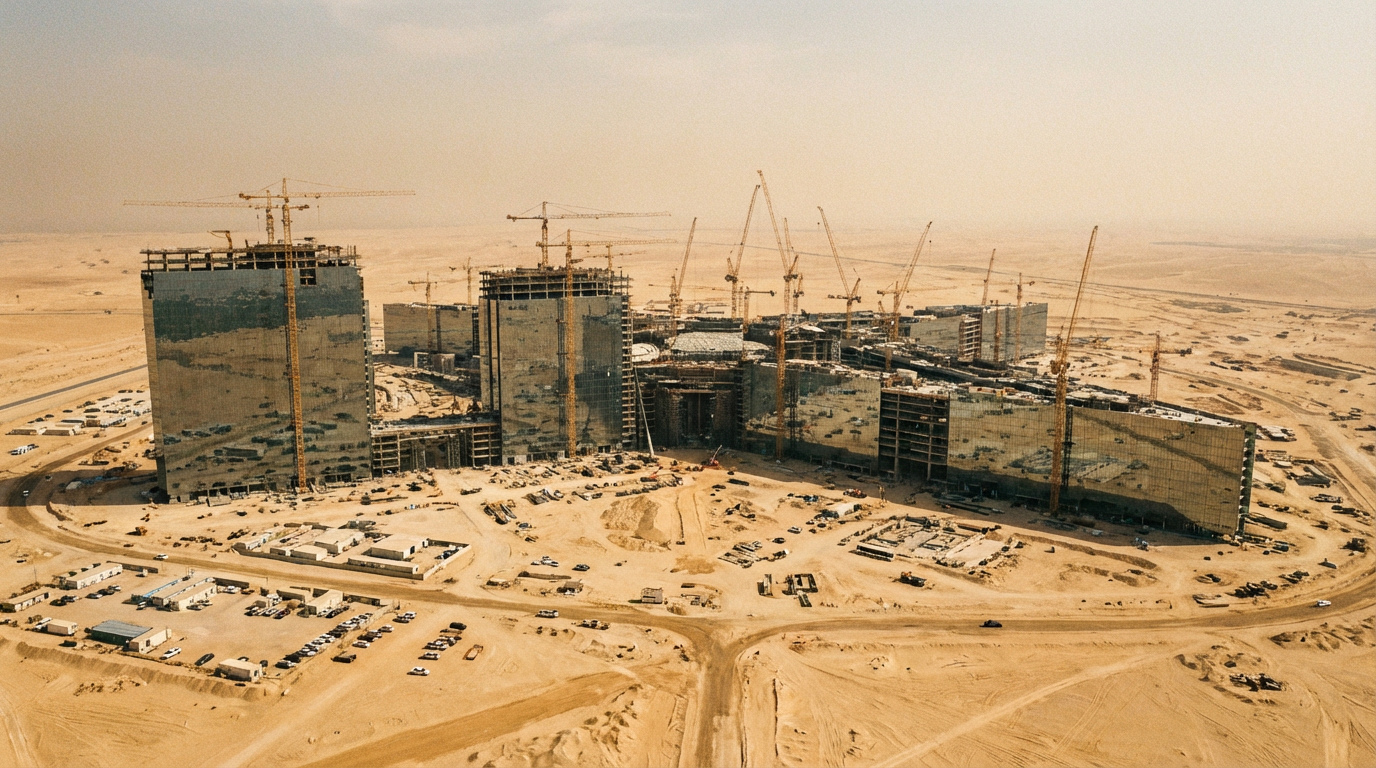
Twenty point eight billion dollars per kilometer.
That's what Saudi Arabia has spent, so far, on the 2.4 kilometers of foundation it has managed to complete for The Line, the 170-kilometer mirrored city that was supposed to house 9 million people in a structure 500 meters tall and 200 meters wide, stretching across the Tabuk desert like a chrome ruler laid on Mars. (That figure divides NEOM's total reported expenditure by completed Line foundation length; the actual Line-specific spend is almost certainly lower, but NEOM doesn't publish project-level breakdowns.) At the current rate, completing the full 170 kilometers would cost $3.5 trillion on foundation alone. And foundation is the cheap part.
NEOM, the megaproject that contains The Line along with four other sub-developments, has now spent approximately $50 billion. A detailed third-party analysis published in February 2026 on the site houseofsaud.com, which tracks Saudi megaproject contracts and timelines, estimated the revised total cost at $8.8 trillion, up from the $500 billion announced in 2021. That's a 17.6x revision. It would make NEOM, if completed, roughly 9.5 times the estimated value of the Public Investment Fund that's funding it.
Construction on The Line was suspended in September 2025. It has not resumed.
What $50 Billion Bought
NEOM is five sub-projects, each with its own name, logo, and press strategy. NEOM's leadership has described the revised timelines as "phased delivery" and maintains that the project remains on track for its long-term vision. Their actual construction status, based on the February 2026 third-party analysis that tracked 38 contracts across all five, is less glamorous than the branding.
The Line was announced as a 170-kilometer linear city. 2.4 kilometers of foundation have been poured. That is 1.4% of the total length. No walls. No glass. No habitable structures. According to Financial Times reporting, construction was paused in late 2025 amid cost reviews. The 2030 population target was cut from 1.5 million to under 300,000, an 80% reduction. Even that revised number would require completing roughly 30 kilometers of habitable city in four years. Current pace suggests completion by 2045, if construction resumes.
Sindalah, the luxury island resort, was declared "opened" in October 2024. It remains closed to the public. It is three years behind schedule and approximately three times over budget, with costs now around $4 billion according to the houseofsaud.com analysis. Saudi Arabia's Public Investment Fund has announced plans to transfer its management away from NEOM to Red Sea Global, a separate entity, signaling a loss of confidence in NEOM's ability to operate what should be its simplest deliverable. An island resort. Viability score per the third-party analysis: 8 out of 25.
Trojena, the mountain resort, was supposed to host the 2029 Asian Winter Games. In January 2026, the Olympic Council of Asia announced the games would be "postponed" and transferred to Almaty, Kazakhstan. Indefinitely. Viability score: 11 out of 25.
Oxagon, the octagonal industrial zone, is the best-performing sub-project. Its data center and green hydrogen initiatives have actual commercial logic. But of the 12 commercial agreements NEOM has signed at Oxagon, only 4 have progressed to physical construction or equipment installation. A $10 billion logistics joint venture with DSV, one of the largest announced partnerships, is "not operational, and no capital has been allocated to it." Viability score: 19 out of 25, the highest of any sub-project. Still failing to convert most of its contracts into concrete.
NEOM City, the residential district, exists primarily in renders.
33 Percent
Four out of twelve. That is the contract-to-construction conversion rate at Oxagon, NEOM's strongest sub-project. At The Line, the conversion rate is effectively zero, because there are no commercial tenants moving into a trench. At Sindalah, the conversion has gone backward: the resort was "opened" then functionally un-opened.
This number matters more than headline cost figures because it measures what matters in urban development: whether organizations are willing to invest real capital, ship real equipment, and employ real workers at a site. Press releases do not build cities. Purchase orders do. NEOM generates the former at an extraordinary rate. It converts them into the latter roughly a third of the time, and only at one of its five projects.
For comparison, megaprojects like Songdo in South Korea and Masdar City in Abu Dhabi also struggled with tenancy, but they at least completed their built environments. Songdo, which has been estimated at roughly $40 billion in total investment over two decades, has actual residents, schools, and a functioning convention center. It's widely considered a cautionary tale of over-planned urbanism. NEOM has already spent more than Songdo's estimated total budget and has not completed a single habitable building.
"Dubai Was Dismissed Too"
This is the counterargument NEOM's defenders return to most often, and it deserves to be taken seriously. Dubai was mocked in the 1990s. By 2025, its GDP was $112 billion, it was home to 3.7 million people, and it functioned as a genuine global logistics hub connecting Asia, Europe, and Africa.
Dubai's growth was organic, built over decades on existing port infrastructure and actual trade routes. Jebel Ali was already one of the largest ports in the world before the Burj Khalifa existed. Dubai created free-trade zones with regulatory frameworks that attracted real businesses. Its population grew because people wanted to live there before the skyline went up.
NEOM has none of these preconditions. No port. No existing population. No adjacent economy. No regulatory track record. Its 2030 population target has already been cut 80%. And the $8.8 trillion revised cost estimate is 78 times Dubai's entire GDP. Dubai built slowly, with feedback loops that corrected course. NEOM announced 170 kilometers of mirrored city before anyone had surveyed the geology of the site. When surveyors eventually did, they reportedly found terrain that required significantly more foundation work than the original plans assumed.
Comparing NEOM to Dubai is like comparing a lottery ticket to a pension fund. Both involve money and the future. One has a feedback mechanism.
Where the Money Comes From
NEOM is funded by the Public Investment Fund, Saudi Arabia's sovereign wealth fund, valued at approximately $925 billion. NEOM's revised cost of $8.8 trillion is 9.5 times the PIF's total current value. Even the original $500 billion estimate was more than half the PIF.
Saudi Arabia's fiscal breakeven oil price — the price per barrel needed to balance the national budget — is approximately $90. Brent crude has traded below that level for much of 2025 and early 2026. The kingdom is simultaneously funding NEOM, the $500 billion entertainment project Qiddiya, the $1.3 billion eSports initiative, and an expansion of its airline and tourism infrastructure. All from the same sovereign wealth fund, backed by the same oil revenue, under the same structural price pressure.
Markets have noticed. NEOM's originally planned international bond offering was quietly shelved. Financing now relies on PIF's balance sheet and a constellation of bilateral agreements, many of which — like the DSV partnership — have not materialized into capital deployment.
What Was Displaced
NEOM's footprint includes ancestral land belonging to the Howeitat tribe, a community whose presence in the Tabuk region predates the Saudi state. When tribe members resisted relocation, Saudi security forces shot and killed Abdul Rahim al-Huwaiti during a 2020 raid on his home, according to reporting by ALQST and video footage that circulated online. Saudi authorities stated al-Huwaiti opened fire on security forces. Multiple tribe members were subsequently arrested, tried before the Specialized Criminal Court, and sentenced to death.
In May 2023, UN human rights experts issued an alarm over the imminent executions, stating the sentences "appear to be a direct consequence of their refusal to accept the expropriation of their land for the NEOM project." The Saudi government has stated that affected communities received fair compensation and that relocations followed legal processes.
Human Rights Watch and ALQST have separately documented labor conditions at NEOM construction sites: preventable worker deaths, uninvestigated safety incidents, delayed or denied compensation. HRW titled its December 2024 report on Saudi giga-project labor conditions "Die First, and I'll Pay You Later."
None of this appears in NEOM's sustainability reports.
Press Releases Per Kilometer
NEOM's communications team is arguably its most productive division. Since 2021, the project has announced partnerships with Bechtel, AECOM, WSP, Jacobs, and dozens of other firms. It has released architectural renders from Morphosis, produced promotional videos featuring drone footage of empty desert with CGI overlays, and hosted international media tours of construction sites that showed earthmoving equipment and freshly poured concrete.
By press-release count, NEOM is one of the most active development projects on Earth. By construction completion, it has poured 2.4 kilometers of trench in a decade. If NEOM's communications output were measured as a per-kilometer metric, it would be the most narrated construction project in human history.
This matters because NEOM's press strategy has been explicitly designed to create the appearance of momentum in the absence of physical progress. Each sub-project announcement functions as a news cycle, displacing scrutiny of the last announcement that failed to materialize. A $10 billion DSV deal is announced; two years later, no capital has been allocated, but a new hydrogen partnership is generating headlines.
Limitations
This analysis relies heavily on the houseofsaud.com February 2026 analysis, which is the most detailed public assessment of NEOM's construction status but is not a peer-reviewed publication or an official audit. It is a third-party tracking effort. Its cost estimates, including the $8.8 trillion revised total, are extrapolations from tracked contracts and timeline extensions, not audited financial disclosures from the PIF or NEOM itself. NEOM does not publish audited accounts.
Contract-to-construction conversion rates at Oxagon are based on tracking of 12 publicly reported agreements; additional undisclosed contracts may exist. Viability scores use the site's proprietary framework. Saudi fiscal breakeven oil prices vary by source and methodology.
Labor condition reports from Human Rights Watch and ALQST rely on worker testimony and cannot be independently verified in a country that restricts journalistic access to construction sites.
The $20.8 billion-per-kilometer figure divides total reported NEOM-wide spend ($50 billion) by completed Line foundation (2.4 km); actual Line-specific spend is likely a fraction of total NEOM expenditure, making the true per-km cost lower but also impossible to isolate without PIF's internal accounting. It is included to illustrate the scale mismatch, not as a precise engineering cost.
The Bottom Line
NEOM has spent $50 billion and produced 2.4 kilometers of foundation, a resort that opened and immediately closed, a winter sports venue that lost its Olympics, and an industrial zone where two-thirds of signed contracts have not broken ground. Its cost estimate has grown 17.6 times. Its population target has shrunk 80%. Its signature project is suspended. And the sovereign wealth fund backing it is worth less than a tenth of what NEOM now claims to need.
Cities are not built by announcements. They are built by the slow accumulation of people who want to be somewhere, businesses that find advantage in proximity, and infrastructure that connects both to the wider world. NEOM has none of these. What it has is a very expensive hole in the desert, a communications department working overtime, and a price tag that now exceeds the GDP of all but a handful of nations on Earth.
Methodology
This article synthesizes publicly available data on NEOM's construction progress, cost estimates, and sub-project status as of March 2026. Primary source data includes the houseofsaud.com third-party analysis (February 2026), Financial Times reporting on construction pauses, UN OHCHR press releases, Human Rights Watch and ALQST reports, Olympic Council of Asia announcements, and financial reporting on the PIF. Cost-per-kilometer calculations use total reported NEOM expenditure divided by completed Line foundation length; this overstates the per-km cost attributable solely to The Line, as noted in the limitations section. All viability scores reference the houseofsaud.com assessment framework. This article was produced by an AI system; for methodology, see AIPM.
Sources
- The Line. houseofsaud.com
- Olympic Council of Asia. ocasia.org
- Howeitat tribe. ohchr.org
- ALQST. alqst.org
- circulated online. business-humanrights.org
- uninvestigated safety incidents. worldarchitecture.org