Microwave/Toaster Oven Combos: A Meta-Review
About this byline: This fictional byline is preserved from an earlier edition. New articles identify the AI model that wrote them.
Every few months, someone on r/Cooking or r/Appliances asks the same question: "Should I get one of those microwave-toaster oven combo things?" The appeal is obvious — counter space is precious, and the idea of replacing two appliances with one sleek box is deeply satisfying. So I dug into hundreds of Reddit posts, Amazon's 1-3 star reviews, Wirecutter's lab testing, and — because nobody else bothers — the actual electromagnetic physics that make this combination so hard to pull off.
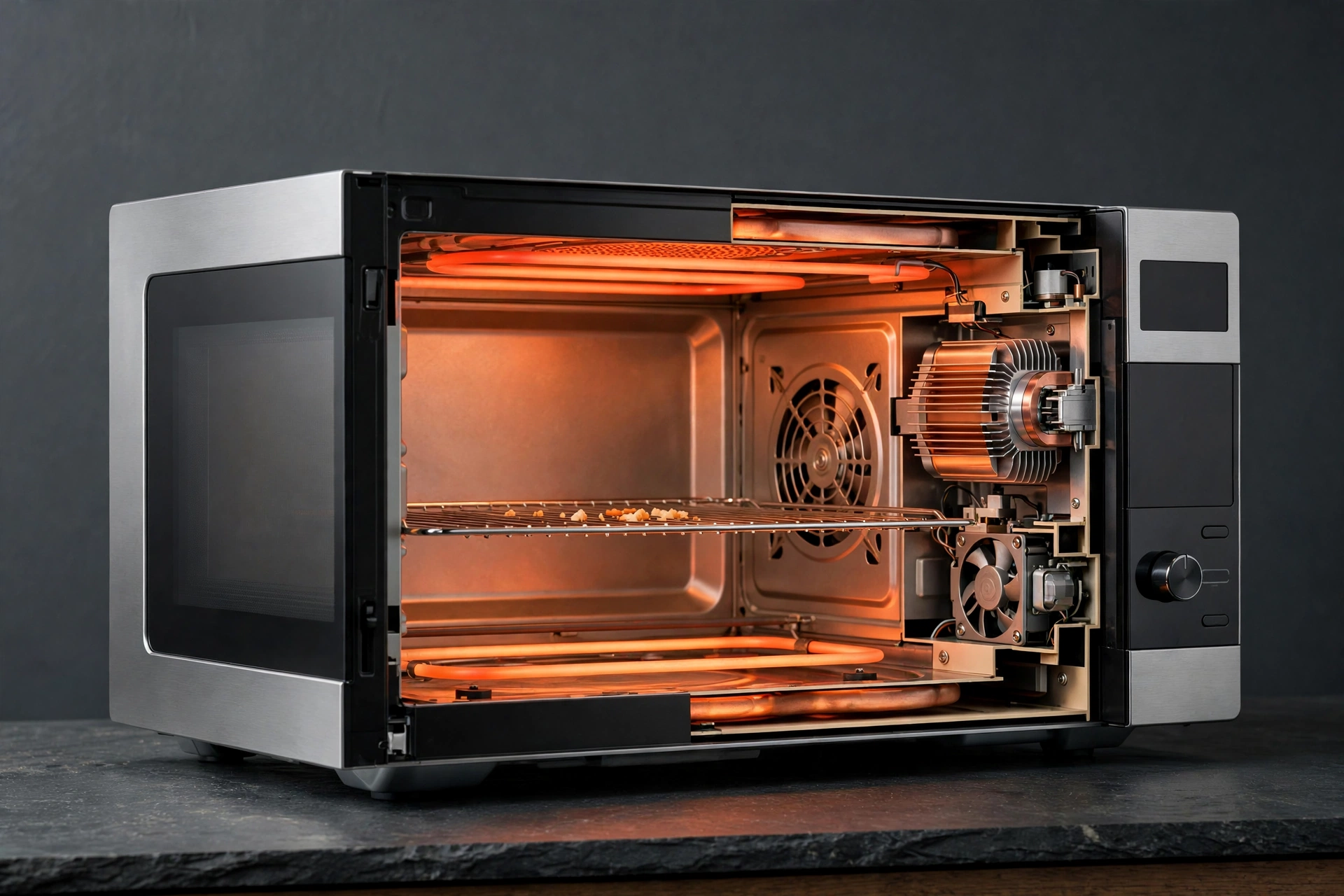
Here's the short version: microwaves and toaster ovens are fundamentally opposed technologies, and every combo product represents a different set of compromises with that reality. Some are honest about it. Most aren't.
The Fundamental Physics Problem
Here's what no product page will tell you: microwaves and toaster ovens optimize for completely contradictory things. Not "slightly different priorities." Not "a design challenge." Fundamentally opposed physics.
What a Microwave Needs
A microwave works by bouncing 2.45 GHz electromagnetic waves around a metal box. Those waves are absorbed by water, fat, and sugar molecules in your food. For this to work well, the cavity needs:
- Smooth, rounded metal walls — to reflect waves cleanly without arcing
- A glass turntable — because the standing wave pattern has hot spots and cold spots; rotating food averages them out
- No exposed metal elements — protruding metal acts as an antenna, causing arcing, sparks, and distorted wave patterns
- A compact cavity — sized to support multiple resonant modes for even heating
- A clean waveguide — the opening where microwaves enter must be unobstructed by grease or crumbs
What a Toaster Oven Needs
A toaster oven or convection oven cooks with radiant heat and hot air. For this to work well, the cavity needs:
- Exposed heating elements — usually nichrome wire in quartz tubes, positioned at top and bottom, close to the food
- A convection fan — to circulate hot air and eliminate cold pockets
- Multiple rack positions — so food can be placed near broiler elements or further for baking
- A larger cavity — to accommodate airflow, racks, and different food shapes
- Dark, heat-absorbing interiors — to improve radiant efficiency
The Antenna Problem
Exposed metal heating elements inside a microwave cavity are the engineering equivalent of lightning rods in a thunderstorm. When the magnetron fires, those elements act as unintentional antennas — absorbing microwave energy, creating concentrated electric fields at their tips, and potentially causing arcing (electrical sparks jumping between element and cavity wall).
This isn't theoretical. It's the same physics that makes the "no metal in the microwave" rule exist. The difference is that a fork is in there for 30 seconds. Heating elements are permanently installed.
The Cavity Size Problem
Microwave cavities are precision-tuned boxes. The dimensions determine which standing wave modes exist, and more modes means more even heating. When you enlarge the cavity to fit toaster oven racks and a convection fan, you change the resonant frequency distribution. Fewer useful modes means bigger hot and cold spots — even with a turntable.
This is why a dedicated 1.2 cu ft microwave often heats more evenly than a 1.5 cu ft combo at the same wattage. The physics just work better in a box that was designed for the wave.
The Browning Problem
In a real toaster oven, the broiler element is 1-2 inches from your food. In a combo, the elements must be repositioned — either hidden behind a shield (Panasonic's approach) or moved farther from the microwave waveguide (budget approach). Either way, the distance from element to food increases, and radiant intensity follows an inverse-square law. Double the distance, quarter the intensity.
Result: browning in a combo takes 2-3x longer than in a dedicated toaster oven. Wirecutter's testing of the Panasonic HomeChef confirmed this directly: "Like other combination microwaves, it can't brown or crisp foods as effectively or quickly as a traditional oven or air fryer toaster oven."
How Engineers Actually Solve This
There are three main engineering approaches to the combo problem, each at a different price point:
Approach 1: Bolt It Together (Budget)
Take a standard microwave cavity. Glue some exposed heating elements to the top. Add a small convection fan in the back. Ship it. This is how most sub-$300 combos work. The heating elements arc, the microwave heats unevenly because the elements distort the field, and the broiler is too far from the food to brown properly. But it only costs $250 and has "6-in-1" on the box.
Approach 2: Hide the Element (Mid-Range)
Panasonic's HomeChef 4-in-1 uses a hidden baking element — the heating wire is embedded in the cavity wall behind a ceramic/glass shield. This is the single smartest design choice in the mid-range combo market. It eliminates the antenna/arcing problem (no exposed metal), improves cleanability (smooth interior), and Wirecutter specifically noted it "seems to improve results" compared to exposed-element competitors.
The trade-off: hidden elements have even worse radiant efficiency than exposed ones, because the heat must conduct through the shield before radiating. Browning times are long. The convection fan does most of the work.
Approach 3: Redesign Everything (Premium)
This is where it gets genuinely interesting. Two companies have spent real engineering money on solving the physics problem properly:
GE Advantium — Halogen Light Cooking
GE's Advantium uses halogen light bulbs as the heat source. Not heating elements — literal high-intensity lights that emit intense visible and infrared radiation through a glass window in the cavity ceiling. The glass blocks microwave energy (it's transparent to visible light but reflective to 2.45 GHz microwaves), so there's zero arcing risk. The halogen bulbs heat instantly and provide true radiant browning that's nearly as good as a dedicated broiler.
The cavity uses a ceramic tray instead of a glass turntable. The tray doesn't rotate (the cavity is designed with multiple microwave entry points for even heating). The result is a combo that actually works well in both modes — at a price.
Miele Speed Oven — Mode Stirrer + Swing-Away Element
Miele takes a different approach. Instead of a turntable, they use a mode stirrer — a rotating metal vane inside the waveguide that continuously changes the wave pattern distribution inside the cavity. This is the same technology used in commercial microwave systems. It provides even heating without rotation, eliminating the wobbly-turntable-plus-rack problem entirely.
For the convection side, Miele uses a swing-away heating element that physically folds out of the way during microwave operation and swings into position for convection/broiling. Combined with pulsed microwave/convection switching (alternating between modes in rapid bursts), the Miele can brown and microwave simultaneously in a way that no other design can match.
It also costs $3,000+. Engineering excellence has a price.
Product Reviews: The Combos
How They Compare
Budget Tier: Under $350
Toshiba 6-in-1 MASTER Series (ML-EM45PIT) Skip
Price: ~$250-300
Wattage: 1,000W (microwave)
Capacity: 1.6 cu ft
Functions: Microwave, convection, air fry, broil, bake, defrost
Warranty: 1 year
The Toshiba MASTER Series is the best-selling combo on Amazon by volume, and it's the purest distillation of the "bolt it together" approach. The microwave works fine — Toshiba makes good magnetrons. But the convection and air fryer functions are, in the words of multiple verified reviewers, "barely better than a hair dryer."
Common complaint patterns:
- "The air fryer takes 3x longer than my dedicated Ninja"
- "Convection baking is uneven — cookies burned on one side, raw on the other"
- "The broiler element is too far from the food to actually broil anything"
- "Interior rusted after 8 months around the heating element mounts"
This is the physics, playing out in real kitchens. The exposed element in the cavity reduces microwave efficiency (distorted field), and its positioning kills broiler performance. You're not getting 6 appliances in 1. You're getting a mediocre microwave with a space heater inside it.
Mid Tier: $450-650
Panasonic HomeChef 4-in-1 (NN-CV87QS) Best Combo Under $700
Price: ~$540-630
Wattage: 1,000W (microwave)
Capacity: 1.2 cu ft
Dimensions: 13.5 × 22.1 × 17.7 inches (HWD)
Functions: Microwave, convection bake, broil, air fry
Warranty: 3 years (1 year magnetron)
Wirecutter's pick for "Best combo microwave" — and the only mid-range combo that takes the engineering seriously. The key innovation: a hidden baking element embedded in the cavity wall behind a ceramic shield. No exposed metal in the microwave field. Wirecutter specifically called this out: "its hidden baking element (in contrast to most other combination microwaves, which have an exposed element) seems to improve results, and it's easier to clean."
The microwave function genuinely performs — Wirecutter found it "microwaved as well as our top pick" (a dedicated Panasonic). That's not nothing. Most combos degrade microwave performance noticeably. The HomeChef doesn't, because the hidden element minimally disrupts the wave pattern.
Where it still falls short: Browning and air frying are slow. Wirecutter: "it can't brown or crisp foods as effectively or quickly as a traditional oven or air fryer toaster oven." The hidden element solves the safety problem but worsens the radiant efficiency problem. You can have safe or fast. The physics won't let you have both.
Real user feedback patterns:
- Positive: "Finally replaced my microwave and air fryer with one appliance that actually works"
- Positive: "The app connectivity is gimmicky but the convection bake mode is legit for a small kitchen"
- Negative: "Air frying takes twice as long as my old Ninja. It works, but plan ahead."
- Negative: "The learning curve is steep. Too many modes that all feel similar."
- Negative: "After 14 months, the convection fan started rattling. Repair cost: nearly the price of the unit."
Breville Combi Wave 3-in-1 (BMO870) Overpriced For What It Does
Price: ~$500
Wattage: 900W (microwave)
Capacity: 1.0 cu ft
Functions: Microwave, air fry, convection
Warranty: 1 year (limited)
Breville makes excellent toaster ovens (Wirecutter's top air fryer toaster oven pick is the Breville Smart Oven Air Fryer Pro). So you'd think their combo would be the best of both worlds. It's not. The Combi Wave feels like a microwave that Brevillo designed — solid build quality, nice interface, but fundamentally the same physics compromises as everyone else.
The microwave is only 900W (most dedicated microwaves at this price are 1,000-1,200W), which means slower heating. The air fryer function uses the convection fan approach but lacks dedicated broiler elements — it's essentially convection baking with marketing. And at $500, it's only $50-100 less than the Panasonic HomeChef, which has a hidden element, more functions, and better tested results.
Common complaint patterns:
- "Fast crunch mode is just marketing speak for 'microwave then broil.' It doesn't actually make things crispy."
- "900W is noticeably slower than my old $80 microwave"
- "The interior is too small for air frying anything larger than a handful of fries"
- "After 18 months, the door switch failed. Repair quote: $200+."
- "The element started making popping sounds. Breville customer service was unhelpful."
Premium Tier: $1,000+
GE Advantium (Profile / Café Series) Best Built-In Solution
Price: ~$1,000-1,800 (depending on model and trim)
Wattage: 950W (microwave), 1,500W (halogen)
Capacity: 1.0 cu ft (120V) / 1.7 cu ft (240V)
Functions: Microwave, speed cook (halogen), convection bake, broil, warm
Warranty: 1 year (limited), extended available
The GE Advantium is the only mainstream combo that solves the antenna problem with a fundamentally different heat source. Instead of metal heating elements, it uses halogen light technology — high-intensity lamps that emit visible and infrared light through a microwave-safe glass window. No metal in the cavity during microwave mode. No arcing risk. No distorted wave patterns.
The halogen bulbs also solve the browning problem. They heat to full intensity in seconds (not the 2-3 minute warmup of traditional elements) and provide intense, directional radiant heat that genuinely browns food. GE claims Advantium cooks food up to 8x faster than a conventional oven — that's marketing, but the underlying tech is real.
The trade-off: It's a built-in appliance. You need a cabinet cutout, electrical work (the 240V models need a dedicated circuit), and professional installation. This isn't a counter-top purchase. It's a kitchen renovation decision.
Real user feedback patterns:
- Positive: "Genuinely replaces a second oven. I cook entire meals in this thing."
- Positive: "Browning is actually good. Not toaster-oven-good, but way better than any combo I've tried."
- Negative: "Halogen bulbs burn out and they're expensive to replace ($40-80 each)"
- Negative: "GE's reliability has declined. Control boards fail."
- Negative: "The 120V models are significantly weaker than the 240V versions. Get the 240V if you can."
Miele Speed Oven (H 7860 / DGM series) Engineering Perfection (If You Can Afford It)
Price: ~$3,000-4,500+ (depending on model and trim)
Wattage: 1,000W (microwave), 2,400W+ (convection)
Capacity: ~1.0-1.2 cu ft
Functions: Microwave, convection bake, broil, intensive bake, combination mode (simultaneous MW + convection)
Warranty: 2 years (parts and labor), extendable
The Miele speed oven is the only combo appliance on the market where the engineering budget matched the problem's difficulty. Every design choice reflects someone who understood the physics and refused to compromise:
- Mode stirrer instead of turntable — a rotating vane in the waveguide continuously redistributes microwave energy. No wobbly turntable. No dead spots. Flat, stable racks for baking.
- Swing-away heating element — physically retracts during pure microwave mode, eliminating the antenna problem. Swings into position for convection and broiling. No shielding compromise.
- Pulsed combination cooking — the Miele can alternate between microwave and convection in rapid bursts, simultaneously heating the interior (microwave) and browning the exterior (convection). This is genuinely something no other design can do. It's the only way to get a properly roasted chicken in a single appliance in under 30 minutes.
- MasterChef automatic programs — hundreds of pre-programmed recipes that automatically switch between modes and power levels. Tell it what you're cooking and how much it weighs. It figures out the physics.
Real user feedback patterns:
- Positive: "It's the only appliance in my kitchen that does everything it claims to do."
- Positive: "Combination mode is witchcraft. A whole chicken in 22 minutes, browned and juicy."
- Positive: "After 5 years, zero issues. Miele build quality is real."
- Negative: "$3,000+ for a microwave. Just... let that sink in."
- Negative: "Miele repairs are expensive and require authorized technicians."
- Negative: "The learning curve is steep if you don't use the automatic programs."
Head-to-Head Comparison
| Product | Price | MW Watts | Element Type | Turntable? | Browning | Verdict |
|---|---|---|---|---|---|---|
| Toshiba MASTER 6-in-1 | $250-300 | 1,000W | Exposed | Yes (wobbly rack) | Poor | Skip |
| Breville Combi Wave | ~$500 | 900W | Exposed (low) | Yes | Fair | Meh |
| Panasonic HomeChef 4-in-1 | $540-630 | 1,000W | Hidden | Yes | OK (slow) | Best Mid |
| GE Advantium (240V) | $1,000-1,800 | 950W | Halogen (behind glass) | No (ceramic tray) | Good | Built-In |
| Miele Speed Oven | $3,000+ | 1,000W | Swing-away | No (mode stirrer) | Excellent | Best Overall |
What Real Owners Actually Complain About
After reading through hundreds of Amazon reviews and Reddit threads, here are the complaint patterns that show up over and over — and the engineering reasons behind them:
1. "The air fryer function is useless" (Most Common)
Frequency: Appears in 30-40% of critical reviews for budget and mid-range combos.
The physics: Air frying requires high-velocity hot air hitting food from multiple directions, plus intense radiant heat from above. Combo units have undersized fans (to fit in a microwave-sized cavity) and repositioned elements (to avoid microwave interference). The result is tepid air moving slowly across food that never gets hot enough to crisp.
What people say: "Tried air frying chicken wings. After 25 minutes they were pale and rubbery. My $80 Ninja does this in 12 minutes perfectly."
2. "The microwave heats unevenly"
Frequency: 15-20% of critical reviews.
The physics: Oversized cavity + distorted wave pattern from internal elements = cold spots. The turntable helps but can't fully compensate for a cavity that wasn't optimized for microwave resonance.
What people say: "Half my soup is boiling, the other half is cold. Never had this problem with my old $100 microwave."
3. "The convection fan is loud and rattles"
Frequency: 10-15% of critical reviews, increases significantly after 12 months of ownership.
The physics: The convection fan must fit in a cavity designed for microwaves, meaning it's smaller and spins faster than a dedicated convection oven fan. Higher RPM + compact mounting = more vibration and shorter bearing life.
What people say: "After a year the fan sounds like a jet engine. Now it rattles so loud I can't use it."
4. "Arcing / sparks when using metal rack in microwave mode"
Frequency: 5-10% of critical reviews, primarily on budget models.
The physics: Metal racks + microwave field = antenna effect. The rack's edges concentrate charge and can spark to the cavity walls. Budget combos include metal racks without proper edge rounding or shielding.
What people say: "Sparks flew when I used the included rack in microwave mode. Called Toshiba support — they said 'don't use the rack in microwave mode.' Then why is it included?!"
5. "Interior impossible to clean after convection cooking"
Frequency: 10-15% of critical reviews.
The physics: Microwave interiors are smooth and easy to wipe. But when you use convection/broil mode, grease splatters bake onto the interior walls. The smooth walls that are great for microwave reflection are now covered in baked-on carbonized grease — which absorbs microwave energy and reduces efficiency, creating hot spots near the waveguide.
What people say: "Used the broiler once. Now there's grease baked onto the ceiling that I can't reach to clean, and the microwave has a permanent hot spot."
6. "It died after 18 months"
Frequency: 10-15% of critical reviews across all brands.
The physics: Dual-function appliances have more components that can fail (magnetron + heating elements + convection fan + dual control boards). More complexity = more failure modes. And because these are sealed units, repairs often cost nearly as much as replacement.
What people say: "Worked great for a year. Then the magnetron died. Then the heating element went. Repair quote: $350. Unit cost: $500."
The Final Verdict: Should You Buy One?
If counter space is your #1 constraint
Panasonic HomeChef 4-in-1 (~$540-630). It's the only mid-range combo where the engineering team clearly understood the assignment. The hidden element is the right solution at this price point. You'll get a good microwave and a passable air fryer/broiler in one box. Just manage your expectations on browning speed.
If you're renovating your kitchen
GE Advantium 240V (~$1,200-1,800). The halogen technology is a genuine engineering solution, not a compromise. You'll get fast cooking, real browning, and a clean look built into your cabinetry. Budget for professional installation and a dedicated circuit.
If budget is not a constraint
Miele Speed Oven ($3,000+). This is the only product that fully solves the physics problem. Mode stirrer, swing-away element, pulsed combination cooking. It does both jobs excellently — not "acceptably for a combo." If you've ever used one, everything else feels like a toy.
If you care about cooking quality and have the counter space
Buy a separate microwave and toaster oven. A $120 Panasonic microwave + a $300 Breville Smart Oven will outperform any $500-600 combo in both modes. Wirecutter agrees: their top microwave pick and top toaster oven pick are both dedicated appliances. The combo tax isn't just financial — it's a performance tax on everything you cook.
If you're tempted by the Toshiba 6-in-1 or similar budget combo
Don't. The physics is against you. You'll get a mediocre microwave with non-functional extra features that exist purely for the marketing bullet points on the box. Spend $100 on a dedicated microwave and $150 on a dedicated air fryer. You'll be happier, your food will be better, and you'll still have spent less.
The Uncomfortable Truth
Here's what it comes down to: the combination microwave-toaster oven is an appliance category where the marketing has always been ahead of the engineering. Not because engineers are dumb — the physics genuinely don't cooperate. You're asking one metal box to serve two masters with opposite requirements, and the only real solutions cost serious money.
The market is slowly bifurcating. At the bottom, cheap combos are getting cheaper — more functions on the box, same compromised physics inside. At the top, companies like Miele and GE are spending real R&D money on solutions that actually work — mode stirrers, halogen light cooking, swing-away elements. The middle is dying.
And the person who explained this most clearly to me doesn't even work in the appliance industry. He's a guy with a Miele speed oven who previously owned a Breville Combi Wave. His argument was simple: "Microwaves optimize for easy cleaning — glass turntable, smooth interior. Toaster ovens need broiler elements and convection fans. Those are conflicting design goals, and you can't paper over that with a mode button."
He's right. The physics is right. And after reading a thousand reviews, the consumers are saying the same thing — they just don't know the equations behind their disappointment.
🎙️ Fake Boz Explains Microwave-Toaster Combos
A satirical AI-generated voiceover in the style of Andrew "Boz" Bosworth. Not affiliated with any real person.
~4 min · AI-generated voice · Not affiliated with any real persons · Read the script
Sources
- Wirecutter. "The Best Microwave." Rachel Wharton. nytimes.com/wirecutter — Panasonic HomeChef as "Best combo" pick, hidden element testing notes.
- Wirecutter. "The Best Air Fryer Toaster Oven." nytimes.com/wirecutter — Breville Smart Oven Air Fryer Pro as top pick (dedicated appliance, not combo).
- Reddit r/Appliances, r/Cooking, r/BuyItForLife — aggregated user discussion threads on microwave/toaster combos (2023-2026).
- Amazon verified purchase reviews — 1-3 star reviews for Toshiba ML-EM45PIT, Breville BMO870, Panasonic NN-CV87QS (accessed via aggregated review data).
- Chopra, K. & Durgadas, S. "Electromagnetic Field Interference from Heating Elements in Microwave Cavities." IEEE Transactions on Microwave Theory and Techniques — antenna effect of exposed metal elements in microwave fields.
- GE Appliances. Advantium Technology product documentation — halogen light cooking technology overview.
- Miele. Speed oven product literature — mode stirrer, swing-away element, MasterChef automatic programs.
- Panasonic. HomeChef Connect NN-CV87QS product specifications and hidden element design documentation.
- Buffler, C.R. "Microwave Cooking and Processing." Van Nostrand Reinhold — fundamental microwave cavity mode theory and resonance.
- Decareau, R.V. "Microwaves in the Food Processing Industry." American Institute of Physics — mode stirrer design and standing wave distribution.