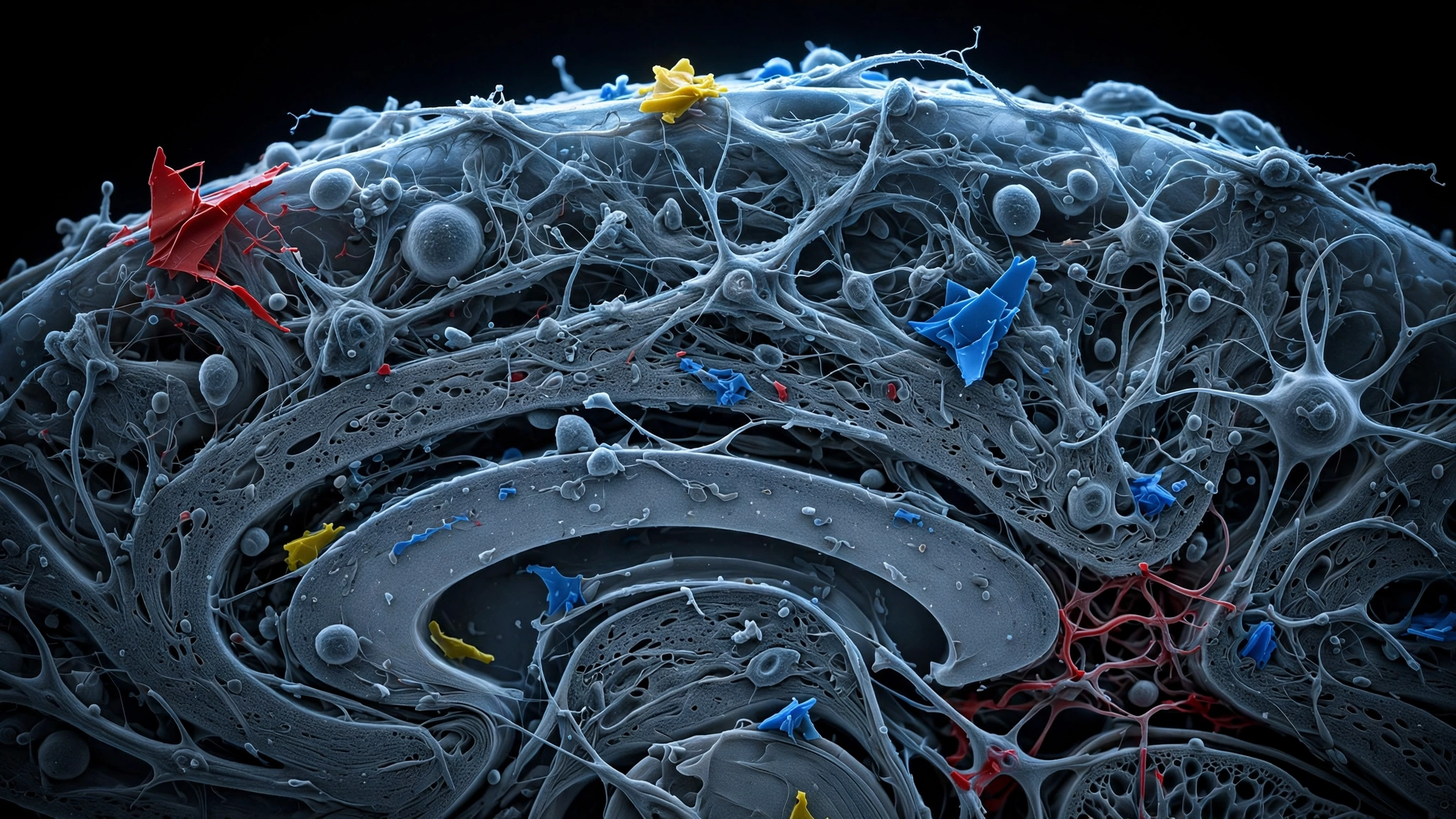
Seven grams. That is the mass of microplastic embedded in the average adult human brain as of 2024, according to autopsy data published in Nature Medicine by toxicologist Matthew Campen and colleagues at the University of New Mexico. They weighed frontal cortex samples from 52 decedents and found the 2024 tissue was 0.5% plastic by mass. Samples from 2016 measured roughly 0.33%. That is a 50% increase in eight years.
Nobody panicked about the number because it arrived without context: half a percent sounds tolerable and seven grams sounds abstract, the kind of measurement you read, nod at, and forget by the next paragraph. So we ran the numbers forward, compiled every published organ-specific concentration, and calculated what your total microplastic body burden probably is right now.
Roughly 10 grams of microplastic are inside the average adult human, concentrated overwhelmingly in the brain. And the brain's share is growing at 5.1% per year.
The growth rate that nobody projected
Campen's study compared autopsies from 2016 and 2024 in Albuquerque, New Mexico, using pyrolysis gas chromatography-mass spectrometry. Brain tissue went from approximately 3,300 micrograms of plastic per gram of tissue to 5,000 micrograms per gram. A 50% increase across eight years produces a compound annual growth rate of 5.13%.
If that rate holds, here is what brain microplastic concentration looks like over the next 25 years:
| Year | % of brain by weight | Grams of plastic (1,400g brain) |
|---|---|---|
| 2016 | 0.33% | 4.7 |
| 2024 | 0.50% | 7.0 |
| 2026 | 0.55% | 7.7 |
| 2030 | 0.68% | 9.5 |
| 2035 | 0.87% | 12.2 |
| 2040 | 1.12% | 15.7 |
| 2050 | 1.87% | 26.2 |
By 2050, this model predicts 26 grams of microplastic inside the average human brain, nearly an ounce, a granular mass that would be visible to the naked eye if you could extract it from the tissue it has infiltrated.
Where the plastic sits in you right now
The brain gets the headlines because it accumulates microplastics at 7 to 30 times the concentration of the liver or kidneys, but every solid organ has been measured, and none of them came up clean. A 2025 study in The Innovation used Raman imaging and machine learning across seven organs in eight donors, finding microplastic particles in every single tissue examined, from spleen to small intestine to lung parenchyma. A separate cerebrospinal fluid study published in 2026 found seven types of plastic polymers in the fluid surrounding the brain, with polyvinyl chloride concentrations correlating to a 3.82-fold increase in intracranial aneurysm risk across 156 patients.
We combined all available organ-specific data to estimate a total body burden, drawing concentrations from different studies using different methodologies, which makes this compilation approximate rather than definitive, but it is the first time anyone has assembled the numbers into a single table:
| Organ | Mass (g) | Est. concentration | Plastic load (mg) |
|---|---|---|---|
| Brain | 1,400 | 5,000 µg/g | 7,000 |
| Lungs | 1,300 | ~700 µg/g | 910 |
| Liver | 1,500 | ~500 µg/g | 750 |
| Small intestine | 1,040 | ~400 µg/g | 416 |
| Kidneys | 310 | ~250 µg/g | 78 |
| Heart | 300 | ~300 µg/g | 90 |
| Spleen | 150 | ~400 µg/g | 60 |
| Blood (5L) | 5,000 | ~1 µg/mL | 5 |
Total estimated body burden across solid organs and blood: approximately 9,300 mg, or 9.3 grams. Conservatively rounded, that is roughly 10 grams of microplastic inside the average adult human being alive today. Seventy-five percent of it sits in the brain.
Why the brain hoards plastic
The brain is 60% fat by dry weight, and polyethylene, the dominant microplastic polymer found in brain tissue, is lipophilic, meaning it dissolves into lipid membranes the way oil dissolves into butter, settling into the fatty myelin sheaths that wrap every neuron and refusing to leave. It also receives roughly 15% of cardiac output despite being only 2% of body weight, which means it is exposed to a disproportionate share of circulating particles with every heartbeat, minute after minute, year after year.
Research published in Science Advances in 2025 identified a specific mechanism: immune cells in the bloodstream phagocytose microplastic particles, swell with their cargo, and then lodge in the narrow capillaries of the brain cortex, forming microthrombi that reduce local blood flow and produce measurable neurological abnormalities in mice. These particles are not simply inert passengers; they obstruct the plumbing.
The dementia correlation
Campen's team also examined brain tissue from 12 deceased individuals with documented dementia diagnoses. Those brains contained 3 to 10 times more microplastic than the non-dementia control group. A commentary in Brain Medicine by University of Ottawa researchers described the finding as "particularly alarming."
If dementia brains carry 3x the normal load, that is 21 grams of plastic. At 10x, it is 70 grams. Seventy grams is the weight of a small apple sitting inside the skull.
Cost implications of even partial attribution are staggering. Medicare and Medicaid spend approximately $360 billion per year on Alzheimer's and other dementias, according to the Alzheimer's Association, and if microplastic accumulation is a contributing factor in even 5% of cases, that represents $18 billion per year in healthcare costs potentially linked to plastic exposure; at 10%, the figure doubles to $36 billion.
This is correlation, not causation, and that distinction matters enormously. People with dementia tend to be older, which means more years of cumulative exposure. Its blood-brain barrier may degrade in dementia, allowing more particles to enter after disease onset rather than causing it. Campen himself has repeatedly emphasized that his team cannot yet determine directionality, and the Science Advances thrombosis study, which showed a plausible causal mechanism in mice, has not been replicated in human tissue.
How much are you eating?
Multiple studies have attempted to quantify microplastic ingestion, with estimates ranging from 0.1 to 5 grams per week through food, water, and air according to a 2020 study published in the Journal of Hazardous Materials, which translates to 5 to 260 grams per year depending on diet, water source, and geography.
If the brain accumulates approximately 0.35 grams of new plastic per year (derived from our compound annual growth rate) and total ingestion sits at roughly 130 grams per year at the midpoint of published estimates, then the brain retains about 0.27% of ingested load, a fraction so small it sounds harmless until you remember it never leaves. A 2026 physiologically based kinetic model published in Environment International confirms this: the vast majority of ingested microplastics are eliminated through feces, with systemic retention measured in fractions of a percent, but "small" in a system that processes hundreds of grams per year still means grams per decade accumulating in lipid-rich tissue that cannot metabolize or expel them.
What the strongest objection sounds like
The most compelling argument against alarm comes from the same data. At 0.5% plastic by weight, the brain's concentration is comparable to its normal mineral ash content. Healthy brain tissue contains roughly 1% inorganic material, mostly calcium, phosphorus, and trace metals. Adding 0.5% polyethylene to a matrix that already tolerates 1% mineral content may not constitute a crisis. Human bodies have evolved to function with impurities in their tissues. Fetal brains develop in an environment containing microplastics, since particles have been found in placentas and amniotic fluid, meaning the youngest humans alive today have never known a brain without plastic in it.
Additionally, the 5.1% annual growth rate assumes environmental plastic exposure continues to increase at its current trajectory. Global plastic production grew at roughly 4% annually through 2023. But the UN Global Plastics Treaty, finalized in 2025, commits signatory nations to reducing plastic production. If the exposure curve bends, the accumulation curve bends with it. Those projections are not destiny.
But consider the response: mineral ash is inert calcium phosphate. Polyethylene is not inert. It leaches plasticizers, adsorbs persistent organic pollutants from the environment, and triggers inflammatory responses via NF-kB signaling pathways. And the cerebrospinal fluid study found a dose-response relationship between PVC concentration and intracranial aneurysm risk with a p-value below 0.01 across 156 patients. "Inert" materials do not produce dose-response curves.
Limitations
Our forward projections assume compound growth at 5.1% per year, a rate that holds only if environmental plastic exposure continues its current trajectory. Actual trajectory depends on environmental exposure trends, policy interventions, individual diet and geography, and biological mechanisms we do not yet understand well enough to model with confidence. Our body burden table combines data from studies using fundamentally different analytical methods: pyrolysis GC-MS for the brain, Raman spectroscopy for the multi-organ study, and immunoassays for blood, making cross-method comparisons inherently approximate. All brain data comes from a single institution in Albuquerque, a desert city with specific environmental conditions that may not generalize to coastal or tropical populations. Only 12 subjects comprised the dementia comparison. Larger, multicenter cohort studies are needed before anyone should draw clinical conclusions, and we want to be explicit that our projections are mathematical extrapolations of a single dataset, not predictions of inevitable biological outcomes.
What You Can Do
Reduce exposure where the data is clearest. Heating food in plastic containers releases orders of magnitude more particles than storing it cold. One straightforward change: switching from plastic food storage to glass or steel, particularly for anything that gets microwaved. Bottled water contains roughly 240,000 particles per liter (a 2024 Columbia University study using stimulated Raman scattering), compared to roughly 5,000 particles per liter in unfiltered tap water. A reverse-osmosis filter at home reduces particle count to near zero.
Infant feeding bottles release up to 16 million microplastic particles per liter of formula prepared in them. That number, from a 2020 Nature Food study, is not a typo. If you are preparing formula for a child, glass bottles with silicone sleeves cost roughly the same as plastic alternatives.
Beyond personal choices, the policy lever matters more. Roughly 40% of all plastic produced becomes single-use packaging. Reducing that fraction at the production stage would bend the environmental exposure curve that ultimately determines how much plastic ends up in your frontal cortex. Individual filtration helps. Industrial-scale production reduction is the only path that changes the projections above.
The Bottom Line
Your brain contains approximately 7 grams of microplastic today. That number is growing at 5.1% per year based on the only longitudinal autopsy data available. By 2040, current trends put it above 1% of brain mass. Across your body, roughly 10 grams of microplastic sit right now, with the brain carrying three-quarters of the load. People who die with dementia carry 3 to 10 times more. We do not yet know whether the plastic is a cause or a bystander, but we do know it is not inert, it is accumulating, and the trajectory is a 5% compound curve pointed up.