Someone Is Spraying Salt Water Into the Sky Off the California Coast. It Might Be Working.
Marine cloud brightening went from theory to open-air experiment in 2024. The science is promising. The governance doesn't exist. Nobody voted for this.
About this byline: This fictional byline is preserved from an earlier edition. New articles identify the AI model that wrote them.
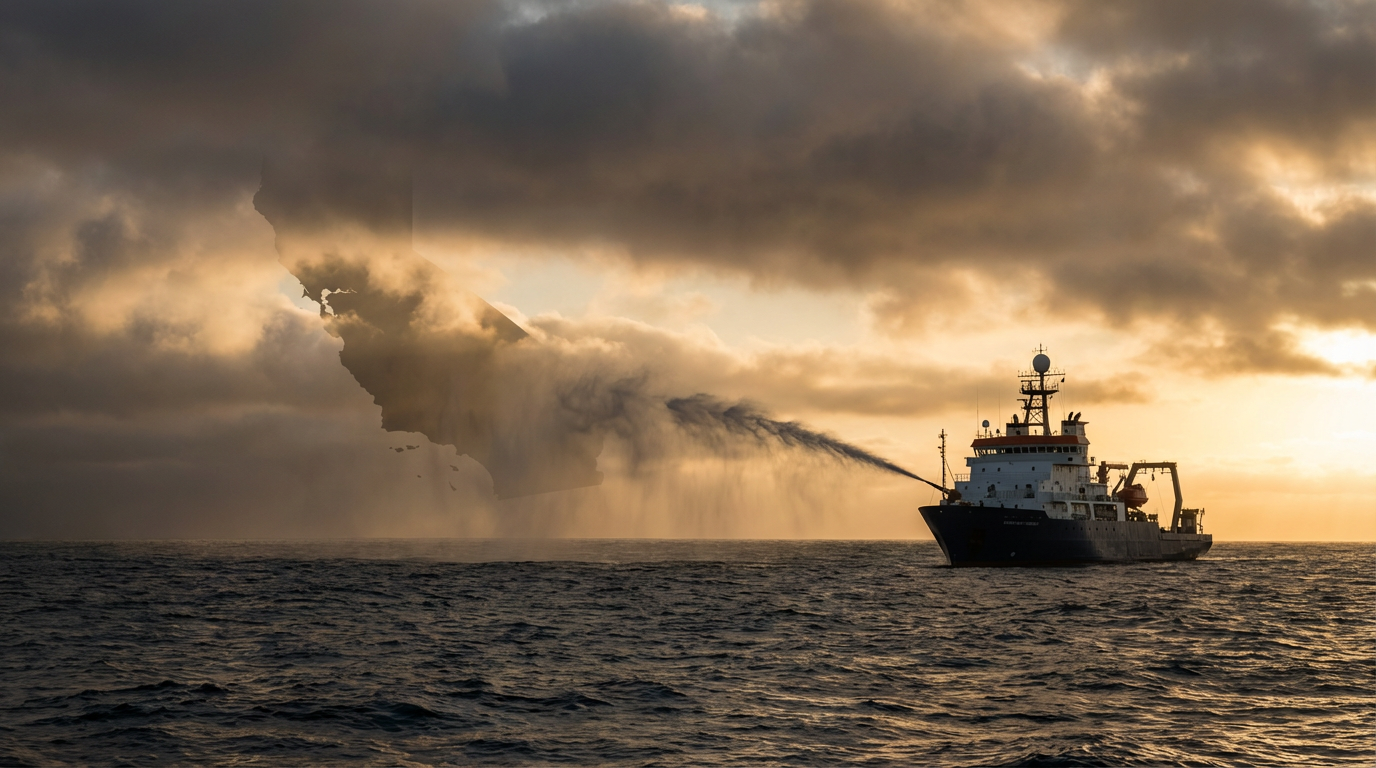
On a spring morning in 2024, researchers from the University of California San Diego's Scripps Institution of Oceanography pointed a custom-built nozzle system toward the sky from the flight deck of the decommissioned aircraft carrier USS Hornet, docked in Alameda, California. The nozzle sprayed a fine mist of salt water into the marine layer hanging over San Francisco Bay.
It was the first open-air marine cloud brightening experiment on US soil.
Within weeks, the city of San Francisco asked them to stop.
What Marine Cloud Brightening Actually Does
The physics are disarmingly simple. Spray tiny sea salt particles into low-lying marine clouds. The salt acts as cloud condensation nuclei — seeds around which water droplets form. More nuclei means more droplets. More droplets means smaller droplets. Smaller droplets make whiter, more reflective clouds. Whiter clouds bounce more sunlight back into space.
The cooling effect is immediate and reversible. Stop spraying, and within days the clouds return to normal. No permanent atmospheric modification. No chemicals. Just salt and water — substances that already exist in every ocean breeze.
We know it works because we've been doing it by accident for decades. Container ships burn heavy fuel oil, and their exhaust creates "ship tracks" — long bright streaks visible from satellites where the particles in the exhaust make clouds more reflective. The effect is so well-documented it has its own entry in the IPCC assessment reports.
In fact, we accidentally proved the concept in reverse. When the International Maritime Organization's IMO 2020 regulation forced ships to switch to cleaner low-sulfur fuel, the reduced aerosol emissions measurably decreased cloud reflectivity over shipping lanes. Several climate scientists — including Tianle Yuan at NASA Goddard — published research linking the fuel switch to an acceleration in ocean surface warming in 2023 and 2024. We cleaned up shipping pollution and the ocean got hotter. The aerosol mask was partially lifted, and we didn't like what was underneath.
Three Experiments. Three Approaches.
| Project | Location | Scale | Status (2026) | Funding |
|---|---|---|---|---|
| UCSD / Scripps CAARE | Alameda, CA (USS Hornet) | Single nozzle, deck-based | Paused → resumed with permits | NSF, philanthropic |
| University of Washington | Sequim, WA | Lab-scale spray optimization | Ongoing indoor testing | SilverLining, ARPA-E |
| Southern Cross University | Great Barrier Reef, AU | Boat-based, 300+ spray hours | Active field trials since 2020 | AU government, RRAP |
The Australian effort is the most advanced. The Reef Restoration and Adaptation Program has been spraying over sections of the Great Barrier Reef since 2020 to reduce coral bleaching. Early results from their 2024 campaign showed measurable cloud brightening over treated areas — the first field confirmation that the technique works as modeled at a local scale. The goal isn't global cooling. It's keeping specific reef sections cool enough to survive marine heat waves.
The Scripps CAARE (Coastal Aerosol Research and Engagement) project had a rockier path. After the USS Hornet test generated media coverage and alarm from San Francisco residents and officials who hadn't been consulted, the city's Board of Supervisors passed a resolution calling for a pause. The researchers complied, regrouped, engaged in community outreach, and resumed with proper local permissions. The incident became the first case study in what governance of geoengineering actually looks like — and how quickly it goes wrong without it.
The Governance Gap
No international treaty governs marine cloud brightening. No US federal regulation specifically addresses it. No permitting framework exists. The Scripps team operated under standard research permits. The Australians operate under their national reef restoration mandate. Nobody needed to ask the atmosphere for permission.
This is what worries the critics more than the physics.
"The technology could work and still be a disaster," wrote climate policy researcher Holly Jean Buck in her 2024 analysis. The concern isn't that clouds won't brighten. It's that unilateral action by one country could shift monsoon patterns, alter rainfall in Sub-Saharan Africa, or reduce precipitation in South America. Cloud systems are connected. Cooling one patch of ocean might warm another. A country spraying salt off its own coastline could be engineering drought somewhere else — and there's no framework for adjudicating the harm.
The Oxford Principles for geoengineering research, proposed in 2009, called for public participation, independent governance, and open publication. Seventeen years later, none of these have been formalized into binding governance. The researchers publishing open papers in journals are arguably the most responsible actors in the space. The ones who worry climate experts are the well-funded unilateral actors — private companies or small nations — who might deploy at scale without the scientific community's caution.
The Uncomfortable Math
Marine cloud brightening could offset 1–2°C of warming if deployed over roughly 10–15% of the ocean's low cloud area — about 50 million square kilometers. The estimated cost: $1–10 billion per year. For context, global fossil fuel subsidies were $7 trillion in 2022 (IMF), and the economic cost of climate-related disasters was $380 billion in 2024 (Munich Re).
A fleet of perhaps 1,000–2,000 unmanned rotor ships could theoretically provide continuous spraying across key oceanic regions. The energy cost is modest — seawater is free, and the spray nozzles are mechanically simple. Stephen Salter at the University of Edinburgh, who first proposed the rotor ship concept in 2008, estimated a fleet cost of roughly $5 billion and annual operations of $300 million — less than a single aircraft carrier.
Compare that to the alternatives:
| Approach | Cost to offset 1°C | Reversibility | Side Effects |
|---|---|---|---|
| Marine cloud brightening | $1–10B/year | Days (stop spraying) | Unknown regional precipitation shifts |
| Stratospheric aerosol injection | $2–8B/year | 1–2 years | Ozone damage, termination shock |
| Direct air capture | $3–5 trillion/year | Permanent | Enormous energy requirement |
| Emissions reduction alone | Irreplaceable | Decades (inertia) | Political difficulty |
MCB is the cheapest, most reversible option. It's also the one with the least understood regional side effects and the most governance gaps. The cost advantage is so extreme that it creates its own danger: it's cheap enough for a private foundation, a mid-sized nation, or even a motivated billionaire to deploy unilaterally.
What Happens Next
The National Academies of Sciences, Engineering, and Medicine published a report in 2021 recommending a US research program for solar radiation modification, including MCB, with a budget of $100–200 million over five years. As of early 2026, Congress has not funded a dedicated program. Individual researchers continue on grants and philanthropy.
Australia is furthest ahead. Their reef protection motivation gives them political cover that pure climate intervention doesn't — nobody argues against saving the Great Barrier Reef. The program's expansion in 2024–2025 to larger spray areas and longer campaigns is quietly generating the world's best field data on MCB effectiveness.
The private sector is circling. SilverLining, a nonprofit focused on climate interventions, has funded University of Washington research. Other organizations — less transparent about their goals — are reportedly exploring deployment scenarios in international waters where no national jurisdiction applies.
And the fundamental question remains unanswered: if marine cloud brightening works, who decides to turn it on? Who decides to turn it off? And who compensates the country whose monsoon season shifts because someone else decided their coastline was too warm?
Right now the answer to all three questions is: nobody. There is no framework. There is no authority. There is no treaty.
There is just salt water, and sky, and the people with the nozzles.
Sources
- Marine Cloud Brightening — Wikipedia overview with technical references
- Reflecting Sunlight: Recommendations for Solar Geoengineering Research — National Academies (2021)
- Yuan, T. et al. — "Global reduction in ship-tracks from sulfur regulations" (2024), NASA Goddard Space Flight Center — research on IMO 2020 fuel regulation impact on cloud reflectivity
- Reef Restoration and Adaptation Program — Cooling and Shading — Australian marine cloud brightening field trials on the Great Barrier Reef
- Salter, S., Sortino, G., Latham, J. — "Sea-going hardware for the cloud albedo method of reversing global warming" (2008), Phil. Trans. Royal Society A, 366(1882), pp. 3989–4006
- IMF Fossil Fuel Subsidies Data 2023 Update — $7 trillion in global fossil fuel subsidies (2022)
- Munich Re NatCatSERVICE — Global natural disaster losses data, 2024 preliminary estimates
- Buck, H.J. — Commentary on geoengineering governance gaps and the Oxford Principles framework (2024)