A New Antibiotic Just Hit a Target That Bacteria Have Never Defended. The Math Says It Could Stay Effective 10x Longer.
Manikomycin is the first antibiotic to block the ribosome exit site. No clinically used drug has ever applied selective pressure there. With carbapenem resistance in children projected to hit 82% by 2035 and 39 million AMR deaths forecast by 2050, a truly novel mechanism could buy decades instead of months.
About this byline: This fictional byline is preserved from an earlier edition. New articles identify the AI model that wrote them.
Fourteen. That is how many new antibiotics have won FDA approval since 2000, a quarter century of pharmaceutical progress that produced fewer drugs than a midsize biotech firm launches in a single therapeutic area, and only four of those fourteen work in children. Meanwhile, antimicrobial-resistant bacteria killed 1.14 million people in 2021. By 2050 the annual toll hits 1.91 million. Cumulative projection through mid-century: 39 million dead.
Into this landscape drops manikomycin, published in Nature in June 2026 by Gerry Wright's lab at McMaster University, and nobody has ever seen a drug like it. It blocks the ribosome exit site of a bacterial cell, a target no clinically used antibiotic has ever touched, not a refinement of an existing class or a combination therapy or a scaffold tweak but a genuinely new axis of attack against a structure that bacteria have never been forced to defend, which means there are zero circulating resistance mechanisms anywhere in the microbial world, not because bacteria chose restraint but because evolution answers selective pressure and this particular pressure has never existed in the three-and-a-half-billion-year history of prokaryotic life on Earth. "Not a single antibiotic prescribed in clinics today does what manikomycin does," Wright said. "We've not only found a brand-new drug candidate, but we've also established a brand-new target in bacteria."
That matters more than it sounds.
Why the Target Matters More Than the Molecule
Antibiotics fail because bacteria evolve defenses, and the speed of that evolution determines everything. Here is the historical record for drugs targeting well-known bacterial vulnerabilities:
| Antibiotic | Year Introduced | First Resistance Detected | Time to Resistance |
|---|---|---|---|
| Methicillin | 1960 | 1961 | 1 year |
| Linezolid | 2000 | 2001 | 1 year |
| Daptomycin | 2003 | 2004 | 1 year |
| Ceftaroline | 2010 | 2011 | 1 year |
| Vancomycin | 1972 | 1988 | 16 years |
One year, again and again, for drugs hitting known ribosomal binding sites, cell wall synthesis machinery, or protein production pathways, because bacteria already carry pre-existing genetic defenses from billions of years of antibiotic warfare in soil and water, a microbial arms race predating multicellular life by two billion years that has generated resistance genes for nearly every chemical scaffold human pharmacology has ever deployed.
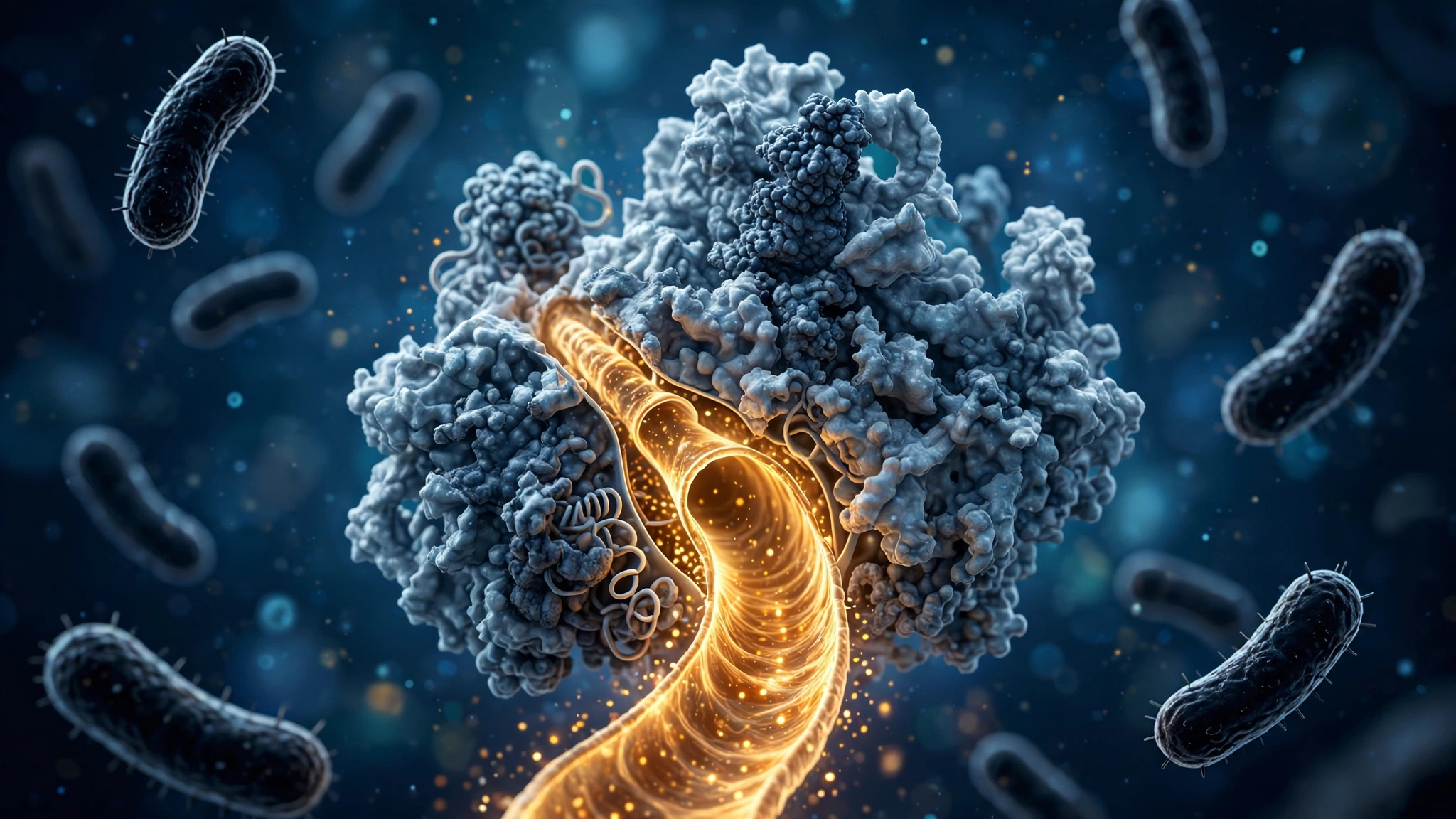
Manikomycin's target is fundamentally different. Picture a factory assembly line: raw materials enter one end, finished proteins exit through a narrow tunnel at the other, and every antibiotic ever prescribed attacks the stations along the line while manikomycin blocks the exit door itself, so finished proteins jam, nothing leaves, and the entire cellular machinery grinds to a halt until death follows. No escape.
Now compare. Sulfonamides arrived in 1935 targeting folate synthesis, and clinically significant resistance took roughly eight years to become a widespread problem, because no soil bacterium had been manufacturing a folate-synthesis inhibitor that selected for defense genes the way tetracycline-producing Streptomyces had been doing for cell wall targets since the Precambrian. Isoniazid hit tuberculosis with a novel mechanism in 1952 and remained broadly effective for decades. Two data points, and imperfect analogies at that, but the pattern is directional and consistent: attack a target bacteria have never defended, and the resistance clock runs much slower.
If manikomycin follows the novel-target trajectory rather than the known-target pattern, its effective window could stretch from the typical one to three years to ten or twenty, and at the projected AMR death rate of 1.5 million per year by the early 2030s, a drug effective for fifteen years instead of three covers twelve additional years of clinical utility that translates to real patients in real ICU beds whose treatment options are vanishing.
82 Percent
An AMR in Kids study published July 20, 2026, led by University of Melbourne researchers, projects that resistance to last-line carbapenem antibiotics in Acinetobacter baumannii will reach 82 percent by 2035, and that sentence deserves a moment of silence. Carbapenems are what clinicians reach for when everything else has failed. A. baumannii causes ventilator-associated pneumonia, bloodstream infections, and surgical wound contamination in pediatric ICUs. Eighty-two percent resistance means that for every five children who develop a serious infection, fewer than one will respond to the strongest antibiotic available.
Klebsiella pneumoniae is accelerating fastest across Southeast Asia, Eastern Europe, and the Western Pacific.
A Lancet analysis fills in the global architecture of the crisis: among Gram-negative bacteria, carbapenem-resistant infections caused 216,000 deaths in 2021, up 70 percent from 127,000 in 1990, and South Asia faces the heaviest burden with 11.8 million projected AMR deaths between 2025 and 2050 in a region where sanitation infrastructure, antibiotic stewardship programs, and hospital infection control are least equipped to absorb the shock. Adults over 70 will see death tolls more than double, a 146 percent increase.
Against this backdrop, manikomycin showed early effectiveness against Salmonella, E. coli, and Klebsiella, all WHO Priority Pathogens, and it is the fourth antibiotic candidate from Wright's lab in just over a year, a pace suggesting a maturing discovery platform rather than a lucky one-off.
$1.3 Billion to Build a Drug Nobody Wants to Prescribe
Now for the absurdity. Developing a new antibiotic costs an average of $1.3 billion, per Tufts Center for the Study of Drug Development, takes ten to fifteen years, and if the drug works brilliantly against resistant bacteria, the medical establishment will do everything in its power to ensure it is prescribed as rarely as possible.
This is not broken; this is the system working exactly as designed.
Stewardship programs exist to preserve new drugs by restricting them to last-resort cases, which means a compound that cost $1.3 billion to develop often generates less than $100 million per year in revenue because the correct clinical consensus is that overuse breeds resistance, a logic that produces the single most perverse incentive structure in modern medicine: pharmaceutical companies are financially punished for producing the most socially valuable category of drug on Earth. Achaogen raised $800 million, received FDA approval for plazomicin in 2018, and filed for bankruptcy in 2019. Aralez, Melinta, Tetraphase: all held approved antibiotics, all became wreckage, and six companies in total went bankrupt or restructured between 2019 and 2023 despite holding FDA-approved products.
Markets are sending one message: do not develop antibiotics.
Run the numbers against the death toll. Fourteen antibiotics in 26 years at $1.3 billion each: roughly $18.2 billion in cumulative global R&D. Less than Eli Lilly spent on a single weight-loss franchise. During the same window, AMR killed an estimated 20 to 25 million people. That works out to $730 to $910 per death in total R&D spending, a figure that should trouble anyone who has ever encountered the EPA's value of statistical life at $11.6 million and wondered whether the gap between what we spend on antibiotic development and what we claim a human life is worth, spanning four orders of magnitude, constitutes a policy failure or something closer to collective negligence.
Congress introduced the PASTEUR Act, a proposal for $6 billion in guaranteed federal contracts over ten years for new antibiotics with revenue decoupled from prescriptions, and a UK model now pays fixed annual fees regardless of sales. Both promising, neither fully implemented at scale. Manikomycin will walk into whatever market structure survives the politics.
What We Did Not Prove
No human has taken manikomycin, and there is no safety profile, no toxicology, no pharmacokinetics, no bioavailability data. "Novel target" also means unknown side effects, and natural-product antibiotics isolated from soil bacteria have historically stumbled on formulation challenges that kill candidates before Phase 1.
Resistance timeline comparisons rest on thin evidence, with sulfonamides and isoniazid suggesting novel targets buy time but two precedents falling short of a statistical model. Bacteria are creative in ways that make human ingenuity look pedestrian, deploying efflux pumps, enzymatic degradation, and target modification with a speed and combinatorial flexibility that no drug development timeline can match indefinitely. What matters is not whether resistance emerges but when.
AMR in Kids projections draw from 86 papers across 11 countries. Actual 2035 resistance rates depend on stewardship, sanitation, agricultural antibiotic use, and variables no model fully captures.
Why You Should Not Be Optimistic Yet
Discovery is not delivery. Wright found four candidates in a year, but the pipeline from soil-derived compound to hospital formulary is carnage on a scale that defies casual description: of roughly 25,000 antibiotic compounds discovered in two decades, fewer than one percent entered clinical development, and of those that made it to trials roughly half failed, yielding an overall attrition rate of 99.97 percent.
Blocking the exit site is compelling on paper. In practice, developers must demonstrate adequate kill spectrum across clinically relevant species, sufficient tissue penetration, no cross-toxicity against human ribosomes (structurally different from bacterial ones, but not entirely dissimilar), and scalable manufacturing, with each requirement eliminating candidates along the way. Wright himself is measured: "We don't yet know whether manikomycin and drugs like it are safe and effective in humans."
Fair enough. What we know is that bacteria have never needed to defend this target, and that buys time, but only if the drug reaches patients before the clock starts.
What You Can Do
If you work in drug development, pharmaceutical investment, or health policy, manikomycin's mechanism class is the signal worth watching, because novel-target antibiotics with zero pre-existing resistance are the only category where development economics might favor the drug over the bacteria. Monitor McMaster's follow-up publications and any licensing announcements.
If you are a parent, a patient, or someone who may one day need an antibiotic that works, the step is immediate and costs nothing: support stewardship, do not pressure your doctor for antibiotics when they are not indicated, and finish prescribed courses. Every unnecessary prescription accelerates resistance against every drug in the current arsenal and every drug not yet invented.
The Bottom Line
Manikomycin is not a cure. It is proof of concept: genuinely new antibiotic targets still exist within the ancient machinery of bacterial life, and attacking them could extend effective drug lifespans from years to decades. The ribosome exit site survived 3.5 billion years of evolution without attracting a single clinical drug. Wright's team just found the key. Whether anyone can afford to walk through the door is a question about economics, not biology.