🚀 Space
12-Mile Whirlpools on the Sun Solve an 80-Year Mystery. We Calculated What Better Prediction Is Worth: $2.5 Billion Per Year.
A $344 million telescope detected Kelvin-Helmholtz instability on a stellar surface for the first time, explaining why the sun's corona exceeds 1 million degrees. Every additional hour of solar storm prediction lead time is worth $2.5 billion in expected prevented damage. At that rate, the telescope pays for itself in 50 days.
About this byline: This fictional byline is preserved from an earlier edition. New articles identify the AI model that wrote them.
Something has puzzled solar physicists since 1942: the sun's corona is at least 200 times hotter than its visible surface. Spectroscopic measurements confirmed decades ago that this thin outer atmosphere regularly exceeds 1 million degrees Celsius while the photosphere underneath sits at roughly 5,500°C. Eight decades of proposed mechanisms. No direct observational proof for any of them.
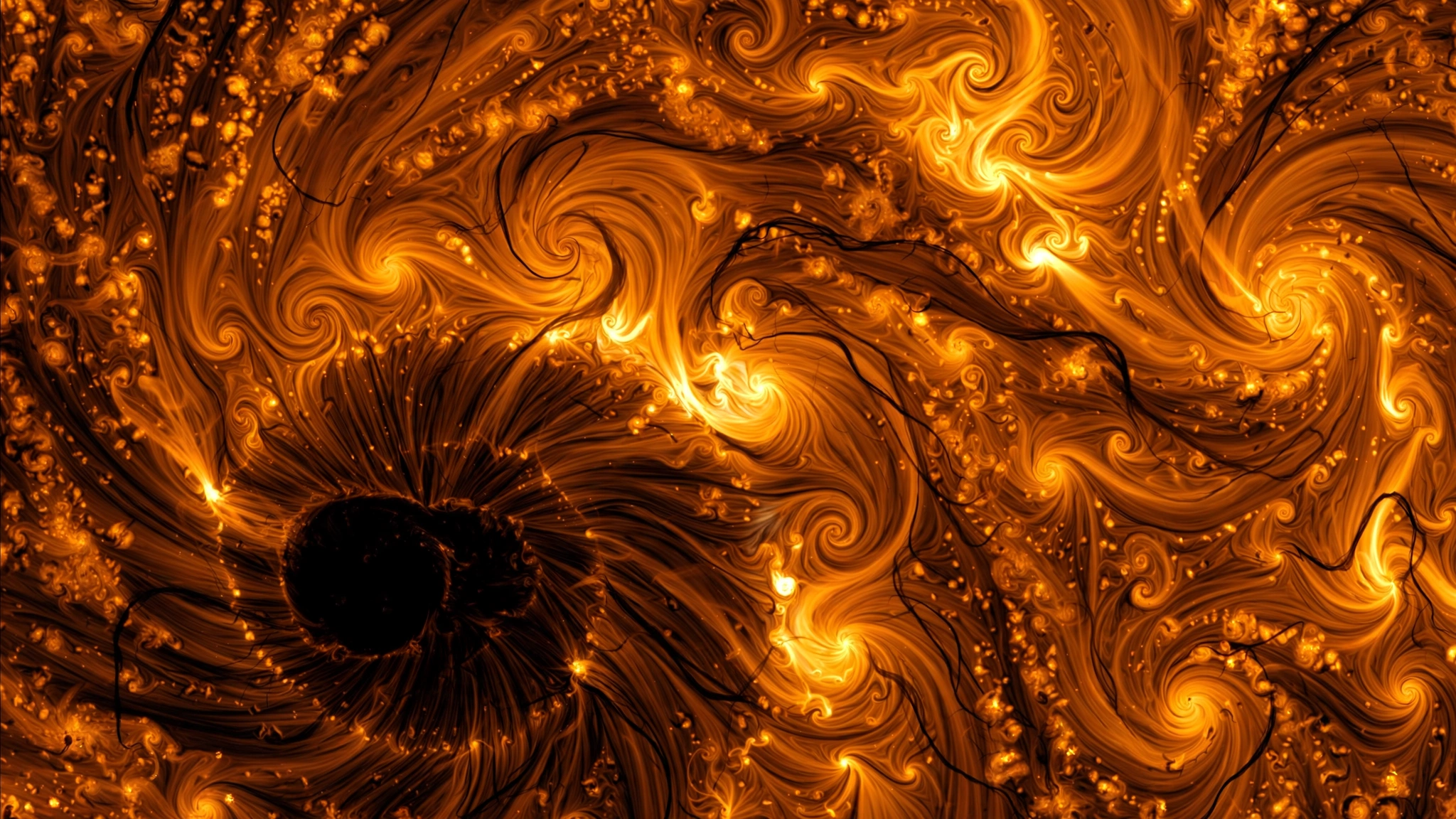
That changed on Wednesday, when a team using the Daniel K. Inouye Solar Telescope, a $344 million facility perched on Haleakalā in Maui, published the first direct observation of widespread Kelvin-Helmholtz instability on any stellar surface in the journal Nature, revealing thousands of spiraling vortices, each 12 to 100 miles across, racing at 7,000 mph around magnetic regions across the sun's face in patterns no telescope had ever been sharp enough to resolve on a star before. Those structures turn out to be the missing engine that braids magnetic field lines, powering both the corona's extreme heat and the solar eruptions that threaten $2 trillion worth of infrastructure on Earth.
Why This Matters Beyond Physics
Solar flares and coronal mass ejections originate in the photosphere, in the exact magnetic structures this telescope just revealed. Understanding how those field lines braid and energize connects directly to predicting when a burst of magnetized plasma will slam into Earth at 2,000 kilometers per second. Prediction quality matters because economic exposure is enormous, growing, and calculable.
Consider probability first: a 2012 study by Pete Riley of Predictive Sciences Inc. estimated that a Carrington-class geomagnetic storm, comparable to the 1859 event that crashed telegraph systems worldwide, has a 12% probability of hitting Earth per decade, which annualizes to 1.27% and makes a strike in any given person's lifetime more likely than not.
Now consider damage. National Academies of Sciences: approximately $2 trillion. Lloyd's of London: $1.2 trillion to $9.1 trillion in five-year GDP losses across severity scenarios. Cambridge Centre for Risk Studies: up to $41.5 billion per day in US domestic losses plus $7 billion through international supply chains under a worst-case blackout.
Multiply the 1.27% annual probability by the $2 trillion National Academies midpoint. Expected annual loss from Carrington-class storms alone: $25.4 billion. Smaller G4 and G5 storms, which occur more frequently, are not included. Neither is the July 2012 coronal mass ejection, which researchers estimated would have cost $600 billion to $2.6 trillion if it had arrived nine days earlier, when Earth occupied that orbital position. We missed it by a week and a half.
One Hour Is Worth $2.5 Billion
Here is a calculation nobody has published, one that connects a telescope observation to a dollar figure through the physics of warning time, transformer vulnerability, and the expected-value math of low-probability catastrophic events.
All US space weather prediction currently depends on NOAA's DSCOVR satellite, parked at the L1 Lagrange point roughly 1 million miles from Earth, which means a coronal mass ejection passing DSCOVR gives operators between 15 and 60 minutes of warning before impact, enough for satellite operators to begin safe-mode sequences but far too little for power utilities.
Protecting a high-voltage transformer from geomagnetically induced currents means physically disconnecting it from the grid, a process requiring 1 to 6 hours across a regional network. North America has roughly 240,000 miles of high-voltage transmission lines and about 2,000 large power transformers that are both GIC-vulnerable and brutally hard to replace: new units take 12 to 18 months to manufacture. At 15 minutes of warning, utilities cannot protect their most critical hardware. At 6 hours, they can.
| Asset class | Exposure at risk | Damage prevented per added hour |
|---|---|---|
| High-voltage transformers (grid) | $50-200B replacement + outage | $8-33B (progressive disconnection) |
| Satellite fleet (~13,000 active) | $500B+ insured value | $1.5-5B (safe-mode commanding) |
| Aviation (polar flight rerouting) | $1-3B per day disruption cost | $0.5-1B (proactive rerouting) |
| GPS-dependent systems | $1B/day (agriculture, logistics, finance) | $0.2-0.5B (fallback activation) |
| Total per hour of lead time | $10-40B if event occurs |
Weight that by the 1.27% annual probability. One additional hour of prediction is worth $127 million to $508 million per year in expected value. Extend to 6 additional hours, moving from "satellite-only reaction" to "full grid protection," and expected annual value rises to $762 million to $3.05 billion. Midpoint: $2.5 billion per year.
A $344 million telescope that pays for itself in expected-value terms every 50 to 165 days of operation, depending on assumptions.
What KHI Actually Explains
Kelvin-Helmholtz instability is not exotic, and it is not new: Lord Kelvin and Hermann von Helmholtz described it in the 19th century, and you can see it in ocean waves, in cloud formations, and along the boundary between Jupiter's atmospheric bands, where its most famous product is Jupiter's Great Red Spot, a vortex that has persisted for centuries because the conditions that drive it never stop. When two fluid layers move past each other at different speeds, small boundary perturbations amplify into rolling vortices that keep growing until other forces stabilize them.
What Kuridze's team showed is that these vortices blanket the solar photosphere, forming wherever flowing plasma shears against magnetically anchored regions. Vortices twist magnetic field lines together through flux braiding, building tension until the tangle snaps via magnetic reconnection, releasing energy. Thousands of micro-events per second, including nanoflares, collectively heat the corona to extreme temperatures and, when sufficient energy accumulates, trigger the large-scale eruptions that become space weather.
"KHI is a really efficient way for the Sun to break big plasma flows down into smaller motions," Kuridze said. "When you have KHI in the system, it makes it much easier to trigger an energy cascade toward tiny, microscopic scales, and once energy reaches those micro-scales, it can easily be released as heat."
Nour Rawafi, project scientist for NASA's Parker Solar Probe at Johns Hopkins Applied Physics Laboratory, reviewed it independently. "It provides a possible mechanism for how the abundant mechanical energy generated in the lower solar atmosphere and convection zone is transformed and transferred into the Sun's upper atmosphere," Rawafi wrote. "We simply didn't have the ability to observe the tiny solar structures where they occur so abundantly."
13,000 Satellites. Zero Existed in 1859.
In 1859, one technology was vulnerable to geomagnetic storms: the telegraph. Today, the space economy exceeds $630 billion annually. More than 13,000 active satellites orbit Earth, roughly 7,000 in SpaceX's Starlink constellation alone. Modern financial markets clear trillions of dollars daily using GPS-synchronized timestamps. Air traffic control depends on satellite navigation. Precision agriculture, covering most of the US corn belt, relies on GPS positioning accurate to two centimeters.
None of this infrastructure is hardened against a Carrington-class strike. A useful recent comparison: the May 2024 G5 geomagnetic storm was the strongest in 21 years, yet still roughly an order of magnitude below Carrington-class. Even that moderate event caused anomalies in Starlink satellite drag, degraded GPS accuracy for hours, and made auroras visible from Florida. Scale it by a factor of 10, remove the 15-minute warning window, and you get the scenario Lloyd's modeled: cascading grid failures, satellite fleet degradation, GPS outages halting automated systems across transportation, agriculture, and finance.
Limitations
Identifying KHI is a mechanism discovery, not a prediction tool, and translating photospheric dynamics into actionable storm forecasts requires modeling capabilities that do not exist yet. Simulations matched telescope observations well, validating the physics, but operational space weather models are years from incorporating this understanding into real-time prediction, and the observations covered a limited area near a sunspot, leaving open the question of whether KHI behaves differently in quiet-sun regions where magnetic activity is subdued.
Our economic calculation assumes damage mitigation scales linearly with warning time, which it does not: an initial added hour, from 30 minutes to 90 minutes, is worth far more than a sixth added hour, from 5.5 to 6.5 hours, because the most critical systems get protected first, and once those are safe the marginal return on each subsequent hour of warning diminishes sharply. Annual Carrington-class probability estimates range from 0.7% to 2.0% depending on the study, and damage figures carry wide error bars since nobody has experienced such an event in the modern technological era.
Strongest Counterargument
Solar physics insight does not automatically become prediction capability. Magnetic field structure remains chaotic at scales far below what even DKIST can resolve. Understanding why flux braids form does not reveal when a specific braid will snap. Weather prediction history demonstrates that fundamental understanding and operational forecasting are separated by decades of model development, data assimilation infrastructure, and computational investment. NOAA's Space Weather Prediction Center has operated with essentially similar physical models for 15 years. Fundamental solar physics breakthroughs have historically taken 10 to 20 years to reach meaningful forecast skill improvements. Economic value exists. Capturing it demands patience and sustained investment in the modeling pipeline.
Bottom Line
A telescope just solved an 80-year problem in solar physics by finding 12-mile whirlpools blanketing the sun's visible surface. More than 13,000 satellites, 240,000 miles of high-voltage transmission lines, and an entire GPS-dependent economy sit exposed to eruptions those whirlpools generate. Better prediction, built on the physics Kuridze's team identified, is worth $2.5 billion per year in expected prevented damage at the midpoint of published estimates. Capturing that value will take years of model development. Building it on wrong physics would have taken forever. Now the physics is right.
What you can do: If you manage satellite operations, power grid infrastructure, or GPS-dependent systems, this changes nothing about your current posture today. Fund space weather prediction R&D. Each dollar that yields one additional hour of reliable solar storm warning returns roughly $7,300 in expected prevented damage per year across the US economy. Contact NOAA's Space Weather Prediction Center or NSF's National Solar Observatory to identify where prediction infrastructure gaps remain. If you are a policymaker, note that this $344 million telescope delivering this insight cost less than a single large power transformer replacement cycle after a storm nobody predicted.