🏙️ Urban
ICON's $20-Per-Square-Foot Walls Are Now on Sale. Here's What It Actually Costs to Print a House.
The Titan 3D construction printer can lay down a 2,500-square-foot home's wall system in seven days with two technicians. The wall cost: $50,000. The real cost to move in: $174,000 to $263,000. Closing the 5.5-million-home US deficit would require 21,154 printers running for a decade.
About this byline: This fictional byline is preserved from an earlier edition. New articles identify the AI model that wrote them.
You can now buy a machine that prints a house. Not a concept render, not a government pilot, not a startup pitch deck with renderings of Mars habitats. A real, commercially available construction robot that lays down structural concrete walls at $20 per square foot, less than half the national average for conventional framing, and ships to your job site in 2027.
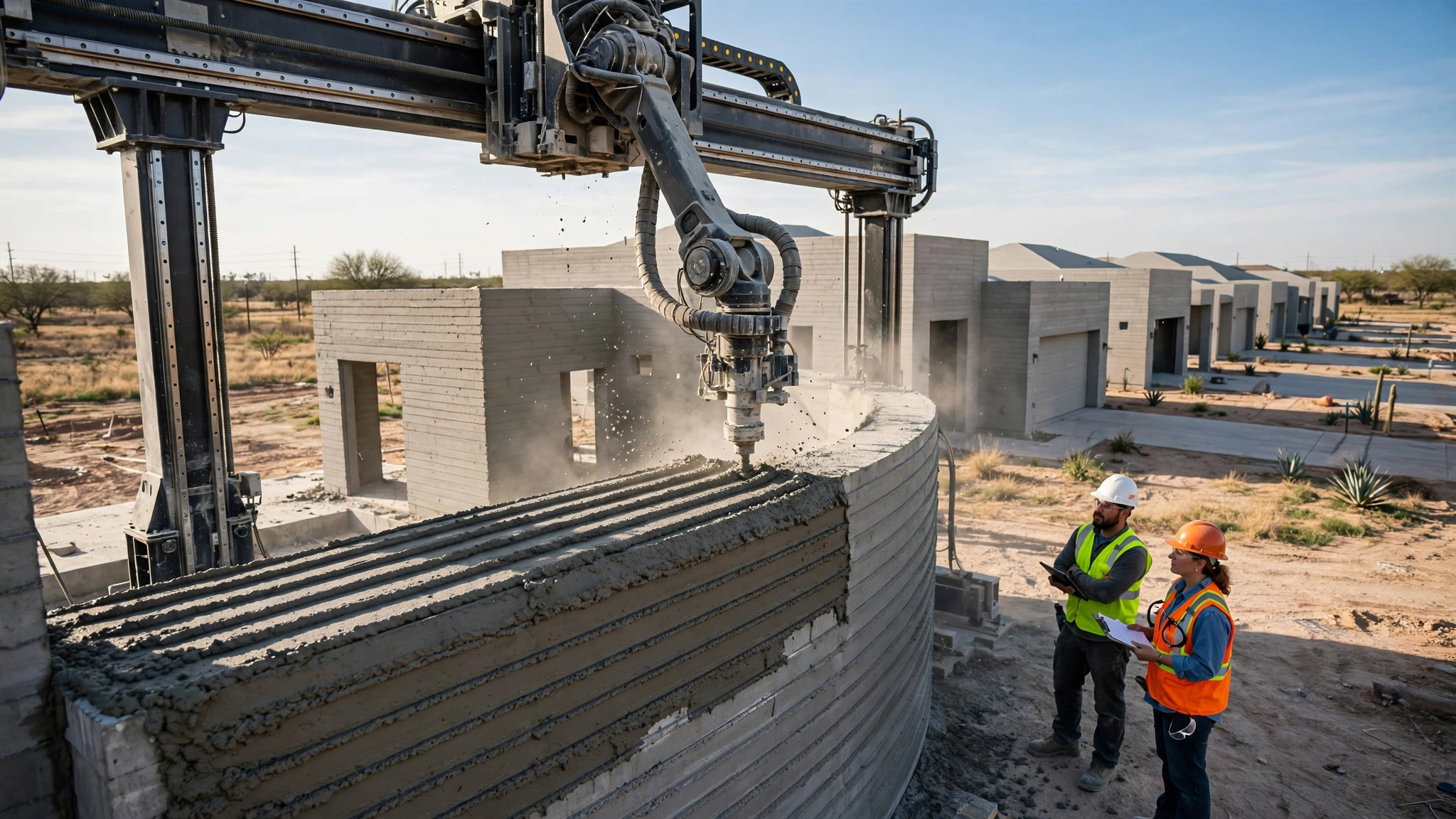
ICON, the Austin-based construction technology company, has opened sales of its Titan 3D construction printer. Its specs sound like science fiction translated into a purchase order: a 2,500-square-foot two-story home's wall system printed in under seven days by two technicians, with under an hour of startup time. Buyers get the printer, a pump system, access to ICON's BuildOS software platform, on-site training, and a three-year warranty.
That $20-per-square-foot wall figure has generated breathless headlines. For a 2,500-square-foot home, it means $50,000 in printed walls. Compare that to the $150-to-$250-per-square-foot range for a conventionally built home, and the savings look revolutionary.
They're not, at least not yet, and understanding why requires doing math that most 3D-printing coverage skips entirely.
The 20% Problem Nobody Mentions
Here's the number that demolishes the "$50,000 house" narrative: the 3D-printed wall system typically represents only 15 to 30 percent of a finished home's total construction cost. The remaining 70 to 85 percent (foundation, roofing, plumbing, electrical, HVAC, windows, doors, interior finishes, cabinetry, appliances) involves the same traditional trades that haven't changed meaningfully since the Eisenhower administration. An analysis by EvoRelic tracking 3D-printed housing ecosystems across the US through 2026 confirms this structural reality. Three-dimensional concrete printing automates the vertical construction phase, which is important, but it's one act in a five-act play.
We built a ground-up cost estimate for a 2,500-square-foot printed home, using ICON's wall pricing, EvoRelic's construction cost data, and RS Means residential construction databases:
| Component | 3D Printed Home | Traditional Home |
|---|---|---|
| Wall system | $50,000 | $62,500–$165,000 |
| Foundation | $15,000 | $15,000 |
| Roofing | $20,000 | $20,000 |
| Plumbing | $20,000 | $20,000 |
| Electrical | $16,000 | $16,000 |
| HVAC | $15,000 | $15,000 |
| Interior finishes | $45,000 | $45,000 |
| Windows and doors | $15,000 | $15,000 |
| Permits, design, site prep | $22,000 | $22,000 |
| Total (excl. land) | $218,000 | $230,500–$333,000 |
The real savings range from roughly $12,500 on the low end to $115,000 on the high end, depending on local framing costs. For a midrange market like Austin or Raleigh, expect the 3D-printed home to come in around 25 to 35 percent cheaper than conventional stick-frame construction. That's genuine and meaningful, but it is not the 87 percent reduction you'd calculate if you confused wall cost with home cost.
The Printer Payback Is Startlingly Fast
ICON hasn't disclosed Titan pricing, but comparable large-format construction printers from COBOD, Apis Cor, and Mighty Buildings range from $250,000 to $3 million depending on configuration and capacity, and industry analysts estimate the Titan will fall in the $1 million to $2 million range given its feature set, its bundled software platform, and ICON's positioning as the premium player in a market that barely existed three years ago.
Assume a midpoint of $1.5 million, average wall-system savings of $50,000 per home over conventional framing (conservative, using the midpoint of our table). Assume one home completed every two weeks, allowing for setup, printing, teardown, and site transition, which yields approximately 26 homes per year.
At $50,000 in savings per home, the Titan pays for itself in 30 homes, or roughly 14 months, and cutting the savings estimate in half still yields a break-even point under two and a half years. For a production homebuilder constructing 50 or more homes per year across multiple sites, the economics are already compelling at current pricing, which means the question is no longer whether the math works but whether the permitting, the code approvals, and the finishing trades can keep pace with what the machine can lay down.
21,154 Printers to Close the Housing Gap
The National Association of Realtors estimates the United States is underbuilt by 5.5 million homes. Freddie Mac puts the figure at 3.8 million. Either number is enormous. American homebuilders completed roughly 1.5 million units in 2025, and the deficit grows by an estimated 400,000 homes per year as population grows faster than construction.
Here is a calculation nobody in the 3D-printing industry has published. To close the NAR's 5.5-million-home deficit within a decade, the US would need to add 550,000 additional homes per year, on top of current production. At 26 homes per printer per year, that requires 21,154 Titan-class printers operating simultaneously.
That number is absurd as a literal production target. But it illustrates the scale gap between the technology's current state and the problem it claims to solve. Even at 1 percent penetration (214 printers, roughly 5,500 homes per year), 3D printing would represent less than 0.4 percent of annual US housing completions.
The technology's impact will be felt first not in volume but in locations. Labor-starved markets like west Texas oil towns, rural communities, and disaster recovery zones, where finding ten skilled framers for six months is the actual bottleneck. Two technicians and a Titan can operate where a traditional crew cannot be assembled at any price.
The 50% Labor Reduction Is Real, but Unevenly Distributed
A conventional 2,500-square-foot home requires five to ten workers over approximately six months, roughly 6,000 to 12,000 labor-hours from foundation to certificate of occupancy. ICON's wall-printing phase requires two technicians for seven days at twelve-hour shifts: 168 labor-hours. Even accounting for the traditional finishing trades that follow (electricians, plumbers, roofers, cabinetry installers), the total labor-hour count drops to roughly 3,000 to 5,000 per home.
That is a 50 to 60 percent reduction in total labor-hours. The Bureau of Labor Statistics reports 440,000 unfilled construction jobs in the United States, with the average worker now 42.4 years old and climbing. The industry isn't just short-staffed; it's aging out of its workforce. Every year, more framers retire than enter the trade.
But the reduction isn't evenly distributed. The 3D printer eliminates framing labor almost entirely. It does nothing for plumbers, electricians, or HVAC technicians, the skilled trades with the worst shortages and highest wages. A printed home still needs a licensed electrician pulling wire through conduit, a plumber sweating copper joints, and an HVAC technician balancing ductwork. Until those trades are automated (and no commercially viable system does this today), 3D printing compresses one bottleneck while leaving the others untouched.
Where the Technology Actually Fits
ICON's strongest competitive position isn't against Lennar or D.R. Horton in suburban subdivisions. It's in three specific contexts where conventional construction fails entirely.
First: disaster recovery. After Hurricane Helene devastated western North Carolina in 2025, FEMA's temporary housing program took months to deploy manufactured units. A fleet of Titan printers could produce permanent concrete homes (hurricane-rated, fire-resistant, termite-proof) faster than modular housing can be trucked in, on sites where skilled labor has evacuated.
Second, military and government housing: the Department of Defense maintains 300,000 family housing units and has a documented maintenance backlog exceeding $35 billion. ICON has already printed structures for the Marine Corps, and a standardized Titan-based replacement program across military installations could cut costs dramatically, operated by a small trained crew rather than local subcontractors whose quality varies by base location.
Third, developing markets: in India, where conventional construction runs ₹1,500-₹3,500 per square foot, 3D printing achieves ₹850-₹1,500, a 40 to 60 percent reduction, with dramatically fewer skilled workers required. For nations facing simultaneous housing shortages and construction labor gaps, the Titan's two-technician model is transformative in ways it is merely incremental in the US market.
What This Analysis Did Not Prove
We don't have ICON's actual Titan pricing. Our payback calculation uses industry range estimates, and the real number could shift the break-even point by a year in either direction. Long-term durability data doesn't exist yet: no 3D-printed concrete home has survived a decade. Concrete is a well-understood material with century-scale durability in conventional construction, but the layer-by-layer deposition process creates horizontal interfaces between each printed course that could behave differently under thermal cycling, seismic loading, or moisture penetration over decades, and nobody knows yet.
Permitting remains jurisdiction-by-jurisdiction: Texas, Virginia, and a handful of other states have approved 3D-printed residential structures, but most haven't. A builder in California or New York faces years of code review before the first concrete layer is deposited, because ready hardware has outpaced unready regulations.
The Strongest Case Against
The most serious objection to 3D-printed housing comes from economics, not engineering. In the markets with the worst housing affordability crises (San Francisco, New York, Boston, Los Angeles), construction cost is not the primary barrier. Land in San Francisco averages $800,000 per lot. Permitting takes 18 to 36 months. Community opposition adds years to any development over four units. A 35 percent reduction in construction cost saves $100,000 on a $1.4 million home, meaningful but not transformative.
Markets where construction costs dominate housing prices (Houston, Phoenix, Raleigh, San Antonio) are also the markets where traditional homebuilders are already most efficient and labor is most available. 3D printing solves the hardest version of the problem (labor-starved, remote, or disaster-affected areas) better than it solves the largest version (urban supply constraints driven by land and regulation).
The Bottom Line
ICON's Titan printer represents the first commercially purchasable system capable of printing residential wall structures at a cost that genuinely undercuts conventional framing. The 25 to 35 percent total cost reduction, 50 to 60 percent labor-hour reduction, and seven-day wall timeline are real numbers backed by completed projects. Printer-payback math works within two years for any builder producing more than 15 homes annually.
But this is not a $50,000 house. It is not going to close the 5.5-million-home deficit. And it is not going to make San Francisco affordable. What it will do is make permanent, hurricane-rated concrete housing buildable in places where conventional construction is impossible due to labor scarcity, and make entry-level housing 25 to 35 percent cheaper in mid-tier markets where land costs haven't already consumed the savings. That alone represents a $40-to-$90-billion annual market opportunity in the United States, if the building codes catch up.
What You Can Do
If you're a production homebuilder: request Titan pricing directly from ICON and model the break-even against your current framing subcontractor costs. At 15+ homes per year, the math likely works in your favor now.
If you're a municipal planner: begin code review for 3D-printed concrete structures before a builder forces the question. Texas and Virginia offer template language, and getting ahead of permitting is the single largest accelerant for adoption in your jurisdiction.
If you're a homebuyer in a mid-tier market: 3D-printed homes will start appearing in new developments in 2027-2028. Watch for them. The structural performance matches or exceeds stick-frame construction (monolithic concrete, no joints, hurricane- and termite-resistant), and the price premium relative to conventional is negative. You'll likely pay less. Ask builders whether they use 3D-printed wall systems the same way you'd ask about insulation grade or foundation type.
If you're in a skilled trade (electrical, plumbing, HVAC): your job is safe from this technology. 3D printing automates framing, not finishing. Every printed home still needs every wire pulled, every pipe fitted, and every duct balanced by a licensed human. Demand for your skills will increase as printed homes drive construction volume up.