💻 Quantum
IBM Just Bought the Lab That Invented the Laser. The Reason Is 18 Electrons Spinning in Silicon.
HRL Laboratories survived mass layoffs, published two breakthrough papers in Nature, and got acquired by IBM in six months. Silicon spin qubits leapt from 2 qubits at 4% error to 18 qubits at 0.2% error in three years. An original qubit-density analysis comparing spin qubits to superconducting circuits reveals why IBM is wagering its $10 billion quantum roadmap on technology built with the same lithography that makes your phone’s processor.
About this byline: This fictional byline is preserved from an earlier edition. New articles identify the AI model that wrote them.
Three years ago, the entire field of silicon spin qubits could fit its best work on a device with two quantum bits. Error rates ran around 4%. One in twenty-five operations went wrong. At that failure rate, the system could not even detect its own mistakes, let alone correct them. Superconducting circuits had hundreds of qubits by then. Trapped ions could run small algorithms. Neutral atoms were scaling into the thousands. Spin qubits had a two-qubit chip and a theoretical argument about silicon manufacturing that sounded increasingly like an excuse.
Not anymore.
Two papers published today in Nature say the excuse was actually a prophecy.
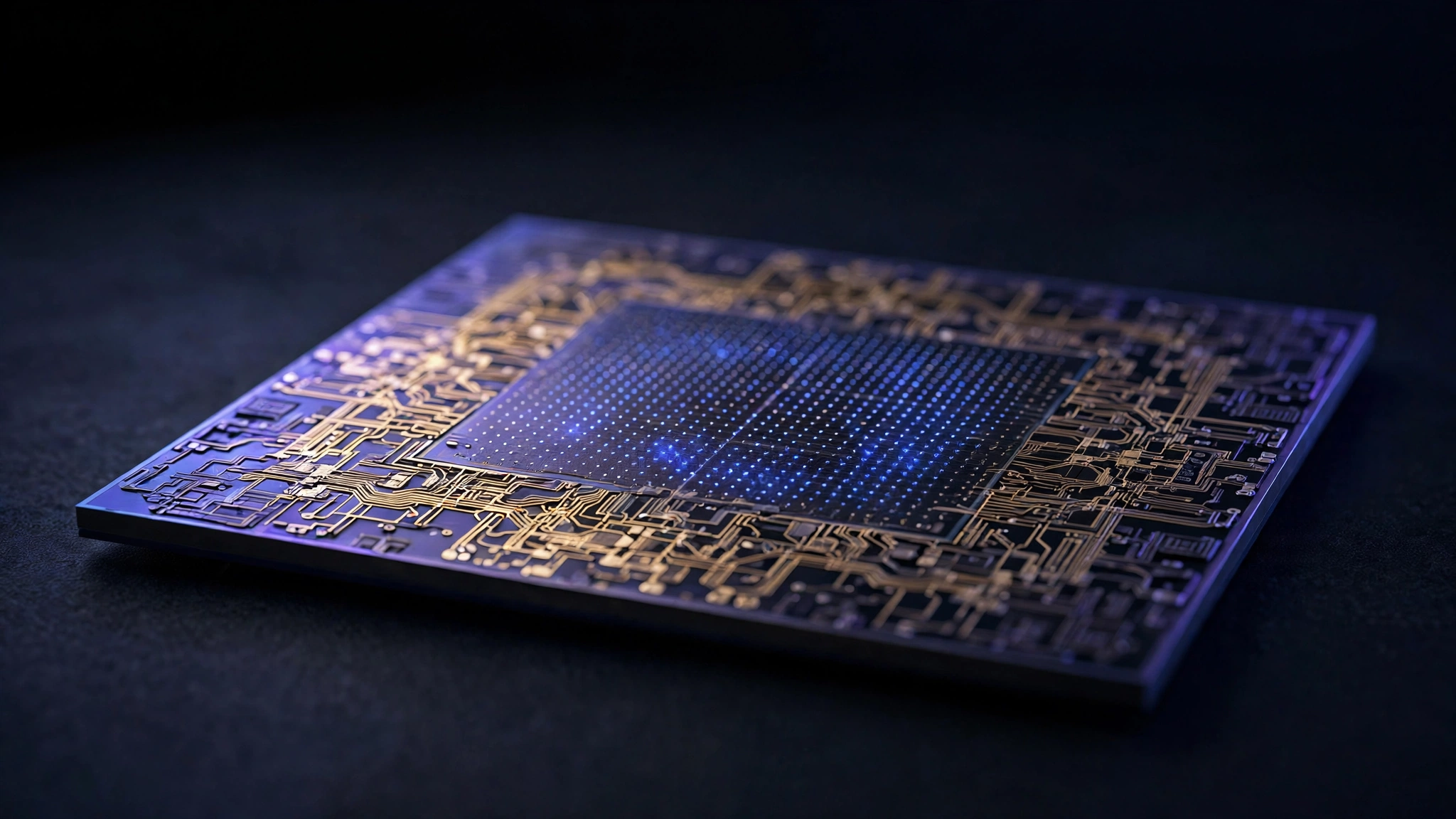
A team at HRL Laboratories in Malibu, California, demonstrated an 18-spin-qubit processor built from 56 quantum dots, running a distance-5 repetition code with error rates of 0.2% and producing a distance improvement factor of 4.7. Errors shrank by nearly five times when they scaled from three data qubits to five. In the same issue, researchers at QuTech in Delft, the Netherlands, reported weight-four parity checks in a spin-shuttling architecture that physically moves electrons between zones on a chip, achieving comparable error rates on five qubits. Both papers are in Nature volume 655.
Nine times more qubits, twenty times fewer errors, in thirty-six months.
And on July 23, six days before these papers went public, IBM announced it had signed a definitive agreement to acquire HRL from its owners Boeing and General Motors.
IBM builds superconducting quantum computers, and it has for two decades, deploying more than 90 systems worldwide while signing over $1.1 billion in client contracts since 2017. It just committed more than $10 billion to quantum computing over five years, all of it premised on superconducting circuits. So why buy a spin qubit lab?
Because spin qubits are made of silicon, and silicon has a trillion-dollar manufacturing ecosystem that no other qubit technology can access.
The Lab That Nearly Died
HRL Laboratories has a claim to fame that most quantum physicists would trade their publication record for: it is the place where the laser was invented. Theodore Maiman, Irnee D’Haenens, and Charles Asawa built the first working laser there in 1960, when the lab was still called Hughes Research Laboratories, a division of Howard Hughes’s aircraft company. HRL also developed the self-aligned gate process for MOS transistors in 1965, a fabrication method that underlies every integrated circuit manufactured today, and wrote the world’s first autonomous cross-country navigation software for DARPA in 1984. Over its nearly eighty-year history, the lab has amassed more than 1,100 patents, and earlier this year it faced mass layoffs after losing US government contracts. Its quantum team kept working. Their Nature paper describes a processor where each qubit is encoded in the collective spin state of three electrons trapped in silicon quantum dots, controlled entirely by electrical pulses delivered through a single cryogenic control chip connected by a superconducting ribbon cable. It operates at approximately zero magnetic field, with external coils canceling Earth’s field. Isotopic enrichment of the silicon suppresses nuclear spin noise, giving the qubits coherence times of about 20 microseconds.
That matters, because 20 microseconds is long enough to run the 335,422 exchange pulses, 1,805 initializations, and 805 measurements required for a single instance of their distance-5 repetition code experiment. Logical error rates bore this out: 5.0 × 10⁻³ per round for the distance-5 code versus 2.4 × 10⁻² for distance-3 subsets. Error correction worked: scaling up reduced errors by a factor of 4.7 rather than introducing new ones.
“A significant milestone in the technological maturity of semiconductor spin qubits,” one peer reviewer wrote, in a report that HRL shared with Nature’s news team. Jay Gambetta, IBM’s Director of Research, was more direct about the commercial implications: “The HRL team will help IBM push even farther forward toward the frontiers of quantum innovation.”
Everyone Showed Up at Once
HRL’s paper is not an isolated result. The spin qubit field just hit an inflection point where multiple groups, using different materials and architectures, are all crossing similar thresholds simultaneously.
QuTech’s paper in the same Nature issue demonstrates a spin-shuttling architecture where electrons are physically moved between functional zones on a chip, achieving weight-four parity checks at error rates comparable to HRL’s, while in April, Groove Quantum, a startup also based in Delft, posted results on arXiv for an 18-qubit germanium-based device with similar error rates, and this month a group at RIKEN in Wako, Japan, reported a 5-qubit system in a preprint with an error rate below 0.01%, which is 400 times lower than the state of the art just three years ago.
These results span three different countries, four different institutions, two different semiconductor materials (silicon and germanium), and at least two distinct device architectures. Convergence like that, across three countries, four institutions, two semiconductor materials, and at least two distinct architectures, is a signal that the underlying technology is ready to scale rather than one group having gotten lucky.
The Density Calculation Nobody Ran
To understand IBM’s acquisition logic, you have to think about physical qubit density, the number of qubits you can pack onto a chip of a given size, and then multiply it by the overhead required for quantum error correction.
Superconducting qubits are built around Josephson junctions, tiny sandwiches of superconductor-insulator-superconductor that need to be large enough to exhibit macroscopic quantum effects, and each one occupies roughly 100 × 100 micrometers of chip area, which gives you approximately 10,000 physical qubits per square centimeter. With the standard surface code that Google, IBM, and most superconducting qubit teams use for error correction, you need on the order of 1,000 physical qubits to build one reliable logical qubit. A machine with 10,000 logical qubits, enough to tackle serious problems in drug discovery and materials science, would require 10 million physical qubits. At superconducting density, that is 1,000 square centimeters of chip area spread across an array of connected cryostats, each the size of a room.
Spin qubits are different. QuTech’s published work spaces quantum dots about 90 nanometers apart. At that pitch, you get roughly 12,300 potential qubit sites per square millimeter, more than 100 times the density of superconducting qubits, fabricated using the same lithographic tools that produce billions of transistors on a chip every year. That density advantage comes not from any quantum trick but from the brute fact that trapped electrons are physically smaller than Josephson junctions by three orders of magnitude.
Now layer on a new error correction scheme. In June, IQM Quantum Computers published results for “directional tile codes,” a family of error-correcting codes that reduce qubit overhead by up to 1,000 times compared to the surface code, using only nearest-neighbor gates at a hardware footprint of about 30 physical qubits per logical qubit. IQM demonstrated these codes on superconducting hardware, but the codes are architecture-agnostic. Applied to spin qubits, the math transforms.
| Metric | Superconducting + Surface Code | Spin Qubits + Directional Tile Codes |
|---|---|---|
| Physical qubit pitch | ~100 μm | ~90 nm |
| Physical qubits per cm² | ~10,000 | ~1,230,000 |
| EC overhead (phys:logical) | ~1,000:1 | ~30:1 |
| Logical qubits per cm² | ~10 | ~41,000 |
| Area for 10,000 logical qubits | ~1,000 cm² | ~0.24 cm² |
The numbers are stylized. Real devices have wiring overhead, control fan-out constraints, and thermal management challenges that eat into raw density, and spin qubits also require cryogenic cooling, though at slightly higher temperatures than superconducting circuits (hundreds of millikelvins versus tens). But even if the practical density advantage turns out to be only 100-fold rather than 4,000-fold, the conclusion does not change: a spin qubit processor with enough logical qubits to solve commercially important problems could fit on a single chip manufactured in an existing semiconductor fab.
That is IBM’s bet. Not that spin qubits are better today, but that their density advantage and their compatibility with CMOS manufacturing could eventually let IBM build quantum processors the way Intel builds CPUs, in factories that already exist, on wafers that already have supply chains.
The Strongest Objection
The hardest critique of this story is not about the science. It is about the timeline.
Superconducting qubits have a fifteen-year head start. IBM has deployed more than 90 quantum systems worldwide and signed more than $1.1 billion in client contracts since 2017. Its 120-qubit Nighthawk processor runs 25,000 times faster than the previous generation, Google demonstrated the first below-threshold surface code in 2024, and every piece of error correction software, every compiler, the middleware, the application libraries, and the developer tools have all been built for superconducting hardware.
Spin qubits have 18 qubits and a proof-of-concept repetition code, and moving from a repetition code, which corrects only bit-flip errors, to a full surface code or stabilizer code that corrects arbitrary errors in any direction typically requires four to five times more qubits, an engineering leap that no group has even started attempting at the fabrication level required for production hardware. Even with the extraordinary pace of the last three years, building a 100-qubit spin qubit processor with full error correction is a multi-year engineering challenge that has not yet begun.
The counterargument is that the semiconductor industry has spent sixty years learning how to scale silicon devices from one transistor to 100 billion. Fabrication infrastructure, EDA tools, packaging technology, and supply chains already exist, and what spin qubits need is not a new industrial revolution but for the existing one to build slightly different patterns on its wafers.
IBM’s roadmap reflects this dual strategy: Quantum Starling, due in 2029, will be the company’s first large-scale fault-tolerant quantum computer, built on superconducting technology, while Quantum Blue Jay, slated for 2033, targets one billion quantum operations across 2,000 qubits. A SiliconAngle report on the HRL acquisition noted that IBM “reportedly believes that [spin qubit] architecture could help unlock new performance gains after the 2033 release of its Blue Jay system.” In other words, spin qubits are not plan A. They are plan A-plus, the technology that takes over when superconducting circuits hit their physical density ceiling.
What We Did Not Prove
Our density comparison uses the best-case qubit pitch reported by QuTech (90 nm) and IQM’s directional tile code overhead (30:1). Both numbers come from frontier demonstrations, not production hardware. Nobody has built a spin qubit device at the qubit counts needed to test whether these density projections hold, and real devices will have wiring channels, classical control electronics, readout resonators, and thermal anchoring that significantly reduce effective density.
IQM’s tile codes have been demonstrated on superconducting hardware, not on spin qubits, and spin qubit error profiles may not be compatible with these codes without modification. RIKEN’s result of less than 0.01% error was on five qubits, and error rates tend to worsen as qubit counts increase due to crosstalk and calibration drift.
We also assumed that existing semiconductor fabs could produce spin qubit processors without major retooling, which is plausible given that quantum dots are fabricated with standard CMOS processes, but unproven at the yield levels required for large-scale quantum processors. IBM’s Anderon foundry in Albany is being built specifically for quantum wafer manufacturing, suggesting the company does not believe existing fabs can be repurposed trivially.
What You Can Do
If you allocate capital to quantum computing stocks or ventures, the HRL acquisition signals that the competitive landscape is shifting from a single-modality race to a multi-modality portfolio play. IBM’s move validates spin qubits as a credible second path and prices out competitors who bet everything on one qubit type. Watch for Intel, which has its own silicon spin qubit program, and TSMC, which recently announced a quantum foundry partnership with Japan, to make parallel moves within the next eighteen months.
If you are an engineer or physicist deciding where to specialize, consider this: HRL went from layoffs to an IBM acquisition in under a year, which means spin qubit expertise was valued at zero by the defense contracting market that funded it and apparently valued at something substantial by a company with a $10 billion quantum budget. Critical skills include cryogenic control engineering, isotopically enriched semiconductor fabrication, and quantum dot array design, and fewer than a thousand people on Earth have them.
If you are a policymaker evaluating quantum competitiveness, the geographic spread of today’s results, Malibu, Delft, Delft again, and Wako, should concern you. The US has exactly one spin qubit group that published at scale this week, and it is now being absorbed into a corporate lab. Europe has two (QuTech and Groove Quantum) and Japan has RIKEN. The Anderon foundry is an encouraging development, but spinning up domestic quantum talent takes a decade and the other programs have been running for longer.
The Bottom Line
A lab that nearly died from defense budget cuts just demonstrated a twenty-fold error improvement and a nine-fold qubit scaling increase in three years on a technology platform that happens to be compatible with the most sophisticated manufacturing infrastructure ever built by the human species. IBM, which has spent two decades and will spend $10 billion more building a quantum computing empire on a completely different type of qubit, decided that was worth acquiring. The spin qubit processors published today have 18 qubits. IBM’s superconducting systems have 120. Density math says that when spin qubits reach a few hundred, they could leapfrog superconducting systems in logical qubit count on a single chip. That day is not tomorrow. Based on current trajectory, somewhere between 2030 and 2035. No guarantee. But IBM is betting on it rather than against it, and that is the most important signal the quantum computing industry has sent in years.