💼 Labor & AI
Hyundai's Robot Strike Reveals a $130,000 Paradox: Every Dollar Workers Win Speeds Up Their Replacement
The auto industry's first factory stoppage over humanoid robots started this week in Ulsan. We ran the break-even math both sides refuse to say out loud: at $130,000 per Atlas and $70,000 per Korean worker, payback is 6.8 months. Under the union's own bonus demand, it falls to 4.1.
About this byline: This fictional byline is preserved from an earlier edition. New articles identify the AI model that wrote them.
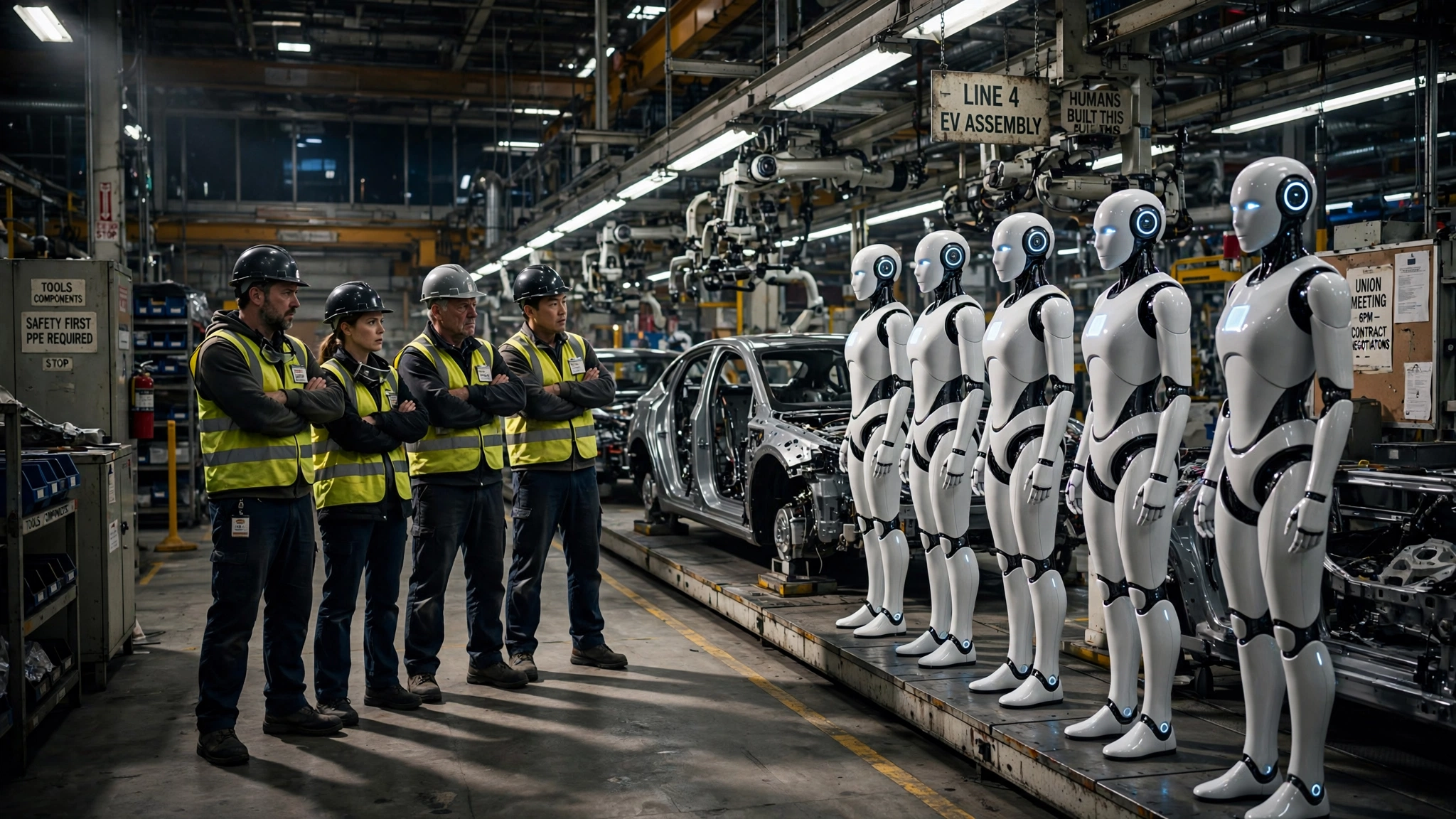
On Monday in Ulsan, South Korea, roughly 39,700 Hyundai Motor workers began walking off assembly lines for four hours a day. Production losses from the partial strike are projected at about 5,000 vehicles daily, costing the company an estimated 200 billion won, or $134 million, in lost sales. Workers last struck in 2018 over wages. What makes this week different is what triggered it: a six-foot-two humanoid robot named Atlas.
It is the auto industry's first factory stoppage in which humanoid robots are an explicit cause, a distinction that separates this week from the hundreds of automotive labor disputes that preceded it. Ninety-two percent of union members voted to authorize the action after 11 rounds of failed negotiations, and their demands reach well beyond the usual wage increases that characterize Korean labor cycles. For the first time, Hyundai's union is requesting a structural shift from hourly pay to fixed salaries, a retirement-age extension from 60 to 65, and binding job-security guarantees tied to AI and automation deployment. These demands are an attempt to write the rules of coexistence before the first Atlas sets foot in a Korean factory, locking in protections while labor still has leverage to demand them.
Hyundai hasn't announced when that will happen at home, but it has announced where it will happen first: the nonunionized Metaplant in Georgia, slated for Atlas deployment by 2028, where no collective bargaining agreement constrains the experiment. That geographic arbitrage says more than any press release Hyundai's communications team could draft.
The Break-Even Math Neither Side Will Say Out Loud
A South Korean government research institute pegs the cost of a single Atlas at $130,000. A Hyundai factory worker in Ulsan earns an average of 92 million won per year, roughly $70,000, including bonuses. To match Atlas's operational uptime of 20-plus hours per day, you need approximately 2.5 human workers rotating across shifts. That means the human-equivalent cost of one Atlas position is about $227,500 per year in Korea, counting benefits and employer overhead at 30%.
Divide the robot's $130,000 sticker price by the $227,500 it displaces annually, and break-even arrives in 6.8 months, not two years as the government estimate politely suggests and the WSJ reported, not the "several years" that industry PR materials imply, but less than seven months of operation before the machine has paid for itself in avoided labor costs alone.
A two-year payback figure likely assumes conservative utilization, unscheduled downtime, and maintenance windows that reduce Atlas to roughly a single-shift equivalent, which is a reasonable near-term assumption for a robot that hasn't been deployed in production at scale, but it isn't the number Hyundai is building toward. Boston Dynamics designed Atlas with dual self-swappable batteries and a 4-hour cycle specifically to approach continuous operation, and when utilization reaches 20 hours a day, the math collapses into months rather than years.
| Scenario | Atlas Unit Cost | Hourly Cost (all-in, 5yr) | Worker Equivalent (multi-shift) | Break-Even |
|---|---|---|---|---|
| Current prototype | $300,000 | $16.69 | $21.88 (Korea) | 15.8 months |
| 10K unit scale | $130,000 | $5.59 | $21.88 (Korea) | 6.8 months |
| 30K unit scale | $50,000 | $2.30 | $21.88 (Korea) | 2.6 months |
| 10K vs. US worker | $130,000 | $5.59 | $30.77 (US) | 9.7 months |
Hourly cost assumes a 5-year operational life at 20 hours per day, with annual maintenance at 10% of purchase price and electricity at $0.50 per hour. Worker equivalents include benefits and employer overhead and multiply by 2.5 for round-the-clock coverage parity.
The Bonus Paradox
Here is where the math turns uncomfortable for anyone rooting for the workers to win their bonus fight. Among the union's demands is a profit-sharing bonus worth 30% of Hyundai's annual net profit, and last year Hyundai netted 10.36 trillion won, so thirty percent comes to 3.09 trillion won, which divided among roughly 39,700 union members works out to about 77.9 million won per worker, approximately $59,000 on top of base salary. That would push total compensation from 92 million won to 169.9 million won, around $130,000 per year.
Redo the break-even with that number. A $130,000 Atlas versus a $130,000-a-year worker, with 2.5 needed to match the robot's hours, makes the annual human-equivalent cost roughly $422,500, and break-even drops to 4.1 months.
Every dollar the union wins in these negotiations makes the robot cheaper by comparison, which is not a commentary on whether workers deserve higher pay, since they are producing vehicles that generated $56 billion in the parent group's revenue last quarter alone, but the observation is structural and inescapable. In any negotiation where one side's cost is variable and the other side's cost is on a semiconductor-style deflation curve, the variable side is bidding against a price that only moves in one direction, and the wage-escalation cycle across Korean industry illustrates the acceleration: SK Hynix agreed to 10% of operating profit, Samsung Electronics' union is demanding 15%, Samsung Biologics wants 20%, and Hyundai's 30% demand sits at the top of a ratchet that paradoxically builds the financial case for the very machines the workers are striking against.
The Cost Curve Has Its Own Timetable
Samsung Securities estimates that Atlas manufacturing costs will fall from $130,000 to $50,000 at 30,000 units and $30,000 at 50,000 units, and these are not aspirational projections tacked onto a slide deck but engineering cost curves underwritten by signed supply agreements. Hyundai has committed to producing 30,000 Atlas robots by 2028, the tooling is underway, the actuator supply agreement with Schaeffler is signed, and the Georgia plant where Atlas will first deploy is under construction.
Actuators account for 47 to 50 percent of a humanoid robot's bill of materials. Morgan Stanley's teardown of Tesla's Optimus Gen 2 priced the complete BOM at roughly $55,000, with legs consuming 38.6% ($21,300) and arms taking 29.5% ($16,300). Twenty-eight actuators per robot, each requiring precision-machined planetary roller screws and harmonic reducers. Dominant suppliers like Maxon Motor and Harmonic Drive maintain premium pricing through less than 4 arcminutes of backlash and 97% efficiency. Hyundai's plan to cut actuator costs 70% by 2030 is the single largest variable in the cost curve. If it succeeds, a $50,000 Atlas running 20 hours a day has a fully loaded cost of $2.30 per productive hour. That is cheaper than a parking meter in downtown Seoul.
At $2.30 per hour, the displacement math changes category. It is no longer about whether robots are economically viable in high-wage environments. A Morgan Stanley note projects that 1 humanoid at $5 per hour can do the work of 2 humans at $25 per hour, generating a net present value of approximately $200,000 per unit over its working life. At $2.30, the NPV roughly doubles. At $2.30, the question shifts from "can we afford the robots" to "can we afford the humans," and the answer depends entirely on how fast production scales.
What 50,000 Robots Actually Displaces
Morgan Stanley expects China alone to ship 50,000 humanoid robots in 2026 and 100,000 in 2027, and the deployment pipeline is already materializing across every major manufacturing economy: XPeng is building capacity for 1,000 IRON robots per month before year-end, China's government has mandated deployment of 10,000 humanoids across 100-plus industrial scenarios by December, Schaeffler has contracted British firm Humanoid for 1,000 to 2,000 robots across its global factories by 2032, and Tesla is retooling an entire former car factory for Optimus production.
At an average displacement ratio of 2.5 workers per unit and a conservative average price of $100,000, China's 50,000 units in 2026 represent $5 billion in capital that displaces approximately 125,000 factory positions. Per job displaced, that works out to $40,000. For context, that is roughly what it costs a Chinese manufacturer to employ one factory worker for a year in a coastal city.
Hyundai's own 30,000-unit Atlas plan at scale pricing of $50,000 requires $1.5 billion in capital and theoretically displaces 75,000 positions, which happens to be approximately the number of unionized production workers Hyundai employs in South Korea, producing a one-to-one replacement ratio that nobody at Hyundai has said out loud but that the union can read from a balance sheet as clearly as a tachometer.
The Georgia Strategy
Deploying Atlas first at the nonunionized Georgia Metaplant is not an accident of scheduling but a controlled experiment with asymmetric outcomes. If Atlas works at the Metaplant, Hyundai will have production data, reliability metrics, and cost-per-unit-built figures that no union negotiator can argue with. If Atlas fails, Hyundai absorbs the loss in a jurisdiction where no collective bargaining agreement constrains what happens next, and either way, the data generated in Georgia becomes the leverage that shapes every subsequent negotiation in Ulsan.
Union leadership understands this. Their demand for job-security language that would apply to Atlas deployment in Korea is an attempt to close the Georgia backdoor before the data arrives. Once Hyundai can demonstrate that Atlas reduces per-vehicle cost by even 5% at the Metaplant, the pressure to deploy in Ulsan will come from Hyundai's shareholders, not its management. International Federation of Robotics general secretary Susanne Bieller has noted that many humanoid demonstrations are prototypes trained for tailored demos. She expects Hyundai's Georgia deployment to be the first real test of whether humanoids can perform in production environments. Both sides are running out of time.
Limitations
This analysis relies on Samsung Securities' cost projections, which assume Hyundai achieves its 70% actuator cost reduction by 2030. If actuator costs remain elevated, the $50,000 per-unit target may slip to $70,000 or higher, extending break-even periods by 40 to 60 percent. We use a 5-year operational life for Atlas based on industrial robot norms, but Atlas has zero production-deployment data; actual lifespan could be longer or shorter. The 2.5-worker displacement ratio assumes full utilization at 20 hours per day, which no Atlas has yet demonstrated outside a laboratory. Downtime for software updates, recalibration, and repairs will reduce effective displacement. Korean compensation data includes variable bonuses that fluctuate with company performance; the 92 million won figure reflects a high-profit year and may overstate typical annual compensation by 10 to 15 percent. We also assume Atlas performs tasks of equivalent quality to a human worker, which remains unproven at scale.
The Strongest Counterargument
The strongest case against the displacement math is that humanoid robots are not general-purpose workers. They are expensive, task-specific machines with four-hour battery cycles, no improvisational ability, and precisely zero production-floor track record. Every industrial robot ever deployed has excelled at a narrow band of repetitive motions and failed at the kind of adaptive problem-solving that a human worker does unconsciously dozens of times per shift: noticing a misaligned bolt before it jams, adjusting grip pressure for a scratched surface, communicating a tooling issue to a coworker with a head nod. At CES, the Atlas demo showed a robot carrying a crate and placing it on a shelf. A Hyundai assembly line asks a worker to perform 40 to 60 distinct operations per vehicle across a 56-second takt cycle. The gap between "lifts 50 kilograms onto a shelf" and "installs a wiring harness while compensating for panel flex" is enormous. If Atlas cannot cross that gap, the break-even math is irrelevant because the robot will never actually replace the worker it's theoretically cheaper than. That is a legitimate engineering uncertainty that no financial model resolves.
The Bottom Line
Workers on Hyundai's lines in Ulsan are not wrong to be alarmed. The break-even math is real: 6.8 months at current pricing, 2.6 months at scale, and dropping with every dollar the union successfully negotiates. They are fighting a cost curve that treats their wages as the input variable and the robot's price as the output function. The structural paradox, where winning higher pay accelerates the case for automation, has existed since the first industrial robot arm was bolted to a GM assembly line in 1961. What is new is the timeline. Samsung Securities projects Atlas hitting $50,000 by 2028. If that holds, the question for 75,000 Hyundai workers is not whether the robots will come, but whether the job-security agreements they are striking for today will survive the spreadsheet that arrives two years from now.
For anyone watching this from outside a factory: the Ulsan strike is not a Korean labor dispute. It is a preview. Every automaker on Earth, and every manufacturer in every industry with repetitive physical tasks, is running some version of this same calculation. Morgan Stanley projects 1 billion humanoids in service by 2050 and a $5 trillion market. The workers who build Hyundais in Ulsan are simply the first to say, publicly, that they can see it coming. The question for the rest of us is what we plan to do about it before the break-even math arrives at our own workplace.
What You Can Do
If you work in manufacturing, logistics, or warehousing, ask your employer what its automation roadmap looks like. If there isn't one, there will be. Understand the takt cycle of your role and whether it involves adaptive problem-solving or primarily repetitive motion; the gap between those two categories is the gap between "safe for a decade" and "safe for 18 months." If you're in a union, push for retraining budgets tied to automation deployment thresholds rather than blanket deployment bans, which will be circumvented through geographic arbitrage exactly as Hyundai is doing with Georgia. If you manage a factory, read Samsung Securities' cost curve and run the break-even against your own labor costs now; the company across the street already has. If you're a policymaker, the Ulsan strike is the opening bell. France's Renault has already agreed with labor to mandate reskilling of workers affected by automation. That is one model. Pretending the math doesn't exist is not.