🤖 Robotics
BMW Is Paying $25 an Hour for a Robot That Never Clocks Out. By 2028, That Price Drops to $6.
The first humanoid robot contract priced at human wage parity landed at BMW this summer. Using the observed hardware cost curve and BLS/ILO manufacturing wage data, we calculated when a humanoid undercuts a factory worker in every major economy. The answer for the U.S. and Germany is now. For China and Mexico, it is 2028.
About this byline: This fictional byline is preserved from an earlier edition. New articles identify the AI model that wrote them.
Thirty dollars and twenty-seven cents per hour. That is what the average U.S. manufacturing production worker earned in June 2026, according to the Bureau of Labor Statistics' Current Employment Statistics release published July 14. Team assemblers, the occupational category closest to the repetitive component-placement and fixture-loading work a humanoid robot actually performs on a production line, earned $22.19 median. Add benefits and payroll taxes, and total compensation runs $39 to $42.
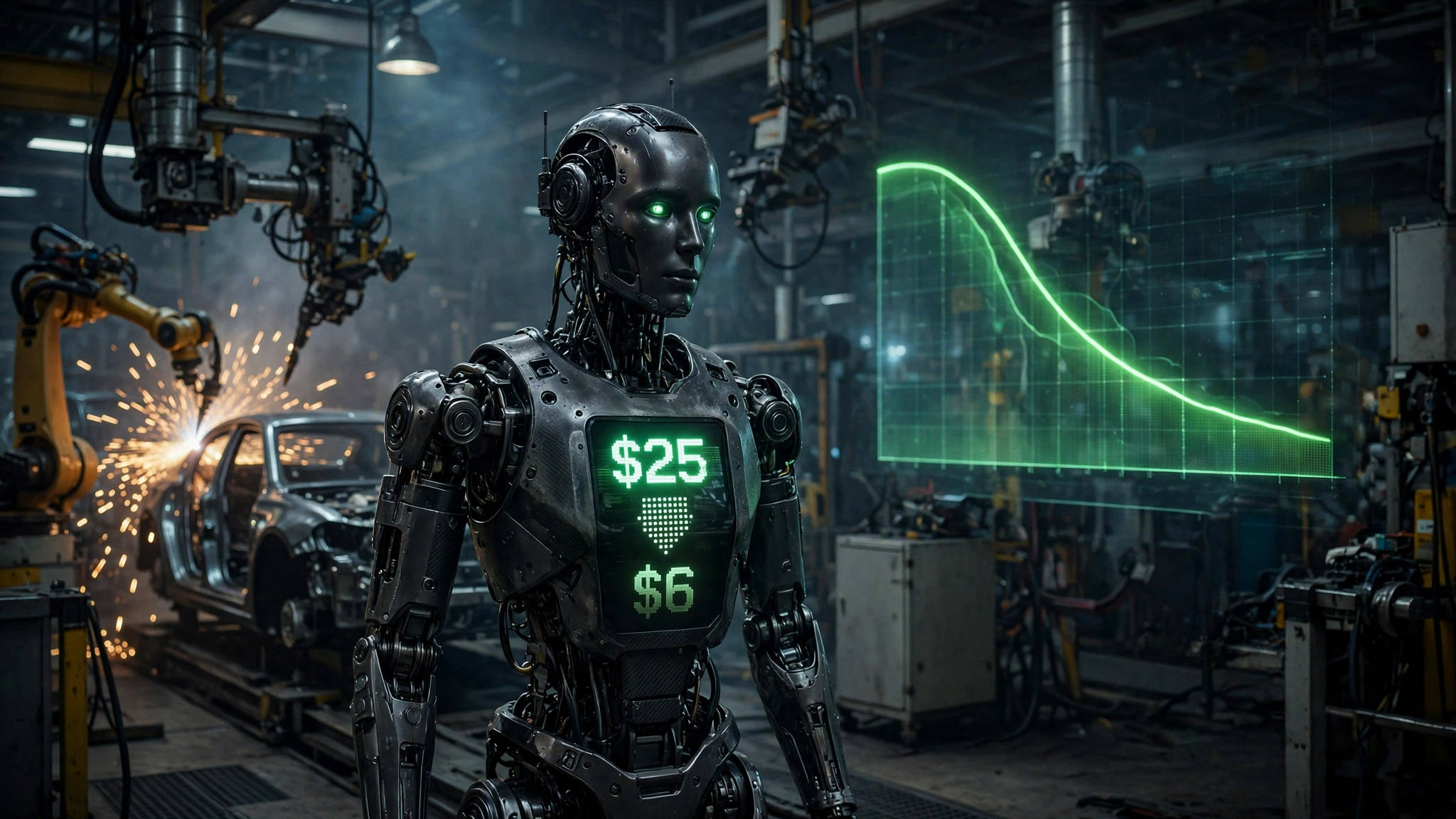
BMW is paying roughly $25 per hour for a Figure 03 humanoid robot, a price that covers capital amortization, maintenance, energy, and software combined. That estimate, derived from BMW's disclosed contract terms for 40 robots across three plants, matches the fully loaded cost of the automaker's lowest-paid Leipzig production worker.
For the first time in the 70-year history of industrial robotics, a general-purpose humanoid costs the same as the human it replaces, and that crossing happened quietly, without a press conference, without a CEO keynote, without anyone outside the procurement office noticing the invoice. The more interesting question is what happens next, because the cost curve says $25 is the ceiling, not the floor, and the floor is falling faster than anyone in labor policy has begun to account for.
The 30,000-Vehicle Proof
This is not a demo, not a pilot, and not a concept video. BMW ran Figure AI's Figure 02 at its Spartanburg, South Carolina plant for 10 months through early 2026, and the results came back with the kind of specificity that makes procurement departments rewrite five-year plans. It worked 10-hour shifts and walked 9,600 steps per day. It handled sheet-metal components with millimeter-precision placement into welding fixtures, a task classified as extremely high ergonomic strain for human operators, the kind of motion that destroys shoulders over a 20-year career. Over that period it processed more than 90,000 individual parts and contributed to the production of 30,000 BMW X3 crossovers at accuracy rates exceeding 99%. Humans do not always hit that mark. Not close.
BMW then signed for 40 of the newer Figure 03 across Spartanburg, Munich, and Regensburg, with a Leipzig pilot launching this summer, while Hexagon's AEON humanoid is separately entering battery-pack assembly at Leipzig under the broader "Physical AI" program. BMW is not experimenting; it is scaling.
The Cost Curve Nobody Has Mapped
We built the first country-by-country parity crossing matrix by combining three datasets: the BLS June 2026 manufacturing wage series, ILO manufacturing employment estimates from the World Employment and Social Outlook 2025, and the observed humanoid cost trajectory derived from publicly reported deployment pricing across five platforms.
Consider the inputs: Japan Airlines deployed Unitree-based humanoids at roughly $15,400 per unit for baggage and cabin work. Agility Robotics frames its Digit RaaS pricing against $30/hr labor at Toyota Canada. Boston Dynamics Atlas commands $90,000 to $100,000 per unit. Figure AI's contract hits $25/hr all-in. A factor of six separates the cheapest from the most expensive, but every trend line runs one way. Down.
Industry analysts tracking the cost curve observe that inference costs for the vision and manipulation models running on these robots are halving roughly every 12 months, while hardware costs, driven by actuator commoditization and the brutal arithmetic of production scaling, are declining approximately 40% annually. Figure AI's own production data tells the story concretely: BotQ went from one robot per day to one per hour in 120 days, a 24-fold throughput increase, with first-pass yields above 80% and battery yields at 99.3%. That is not a prototype shop but a learning curve with genuine manufacturing teeth, the kind of exponential improvement that turned solar panels from a rich-country curiosity into the cheapest electricity source on Earth in roughly a decade.
Applying a combined annual cost decline of 50% (conservative, given the dual hardware and software curves) against ILO and national statistical office manufacturing wage data produces the following crossing points:
| Economy | Mfg. Wage ($/hr) | Parity Year | Mfg. Workers (millions) |
|---|---|---|---|
| United States | $30.27 | 2026 | 12.8 |
| Germany | ~$28 | 2026 | 7.5 |
| South Korea | ~$17 | 2027 | 4.3 |
| Japan | ~$14 | 2027 | 10.5 |
| China | ~$7 | 2028 | 100+ |
| Mexico | ~$5 | 2028 | 9.2 |
| Vietnam | ~$2.50 | 2029 | 10+ |
| India | ~$1.80 | 2029–2030 | 60+ |
| Bangladesh | ~$0.70 | 2030+ | 5+ |
The combined manufacturing workforce across just these nine economies exceeds 220 million people. Under the observed cost trajectory, a humanoid becomes cheaper per hour than a human factory worker for more than half of them by 2028, and for nearly all of them by 2030.
The Scale Numbers
Figure AI has delivered over 350 Figure 03 units, and its BotQ facility is targeting 12,000 units per year now with 100,000 over four years. Tesla converted its Model S and X production line at Fremont to manufacture Optimus Gen 3, targeting 50,000 to 100,000 units in 2026 with stated capacity of one million per year, which would make it the largest humanoid robot factory on Earth by an order of magnitude if Tesla ships even a quarter of that target. China's Ministry of Industry and Information Technology launched its Work Mode program mandating 10,000 commercially deployed humanoids in real operations by December 2026, not a suggestion but a quota, with local governments required to submit implementation plans. The Schaeffler-Humanoid agreement targets 1,000 to 2,000 wheeled humanoid robots across global manufacturing sites by 2032, starting with live factory shifts in Germany this December.
Robotics companies raised $55.8 billion in the first half of 2026, nearly double the 2025 full-year record, and that capital has a singular destination: building the machines that will work in other people's factories.
The Strongest Case Against This Math
The counterargument deserves its full weight. It is strong. This cost curve assumes continued rapid improvement in a technology that has been perpetually "two years away" for decades. Eighty percent of the calculation rests on cost projections beyond 12 months, which extrapolate from early-stage trends that may flatten as robotics companies hit engineering walls in dexterity, reliability, and edge-case handling.
A Capgemini survey found that only 30% of executives believe general-purpose humanoids will be production-ready within three to five years, with the median corporate horizon at seven years. Most commercial humanoids in 2026 still cost $75,000 to $250,000 per unit, run two to four hours on a charge, and handle only narrow, repetitive tasks. Global production through 2027 will be measured in thousands of units, not the tens of thousands some investor decks promise. The 99% accuracy BMW achieved was for component placement in welding fixtures, one specific task in one specific environment, not a transferable proof of general capability.
And the venture subsidization problem is real, and large. Many robotics companies are burning cash to price robots below true cost of delivery, and the $25/hr figure includes amortization schedules that assume utilization rates and lifespans that have not yet been demonstrated at fleet scale. If maintenance costs do not decline as fast as unit costs, every crossing date in our table could shift right by one to two years.
What We Did Not Prove
This analysis relies on several data points that carry material uncertainty. The $25/hr BMW-Figure pricing is an analyst-derived estimate, not an official company disclosure; neither BMW nor Figure AI has published contract terms. Manufacturing wage data for non-U.S. economies uses ILO modeled estimates that may lag current conditions by 12 to 18 months, which means the actual crossing dates could arrive earlier in fast-growing Asian economies where wages are rising faster than historical trend, or later in stagnant European labor markets where collective bargaining holds floors in place. The 50% annual cost decline is a blended projection across multiple platforms at different maturity stages, and actual decline rates will vary by manufacturer, geography, and task complexity in ways nobody can yet quantify with confidence. Total cost of ownership data, specifically maintenance intervals, software licensing fees, and downtime patterns at fleet scale, remains almost entirely undisclosed across the industry.
Perhaps most importantly, our parity table compares hourly costs without adjusting for capability. A $6/hr robot in 2028 will not do everything a $6/hr human worker in Vietnam can do. Not even most things. Cost parity is not task parity. That gap is where most manufacturing jobs survive longest.
The Bottom Line
The mathematics of humanoid robot deployment crossed a threshold in 2026 that will not un-cross. At $25/hr, a Figure 03 matches BMW's line worker cost; at the observed trajectory, it undercuts the U.S. manufacturing average by 2027 and drops below minimum wage in every G7 country by 2028. The global manufacturing workforce of 475 to 555 million people, the single largest category of formal employment on Earth, just got a price competitor that improves at 50% per year while wages grow at 3 to 4%, and that asymmetry compounds in one direction only.
What You Can Do
If you manage a manufacturing floor, start with a single-task pilot on your most ergonomically demanding or highest-turnover station; the BMW data shows 99% accuracy is achievable for component placement within 10 months. Budget for RaaS before capex. If you work on a production line, the ILO data says you have 18 to 36 months in high-wage economies before cost pressure intensifies on repetitive manual tasks, so use that window to cross-train into maintenance, programming, or quality oversight for the robots themselves, which are the roles that scale with deployment rather than against it. If you vote, know this: your representatives have not yet proposed a single policy for a labor transition affecting 220 million workers in nine economies, and the parity clock is already running while the policy clock has not started.