A $20,000 Home Robot Sold 10,000 Units in Five Days. A Human in a VR Headset Still Folds Its Laundry.
1X Technologies opened a 58,000 square foot factory in Hayward, California and moved 10,000 pre-orders for its NEO humanoid robot at $20,000 apiece within a business week. When NEO encounters a task it cannot perform autonomously, a 1X employee wearing a VR headset assumes direct control through a live camera feed of the customer's home. An original cost-per-autonomous-hour analysis reveals why the teleoperation model faces a $109.5 million annual operator bill at 10,000 deployed units, and why 1X must eliminate human intervention or watch its economics collapse before the Chinese competition arrives at half the price.
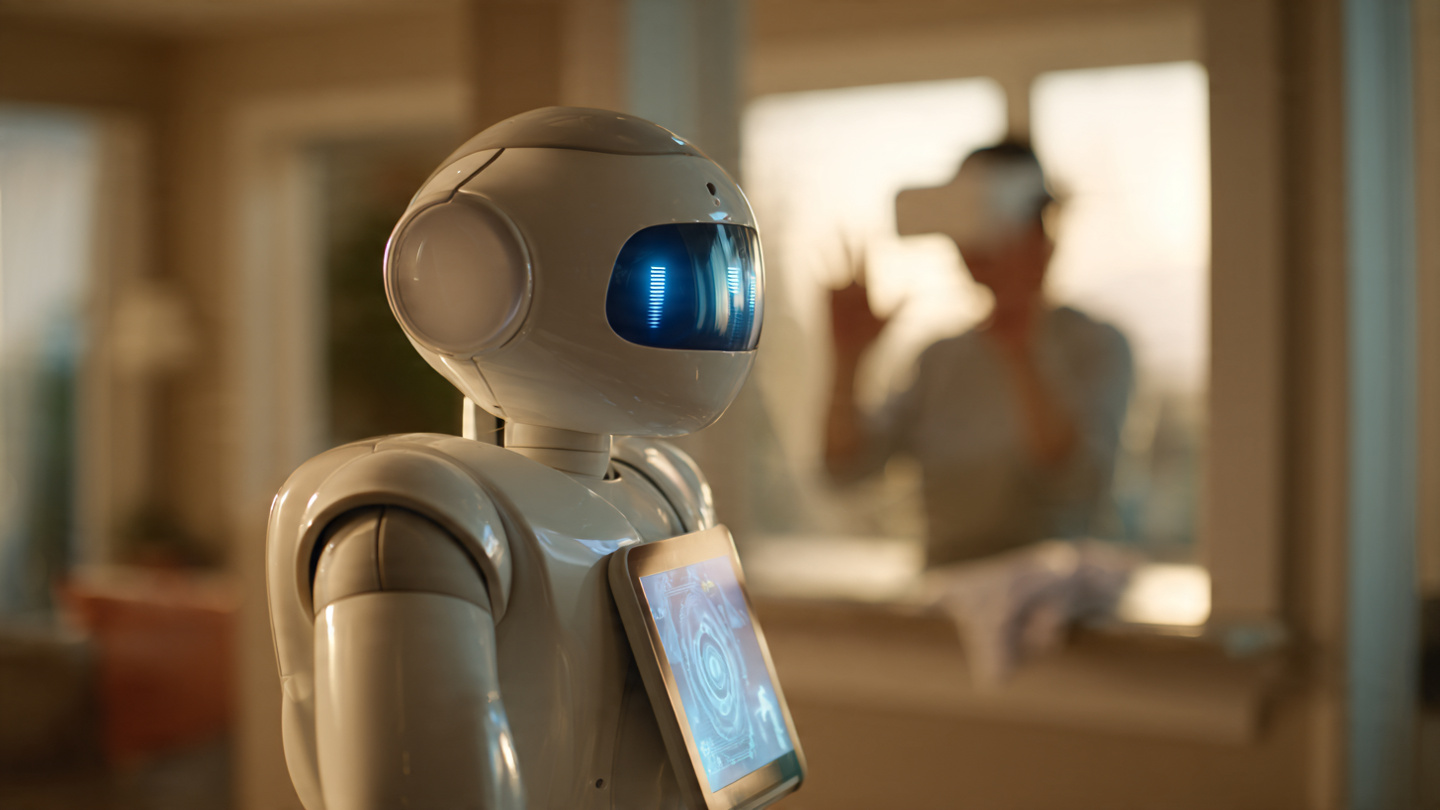
Ten thousand. That is how many pre-orders 1X Technologies collected in five days when it opened sales of the NEO humanoid robot in October 2025 at $20,000 per unit, generating $200 million in committed revenue before the first production robot rolled off a line that did not yet exist. It exists now: on April 30, 2026, 1X opened a 58,000 square foot vertically integrated manufacturing facility in Hayward, California, where it builds its own motors, actuators, batteries, sensors, and transmissions under one roof, employing more than 200 people. NEO robots already work alongside them on the production floor, moving parts and stocking shelves, collecting the real-world training data that will eventually teach the robots how to do the same things in your kitchen.
That milestone deserves attention. It marks the first consumer humanoid robot to enter volume production for residential deployment, beating Tesla's Optimus (still confined to Fremont factory floors), Figure AI (achieving one robot per hour but for industrial clients), and Boston Dynamics' Atlas (Hyundai auto parts, no consumer roadmap). But the milestone also contains a detail that 1X's marketing materials treat as a feature and that privacy researchers should treat as a five-alarm fire: when NEO cannot complete a task autonomously, a 1X employee puts on a VR headset and takes remote control of the robot through a live camera feed streaming from inside the customer's home.
The Wizard Behind the Curtain
Teleoperation is not new in robotics. Surgical systems like Intuitive's da Vinci have used it for decades in operating rooms where a trained specialist's remote hands justify the architecture. Autonomous vehicle companies ran safety drivers for years. What makes 1X's implementation different is the environment: not a sterile operating theater, not a public road, but the interior of a private residence, including bedrooms, bathrooms, and whatever else falls within camera range when the robot rolls through to fetch a glass of water.
According to Botmarket's April 2026 review, a January software update reduced but did not eliminate human interventions. Full autonomy remains, in 1X's own characterization, undefined in timeline. Every teleoperation session is recorded, and every recording feeds the AI training pipeline. Customers are paying $20,000 to participate in a data collection program that improves the product for future buyers while granting a stranger in a VR headset live visual access to the most private spaces in their lives.
This is a familiar business model wearing a new exoskeleton.
The Data Flywheel You Already Paid For
Tesla charges $12,000 or $199 per month for Full Self-Driving, a supervised autonomy system that uses customer driving data to train the neural network serving all future Tesla owners. Billions of miles collected. Its privacy surface area is public roads, where legal expectations of privacy are minimal and other cameras are already recording the same scenes. 1X's NEO applies an identical flywheel logic to the interior of your home, where privacy expectations are highest and cultural norms most protective, and the intervention rate is considerably worse than Tesla's disengagement metrics because the robot is attempting orders-of-magnitude harder tasks than lane-keeping on a highway.
Chinese competitors use a different model entirely. Unitree shipped 5,500 G1 robots in 2025 at $16,000 each, mostly to research institutions and enterprise warehouses. AGIBOT produced 10,000 units in three months. Both companies collect training data primarily from controlled industrial environments, not residential interiors. Slower progress on domestic tasks is the trade-off. Nobody's kitchen is being livestreamed to a warehouse in Shenzhen.
What a $20,000 Robot Actually Costs Per Hour
Nobody has published this calculation, so here it is. All inputs are conservative, the assumptions stated, and the math transparent enough for anyone to adjust.
| Variable | Assumption | Source / Basis |
|---|---|---|
| Robot operating hours/day | 4 | 1X marketing ("daily household tasks") |
| Autonomous task rate | 70% | Estimated from Botmarket review (January update "reduced" interventions; 30% is generous) |
| Autonomous hours/day | 2.8 | 4 × 0.7 |
| Autonomous hours/year | 1,022 | 2.8 × 365 |
| Robot cost amortized (5 yr) | $4,000/yr | $20,000 / 5 |
| Cost per autonomous hour | $3.91 | $4,000 / 1,022 |
| Teleoperator hours/day/robot | 1.2 | 4 × 0.3 |
| Burdened teleoperator cost | $25/hr | Estimate based on US remote operation wages (Indeed, Glassdoor ranges) |
| Annual operator cost/robot | $10,950 | 1.2 × 365 × $25 |
| Fleet operator cost (10K units) | $109.5M/yr | 10,000 × $10,950 |
At 10,000 deployed robots requiring 30 percent human intervention, 1X faces $109.5 million per year in operator labor costs alone, before accounting for VR headset hardware, network infrastructure, operator training, or the inevitable customer support burden of explaining why someone in Norway is watching through your robot's eyes at 3 AM. That $200 million in pre-order revenue covers roughly 22 months of operator costs at full deployment, and that assumes zero hardware cost of goods sold, which is obviously wrong.
For comparison: a Roomba j9+ costs $899 and vacuums autonomously at approximately $0.14 per operating hour over a five-year lifespan with zero human intervention. A human housekeeper in the San Francisco Bay Area charges $35 to $50 per hour and does not require firmware updates. NEO's $3.91 per autonomous hour looks reasonable until you realize that 1X, not the customer, absorbs the teleoperator cost during the training phase, and that cost scales linearly with every unit sold while the revenue from each unit is collected once.
What Hayward Actually Built
Credit where earned: the Hayward facility itself is impressive. 1X runs automotive-grade Design Failure Mode and Effects Analysis on every component. Each hardware subsystem endures more than 20 million stress test cycles before qualification. 1X winds its own copper motor coils on automated machines, manufactures its own tendon-driven actuators, and builds proprietary 3D-lattice cushioned limbs covered in machine-washable nylon knit suits available in tan, gray, and dark brown. Vertical integration is genuine, with a second factory operating in Moss, Norway.
Forbes reported on April 30 that 1X targets 10,000 units in year one and 100,000 by the end of 2027. NEO runs on NVIDIA's Jetson Thor platform under a software layer called NEO Cortex. NEO stands 168 centimeters tall, weighs 30 kilograms, and operates below refrigerator noise levels. These are real engineering achievements backed by $100 million in Series B funding from Tiger Global, Samsung Next, and a previous investment from OpenAI.
Nobody questions whether 1X can build robots. It clearly can. What remains unanswered is whether a business model that requires a human teleoperator for 30 percent of operating hours can survive the transition from 10,000 to 100,000 units without either solving autonomy or drowning in labor costs that grow faster than revenue.
A Competitive Vise Closing Fast
1X is not building in a vacuum. China shipped 5,500 humanoid robots in 2025 and targets 20,000 in 2026. Unitree's G1 retails at $16,000, four thousand dollars below NEO's price, and the Chinese manufacturing cost curve is steeper and faster than anything a 200-person Hayward factory can match. Tesla has more than 1,000 Optimus units working in its own facilities, with a target price of $20,000 to $30,000 and Fremont retooling underway for external production. Figure AI has achieved a production rate of one robot per hour.
Analysts project the humanoid robot market to reach $38 billion by 2035. But the International Federation of Robotics assessed in 2025 that useful, widely accepted home humanoids remain approximately 20 years away from mainstream deployment. Between the factory opening celebrations and the IFR's sober timeline sits the gap between what can be built and what can be sold as a finished product to people who expect their appliances to work without a remote pilot.
What This Analysis Cannot Tell You
The 30 percent intervention rate is an estimate. 1X does not publish disengagement metrics the way autonomous vehicle companies are increasingly required to. Actual rates could be lower if the January 2026 software update was more effective than Botmarket's review suggests, or higher if early adopters are selecting simpler tasks that flatter the autonomy statistics. A burdened teleoperator cost of $25 per hour assumes US labor; 1X could reduce this by operating call-center-style facilities in lower-cost geographies, though that multiplies the jurisdictional privacy exposure.
Learning-curve improvements are absent from the cost-per-hour calculation. If every teleoperation session trains the model, intervention rates should decline over time, potentially rapidly. Tesla's FSD disengagement rate has improved roughly tenfold since 2020. If 1X achieves a similar trajectory, the 30 percent rate could fall to 3 percent within three to four years, at which point the operator cost drops from $109.5 million to $10.9 million annually and the economics become viable. Whether the company has enough runway to survive the interim is a question its $100 million Series B and rumored $1 billion raise at a $10 billion valuation will have to answer.
We also cannot assess the actual privacy practices because 1X has not published a detailed data handling policy for teleoperation sessions. How long are recordings retained? Who has access? Are sessions encrypted end-to-end or accessible to 1X engineering staff? Is footage from bedrooms and bathrooms handled differently from kitchens and living rooms? These questions have answers. 1X has chosen not to share them.
Why You Might Buy One Anyway
Dismiss 1X as a surveillance device selling robot-shaped hardware and you miss the genuine strategic logic. Every technology platform with a data flywheel has asked early customers to tolerate worse performance in exchange for the implicit promise that their usage data makes the product better for everyone, including themselves. Gmail scanned your emails to target ads. Facebook used your photos to train facial recognition. Tesla used your commute to train autopilot. In each case, early adopters accepted a privacy trade-off that later users benefited from without fully bearing.
NEO's case rests on a 30 percent intervention rate in 2026 becoming a 5 percent rate by 2028, then 1 percent by 2030, and the early buyers who tolerated a stranger operating their robot while it learned to fold shirts will own a machine that eventually folds shirts, loads dishwashers, and retrieves items from other rooms without any human in the loop. At $20,000, the price may look cheap in retrospect if the fully autonomous version costs $35,000 in 2030 dollars.
This argument has force. It also requires trusting that a startup with undefined autonomy timelines will deliver on a trajectory that even well-capitalized companies like Tesla have repeatedly delayed. But the strongest counterargument to the counterargument is the IFR's 20-year timeline, which suggests the optimistic learning curve may be optimistic by a decade.
What You Can Do
If you are considering a NEO pre-order, ask 1X three questions before committing: What is the current teleoperation intervention rate, expressed as a percentage of operating hours? What is the data retention policy for teleoperation recordings, and can customers opt out of having intervention sessions used for training? Is there a contractual commitment to a minimum autonomous performance level, with a refund mechanism if the robot fails to reach it within a stated timeframe? If 1X answers all three clearly, the purchase becomes an informed bet on a technology curve. If they decline to answer, you are buying a $20,000 camera you cannot control.
If you work in home robotics or adjacent fields, the cost-per-autonomous-hour framework above is a tool for evaluating any teleoperation-dependent system. What matters most is the intervention rate trajectory: plot it quarterly, compare it to the labor cost curve, and you can estimate the quarter in which the business model becomes self-sustaining or the quarter in which it requires another funding round to survive. For NEO, the crossover point where operator costs fall below 10 percent of annual hardware revenue is approximately 5 percent intervention rate, which means roughly 12 minutes of human control per four-hour operating day.
If you are a policymaker, the regulatory vacuum around residential teleoperation is worth closing before it becomes a scandal. Autonomous vehicles required years of regulatory framework development after deployment began. Residential robots with live camera feeds operated by remote workers should not repeat that sequence. A reasonable starting point: require teleoperation session disclosure (a visible indicator on the robot when a human is controlling it), mandatory data retention limits, and a prohibition on using residential teleoperation footage for purposes beyond robot training without explicit, session-level consent.
Where This Leaves You
1X Technologies has accomplished something no other company has: opening a vertically integrated factory for consumer humanoid robots, moving 10,000 pre-orders in under a week, and putting robots on its own production floor to collect training data. Engineering is real, demand is real, and a $20,000 price point sits within range of a high-end appliance rather than a luxury curiosity. But autonomy is not real, not yet, and the teleoperation model that fills the gap creates both a $109.5 million annual cost problem at scale and a residential privacy exposure that no previous consumer technology has attempted. One bet drives everything: can 1X reduce human intervention faster than its operator costs consume its capital? If yes, early buyers own the future of home automation at a bargain price. If no, they own a very expensive coat rack that occasionally phones home to Norway.