🎓 Education
Google's $1,000 Laptop Has a $3.5 Billion Problem: 38 Million Students Can't Afford It
Google announced the Googlebook at I/O 2026, an AI-native laptop with a $1,000 floor price and mandatory premium hardware. It replaces the Chromebook vision that put $300 devices in front of 38 million students worldwide. Nobody on stage mentioned what happens to school districts that built their entire technology budgets around cheap laptops. We ran the math.
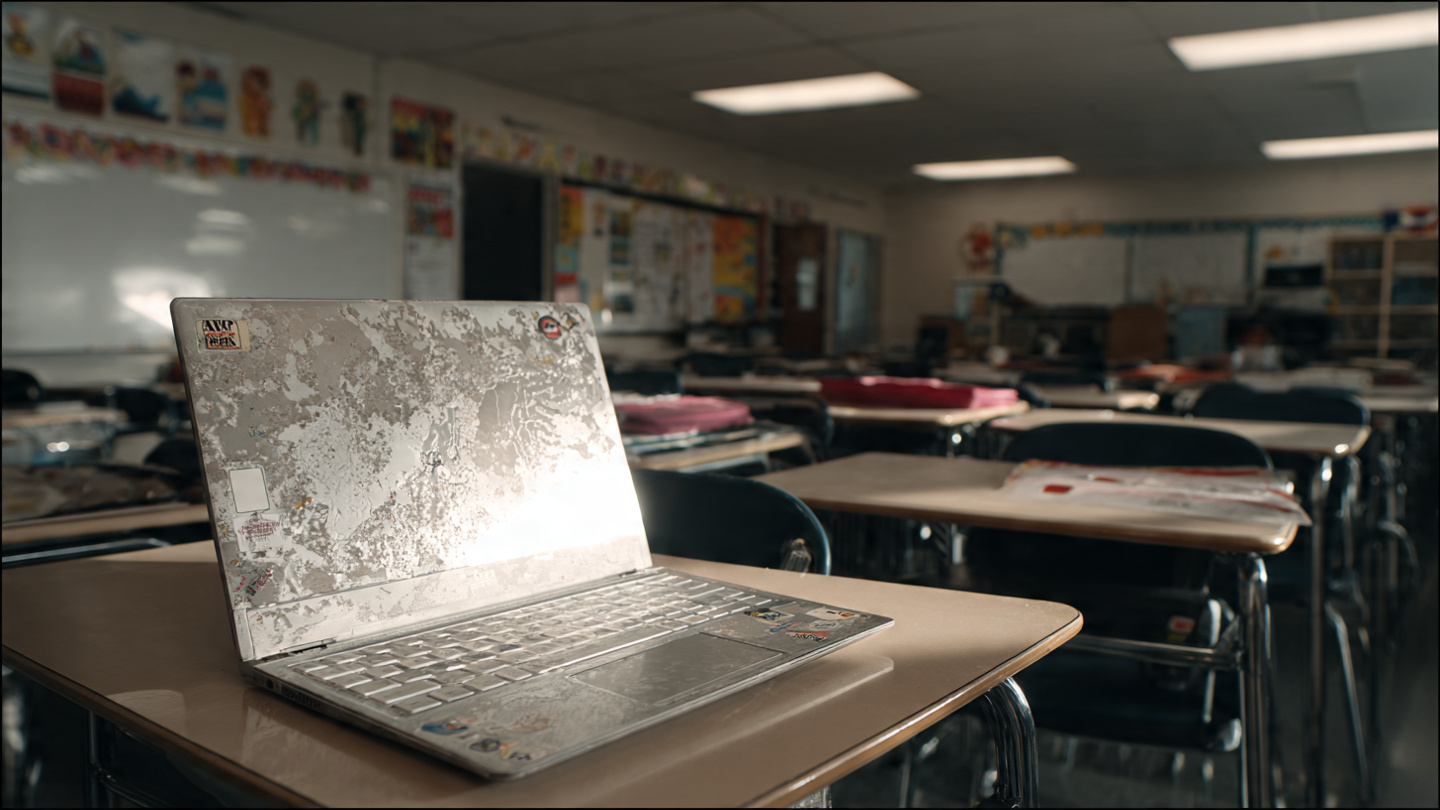
Three hundred dollars. That was the number that built an empire. When school districts across the United States started buying Chromebooks a decade ago, the pitch was irresistible: for the price of one $800 Windows laptop, you could put two Chromebooks on two desks in front of two students who otherwise would have shared or gone without. Fauquier County, Virginia, chose Chromebooks for exactly this reason, a decision echoed by thousands of districts operating under the relentless arithmetic of per-pupil budgets. By 2026, 38 million Chromebooks sit in K-12 classrooms globally, commanding 60.1% of the education device market, deployed in 93% of U.S. school districts.
Today at Google I/O 2026, Google killed the $300 laptop vision and replaced it with a $1,000 one.
The Googlebook is a new category of AI-native laptop with mandatory premium hardware, Gemini Intelligence integration, and a distinctive LED light bar that signals when AI features are active. According to early pricing reports, it starts at approximately $1,000. The same five OEMs that manufacture Chromebooks for schools — Acer, ASUS, Dell, HP, and Lenovo — are building Googlebooks for consumers, with devices launching Fall 2026. Google positioned the Googlebook as the future of its laptop strategy, complete with dedicated Gemini hardware acceleration that ChromeOS will not receive.
Nobody at I/O mentioned the 38 million students sitting behind $300 screens. So we ran the numbers they didn't.
The Education Pricing Cliff
School districts replace devices on a four-year refresh cycle, according to a 2023 report by the U.S. PIRG Education Fund that analyzed Chromebook lifespans across hundreds of districts. The PIRG report found that doubling Chromebook lifespans could save $1.8 billion nationally across 48.1 million U.S. public school students. Their math assumed the existing $300 price point would hold. It won't.
Here is what the Googlebook's pricing floor does to per-student costs:
| Metric | Chromebook | Googlebook | Change |
|---|---|---|---|
| Device price | ~$300 | ~$1,000 | +$700 (+233%) |
| Annual cost per student (4-yr cycle) | $75 | $250 | +$175/yr |
| Chrome Education Upgrade license | $38 | TBD | — |
| Total per-student-per-year | ~$85 | ~$260+ | +$175 (+206%) |
A 206% increase per student, per year. Absorbing that at scale requires more than creative budgeting.
District Math: 27 Teachers or AI Laptops
Consider a mid-sized school district with 10,000 students, the kind of system where the superintendent personally knows the principals and budget votes make the local paper. Under the Chromebook model, annual device refresh runs approximately $750,000. Under the Googlebook model, the same refresh costs $2.5 million. That is $1.75 million in new annual spending that has to come from somewhere.
Where? The average U.S. teacher salary is $65,000 per year, according to NEA data. Divide $1.75 million by $65,000 and you get 27. That is how many teaching positions a single district would need to sacrifice to afford premium Google hardware on every desk. Twenty-seven teachers, or twenty-seven AI laptops for every teacher eliminated. Superintendents who built their 1:1 device programs on the promise of affordable computing now face a question that no Google I/O keynote addressed: do you want the AI, or do you want the humans teaching the students how to use it?
Scale the math nationally and the numbers become staggering.
The National Bill: $3.5 Billion
The National Center for Education Statistics counts 48.1 million students in U.S. public K-12 schools. North America accounts for roughly 52.4% of global Chromebook deployments, putting the U.S. installed base at approximately 20 million devices. On a four-year refresh cycle, that means about 5 million Chromebooks get replaced annually at a cost of roughly $1.5 billion.
Replace those with Googlebooks and the annual bill jumps to $5 billion, opening a $3.5 billion annual gap that, expressed in teacher salaries at the NEA average, equals 53,800 positions eliminated nationwide. For context, the entire U.S. K-12 technology budget runs approximately $30 billion annually, meaning Chromebook refresh currently consumes about 5% of the total while Googlebook refresh would devour 17%. A single hardware decision by a single company would redirect one-sixth of all education technology spending in the United States toward more expensive devices with AI capabilities that no peer-reviewed study has yet linked to improved student outcomes.
The Title I Collision
These are averages, and averages hide the pain.
The average U.S. school spends roughly $624 per student per year on all technology, derived from the $30 billion national technology budget divided across 48.1 million students. A $300 Chromebook on a four-year cycle consumes $75 of that budget annually, or about 12%. A $1,000 Googlebook consumes $250, which is 40% of the entire technology allocation for a single device category.
Title I schools, which serve predominantly low-income student populations and operate on tighter per-pupil budgets than suburban counterparts, face the sharpest version of this dilemma. These are the districts where Chromebooks proved most transformative precisely because they were cheap enough to deploy universally, where the difference between a $300 device and a $1,000 device isn't a line item to optimize but a program to cut.
The Fauquier County administrator told EdWeek in 2023: "For every one laptop, I could buy two Chromebooks." The ratio at Googlebook pricing is even worse. For every one Googlebook, you get three Chromebooks. Or one Googlebook and zero supplementary technology spending for the year.
The Two-Tier Classroom
Google says Chromebooks will coexist with Googlebooks, Samsung confirmed that its Galaxy Chromebook 3 360 will receive support through 2035, and OEMs will continue manufacturing ChromeOS devices alongside their new Googlebook lines. But coexistence and parity are different things, and the incentive structure tells the real story.
When Lenovo can sell a school a $1,000 Googlebook or a $300 Chromebook, the engineering talent follows the margin. R&D investment flows toward the premium product because that is where the profit sits. Google is building Gemini Intelligence for the Googlebook platform, not for ChromeOS. The AI features demoed at I/O — real-time language tutoring, adaptive problem sets, contextual research assistance — require the dedicated hardware in a Googlebook. They are not coming to a $300 Chromebook with 4GB of RAM and an ARM chip from 2022.
What emerges is a two-tier classroom split along wealth lines. Wealthy suburban districts with bond-levy capacity and PTA fundraising buy Googlebooks and get AI-native education tools. Underfunded urban and rural districts keep aging Chromebooks running ChromeOS in what increasingly resembles maintenance mode — security patches and bug fixes, but no new capabilities, no new AI features, no new reason for Google to care.
We have seen this movie before, and it played in the 1990s when schools split between Macs and whatever beige boxes the budget could handle, and the students on the beige boxes got a qualitatively different education in software availability, internet capability, and teacher confidence with the tools on the desk. The question is whether Google intends to write the same script with a 2026 cast.
The Strongest Case Against This Thesis
The most credible rebuttal is simple: Google never said Chromebooks are dying. The company explicitly stated at I/O that ChromeOS devices will continue, OEMs will keep building them, and support extends for a decade. The Googlebook is a premium product aimed at MacBook and Surface buyers, not a replacement for the education workhorse. Acer, ASUS, Dell, HP, and Lenovo will continue shipping $300 Chromebooks to schools because school procurement offices will continue demanding them. Google may announce education-specific Googlebook pricing, bulk licensing programs, or subsidized AI tiers that this analysis cannot account for because they do not exist yet.
The $1.8 billion PIRG savings figure assumed the same $300 Chromebook paradigm would persist. If it does persist — if schools simply keep buying Chromebooks and ignore the Googlebook entirely — then the pricing cliff never arrives and the budget math does not change.
This rebuttal deserves serious weight because it rests on publicly stated Google policy, not speculation. It is entirely possible that the Googlebook becomes a consumer and enterprise product while education remains a Chromebook stronghold for another decade. But the counterargument depends on two assumptions: that Google will continue investing meaningfully in a platform with shrinking strategic importance, and that school districts will voluntarily choose the device without AI when the device with AI exists and parents are asking why their children don't have access to it. Neither assumption is guaranteed, and the history of bifurcated product strategies in technology suggests the lower tier eventually withers even when the company promises otherwise.
What We Did Not Prove
This analysis models a scenario, not a certainty. Several limitations constrain our conclusions and readers should weigh them carefully before treating these projections as predictions.
First, the $1,000 price comes from early financial reporting by BigGo Finance, not an official Google MSRP, and actual retail pricing could differ significantly. Education-specific bulk pricing programs could substantially reduce the per-unit cost, and we cannot evaluate a program that has not been announced. Second, we model four-year refresh cycles based on PIRG data, but real district behavior varies widely, with some systems stretching devices to five or six years while others replace at three when grant funding materializes. Third, the teacher-salary equivalency ($1.75 million = 27 teachers) assumes the cost difference is discretionary, but in practice, technology and personnel budgets are often separately line-itemed with different funding sources and different approval processes. A dollar cut from the technology budget does not automatically become a dollar available for teacher hiring.
Fourth, the 38 million global figure includes deployments outside the United States, and the U.S.-specific installed base of approximately 20 million is an estimate derived from North America's 52.4% share of global deployments, not a figure Google directly reports. Fifth, no peer-reviewed evidence currently exists showing that AI-powered educational laptops improve student outcomes relative to standard devices, meaning our entire analysis assumes the technology gap matters without proving that it does, and the gap could turn out to be pedagogically meaningless.
What You Can Do
If you're a school board member or superintendent: Freeze any 2026-27 laptop purchase decisions that assume long-term Chromebook availability until Google publishes a formal ChromeOS education roadmap. Specifically, demand in writing from your OEM sales representatives that ChromeOS education devices will receive feature updates — not just security patches — through at least 2030. If they hedge, that tells you everything about where R&D priorities are heading.
If you're a state legislator involved in education funding: Consider including hardware cost caps or cost-per-student-per-device benchmarks in ed-tech funding formulas. The current model lets a single vendor's pricing decision cascade into statewide budget reallocations that no legislative body voted on. The California education technology budget alone runs over $3 billion. A 206% increase in device costs hits those appropriations directly.
If you're a parent: Ask your school district's technology director two questions at the next board meeting. First: what is the district's per-student annual device cost, and how does it compare to the national average of $85? Second: has the district evaluated what the Googlebook transition means for their refresh budget? These numbers are public record in most states. Asking forces the conversation before the procurement cycle makes the decision for you.
If you're at Google: Announce education pricing for the Googlebook before Fall 2026 launch. The silence is louder than any number in this article, and thirty-eight million students who built your laptop platform deserve to know whether they're still part of the plan.
The Bottom Line
Google built the most successful education computing platform in history on a single insight: that a $300 laptop could do 90% of what a student needs. Thirty-eight million devices later, the company announced its successor at three times the price with mandatory premium hardware and AI features the old platform will never receive. The national cost of that transition is $3.5 billion per year, the equivalent of 53,800 teacher salaries, consuming 17% of all U.S. K-12 technology spending. Google says Chromebooks will coexist with Googlebooks, and maybe they will, the way flip phones coexisted with smartphones for a few polite years before the ecosystem moved on. The question school districts need answered before Fall 2026 is not whether the Googlebook is a better laptop, but whether Google plans to keep investing in the $300 device that made computing accessible to 38 million students or whether those students just became legacy users on a platform their benefactor has outgrown.
Sources
- Google I/O 2026 keynote, Googlebook announcement, blog.google. blog.google
- BigGo Finance, "Googlebook starting price ~$1,000, partner OEMs confirmed," May 2026. finance.biggo.com
- Futuresource Consulting / CommandLinux, "ChromeOS Market Share in Education: 60.1% globally, 38 million Chromebooks in K-12," 2026. commandlinux.com
- US PIRG Education Fund, "Chromebook Churn" report, April 2023, via EdWeek: 4-year lifespan, $1.8B savings potential, Fauquier County VA case study. edweek.org
- NCES, U.S. public school enrollment: 48.1 million students. nces.ed.gov
- Research.com, "US Education Spending Statistics," average per-pupil spending $17,250, $30B annual technology budget. research.com
- NEA Rankings & Estimates, average U.S. teacher salary ~$65,000. nea.org
- Samsung/Google Chromebook support policy, Galaxy Chromebook 3 360 supported through 2035. undercodenews.com