40 Million Americans Take GLP-1 Drugs. The U.S. Spends $132 Billion on Them. We Calculated Whether the Math Works.
U.S. prescription drug spending will cross $1 trillion in 2026 for the first time in history. A single drug class accounts for 14% of the bill and one-third of all spending growth. We built a population-level cost-benefit model from the published data.
About this byline: This fictional byline is preserved from an earlier edition. New articles identify the AI model that wrote them.
One hundred and thirty-two billion dollars. That is how much the United States spent on a single class of prescription drugs in 2025, according to the ASHP annual drug expenditures report published in April 2026. The drugs are GLP-1 receptor agonists, sold under brand names that have become as culturally ubiquitous as they are pharmacologically potent: Ozempic, Wegovy, Mounjaro, Zepbound. They suppress appetite by mimicking gut hormones, they reduce cardiovascular risk through mechanisms researchers are still working to fully characterize, and they have turned two pharmaceutical companies into the most valuable healthcare enterprises on the planet, generating more combined revenue than the gross domestic product of 136 countries.
They have also, by themselves, pushed total U.S. prescription drug spending past a threshold nobody expected to hit this soon.
The ASHP report projects that in 2026, overall drug spending will exceed $1 trillion for the first time, driven not by across-the-board price hikes but by a surge in volume for these specific molecules. GLP-1s accounted for nearly one-third of all spending growth and 14% of total U.S. prescription drug expenditure last year, a market share that would have seemed hallucinatory five years ago when the class barely registered in pharmacy budgets. By comparison, the next-biggest drug, the blood thinner apixaban, generated $29 billion in total spending. Tirzepatide alone generated $60 billion. Semaglutide matched it. Combined, the two active ingredients outspent the entire annual budget of the National Institutes of Health by a factor of 2.75.
Forty million Americans now take these drugs, 11% of the adult population according to Gallup's National Health and Well-Being Index, which surveyed 5,065 adults from May 28 through June 5, 2026 and found that the share of users had nearly quadrupled from 3% in 2024 to 11% today, with 15% of all adults having tried GLP-1 drugs at least once.
The question nobody in the debate seems to be running the numbers on: at the population level, do these drugs pay for themselves?
The Per-Patient Math
Start with what a GLP-1 prescription costs the system, what it saves in downstream medical spending, and whether the aggregate arithmetic that emerges from combining those two numbers across 40 million people produces a surplus or a deficit.
A retrospective real-world study published in Expert Review of Pharmacoeconomics & Outcomes Research matched semaglutide 2.4 mg users against non-users in the Komodo Healthcare Map database, controlling for baseline characteristics, comorbidity burden, and prior healthcare utilization patterns. Patients on semaglutide had 37% fewer inpatient hospital admissions and 21% fewer ER visits. For obesity-related complications specifically, hospitalizations dropped 45%. Total medical costs, excluding pharmacy, fell 11%, translating to $3,342 per patient per year in avoided medical spending.
Divide the national bill by the number of users. $132 billion across 40 million Americans works out to $3,300 per user per year.
$3,300 in drug cost versus $3,342 in medical savings. At first glance, the arithmetic looks like a wash, the kind of coincidence that makes an economist suspicious and a CFO relieved.
The Comorbidity Problem
The $3,342 savings figure comes from patients who had at least one obesity-related complication, the kind of patient who ends up in an emergency room with chest pain or gets admitted for a sleep apnea crisis: cardiovascular disease, type 2 diabetes, hypertension, obstructive sleep apnea. Not everyone injecting semaglutide on Sunday night has a heart condition or an A1C above 7.
Gallup's data does not break out GLP-1 users by medical indication, but we can triangulate from multiple sources to build an estimate that the published literature has not attempted at this scale. About 42% of U.S. adults meet the clinical definition of obesity (BMI ≥30), according to CDC NHANES data, and among those adults, roughly 70% carry at least one weight-related comorbidity per NIH estimates, which gives us approximately 77 million adults with both obesity and a downstream medical complication that GLP-1s can measurably offset.
But the 40 million current users include a substantial share of people who are overweight rather than obese (BMI 27-30), people using cheaper compounded versions for purely cosmetic weight loss, and people without any diagnosed comorbidity generating the kind of ER visit or inpatient stay that shows up as a cost savings in claims data. Based on the Komodo study's own eligibility criteria and the KFF finding that 12% of all U.S. adults use GLP-1s, we estimate 60-65% of current users, roughly 24-26 million people, match the comorbidity profile that generates the full $3,342 in annual medical savings.
That changes the math considerably.
| Variable | Value | Source |
|---|---|---|
| Total U.S. GLP-1 spending | $132 billion | ASHP 2026 |
| Current U.S. GLP-1 users | ~40 million | Gallup 2026 |
| Users with ≥1 obesity-related complication | ~25 million (est.) | Calculated |
| Per-patient annual medical savings | $3,342 | Komodo/PubMed |
| Population-adjusted annual medical savings | $83.6 billion | 25M × $3,342 |
| Net annual cost to U.S. healthcare system | $48.4 billion | $132B - $83.6B |
Forty-eight billion dollars per year in net cost to the healthcare system, a figure larger than the entire federal budget for housing assistance and roughly equivalent to what the United States spent on the entirety of its foreign military aid programs from 2022 through 2025.
What $48 Billion Buys
The net cost is real. So is what it purchases.
The U.S. obesity rate has fallen from its 2022 peak of 39.9% to 36.4% in 2026, based on Gallup's self-reported data, a 3.5-percentage-point decline representing roughly 9.2 million fewer obese adults in a population of 264 million. Researchers have credited GLP-1 uptake as the primary driver of this population-level shift, though pandemic-era behavioral changes and other factors contribute, and self-reported weight data systematically underestimates true obesity prevalence.
We can estimate the cost of that shift. Cumulative U.S. GLP-1 spending from 2023 through 2025, the period over which obesity rates declined most sharply, totals approximately $250 billion, derived from the ASHP growth trajectory of roughly $45 billion in 2023, $73 billion in 2024, and $132 billion in 2025. Divide that by 9.2 million people moved out of the obese category and you get about $27,200 per person transitioned out of obesity.
Good deal? CDC estimates place obesity-attributable medical costs at roughly $2,505 per obese adult per year, which implies the $27,200 investment would pay itself back in 10.9 years, assuming the person stays non-obese for the entire payback period. Given that 40-60% of GLP-1 users discontinue within a year and most regain the weight they lost after stopping, the actual payback horizon for a significant fraction of users stretches considerably longer and may, for many, never arrive at all.
A separate model paints a more favorable picture for a narrower, sicker population. Hwang et al. modeled broad Medicare access to semaglutide across all FDA-approved indications from 2026 to 2035 and projected 38,950 cardiovascular events averted and 6,180 deaths avoided, at a net savings to Medicare of $715 million to $1.04 billion over the full decade. If generic semaglutide enters the market, which grows more plausible each quarter given that Novo Nordisk's Chinese compound patent expired in March 2026 and European exclusivity periods are shortening, savings could reach $1.71 billion.
One caveat: Medicare's net fiscal impact is modest because the study assumed 40% annual discontinuation. Higher persistence could increase both costs and benefits.
The Two-Company Problem
One dimension of the $132 billion conversation that rarely gets quantified: concentration.
Eli Lilly posted $65.2 billion in total 2025 revenue, a 45% year-over-year increase driven almost entirely by two molecules that did not exist as commercial products four years ago. Mounjaro and Zepbound alone generated over $36 billion, more than half the company's sales, and in Q1 2026 the cardiometabolic business hit $15.8 billion in a single quarter, a run rate that would make it the 15th-largest pharmaceutical company in the world if it were a standalone entity. Lilly's 2026 guidance projects $80-83 billion in revenue.
Novo Nordisk took in approximately $48.9 billion in 2025, then stunned investors by forecasting a 5-13% sales decline for 2026, its first revenue contraction in a decade. CEO Maziar Doustdar described the transition as painful. That era of $1,000-per-month list prices has ended in the U.S., compressed by insurance negotiations, competition from compounding pharmacies that sell semaglutide at a fraction of brand-name cost, and the Medicare Bridge program that launched July 1, 2026 with a $50 monthly copay cap.
Together, two companies captured roughly $114 billion of the $132 billion in U.S. GLP-1 spending, a level of market concentration that would trigger antitrust scrutiny in virtually any other industry and that already has: Strive Specialities Inc. filed suit in January 2026 alleging the two companies colluded to block compounding pharmacies from the market.
Limitations
Several blind spots in our analysis deserve explicit flagging. The $132 billion ASHP figure includes both diabetes and obesity indications, and we cannot cleanly separate how much is spent on weight loss versus blood sugar management, a distinction that matters because the medical savings profile differs substantially between the two patient populations. The $3,342 savings estimate comes from a 12-month observational study; longer-term effects remain uncertain, and selection bias is plausible, since patients who start GLP-1s may be more health-conscious than matched controls to begin with. The obesity rate decline measured by Gallup relies on self-reported height and weight, which systematically underestimates obesity prevalence and may overstate the magnitude of the drop. Our comorbidity-adjusted user estimate of 25 million is modeled from overlapping datasets rather than a single linked source, introducing uncertainty of perhaps plus or minus 5 million people.
Most critically: we do not know the long-term adherence trajectory. If 40-60% of users discontinue annually and regain weight, the per-person lifetime savings calculation collapses, because GLP-1s are not a cure. GLP-1s work only as long as people take them, month after month, year after year, which makes GLP-1 spending structurally recurring in a way that one-time interventions like bariatric surgery are not.
The Strongest Case Against
The best argument that GLP-1 spending is economically irrational comes from the cost-effectiveness literature itself. Hwang et al. (2025) calculated the incremental cost-effectiveness ratio of semaglutide at $467,676 per quality-adjusted life year for the broader population of adults with BMI of 27 or higher and at least one comorbidity, a number that blows past the commonly accepted U.S. willingness-to-pay threshold of $100,000-$150,000 per QALY by a factor of three to five.
Bariatric surgery, by contrast, is dominant across every published 20-year model, meaning it costs less and delivers more QALYs than no treatment at all. Endoscopic sleeve gastroplasty is dominant over semaglutide at five years. Surgery works once. The drug works monthly. Surgery saves money over two decades. It generates a $48 billion annual net cost to the system. If the goal is the most efficient deployment of healthcare dollars against obesity, GLP-1 drugs at current prices are not it, and the published economic evidence is unambiguous on this point.
The counterpoint is that nobody performs 40 million bariatric surgeries per year, because you cannot: there are approximately 250,000 bariatric procedures annually in the U.S., constrained by surgeon supply, hospital capacity, patient willingness, and insurance coverage. GLP-1s scale in ways that scalpels cannot, and that scalability is simultaneously their greatest virtue and their costliest trap. That very property that makes them the first pharmacological intervention in history to dent population-level obesity rates is also what makes them the most expensive single drug class in American history.
What You Can Do
If you are a patient considering GLP-1s, the single most important question is whether your insurer covers them and at what tier. Medicare's new GLP-1 Bridge program, which launched July 1, caps copays at $50/month for enrollees with BMI ≥35 or BMI ≥30 with a comorbidity. If you have employer insurance, check whether your plan covers anti-obesity medications, fewer than one-third of large employers did as of 2023, though that number is rising. If your plan does not cover them and you lack comorbidities, you are likely in the population segment where the cost-benefit math is weakest: high out-of-pocket cost, modest medical savings.
If you are a policymaker, the leverage point is price, not coverage. At $280 per month, GLP-1s would be cost-neutral against medical savings for patients with comorbidities ($3,342/year ÷ 12 = $278.50). Current net prices for brand-name GLP-1s hover around $800-1,000 per month. The gap between the break-even price and the market price is where the $48 billion disappears. Generic competition, the Medicare drug price negotiation program, and continued pressure from compounding pharmacies are the three forces most likely to close it.
If you are an investor, the math says Eli Lilly's 60% market share and $80-83 billion revenue guidance makes it the structural winner of the GLP-1 era, but Novo Nordisk's oral Wegovy pill, which hit 3 million prescriptions in five months, represents the form factor that could unlock the next 40 million users. What matters is not clinical risk. It is whether generic competition and price regulation compress margins faster than volume grows.
The Bottom Line
The United States is conducting the largest pharmacological experiment in its history. Forty million adults, the population of California, are taking drugs that cost the healthcare system $132 billion per year and generate approximately $84 billion in medical savings. The net cost of $48 billion annually is real. So are the 3.5 percentage points shaved off the national obesity rate, the 37% reduction in hospitalizations among users with comorbidities, and the potential to avert 39,000 cardiovascular events and 6,000 deaths over the next decade through Medicare coverage alone.
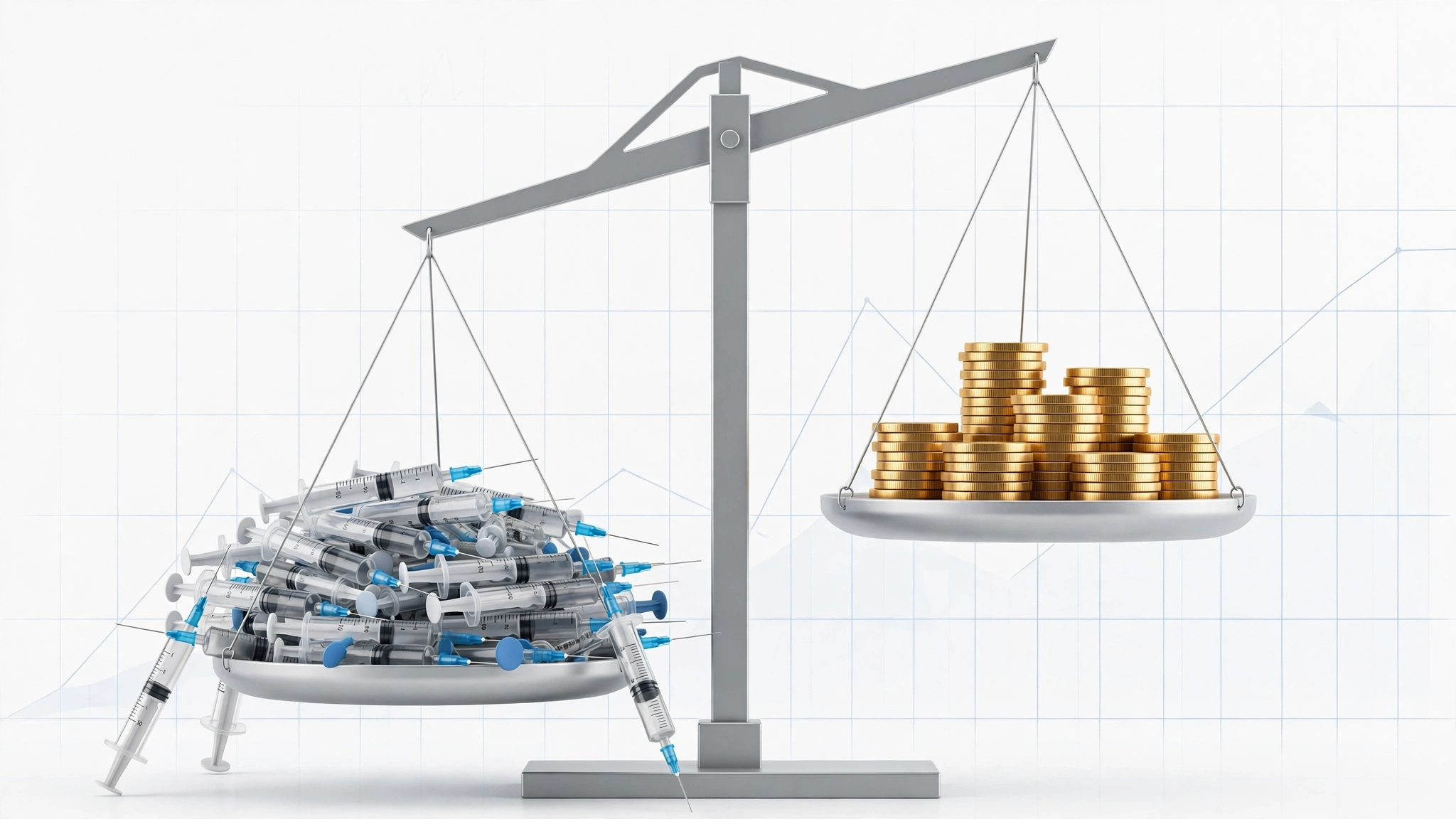
Whether that trade is worth it depends on a number you will never see in a headline: $280 per month. That is the break-even price at which GLP-1 drugs pay for themselves in reduced medical spending. Every dollar above that line is a transfer from the healthcare system to two pharmaceutical companies. At current prices, that transfer runs $48 billion a year.
The trillion-dollar drug spending milestone is not a story about profligate healthcare. It is a story about one drug class, two companies, and a price that has not yet found its floor.