🤖 AI
The U.S. Government Just Funded 20 Laboratories That Run Experiments While Scientists Sleep. We Calculated What Happens When They All Turn On.
The National Science Foundation's Genesis Mission invested $400 million to build a nationwide network of AI-powered autonomous laboratories that plan, execute, and analyze experiments without human hands. An original throughput analysis reveals the network will generate roughly 3 million experiments per year, effectively doubling U.S. experimental capacity in materials science for less than a single national lab's annual budget.
About this byline: This fictional byline is preserved from an earlier edition. New articles identify the AI model that wrote them.
It takes an average of 15 to 20 years to move a successful new material from laboratory testing to commercial application. That number, calculated by MIT's Thomas Eagar and cited in Scientific American, has been the defining bottleneck of materials science for decades. Sony's lithium-ion battery took nearly two decades of stumbling research before its 1991 debut. Perovskite solar cells were first reported in 2009 and still await mass production. Synthesizing, testing, and optimizing a candidate material is so slow and expensive that most promising leads die in the lab. Not because they failed, but because nobody had the time or money to finish testing them.
NSF just made a $400 million bet that AI can break this bottleneck. Permanently.
Twenty Laboratories That Never Sleep
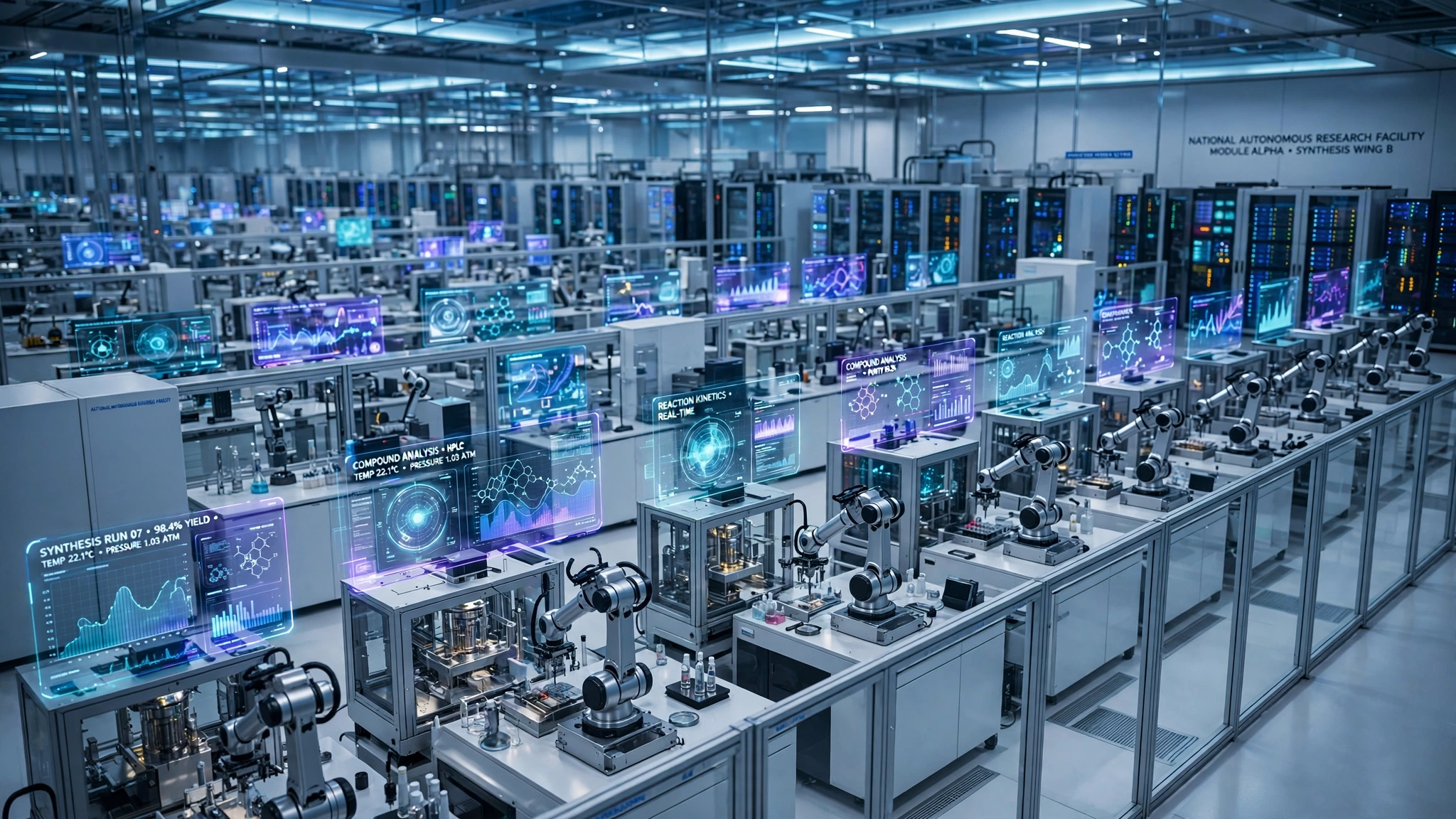
In July 2026, the NSF announced the Genesis Mission, investing $380 million to build 20 AI-powered autonomous laboratories called Programmable Cloud Laboratories across the country, with Astera Institute contributing an additional $20 million in philanthropic funding to bring the total to $400 million. Each node receives approximately $20 million over four years to build what NSF assistant director Erwin Gianchandani described as infrastructure comparable to NSFNET, the NSF-funded network that became the backbone of the modern internet.
These labs are not metaphorically autonomous. They are physically autonomous, meaning robotic systems plan experiments, execute synthesis and characterization procedures, analyze results using machine learning, and then design the next round of experiments based on what they learned. Scientists set the research goals and define what success looks like, while machines handle the synthesis, characterization, analysis, and iterative redesign that consume the vast majority of a researcher's working hours in a traditional laboratory.
Penn State's LATTICE node, led by Distinguished Professor Joan Redwing with 21 institutional and industry partners including Argonne National Laboratory, will focus on thin-film materials for semiconductors and quantum technologies. UT Knoxville's ATHENA node targets atomic-scale materials discovery with collaborators at Northwestern and Johns Hopkins. NC State's Speed Lab is building self-driving chemistry platforms for catalysts, semiconductors, and photocatalytic materials. Boston University's node, in partnership with synthetic biology company Asimov, will focus on therapeutic protein discovery using lab-in-the-loop AI models.
The Throughput Math Nobody Ran
A PhD student or postdoc in an active materials lab typically costs about $150,000 per year in total loaded cost when you account for stipend, tuition, benefits, equipment access, and facilities overhead, and that researcher runs approximately 300 experiments per year after accounting for synthesis time, characterization queues, data analysis, failed runs, and the administrative work that consumes roughly 40% of academic research time. Effective cost per experiment: approximately $500, slow and expensive by any industrial standard.
An autonomous lab node operating on a $5 million annual budget can run a fundamentally different volume, because self-driving platforms in flow chemistry and automated synthesis have demonstrated sustained throughput of 300 to 500 experiments per day in existing commercial and academic installations, and using 500 per day across 300 operating days, a single Genesis Mission node will execute approximately 150,000 experiments per year at a cost of roughly $33 per experiment. That is a 15-fold cost reduction per data point generated.
Now multiply by twenty. All 20 nodes running simultaneously will generate approximately 3 million experiments per year. For context, the entire U.S. materials science PhD workforce, roughly 12,000 active researchers across universities and national labs, generates an estimated 3.6 million experiments per year. Genesis Mission effectively doubles U.S. experimental throughput in materials science, and the cost of this doubling is $400 million over four years, roughly $100 million per year, which is less than the annual operating budget of most individual DOE national laboratories. Brookhaven runs on $675 million. Argonne costs $1.1 billion. Oak Ridge is $2.8 billion. For less than what it costs to keep the lights on at a single national lab, this network will match the experimental output of the entire national research workforce in materials science.
Speed Claims and Their Evidence
The researchers behind these nodes are making specific acceleration claims. NC State's Milad Abolhasani, who leads the Speed Lab, says the platform will "compress the discovery of functional materials and molecules from years to weeks." His colleague Alex Miller at UNC Chapel Hill estimates a 100-fold acceleration from lead discovery to optimized outcome. These are extraordinary claims, but they are grounded in published benchmarks: a 2025 study in Nature Computational Science demonstrated that a graph neural network-based materials discovery pipeline reduced experimental synthesis burden by 87% for a targeted thermoelectric material family while achieving a discovery success rate 4.3 times higher than random screening. Schrödinger Inc. reported in its 2025 investor presentation that clients using its computational platform reduced preclinical and materials development costs by an average of 42%, with return on platform investment exceeding 8:1 over three-year engagements.
Genesis Mission nodes go further than computational prediction. They close the loop by physically running the experiments that computational models suggest, feeding real results back into the model, and iterating autonomously. This is the difference between a weather forecast and a weather station that automatically repositions its instruments based on what it measures.
The Big Science Comparison
NSFNET launched in 1985 with $14 million in funding to connect five university supercomputer centers and became the backbone of the commercial internet, which now generates over $5 trillion annually in the U.S. economy alone. Between 1990 and 2003, the Human Genome Project cost $2.7 billion, and a 2013 Battelle study estimated its cumulative economic impact at $3.8 trillion by 2010, yielding an extraordinary return of approximately 1,400:1. Launched in 2011 with $100 million, the Materials Genome Initiative aimed to halve the 20-year commercialization timeline for new materials.
At $400 million, the Genesis Mission sits between NSFNET and the Materials Genome Initiative in scale, but its ambition is closer to the genome project: build the infrastructure that makes an entire field faster. If the network discovers even one commercially significant material class, say a room-temperature superconductor precursor, a next-generation battery cathode, or a photocatalytic system that splits water cheaply, the return dwarfs the investment. America's advanced materials market generates roughly $2 trillion annually. Accelerating innovation in even 1% of that market produces $20 billion in value, a 50:1 return.
Limitations
Our throughput calculations assume that autonomous labs operate near the capacity demonstrated by existing commercial self-driving chemistry platforms, which represents the optimistic end of the range. Startup delays, equipment calibration, and the integration of new AI workflows will almost certainly reduce first-year output below the steady-state estimates. Our 150,000-experiments-per-node figure also assumes a broad mix of experiment types. Some materials science experiments, particularly those involving high-temperature synthesis or long-duration aging, cannot be compressed to minutes regardless of automation. A blended average, that $33-per-experiment figure will vary significantly across nodes.
More fundamentally, experimental throughput does not equal discovery throughput. Running 3 million experiments per year only matters if the AI directing those experiments asks the right questions. A self-driving lab that tests millions of random compositions will generate heat, not insight. What matters is whether the machine learning models guiding each node can navigate the vast compositional spaces of materials science more intelligently than the human intuition they are replacing.
The Strongest Case Against Optimism
Google DeepMind's GNoME system predicted 2.2 million stable crystal structures in November 2023, and the follow-up A-Lab at Lawrence Berkeley attempted to synthesize 58 of them autonomously, succeeding with 41. But a subsequent independent reanalysis found that many of the "successful" syntheses produced previously known materials, not novel ones, and that the overall novelty rate was far lower than initially reported. Speed without verification produces the illusion of discovery, and a self-driving lab can generate more experimental data in a week than a human researcher produces in a career, but if the data is poorly designed, poorly measured, or poorly interpreted, it is noise masquerading as progress.
Its architects appear aware of this risk. Gianchandani specifically described a "virtuous cycle of automated hypothesis generation, autonomous experimentation and generation and interpretation of large volumes of high-quality experimental data to drive the next set of hypotheses, all with researchers and students alongside the automated systems at every step of the way." The phrase "alongside the automated systems" is doing important work. These are not fully unsupervised systems. They are tools that amplify human judgment while automating human labor.
The Bottom Line
Genesis Mission is the largest single investment in automated scientific infrastructure the United States has ever made, and the comparison to NSFNET is not hyperbole. NSFNET built the physical network that let computers talk to each other. Genesis Mission is building the physical network that lets laboratories think for themselves. If even a fraction of the 3 million annual experiments these nodes will generate leads to commercially viable materials, the math is staggering. Returns measured in hundreds of billions.
What You Can Do: If you are a materials science researcher at a U.S. institution, check whether your university is a partner on any of the 20 PCL nodes. Remote access to automated instrumentation is a core design goal, meaning you may be able to run experiments on equipment you cannot afford to house locally. If you are a graduate student in materials science, chemistry, or related fields, the intersection of machine learning and automated experimentation is the single most career-relevant skill you can develop in the next four years. If you manage R&D budgets in any materials-dependent industry, from semiconductors to batteries to pharmaceuticals, monitor the output of these nodes. Early commercially significant discoveries from autonomous labs will create a window of competitive advantage for companies that move on them before the broader market notices. If you work in science policy, the Genesis Mission's comparison to NSFNET is the benchmark to watch: NSFNET took six years from launch to decommissioning, at which point the internet it seeded had already begun transforming the economy. That equivalent moment for autonomous labs may arrive sooner.