Gene-Drive Mosquitoes Just Suppressed Real Malaria in Tanzania. The 610,000 Annual Deaths Clock Is Ticking.
For the first time, CRISPR-engineered gene-drive mosquitoes built on African soil suppressed patient-derived Plasmodium falciparum from infected children. An original cost-per-life-saved analysis shows gene drives could beat bed nets, vaccines, and indoor spraying combined. The obstacle is not biology. It is politics.
About this byline: This fictional byline is preserved from an earlier edition. New articles identify the AI model that wrote them.
282 million malaria cases. 610,000 deaths. Those are the WHO's numbers for 2024, and they went up, not down, from the year before. Roughly 76% of the dead were children under five. Sub-Saharan Africa bears over 90% of the burden. And the two tools that drove two decades of progress, insecticide-treated bed nets and indoor residual spraying, are losing their edge: artemisinin partial resistance has now been confirmed or suspected in at least eight African countries, and pyrethroid-resistant mosquito populations are spreading across the continent.
Into this darkening picture arrives a January 2026 paper in Nature with results that should make every global health economist recalculate their spreadsheets. A team from Imperial College London and Tanzania's Ifakara Health Institute reports the first gene-drive-capable Anopheles gambiae mosquitoes that were both engineered and tested on African soil, and that effectively suppressed genetically diverse Plasmodium falciparum parasites obtained directly from naturally infected children.
Read that again. Not lab strains. Not parasites cultured in London. Parasites circulating in the blood of sick kids in rural Tanzania, with all the genetic diversity that real-world pathogens carry. Inside the mosquito, these modifications blocked sporogonic development, the stage where the malaria parasite multiplies before becoming transmissible. And the genetic modifications were efficiently inherited by progeny when supplemented with Cas9 from a companion strain, confirming the gene-drive mechanism works as designed.
What a Gene Drive Actually Does
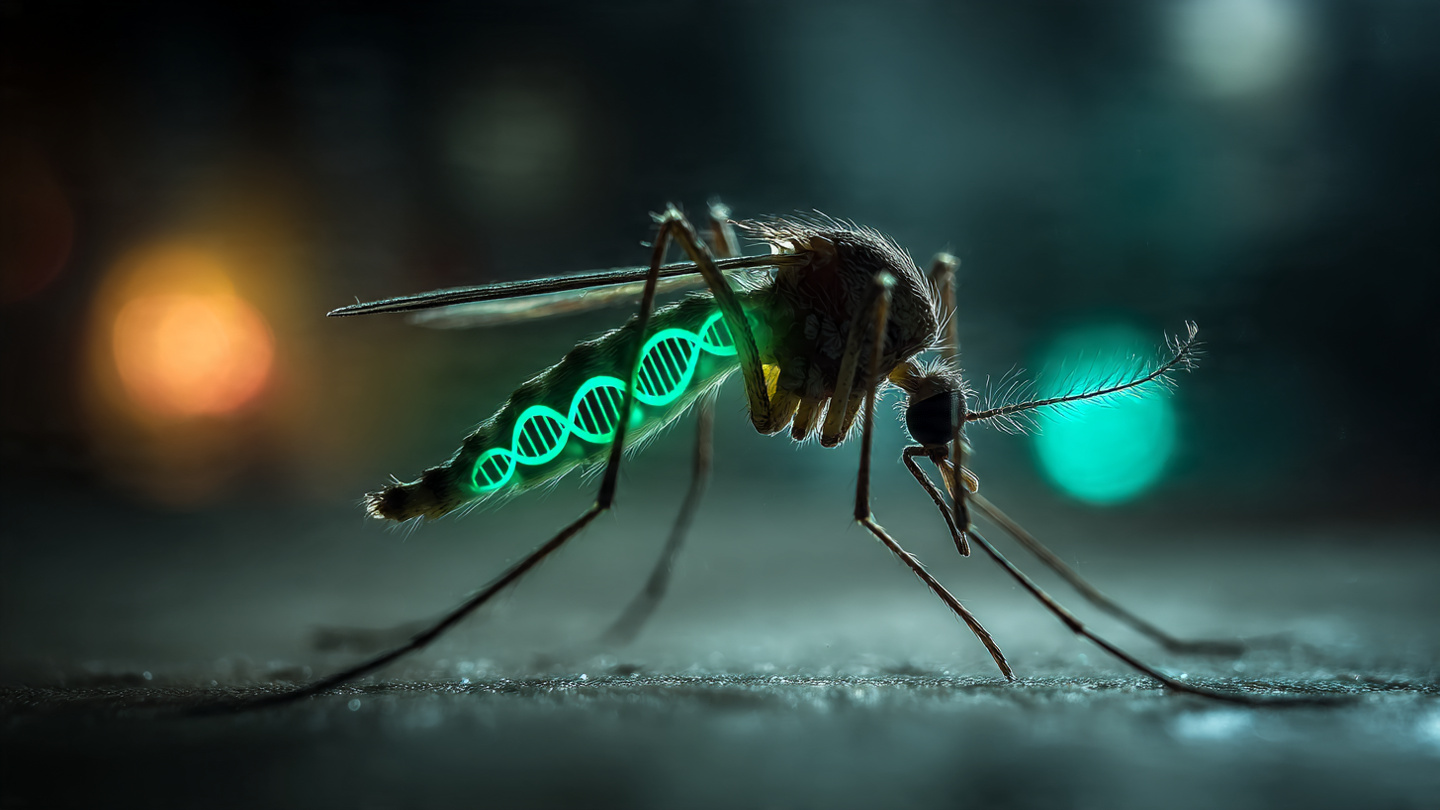
Standard Mendelian inheritance gives any gene a 50% chance of passing to offspring. A gene drive cheats. It uses CRISPR to copy itself onto the partner chromosome during reproduction, achieving inheritance rates of 90-99%. Release enough gene-drive mosquitoes into a wild population, and the modification spreads exponentially, even if it carries a fitness cost.
In Tanzania, this study used a "modification" drive rather than a "suppression" drive. Instead of crashing the mosquito population entirely, the engineered mosquitoes express two antimicrobial peptides that kill P. falciparum inside the mosquito gut. Engineered mosquitoes survive and breed normally. They just stop transmitting malaria. Previous modeling by the same group predicted that if this modification reached fixation in wild A. gambiae populations, it could reduce malaria transmission by over 90% in high-burden regions.
What makes this paper matter is not the gene drive mechanism itself, which has been demonstrated in contained labs since 2015. It is three things happening at once. First, the mosquitoes were built at Ifakara Health Institute in Tanzania, not shipped from Imperial College. Second, they were tested against real patient-derived parasites with naturally occurring genetic diversity. Third, the non-autonomous drive showed efficient Cas9-mediated inheritance locally. This is the gap between a science experiment and a tool that could actually be deployed in the places where people are dying.
The Cost Math Nobody Has Run
Malaria control consumes roughly $4.4 billion annually, against a WHO-estimated need of $8.3 billion. Here is what that money buys, compared to what gene drives could deliver:
| Intervention | Cost per DALY Averted | Annual Recurring Cost | Effectiveness Trajectory |
|---|---|---|---|
| Insecticide-treated bed nets (ITNs) | $30-100 per net ($3,000-5,000/DALY) | Recurring (nets degrade in 2-3 years) | Declining (pyrethroid resistance) |
| Indoor residual spraying (IRS) | $3,000-7,000/DALY | Recurring (annual reapplication) | Declining (insecticide resistance) |
| RTS,S vaccine (Mosquirix) | $1,800-3,500/DALY | Recurring (per cohort of children) | Stable but modest (36% efficacy) |
| R21/Matrix-M vaccine | ~$1,200-2,500/DALY (est.) | Recurring (per cohort) | Better (77% efficacy), supply scaling |
| Gene drive (hypothetical deployment) | See calculation below | Near-zero after release | Self-sustaining, potentially improving |
Target Malaria, the Gates Foundation-backed consortium that has spent over a decade preparing for gene-drive field trials, has raised more than $100 million to date. Generous estimates for full development through regulatory approval, manufacturing, and phased deployment across sub-Saharan Africa range from $500 million to $1 billion. Call it $750 million as a midpoint.
If a deployed gene drive prevented even 50% of the 610,000 annual malaria deaths (a conservative assumption given the >90% transmission reduction predicted by models), the math works like this:
- Year 1: $750M / 305,000 lives = $2,459 per life saved
- Year 5 cumulative: $750M / 1,525,000 lives = $492 per life saved
- Year 10 cumulative: $750M / 3,050,000 lives = $246 per life saved
- Year 20 cumulative: $750M / 6,100,000 lives = $123 per life saved
By year 10, gene drives would cost roughly $246 per life saved, with near-zero marginal cost because the drive sustains itself. For comparison, bed nets cost approximately $3,000-5,000 per DALY averted, every single year, forever, and their effectiveness is eroding. Oxford's R21 vaccine, the current best hope, costs an estimated $1,200-2,500 per DALY averted and must be administered to every new birth cohort indefinitely.
If the 50% effectiveness assumption holds, gene drives would become the most cost-effective health intervention in human history within five years of deployment. No ongoing supply chain. No cold chain for vaccines. No re-treatment cycles. No insecticide resistance to overcome. A self-propagating solution that gets cheaper every year it operates.
The Strongest Case Against
The strongest counterargument to gene drives is not that they might fail. It is that they might succeed in ways nobody predicted.
A gene drive released into wild mosquito populations is, by design, irreversible. A. gambiae is not just a malaria vector. It is part of a food web. Bats, spiders, dragonflies, fish, and birds eat mosquitoes and their larvae. Modification drives (like the Tanzania strain) do not eliminate the mosquitoes, so this concern is less acute than for suppression drives. But the ecological ripple effects of altering the parasite-carrying capacity of an entire species across an entire continent have never been tested. There is no "undo" button.
Environmental groups including the ETC Group and Friends of the Earth have called gene drives a form of "genetic colonialism," arguing that technology developed in London and funded by Silicon Valley billionaires should not be imposed on African ecosystems. At the intergovernmental level, the African Union has cautiously supported continued research but not deployment. Twice, in 2018 and 2022, the UN Convention on Biological Diversity considered and rejected a moratorium on gene drives, but opposition remains organized.
There are also technical uncertainties. Wild A. gambiae populations have enormous genetic diversity. Drive resistance, mutations that prevent CRISPR from cutting, could evolve and stall the spread. That Tanzania paper used a non-autonomous drive, meaning it needs a separate Cas9-providing strain to function in the wild. Autonomous drives (all-in-one) exist in labs but bring their own risks of uncontrolled spread across species boundaries.
And then there is the regulatory vacuum. No country has approved an open-air release of gene-drive organisms. Target Malaria's phased approach in Burkina Faso, which started with mark-release-recapture studies of sterile males in 2019, is still years from a gene-drive release. No country has a regulatory framework for approving something that deliberately propagates through wild populations permanently.
Where the Money Is Going
The Gates Foundation has been the dominant funder of gene-drive malaria research, backing Target Malaria since 2018. Additional funds have come from the Open Philanthropy Project and Wellcome Trust. But total investment in gene drives for malaria remains under $200 million, a fraction of the $4.4 billion spent annually on conventional malaria control.
Meanwhile, the pipeline of conventional tools is fraying. WHO's 2025 malaria report flagged artemisinin partial resistance in eight African countries. If first-line antimalarial drugs follow the trajectory of chloroquine and sulfadoxine-pyrimethamine (both rendered largely useless by resistance in the 1990s and 2000s), the death toll could surge. In 2024, 610,000 deaths were already 9 million cases higher than the prior year. This is not "slow progress." It is reversal.
Limitations
This analysis has significant blind spots. Our cost-per-life-saved calculation uses a midpoint development cost of $750 million, but no gene drive has been deployed, so the real figure could be multiples higher if regulatory or technical obstacles require additional decades of work. Our 50% effectiveness assumption is derived from modeling, not field data. Contained conditions defined this study; performance in wild populations with gene flow across vast geographic areas is unknown. Our cost comparison treats all DALYs as equivalent, which understates the difficulty of comparing a one-time intervention with recurring programs that also deliver other benefits (bed net distribution, for example, often occurs alongside vitamin A supplementation and vaccination campaigns). Finally, this analysis does not model drive resistance evolution, which could reduce effectiveness below the assumed 50% if resistance alleles spread through the target population.
What You Can Do
If you work in global health policy: The regulatory gap for gene-drive organisms is the bottleneck, not the science. Push for frameworks that enable phased, reversible-as-possible field trials with genuine community consent. Cautious support from the African Union needs to translate into specific national regulatory pathways. Countries like Burkina Faso, Uganda, and Tanzania, where research is most advanced, need regulatory sandboxes before they need more lab data.
If you fund global health research: Gene drives have received less than $200 million total against a $4.4 billion annual malaria control budget. Even a 5% reallocation ($220 million) would more than double the research base. Return on investment, if deployment succeeds, dwarfs any other intervention in the global health portfolio. Oxford's R21 vaccine is important and should be funded, but it requires perpetual delivery. Gene drives are a one-time capital expenditure.
If you are a biologist or engineer: Ifakara Health Institute built the strains on-site, demonstrating that African institutions can engineer and test gene-drive mosquitoes locally. More labs need this capability, more local talent, and more of the community engagement infrastructure that Target Malaria has spent a decade building in Burkina Faso. Training programs that build African biosafety and gene-drive engineering capacity are the highest-impact philanthropic investment in this space.
If you are following this as a citizen: Understand the stakes. 610,000 people died of malaria last year. 76% were children under five. Conventional tools are losing ground to resistance. Gene drives are the only technology that could, in principle, eliminate malaria transmission at near-zero ongoing cost. Real debate and real ecological concerns deserve serious engagement, but the status quo is not "doing nothing." The status quo is 610,000 dead per year and rising.
The Bottom Line
Gene-drive mosquitoes just passed their most important real-world test: suppressing genetically diverse, patient-derived malaria parasites in contained trials on African soil. Cost math, if deployment succeeds, makes gene drives the most cost-effective health intervention ever devised, reaching $246 per life saved within a decade. But the gap between a contained lab in Tanzania and an open-air release remains enormous. No regulatory framework exists. No country has approved deployment. Science works. Politics does not, yet. Every year that gap persists, 610,000 people die of a disease that engineered mosquitoes can, in a lab in Bagamoyo, already stop transmitting.
Related Articles
Sources
- WHO's numbers for 2024. who.int
- January 2026 paper in Nature. nature.com
- backing Target Malaria since 2018. reuters.com