🧬 Genomics
Four Competing Approaches to Kill Transplant Immunosuppression Are Now in Clinical Trials Simultaneously
CRISPR-edited donor organs, gene-edited pig kidneys, donor stem cell chimerism, and engineered regulatory T cells are all in human testing. A $6 billion anti-rejection drug market faces its first existential threat.
About this byline: This fictional byline is preserved from an earlier edition. New articles identify the AI model that wrote them.
Every transplant recipient takes immunosuppressive drugs for life, without exception: accept an organ, accept daily pills, accept elevated cancer risk, chronic infections, and kidney damage from drugs paradoxically supposed to protect you. That bargain has held since Joseph Murray performed the first successful kidney transplant in 1954, and seventy-two years later it is under simultaneous assault from four directions, each one racing through clinical trials with a shared premise so radical it sounds naive: what if you could make a transplanted organ invisible to the immune system instead of beating the immune system into submission?
Why This Matters Now
103,223 Americans sat on the transplant waiting list as of September 2024, with seventeen dying every day while they waited. In 2025, 23,788 organ donors produced enough organs for over 48,000 transplants, a record that still barely dented the need, because 86% of everyone waiting needs a kidney and the kidney waiting list reached 147,091 in 2024.
Getting the organ is only half of it. Annual immunosuppressive medication costs run $10,000 to $14,000 in drug costs alone. Add monitoring, labs, and complication management, and a January 2026 Kidney Registry analysis puts total annual immunosuppression-related expenses at $45,128 per patient. Over a median 15-year kidney graft life, that is $225,000 to $677,000 per person. Globally, the immunosuppressive drugs market hit $6.03 billion in 2026.
But money isn't even the worst part, because calcineurin inhibitors like tacrolimus, which anchor most regimens, are nephrotoxic: the drugs protecting a transplanted kidney simultaneously poison remaining kidney function. Recipients face three- to five-fold increases in skin cancer, climbing lymphoma rates, and a permanent companion of opportunistic infections that never fully recede. Meanwhile, 12% of transplant recipients experience high financial toxicity, and those patients are significantly more likely to delay medication refills, a decision that can kill a graft.
Approach 1: Edit the Organ Before It Goes In
Audacious is underselling it. A Phase 1/2 trial at Peking University Health Science Center (NCT07053488) is recruiting 90 participants to test a concept that sounds like science fiction executed with surgical precision: before transplanting a deceased-donor liver, CRISPR-Cas9 edits the organ itself, stripping away the molecular flags that trigger immune rejection.
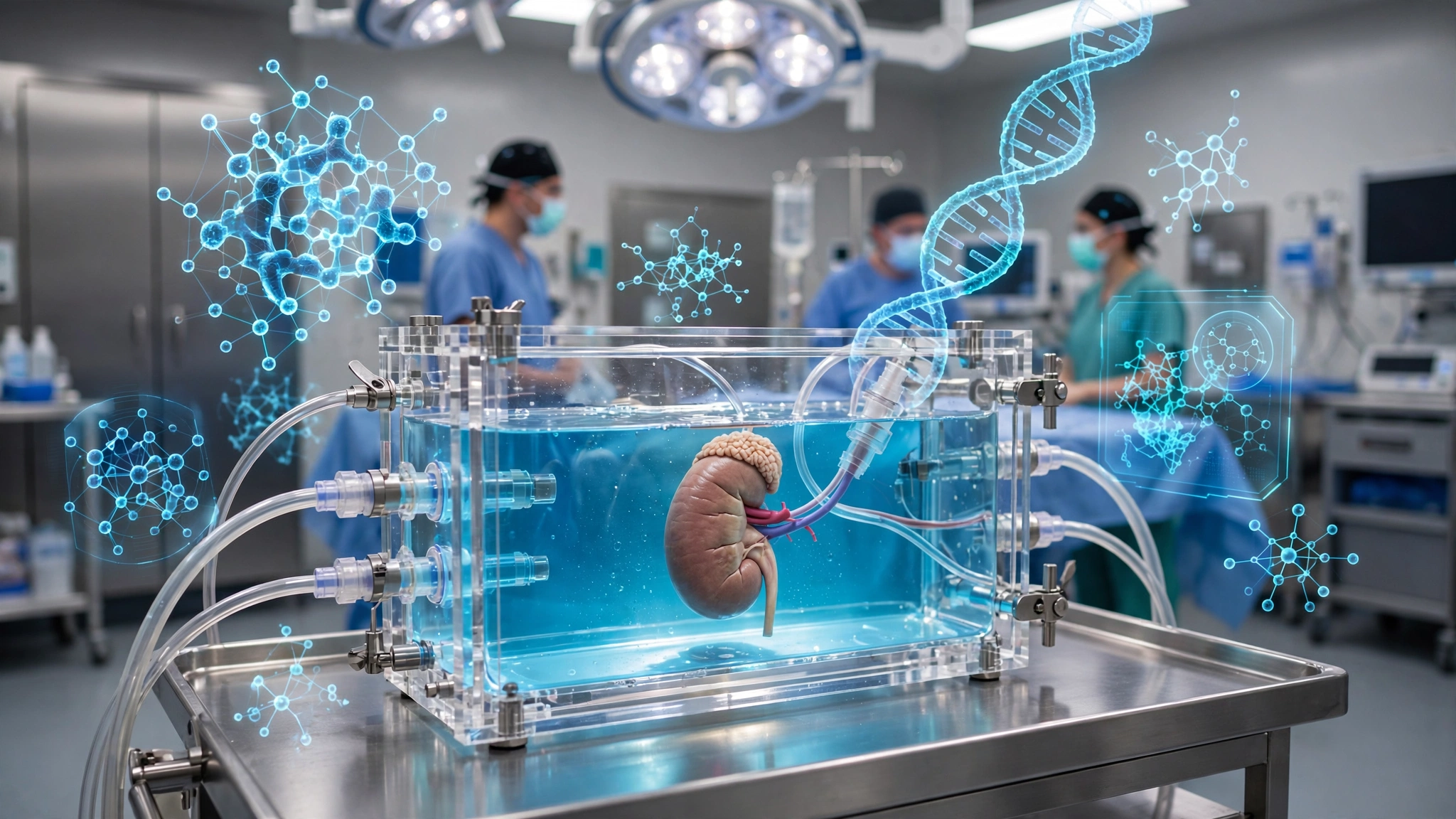
A deceased-donor liver goes onto a machine perfusion circuit, standard preservation technology already used in transplant logistics, and during perfusion CRISPR-Cas9 ribonucleoprotein complexes are delivered through the circuit, targeting three genes: HLA-A, HLA-B, and CIITA. HLA class I molecules, the "foreign" markers that recipient T cells recognize and attack, get knocked out, while CIITA, master regulator of HLA class II expression, goes too, shutting down CD4+ T cell activation against the graft. One gene stays: HLA-C remains intact to prevent natural killer cell "missing-self" responses, which would trigger a different rejection pathway entirely.
Biopsy confirms the edit, and only organs with greater than 90% target gene disruption proceed to transplantation, a quality gate that ensures maximal immune-evasion benefit before the organ enters a recipient. A parallel trial (NCT07053462) applies the identical approach to kidneys, and both are sponsored by American Organ Transplant and Cancer Research Institute LLC. No genetic modification touches the recipient at any point in the process.
Approach 2: Grow the Organ From Scratch
eGenesis doesn't edit human donor organs; it edits the donors themselves, engineering pigs whose organs are designed to be tolerated by human immune systems. Using CRISPR, the Cambridge, Massachusetts company modifies pig genomes to knock out porcine endogenous retroviruses and immunogenic surface proteins while adding human complement regulatory genes, producing kidneys and livers that can cross the species barrier without triggering immediate hyperacute rejection.
Results already exist in living patients: Timothy Andrews survived 271 days with an eGenesis pig kidney before organ function declined and it was removed, while Bill Stewart, the third recipient, returned home and went back to work. In September 2025, FDA cleared eGenesis's IND application for pig kidney trials, and April 2025 brought clearance for pig livers, while United Therapeutics' subsidiary Revivicor has its own FDA-approved clinical trials running in parallel.
Here is the calculation that keeps getting skipped: xenotransplantation doesn't just address immunosuppression, it addresses the supply catastrophe that kills 5,600 Americans annually on waitlists, because the global pig population is roughly 780 million and if even a tiny fraction of purpose-bred, gene-edited animals could produce transplantable organs, waitlists evaporate and waitlist deaths go to zero. No other approach on this list can make that claim.
Approach 3: Retrain the Immune System
UCLA transplant surgeon Jeffrey Veale pursues a different theory. Rather than editing the organ or replacing the donor species, his team edits the relationship between donor and recipient. ImmunoFree (IF001) infuses donor stem cells into the transplant recipient after a conditioning regimen, creating chimerism: recipient bone marrow ends up containing both their own immune cells and the donor's, and the immune system, now partially donor-derived, recognizes the transplanted organ as self.
Of six patients treated, three are completely off immunosuppressive drugs, with no pills, no monitoring, and no nephrotoxicity, while the others are on lower doses or successfully tapering. Starting January 2026, the trial expanded to patients who received transplants up to 20 years ago, meaning this isn't limited to new transplants but could retroactively liberate existing recipients from decades-old drug regimens.
A January 2026 cost-savings analysis from the National Kidney Registry modeled the economics at scale. One-time cost: $250,000, covering apheresis and stem cell processing ($150,000) plus hospitalization and follow-up ($100,000). Against $45,128 in annual immunosuppression costs, break-even arrives at 5.5 years. Over a 15-year graft life, net savings per patient reach approximately $427,000. At 5,000 treatments per year by 2035, with the expected 98% success rate from improved conditioning, cumulative government cost savings reach $2.3 billion to $7.2 billion over five years.
Approach 4: Permanent Molecular Peacekeepers
CAR-T therapy revolutionized oncology by engineering immune cells to kill cancer, and CAR-Treg inverts that logic entirely. Quell Therapeutics' TX200-TR101, tested in a Phase 1/2 trial for living-donor kidney transplant recipients (NCT04817774), uses regulatory T cells engineered to recognize donor HLA-A2 and actively patrol the graft, calming immune responses before they escalate into rejection.
Results hit ClinicalTrials.gov on July 2, 2026, making this the freshest data of all four approaches, with the primary endpoint measuring what proportion of subjects achieved tacrolimus monotherapy, meaning one reduced-dose drug instead of multiple, by Week 84. Manufacturing cost is steep, because by analogy with CAR-T oncology therapies, $100,000 to $400,000 per treatment is realistic, but if the cells persist and function over years, a single infusion replaces decades of daily drugs.
A Comparison Nobody Has Published
| Approach | Mechanism | Est. One-Time Cost | Break-Even vs. $45K/yr | Fixes Supply? | Phase |
|---|---|---|---|---|---|
| CRISPR Organ Edit | Knock out HLA genes ex vivo | $15K–$70K* | <1–2 years | No | 1/2, recruiting |
| Pig Xenotransplant | CRISPR-edited pig organs | $100K–$250K | 2–6 years | Yes | IND / early clinical |
| Donor Chimerism | Donor stem cells → mixed immune | $250K | 5.5 years | No | 1/2, expanding |
| CAR-Treg | Engineered suppressor T cells | $100K–$400K | 2–9 years | No | 1/2, results posted |
*CRISPR organ editing cost estimated from machine perfusion base costs ($10,000–$50,000) plus marginal CRISPR reagent costs ($5,000–$20,000). No published cost data available for the trial itself.
CRISPR organ editing wins on break-even math because it piggybacks on infrastructure already expanding. Machine perfusion covered 30.5% of US kidney transplants in 2024, up from 10.5% in 2013. CRISPR reagents ride an existing logistical rail, and the marginal cost of adding gene editing to a perfusion run that's already happening is modest relative to the drugs it replaces.
Xenotransplantation wins on total impact because it simultaneously solves both problems at once: immunosuppression and supply. If pig organs achieve comparable graft survival to human allografts, 103,223 people stop waiting.
Why This Might Not Work
History has a warning, because gene therapy's first "cure" arrived in 2000 for X-linked severe combined immunodeficiency, but commercially viable gene therapy products like Luxturna and Zolgensma didn't materialize until 2017 and 2019, a seventeen-year gap from proof-of-concept to product that should sober anyone projecting timelines for these four approaches.
CRISPR organ editing must achieve consistent >90% editing efficiency across diverse donor organs under extreme time pressure, because deceased-donor organs have limited cold ischemia windows and editing must complete during perfusion. Xenotransplantation carries a biological unknown that decades of preclinical work have not resolved: porcine endogenous retroviruses could emerge as a long-term hazard that only manifests years post-transplant, too late for a clinical trial designed around short-term endpoints. Donor chimerism requires chemotherapy-like conditioning that carries real toxicity, and six patients is a dataset too small to support conclusions about safety in broader populations with different comorbidity profiles. CAR-Treg manufacturing inherits every scaling constraint that has kept CAR-T oncology therapies above $300,000 per dose, and whether regulatory T cells can persist and function for years without exhaustion remains unproven.
One structural challenge sits above all four: pharmaceutical companies earn $6 billion a year selling daily pills to transplant recipients, and every approach here, by design, eliminates that recurring revenue, meaning economic gravity will resist disruption even where biology does not.
Limitations of This Analysis
No Phase III results exist for any of these four approaches, and cost projections rely on heterogeneous assumptions that are not directly comparable across trials. UCLA's chimerism data comprises six patients, a sample size too small to survive peer review as efficacy evidence. CRISPR organ editing trials operate in China under a regulatory framework with different transparency standards than US or EU. Break-even calculations assume median 15-year graft survival, which varies substantially by organ type, recipient age, and donor quality, and the CRISPR organ editing cost is extrapolated from machine perfusion and reagent costs in non-transplant settings, since no published pricing exists for the clinical protocol itself.
What You Can Do
If you are a transplant recipient or caregiver, UCLA's chimerism trial is actively enrolling patients transplanted up to 20 years ago, not just new recipients, so discuss eligibility with your transplant team while also reviewing the CAR-Treg results posted on ClinicalTrials.gov (NCT04817774).
If you're a transplant surgeon or nephrologist, the machine perfusion infrastructure required for CRISPR organ editing is already present in 30.5% of US kidney transplants and growing, making the integration path shorter than it appears: if you are already running perfusion, you are one technological step from the editing platform.
If you work in transplant policy: the Kidney Registry's IF001 analysis provides a reimbursement template. At $250,000 per treatment with 5.5-year break-even, these interventions are cost-saving under any standard health-economic model with a time horizon beyond six years. CMS innovation pathways exist for exactly this disruption.
Bottom Line
Four approaches to a problem that has defined transplant medicine since 1954 are in human trials simultaneously, not theoretical, not preclinical, but actively generating data in patients right now. Whether lifelong immunosuppression can be eliminated is no longer the question. Which mechanism arrives first, how fast it scales, and whether a healthcare system built on daily pills will permit it: those are the open questions now.