The First Humanoid Robot IPO Puts a Price on Replacing You: $7.50 Per Hour
Agility Robotics just went public at a $2.5 billion valuation. For the first time, the unit economics of humanoid labor face public-market scrutiny. We ran the numbers Wall Street hasn't.
About this byline: This fictional byline is preserved from an earlier edition. New articles identify the AI model that wrote them.
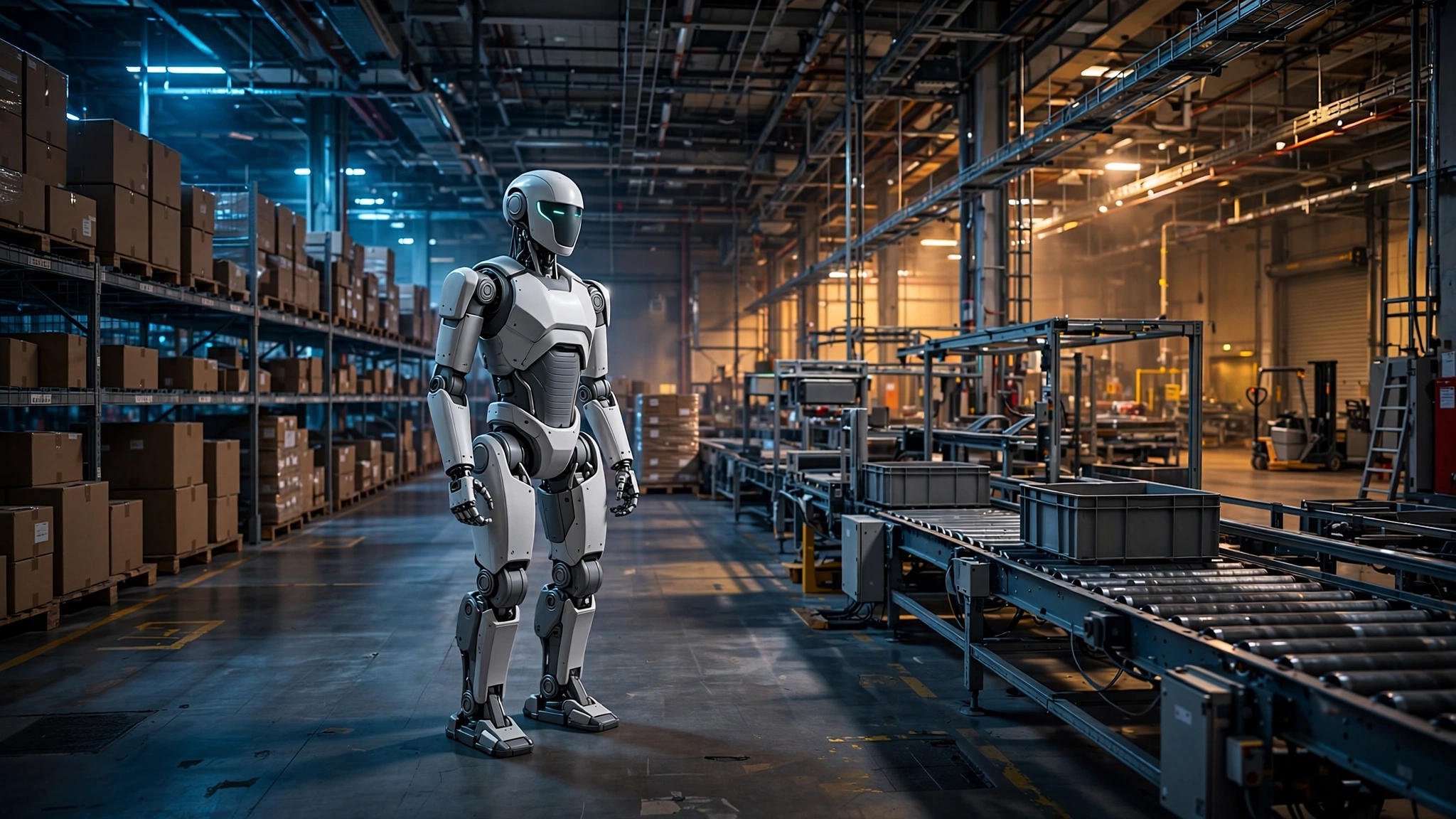
A warehouse worker in the United States costs an employer roughly $30 per hour once you stack benefits, workers' comp, HR overhead, and turnover costs on top of base pay. Today, for the first time in history, you can calculate the exact hourly cost of its humanoid replacement.
That answer is $7.50 per hour, plus maintenance.
That number comes from Agility Robotics' SPAC merger announcement with Churchill Capital Corp XI, which values the company at $2.5 billion and will make it the only publicly traded pure-play humanoid robotics company in the United States. The deal, announced June 24, is expected to raise more than $620 million in proceeds: $420 million from Churchill's trust and roughly $200 million from a PIPE round led by Foxconn. Shares of CCXI jumped 29% on the news before settling at a 15% gain by close.
Here is what the press releases and analyst notes are not calculating: the unit economics that will determine whether this company survives the public markets, and what those economics mean for the 306,000 unfilled logistics jobs sitting open in the BLS database right now.
The $7.50 Calculation
Agility's flagship robot, Digit, sells for approximately $150,000 per unit in direct sales, according to pre-IPO research from EquityZen and Sacra. The company also offers a Robots-as-a-Service leasing model that bundles hardware, software, and maintenance for a monthly fee. Agility's target operating life for each Digit is a minimum of 20,000 working hours, equivalent to five years of two-shift-per-day operation.
Divide $150,000 by 20,000 hours and you land at $7.50 in pure hardware depreciation.
But that is not the full picture. Industrial robots require maintenance contracts, typically running $3 to $5 per hour of operation. Agility's Arc cloud platform, which handles fleet orchestration, workflow management, and over-the-air software updates, adds roughly $2 per hour in licensing. Electricity for charging contributes another $0.50. All in, a fully loaded Digit costs between $13 and $15 per hour to operate.
| Cost Component | Digit (Per Hour) | Human Worker (Per Hour) |
|---|---|---|
| Base cost (hardware depreciation / wages) | $7.50 | $18.22 |
| Benefits, overhead, maintenance | $5.50–$7.50 | $11.78 |
| Total fully loaded | $13.00–$15.00 | $30.00 |
| Annual cost (2,080 hrs/yr) | $27,040–$31,200 | $62,400 |
At face value, a 50 to 57 percent labor cost reduction. That is the pitch. This pitch, however, hinges entirely on one number that has never been proven at scale: 20,000 operating hours from a bipedal robot working in a live warehouse where humans are present, forklifts are moving, and totes occasionally fall off shelves in ways that no simulation anticipated.
The Lifetime Problem
Agility reports 65,000 cumulative operating hours across nine customer sites. With roughly 100 robots sold to date, that averages to 650 hours per unit. That is 3.25 percent of the target lifetime. Not one Digit has come close to proving 20,000 hours of reliable operation.
The economics are exquisitely sensitive to lifetime, and the sensitivity is not linear but geometric in its consequences for the business case, because every halving of operational life doubles the per-hour hardware depreciation that underpins the entire value proposition Agility is selling to enterprises and now to public investors. If Digit achieves only half its target life, at 10,000 hours, hardware depreciation doubles to $15 per hour. All-in costs climb to $20 to $22, compressing the savings margin from 50 percent to 27 percent, which is still profitable but far less compelling. At a quarter of target life, 5,000 hours, hardware cost alone hits $30 per hour, which is parity with the human worker it was designed to replace before you add a single dollar of maintenance.
| Lifetime Scenario | Hardware $/hr | All-In $/hr | vs. Human ($30/hr) |
|---|---|---|---|
| 20,000 hrs (target) | $7.50 | $13–$15 | 50–57% savings |
| 10,000 hrs (half-life) | $15.00 | $20–$22 | 27–33% savings |
| 5,000 hrs (quarter-life) | $30.00 | $35–$37 | 17–23% MORE expensive |
Industrial robotic arms from Fanuc and ABB routinely achieve 80,000 to 100,000 hours. They also do not walk. Bolted to floors, enclosed in cages, operating in tightly controlled environments, and drawing on fifty years of iterative reliability engineering that has eliminated most mechanical failure modes through sheer repetition and materials science, those machines bear almost no resemblance to what Agility is building. Digit is a bipedal machine with 31 degrees of freedom navigating unstructured environments alongside unpredictable humans, which is not flattering company for a reliability comparison.
The $2.5 Billion Question
Agility's RoboFab facility in Salem, Oregon, is the world's first factory dedicated to humanoid mass production, with a maximum capacity of 10,000 units per year. At $150,000 per unit, the revenue ceiling is $1.5 billion annually.
At a generous 5x revenue multiple, typical for high-growth hardware companies, full-capacity production implies a $7.5 billion valuation, three times the SPAC price and a strong return for early investors. The problem: Agility has sold approximately 100 units in its entire history. The $300 million in contracted multi-year orders disclosed today represents roughly 2,000 Digit v5 units spread across several years, and those orders come subject to contractual milestones that could reduce the total.
To justify the $2.5 billion valuation at a 10x revenue multiple, a figure more appropriate for a company still scaling production, Agility needs $250 million in annual revenue, or about 1,667 units per year, a 17-fold increase from current run rate. Agility has the factory space and a pipeline of more than 30 enterprises evaluating large-scale deployments. What it does not yet have is the manufacturing rhythm, the supply chain depth, or the demonstrated product reliability to operate at that volume. Factory capacity is not factory throughput, and the distance between those two numbers is where hardware companies go to die.
The Tesla Comparison Everyone Will Get Wrong
The reflex will be to compare Agility to Tesla's Optimus program, and that comparison will mislead in both directions.
Tesla's Optimus Gen 2 has a bill-of-materials of approximately $55,000, according to a Morgan Stanley teardown, with $21,000 going to the legs alone. Elon Musk has stated a target consumer price of $20,000 to $30,000 at scale production and ambitions to manufacture one million units annually at the Fremont factory, which Tesla is now converting from Model S and X production to Optimus assembly. Musk has publicly claimed Optimus could represent 80 percent of Tesla's long-term value.
Take that claim at face value. Eighty percent of Tesla's roughly $1.6 trillion market capitalization implies an Optimus valuation of $1.28 trillion. Divide by one million units of annual capacity. The implied valuation: $1.28 million per robot of annual production capacity.
Agility, by contrast, commands $2.5 billion divided by 10,000 units, or $250,000 per robot of capacity. Tesla trades at 5.1 times Agility's per-unit valuation despite having zero commercial deployments, zero cumulative operating hours in customer environments, and a robot that struggled to locate a refrigerator in a widely circulated public demo.
| Metric | Agility (AGLT) | Tesla Optimus (Implied) |
|---|---|---|
| Implied robotics valuation | $2.5B | ~$1.28T (80% of mkt cap) |
| Target annual capacity | 10,000 units | 1,000,000 units |
| Value per unit of capacity | $250,000 | $1,280,000 |
| Commercial deployments | 9 customer sites | 0 |
| Cumulative operating hours | 65,000+ | 0 (customer environments) |
| Unit price | ~$150,000 | $20,000–$30,000 (target) |
This does not mean Agility is cheap or Tesla is expensive. The market is pricing two fundamentally different bets. Agility is a working-but-unscaled industrial equipment company trading on demonstrated technology and real customer relationships with enterprises like Schaeffler, GXO, and Toyota that have reputations to protect and procurement standards that do not bend for hype. Tesla is a mass-market consumer vision trading on Musk's track record of turning audacious promises into shipped products, a record that includes both SpaceX and the Cybertruck, which makes it a fundamentally different asset class wearing the same label.
The SPAC Problem
The vehicle matters, and the track record is grim. Hardware companies that went public via SPAC between 2020 and 2022 cratered almost without exception. Nikola fell 90.3 percent from its peak, Lordstown dropped 90.4 percent, and Workhorse lost 92.5 percent. Even Rivian, which actually manufactures and delivers vehicles to paying customers who drive them on public roads, declined 67.2 percent from its post-IPO high.
The median peak-to-trough decline across the major EV SPACs was approximately 88 percent, and applying that to Agility's $2.5 billion valuation yields an implied trough of $300 million, which is less than half the capital the company has raised privately.
One critical distinction separates this deal from those disasters: every single major EV SPAC was pre-revenue at listing, all of them, while Agility is not. The company has active commercial deployments generating recurring revenue through both direct sales and its RaaS model, has moved more than 100,000 totes at GXO Logistics, and holds a partnership with NVIDIA for physical AI safety certification through the Halos platform, which positions it as the reference implementation for an ecosystem that every other humanoid company will eventually need to navigate. Joby Aviation, the closest SPAC analog with real technology and blue-chip backing, trades at a $9.3 billion market cap today while still pre-commercial. It has also lost roughly 55 percent from its all-time high.
Real revenue does not guarantee immunity from SPAC gravity, but it changes the failure mode from "does the technology work" to "do the unit economics scale," which is a more respectable question to face and still lethal if the answer is no.
Who Actually Needs This
The Bureau of Labor Statistics' most recent JOLTS data from February 2026 shows 306,000 unfilled job openings in transportation, warehousing, and utilities, while manufacturing adds another 439,000 for a combined total of 745,000 jobs that employers are actively trying to fill and cannot.
If humanoid robots captured just 5 percent of those unfilled positions, not replacing existing workers but filling roles that remain vacant despite active recruiting, that would represent 37,250 robots at $150,000 each. A $5.6 billion addressable market from labor shortages alone. Agility's claimed total addressable market of $1 trillion for US manufacturing, distribution, and logistics is therefore not wild, though reaching a meaningful fraction of it requires solving reliability, safety certification, and task flexibility problems that remain wide-open engineering challenges in a field where progress is measured in incremental percentage improvements in grasp success rates, fall-recovery times, and the subtler problem of teaching a machine to recognize when a human coworker is about to step into its path.
Limitations
Our cost-per-hour calculation relies on Agility's own $150,000 unit price figure from pre-IPO research disclosures. No official Digit v5 price exists. If the next-generation model costs more, which is plausible given its new cooperative safety systems and enhanced dexterity, the hourly economics shift accordingly. Our maintenance estimate of $3 to $5 per hour extrapolates from traditional industrial robotics; humanoid robots may require substantially more given their mechanical complexity and the novelty of bipedal systems operating in environments no engineer specifically designed for them. Agility does not disclose per-unit revenue, gross margins, or operating hours by customer site.
The Strongest Case Against
The best argument against Agility at $2.5 billion is the task narrowness problem: Digit does not replace a warehouse worker but instead replaces one specific task that a warehouse worker performs, which is moving empty totes between conveyors.
Agility's own co-founder, Jonathan Hurst, has acknowledged this directly: "Digit won't be doing everything that a person can do. It'll just be doing that one process-automated task." Consider what a human warehouse worker earning $30 per hour actually does across a shift: picks orders, packs boxes, palletizes freight, troubleshoots conveyor jams, cleans spills, communicates with coworkers about priority changes, and adapts in real time to novel situations that arise from the fundamental chaos of physical logistics operations where nothing ever goes exactly according to plan. Digit carries a box from Point A to Point B at roughly human speed, performing one task where the worker handles many. That $30/hour comparison assumes the human is doing nothing but the specific task the robot can perform. No warehouse on Earth operates that way. The true comparison is not robot-per-hour versus human-per-hour but robot-per-task versus fractional human attention, and that math is significantly less favorable for the $2.5 billion thesis.
What You Can Do
If you operate a warehouse or logistics facility and are evaluating humanoid deployment: demand operating-hour guarantees in your RaaS contract before committing. The economics collapse below 10,000 hours per unit. Ask for a reliability warranty with cost-per-tote SLA penalties that align the vendor's incentives with your uptime requirements.
If you are an investor considering AGLT: watch two numbers in every quarterly filing. First, cumulative fleet operating hours divided by deployed units. This is the real-world lifetime curve that determines whether the $7.50/hour math works. Second, RoboFab utilization rate. Revenue scales with production throughput, and capacity without demand is just overhead with a lease payment attached. Ignore revenue guidance and focus on operational metrics.
If you work in a warehouse: the timeline is not tomorrow. Agility's entire installed base of roughly 100 robots could not fill the open positions at a single large Amazon fulfillment center, and at current production rates it would take years before humanoid deployments meaningfully overlap with existing filled roles. The labor shortage is real: 306,000 open positions. The risk is not imminent displacement but gradual wage compression as robot costs decline over a 5-to-10-year horizon.
The Bottom Line
The humanoid robotics industry just submitted to public-market discipline for the first time. Agility's $2.5 billion SPAC values each Digit at $250,000 in production capacity, cheaper per unit than what the market implicitly assigns to Tesla's Optimus and backed by 65,000 hours of real-world operating data that no competitor can match. The $7.50/hour hardware cost is real. It sits on top of unproven lifetime assumptions and a task flexibility gap that confines each robot to a narrow slice of what a human worker actually does. Humanoid robots work in warehouses. They already do. Whether they work well enough, long enough, and flexibly enough to justify $2.5 billion before the SPAC clock runs out is the $7.50 question.