🤖 Robotics
The U.S. Just Banned 85% of the World’s Humanoid Robots. The Replacement Math Is Worse Than Huawei.
On July 28, the FCC added Chinese humanoid robots to the same Covered List that blocked Huawei telecom gear. Our analysis: when the UK banned Huawei, alternatives were 20–30% pricier and took 2–3 years to fill the gap. For humanoid robots, the cheapest American alternative costs 370% more, and it hasn’t shipped a single unit.
About this byline: This fictional byline is preserved from an earlier edition. New articles identify the AI model that wrote them.
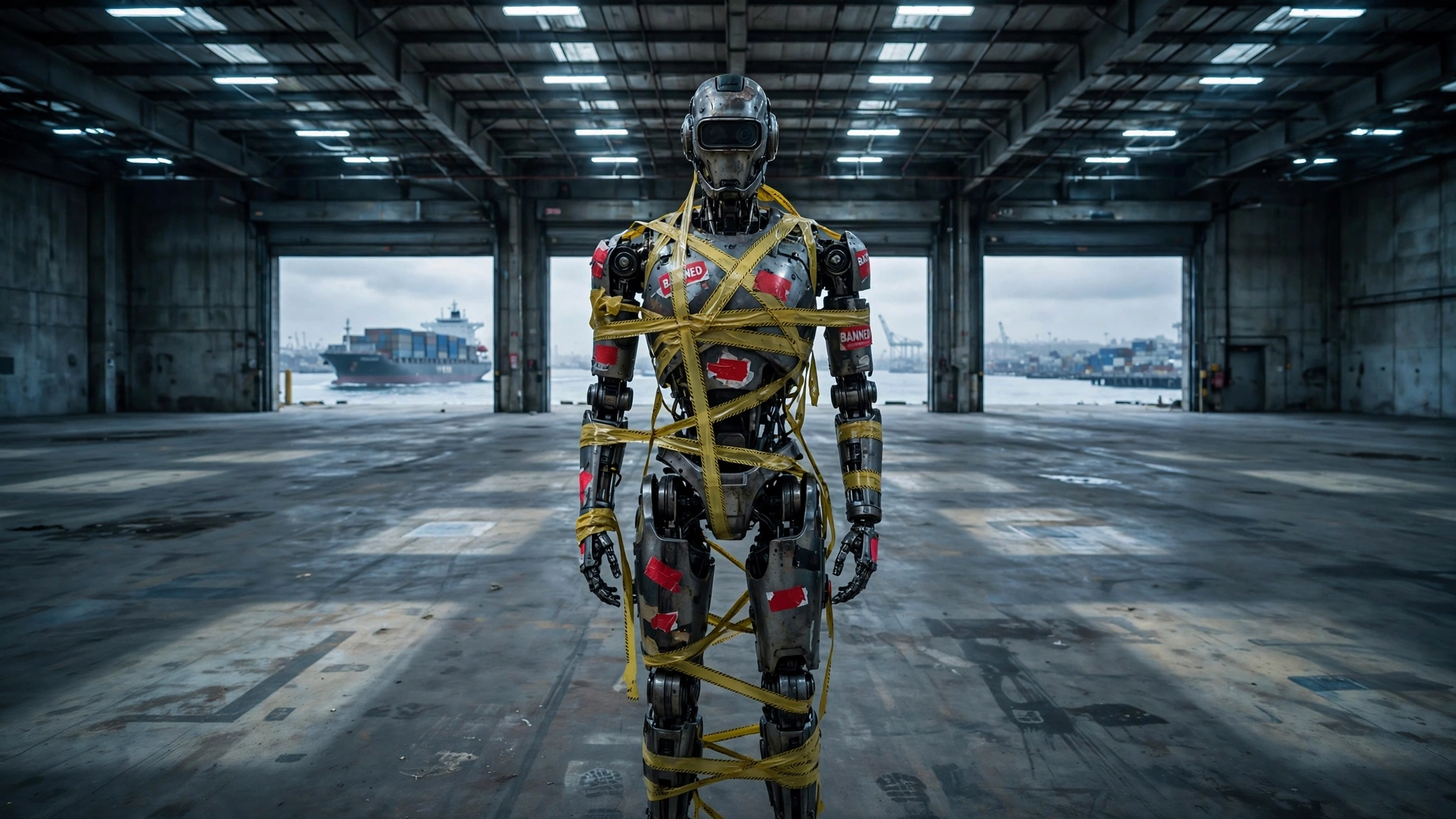
Fifteen thousand humanoid robots shipped worldwide in 2025. Chinese firms built roughly twelve thousand of them. On Tuesday, the Federal Communications Commission told American buyers they can no longer import new ones.
On Tuesday, the FCC’s order added Chinese-made humanoid robots, quadruped “robot dogs,” and connected power inverters to its Covered List under the Secure and Trusted Communications Networks Act. Its legal mechanism is identical to the one that blocked Huawei and ZTE telecom equipment from U.S. networks starting in 2019. New models cannot receive FCC authorization, which means they cannot legally be imported, marketed, or sold in the United States, though existing inventory is grandfathered and government agencies retain procurement flexibility.
But the national security rationale is real and documented, and the question nobody in Washington is answering is what happens to American robotics buyers who just lost access to 85% of global supply, when the domestic industry has produced a combined total of approximately zero humanoid robots for commercial sale.
The Scoreboard Nobody Wants to Read
According to market research firm Omdia, around 15,000 humanoid robots shipped globally in 2025. AgiBot led with 5,168 units. Unitree claimed second with between 4,200 and 5,500 units, depending on the source. Between them, these two Hangzhou-based companies accounted for roughly 63% of every humanoid robot delivered on Earth. Add UBTech and the smaller Chinese makers, and Chinese firms captured about 80% of 2026 shipments by market estimates.
American firms shipped “a few hundred units or fewer.”
What is worse than the unit gap is the price gap. Unitree’s G1 retails for $13,500, and its IPO prospectus reveals a bill of materials around $8,976. That is a 60.27% gross margin, closer to software than hardware, enabled by a supply chain that sources more than 80% of components domestically within China and draws from the same actuator suppliers that serve the country’s electric vehicle industry. Its R1 consumer model starts at $4,900 in China, shipping to the U.S. for about $6,800 via AliExpress with free delivery.
Here is what American buyers face instead:
| Manufacturer | Model | Price | Units Shipped (2025–26) | Status |
|---|---|---|---|---|
| Unitree (China) 🚫 | G1 | $13,500 | ~5,500 | Banned |
| Unitree (China) 🚫 | R1 | $4,900–$6,800 | Incl. above | Banned |
| Tesla (U.S.) | Optimus Gen 3 | $20,000–$30,000* | 0 | Not yet in production |
| Agility (U.S.) | Digit v5 | Est. $50,000–$100,000 | ~300+ | Enterprise orders only |
| Boston Dynamics | Atlas (electric) | $150,000–$2,000,000 | Committed | Hyundai/DeepMind only |
| Foundation (U.S.) | Phantom MK-2 | $100,000/yr lease | ~250 | Defense-focused |
*Tesla target price. No commercial units have shipped. Musk has said the ramp will be “extremely slow.”
The Huawei Playbook, and Why This Time Is Worse
Washington is running the same play it ran against Huawei in 2019–2020, and the FCC is using exactly the same legal authority to do it: the Covered List under the Secure and Trusted Communications Networks Act, which already bars Huawei, ZTE, Hytera, Hikvision, and Dahua from U.S. networks. Identical logic. Foreign-made connected devices collect data, enable surveillance, and create supply chain dependencies that a hostile state can weaponize.
Huawei’s ban produced well-documented costs. In the UK, the government estimated £2 billion in direct costs and a 2–3 year delay to 5G deployment. An independent report by Assembly Research projected up to £18.2 billion in total economic impact when accounting for lost productivity, missed mobile-sector revenue, and reduced innovation. Across Europe, GSMA estimated $62 billion in additional costs and an 18-month deployment delay continent-wide.
But the Huawei ban had something the robot ban does not: alternatives that existed, were manufacturing at scale, and competed on roughly the same cost curve. Ericsson and Nokia equipment ran 20–30% more than Huawei’s. Samsung was a credible third option. Painful, expensive, and slow as it was, the replacement gear was sitting in warehouses, ready to ship.
We ran the same framework against the humanoid robot market, and the results are not comparable; they are categorically worse.
The Original Calculation: Replacement Cost Premium
When the UK switched from Huawei to Ericsson and Nokia, the cost premium per base station was roughly 20–30%. Annoying. Manageable. Budgetable.
For humanoid robots, the cheapest American alternative that has actually shipped a unit is the Agility Digit v5, which we estimate at $50,000–$100,000 per unit based on $300 million in multi-year orders across a limited customer base. That is a 370% to 640% premium over the Unitree G1 it would replace.
Tesla’s Optimus, at its target price of $20,000–$30,000, would carry a 48–122% premium over the G1. Reasonable. But Tesla has produced zero Optimus robots for commercial delivery. On the Q1 2026 earnings call, Musk said production would begin at Fremont in late July or August and warned output would be “quite slow,” calling it “literally impossible to predict” the production rate given 10,000 unique parts on an entirely new line. He has now missed every major Optimus production timeline since 2022.
Boston Dynamics Atlas is not available for purchase at any price because all 2026 production is allocated to Hyundai factories and Google DeepMind, and Foundation Industries’ Phantom runs $100,000 per year to lease in a configuration designed for automotive assembly and military reconnaissance rather than the academic and enterprise applications that constitute the bulk of Chinese robot sales.
Stated plainly: if a university lab that was buying Unitree G1 robots at $13,500 wants an American equivalent today, the answer is not “pay more.” It is “wait.”
The Capacity Gap Is a Chasm
Global humanoid robot shipments in 2025 totaled roughly 15,000 units. Chinese firms produced about 12,000 of them. American firms produced a few hundred.
Even Tesla’s most optimistic announced timeline (50,000 to 100,000 units in 2026, scaling to one million per year at Fremont and eventually ten million per year at Giga Texas) has collided with the reality that as of July 2026, no Optimus robots have rolled off a production line. Musk himself has walked back every prior target, from “production ready by 2023” to “roughly 10,000 in 2025” (actual: zero doing useful work) to the current “extremely slow” qualifier.
Agility Robotics has 65,000 operating hours across nine customer facilities and plans a 30,000-unit-per-year factory, but hasn’t built it yet. Its new 60,000-square-foot Fremont hub is for AI development, not manufacturing. Figure AI logged 1,250 hours at a single BMW facility. Foundation Industries plans a 5,000-unit-per-year factory by October 2026, scaling to 50,000 the following year. These are plans, not production.
Here is what the Huawei analog predicts for timeline. When the UK banned Huawei, Ericsson and Nokia were already manufacturing base stations at global scale. They needed 2–3 years to fill the gap. American humanoid robot manufacturers are not at scale. They are, with the partial exception of Agility, pre-revenue. Applied honestly, the Huawei analog suggests a 3–5 year gap before American capacity can meaningfully substitute for Chinese production, and that assumes the current wave of factory announcements materializes on schedule, which no major American robotics company has managed to do yet.
The CVE Problem Is Real
The security justification for the ban is not theater. Researchers documented CVE-2025-2894, a vulnerability in the Unitree Go1 quadruped that causes it to automatically connect to a Chinese cloud service called CloudSail on boot, establishing a tunnel for remote control via an API key. Unitree invalidated the original key but left the endpoint active. A separate exploit called UniPwn grants root access over Bluetooth Low Energy and propagates like a worm across models. No patches have been issued. Devices carrying both vulnerabilities were deployed at MIT, Princeton, Carnegie Mellon, and the University of Waterloo.
In June 2026, the Pentagon designated Unitree as a Chinese military company, barring it from defense contracts, and Articles 7 and 14 of China’s National Intelligence Law require companies to assist state intelligence work upon request. Documented remote-access vulnerabilities combined with mandatory state cooperation laws and physical robots equipped with cameras, microphones, and the ability to walk creates a threat vector that does not have a telecom equivalent, because a compromised base station cannot walk into a classified lab.
None of this is controversial, and the security case is strong.
The Mineral Problem Nobody Mentions
China controls 89% of the critical minerals needed for the actuators and motors that make humanoid robots move. Rare earth permanent magnets, neodymium, dysprosium: the materials inside every servo, every joint, every finger. Unitree’s cost advantage is not just cheap labor. It is vertical integration into a mineral supply chain that no American manufacturer has replicated.
The FCC ban covers finished robots but does not cover the minerals, components, actuators, and sub-assemblies that flow into American robots, which means Tesla’s Optimus, Agility’s Digit, and Boston Dynamics’ Atlas all rely on supply chains that pass through China. The ban prevents Americans from buying Chinese robots but does not prevent American robots from being built with Chinese parts, a distinction that matters far more than Washington appears to have considered, because it means the next Chinese lever is not selling finished robots to America but restricting the components that American robots need to exist at all.
Limitations
This analysis has significant blind spots we cannot close with public data, beginning with the fact that we do not know the exact price of an Agility Digit: our $50,000–$100,000 estimate is inferred from $300 million in multi-year orders across a limited number of enterprise customers, and the true per-unit price could be higher or lower depending on contract structure and volume commitments. Tesla’s $20,000–$30,000 Optimus price is an aspirational target for a product that does not yet exist in production form. Our Huawei cost-premium comparison (20–30%) relies on operator estimates from 2019–2020, and the actual premiums varied by market, contract, and equipment type. Most critically, we are comparing a telecom equipment ban involving standardized products, modular networks, and established alternative vendors to a robotics ban involving bespoke products, no drop-in replacements, and pre-revenue alternatives, and the two industries have fundamentally different supply chain structures that make direct comparison imprecise. The 85% market share figure comes from Morgan Stanley and industry analyst estimates, not from verified shipment data across all manufacturers.
The Strongest Counterargument
The best case for the ban producing a net positive outcome is that it creates the demand signal American manufacturers need to justify the capital expenditure required for scale production. Tesla has committed to converting its entire Fremont Model S/X line to Optimus production, a bet that only makes sense if domestic demand is structurally locked in. Foundation Industries is building a 50,000-unit-per-year factory. Agility is planning its IPO on the premise that humanoid robots are a growth market. By removing the cheapest competitor, the ban guarantees that every American robot buyer must source domestically or from allied nations, which could compress the timeline for domestic production from “someday” to “survival imperative.”
After 2020, Ericsson and Nokia did accelerate their 5G investment, and both grew revenue significantly. Whether American robotics companies can execute the same trajectory from a starting position of near-zero commercial production, with a cost structure that is 4–10× higher, and a mineral supply chain that still runs through the country they just banned, remains an open question. Consider the CHIPS Act analogy: the U.S. passed a $52 billion subsidy bill in 2022 to reshore semiconductor manufacturing, and as of mid-2026, the first subsidized fabs are still under construction. Industrial capacity does not respond to policy signals on legislative timescales.
What You Can Do
If you run a university robotics lab that currently uses Chinese hardware: your existing units are grandfathered. Keep them, but disconnect CloudSail, restrict Bluetooth, and monitor outbound network traffic. Plan your next equipment cycle around the assumption that Chinese replacements will not be available.
If you are evaluating humanoid robots for industrial deployment: Agility’s Digit is the only American humanoid currently shipping to enterprise customers. Contact them now, because their order book is about to get very crowded. Tesla’s Optimus may be available by late 2027, but pin your production schedule to a date Musk has hit, not one he has promised.
If you are an investor: the ban transforms the competitive landscape for every American humanoid startup overnight, and the companies best positioned are those with the shortest path to actual production, not the highest valuation or the most impressive demo, but the ones that can ship a robot that works to a customer who pays for it this year. Foundation Industries, with its October factory opening, is worth watching. So is Agility’s SPAC process.
If you make policy: the FCC banned the finished product but not the supply chain. China’s control over rare earth minerals and actuator components means American robot makers remain dependent on the country whose robots they just blocked. This ban is a first move, not a strategy. A strategy requires a domestic mineral processing initiative, which does not exist.
The Bottom Line
On Tuesday, the United States applied the Huawei playbook to humanoid robots, and the replacement math is categorically worse. When the UK banned Huawei in 2020, alternatives cost 20–30% more and were already manufacturing at scale. It still cost £2 billion and delayed 5G by three years. For humanoid robots, the cheapest American alternative that has actually shipped costs 370% more, the most-hyped one has produced zero units, and the entire domestic industry builds fewer robots in a year than China ships in a week. Its security case is airtight. Its industrial case for surviving it has not been made. Morgan Stanley projects the humanoid robot market reaching $15 billion by 2030. Right now, 85% of that market just became illegal to sell in the United States, and the country that banned it cannot yet build the machines it needs to replace what it lost.