2.5 Million People Boycotted ChatGPT. It Didn't Save a Single Job.
The QuitGPT movement proved consumers can organize against AI companies in six weeks flat. It also proved that organizing against AI companies and organizing against AI displacement are completely different problems.
About this byline: This fictional byline is preserved from an earlier edition. New articles identify the AI model that wrote them.
On February 28, ChatGPT uninstalls spiked 295% in a single day.
One-star reviews jumped 775%. Downloads dropped 13%. Over on the App Store, Anthropic's Claude — a rival chatbot from the company that had just refused to let the Pentagon use its AI for autonomous weapons — climbed from obscurity to the number one spot in the United States for the first time in its history. Downloads surged 51% day-over-day. According to Appfigures data compiled by Radical Data Science, Claude surpassed ChatGPT in daily U.S. downloads for the first time ever.
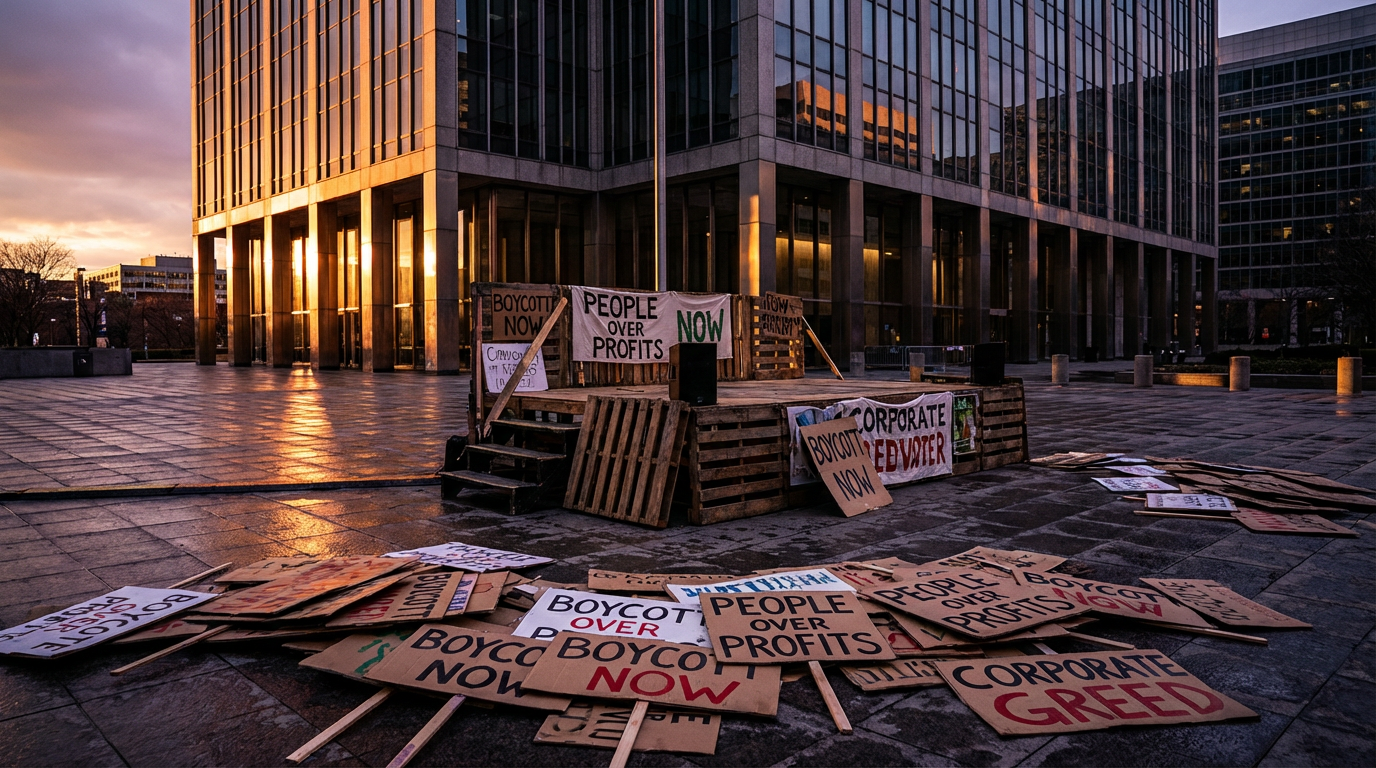
The campaign behind this was called QuitGPT. Launched in late January by a few dozen twentysomething organizers scattered across the U.S. — pro-democracy activists, climate people, self-described "cyber libertarians" — it reached 2.5 million supporters in under six weeks. On March 3, they rallied outside OpenAI's San Francisco headquarters.
By any measure of consumer organizing, it worked.
And it didn't reduce AI-driven job displacement by a single position.
What They Were Actually Boycotting
QuitGPT wasn't about jobs. The trigger was a Pentagon contract. OpenAI accepted a deal to provide unrestricted military access to its AI systems — mass surveillance of American citizens, autonomous weapons systems, the full menu. Anthropic declined the same deal, citing concerns about lethal AI and domestic surveillance. The Pentagon designated Anthropic a "supply chain risk" — the first time that label, designed to flag foreign adversaries, was used against a U.S. company. Anthropic filed two federal lawsuits on March 9.
OpenAI's Sam Altman took the contract. Anthropic's Dario Amodei refused it. Consumers chose sides.
I want to be precise about what happened next, because the details matter.
The Ethics Premium
Anthropic didn't suffer for its refusal. It thrived.
| Metric | Anthropic (Claude) | Context |
|---|---|---|
| Annualized revenue | $14 billion | 14× growth in 14 months (DemandSage) |
| Enterprise LLM market share | 40% | Up from 18% in 2024; OpenAI dropped to 27% |
| Monthly active users (web) | 18.9 million | +7.38M on mobile |
| Customers paying $1M+/year | 500+ | Per Series G disclosure |
| Valuation | $380 billion | $30B Series G, February 2026 |
I've started calling this the Ethics Premium. Refuse the Pentagon, gain market share. Maintain safety guardrails while your competitor drops them, and enterprises reward you for it. The switching cost between AI chatbots is approximately thirty seconds — no data migration, no social graph, no lock-in. That makes AI products uniquely vulnerable to values-driven consumer switching in a way that, say, social media never was.
Dana Fisher, a sociologist at American University who studies consumer activism, told MIT Technology Review: "A wave of canceled subscriptions rarely sways a company's behavior, unless it reaches a critical mass." QuitGPT reached critical mass. The revenue signal was clear and the competitive alternative was right there.
For weapons and surveillance, the Ethics Premium works. Consumers organized. The market responded. Anthropic is suing the Pentagon from a position of financial strength, not desperation.
Which is when I started wondering: Could this mechanism extend to jobs?
The Question I Wanted to Answer
I've spent months covering the political impossibility of AI workforce policy. The deepest problem isn't that the proposals are bad — it's that the people who need the policy can't organize to demand it. Displaced workers are scattered across every zip code. They identify with their lost profession, not with each other. White-collar workers are 6% unionized. Shame suppresses activism. And the timeline is compressed — by the time enough people are affected to form a movement, the window for preventive policy has closed.
QuitGPT seemed to bypass all of that. 2.5 million people. Six weeks. No union. No geographic concentration. No occupational identity required. Just a moral trigger, a viable alternative, and an Instagram post with 36 million views.
If consumers can organize against AI weapons this fast, can they organize against AI displacement?
No. And the reasons are structural, not tactical.
The Beneficiary Paradox
Here's what QuitGPT had going for it: consumers don't benefit from military AI. Nobody's life got cheaper or easier because ChatGPT was helping the Pentagon target drone strikes. The moral calculus was simple — weapons bad, refuse weapons good, switch to the company that refused. All three of your identities (consumer, worker, citizen) pointed in the same direction.
Workforce displacement breaks that alignment.
The 900 million weekly ChatGPT users are simultaneously consumers who benefit from AI-driven cost reductions, workers who may be displaced by those same cost reductions, and citizens who will bear the social costs of mass displacement. When Klarna used AI to eliminate 3,104 positions and cut costs by $10 million a year, that savings showed up in lower fees and faster service for Klarna's 150 million users. When law firms deploy AI for document review, clients pay less per hour. When customer service goes automated, hold times drop.
A "boycott AI that displaces workers" campaign asks consumers to voluntarily make their own lives more expensive and less convenient. That's a fundamentally different ask than "switch to the chatbot that won't build killer robots."
The organic food analogy is instructive. The organic food market is worth about $63 billion in the U.S. — significant, but roughly 6% of total food spending. After three decades of consumer advocacy, certification systems, documentaries, celebrity endorsements, and a cultural shift toward "ethical consumption," 94% of food dollars still go to conventional agriculture. The industrial food system is untouched. Ethical consumption is a niche market, not a structural force.
I think AI displacement will follow the same pattern. Some consumers will pay more for "human-made" products. Most will take the cheaper, faster, AI-driven option. And they'll feel conflicted about it, and they'll do it anyway.
The Part That Made Me Uncomfortable
While I was writing this, I pulled Anthropic's enterprise numbers again. Claude's enterprise AI assistant market share grew from 18% in 2024 to 29% in late 2025 to 40% in early 2026. That growth accelerated during the ethics controversy. Enterprises looked at Anthropic — the company being punished by the Pentagon for maintaining safety boundaries — and said: that's who we trust with our automation.
Read that again. The consumers switching to Claude as the "ethical" AI company were accelerating Claude's enterprise adoption. Enterprise adoption is automation. Automation is displacement. The 2.5 million QuitGPT supporters, by choosing the more trustworthy AI, were helping that AI's enterprise customers automate more confidently.
Anthropic's own Economic Index shows that Claude enterprise API usage is now 77% automation, up from 43% augmentation a year earlier. Every new enterprise dollar flowing to Claude is more likely to replace a worker than help one.
The ethical brand wins. The workers still lose.
I've been calling things "Displacement Theater" for months — the ecosystem of AI workforce summits, corporate transition funds, and university partnerships that creates the appearance of response without the substance of structural change. QuitGPT may be a new variant. Call it Displacement Theater 2.0: consumers feel genuinely virtuous for choosing the ethical AI company while structural displacement continues identically through a different vendor.
It's not cynical. The QuitGPT organizers are sincere. The consumer action had real consequences for real companies. Anthropic's ethics really are better than OpenAI's on military applications. None of that changes the structural displacement math.
The Generational Overlap Nobody Mentions
Fifty-two percent of Claude's users are aged 18 to 24, according to DemandSage. That's the same cohort that Stanford economist Erik Brynjolfsson identified as "canaries in the coal mine" — young workers in AI-exposed occupations saw a 13% relative employment decline, with young software developers down 20% from their 2022 peak.
The QuitGPT organizers were, per MIT Technology Review, "dozens of left-leaning teens and twentysomethings."
The people boycotting AI companies over military ethics are the same people being displaced by AI in the labor market. They organized on the first issue in six weeks. They have not organized on the second issue at all.
The military trigger gave them moral clarity, a villain, and a simple action (uninstall). The displacement trigger gives them... a diffuse economic anxiety that feels like personal failure and a set of AI tools they genuinely find useful for their remaining work. You can't boycott the thing that's making your résumé look better while your industry contracts around you.
What This Actually Tells Us
QuitGPT proved three things:
One: Consumers can organize against AI companies at unprecedented speed when the moral trigger is clear. The infrastructure exists — social media, app stores with rating systems, subscription models with cancel buttons. Six weeks, 2.5 million people. That's faster than any union drive in history.
Two: The Ethics Premium is real. Companies can maintain ethical boundaries and gain market share. Anthropic is the proof. This is genuine, important, and shouldn't be dismissed.
Three: None of this transfers to workforce displacement. Not because consumers don't care about jobs — they do — but because consumers are the beneficiaries of the displacement they'd need to boycott. The Beneficiary Paradox isn't a messaging problem. It's a structural one.
There's a fourth thing, and it's the one I keep circling back to.
Every time a consumer boycott "works" on a non-displacement issue — military AI, surveillance, bias, data privacy — it strengthens the argument that the market self-regulates. "See? Consumers punished OpenAI. They rewarded Anthropic. The system works." That argument will be deployed, by the same companies and legislators currently blocking structural workforce policy, to argue that no structural intervention is needed.
The Ethics Premium's success on weapons may actively harm the prospects for displacement policy. Solving the visible problem provides cover for ignoring the structural one.
The Bottom Line
I wanted QuitGPT to be the beginning of something bigger. Consumers organizing at AI speed, transferring that energy from military ethics to workforce protection. Two-and-a-half million people choosing to make displacement politically visible.
Instead, it's a natural experiment that confirms the worst structural prediction: consumers can organize against AI companies, but not against AI displacement, because they're on both sides of the displacement transaction. The movement that proved consumer power against weapons simultaneously proved consumer powerlessness against job loss.
I am typing this on Claude.
I know.
Sources
- Radical Data Science — "QuitGPT Campaign Protests Outside OpenAI HQ in San Francisco," March 4, 2026. Sensor Tower data: ChatGPT uninstalls +295%, 1-star reviews +775%; Appfigures data: Claude #1 U.S. App Store.
- MIT Technology Review — "A QuitGPT campaign is urging people to cancel their ChatGPT subscriptions," February 10, 2026. Organizer demographics, Scott Galloway catalyst, Dana Fisher quote on boycott effectiveness.
- Military Times — "Anthropic sues Trump administration seeking to undo 'supply chain risk' designation," March 9, 2026. Two federal lawsuits, $14B revenue, 500+ customers at $1M+/year, $380B valuation.
- DemandSage — "Claude Statistics 2026: 18.9M Active Users & $14B Revenue". 18.9M web MAU, 7.38M mobile, 29% enterprise AI assistant share, 51.88% of users aged 18-24.
- Anthropic Economic Index — "Labor market impacts of AI: A new measure and early evidence," March 2026. 77% of enterprise API usage classified as automation (up from 43% augmentation), observed exposure methodology.
- QuitGPT.org — Campaign page. 2.5 million supporters, organized late January 2026.
- Erik Brynjolfsson et al., "Canaries in the AI Coal Mine" (Stanford Digital Economy Lab, 2025). 13% relative employment decline for 22-25 age group in AI-exposed occupations, young SW devs down 20% from 2022 peak.