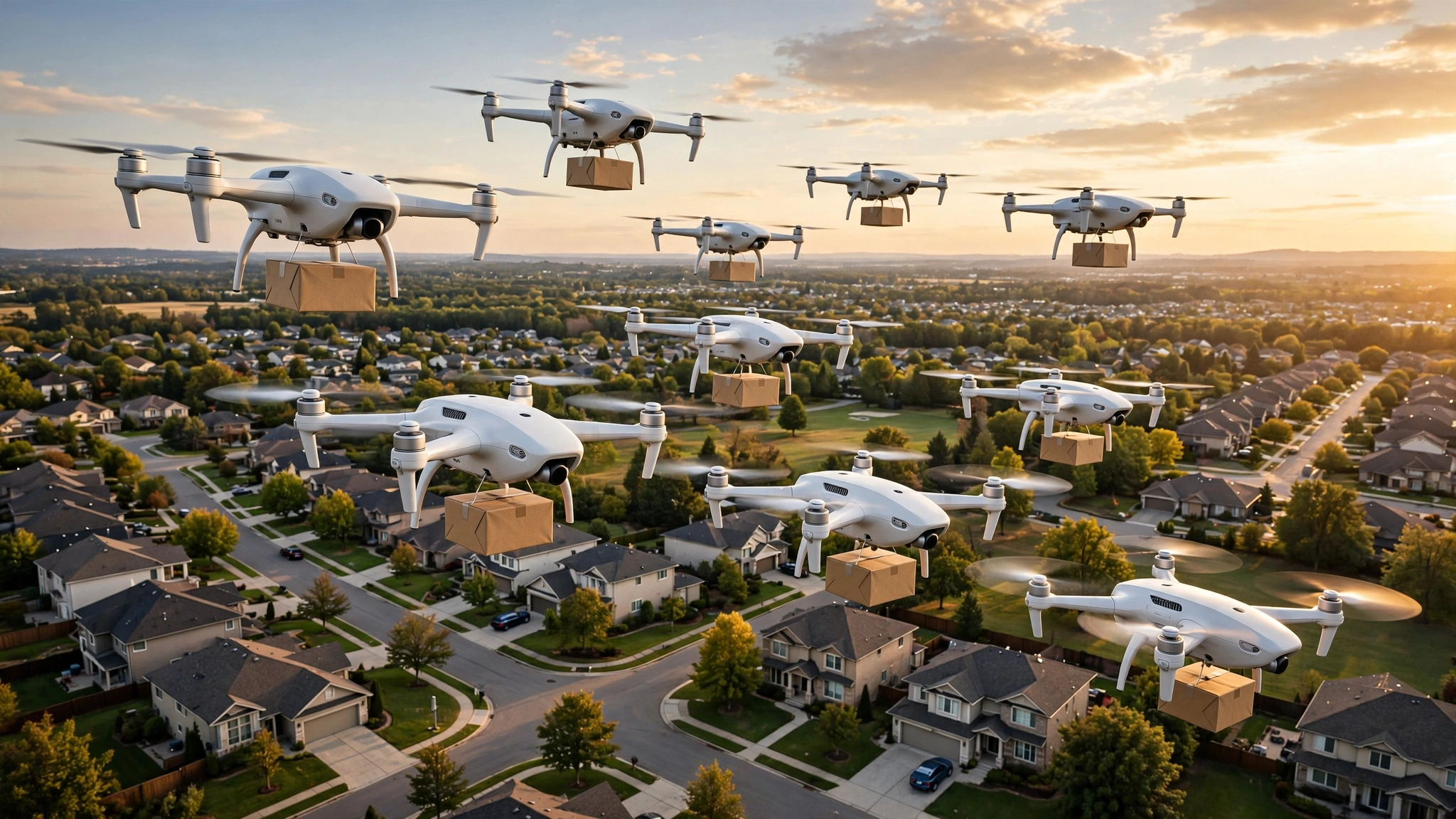
Eight companies in the United States now hold FAA Part 135 air carrier certificates for drone delivery, and DoorDash became number eight on July 29, 2026, joining Wing, UPS Flight Forward, Amazon Prime Air, Zipline, Causey Aviation (Flytrex's operator), DroneUp, and Matternet in a club that has doubled its membership in the past three years. DoorDash Labs built both the aircraft and ground infrastructure in-house, and commercial flights are planned for this fall.
The announcement came with a disclosure worth digging into. DoorDash said that over 20% of its orders last year were mid-range deliveries covering three to five miles, and that these trips took roughly 25% longer to complete than shorter ones because Dashers actively avoid them, preferring to stay close to restaurant clusters where they can knock out quick runs rather than spending 40 minutes round-tripping to a subdivision four miles out. That 20% figure, applied to DoorDash's own SEC filings, opens the door to a cost model nobody has built yet.
634 Million Orphaned Orders
DoorDash reported 3.172 billion total orders in fiscal year 2025, with Marketplace Gross Order Value of $102.3 billion and an average order value of about $32.25. Twenty percent of that is 634 million orders per year, roughly 1.74 million per day, and every one of them is an order the platform fills slowly because it has to sweeten the payout with peak incentives to attract drivers willing to make the longer trip.
Based on DoorDash's disclosed contribution margin (4.4% to 5.1% of GOV across 2025 quarters) and industry analysis of Dasher payout structures, we estimate the blended cost for a mid-range delivery runs about $8 per order once base pay, incentives, and longer queue times are factored in. Multiply that by 634 million and DoorDash is spending approximately $5.1 billion annually on the deliveries its couriers least want to make.
What Drones Actually Cost Today
According to Low Altitude Economy's analysis of operating networks, the current industry average sits at 3 to 8 deliveries per drone per day, while the number required for unit economics to work is 200 or more, a 25× to 65× improvement where the mechanism is not a better aircraft but simply volume at sufficient density.
Published cost figures reveal the scaling curve. Amazon Prime Air projected $63 per drone delivery in 2025. DroneUp charges roughly $30 per delivery and is targeting below $7. Dublin-based Manna claims about $4 per flight and says it is the only operator currently profitable per delivery, projecting $1 at scale through ruthless operational discipline: hot-swapping batteries, single operators overseeing up to 20 aircraft, lean staffing. That $4-to-$63 range tells you this is a throughput problem where the hardware works but the cost per flight plummets only as utilization climbs:
| Deliveries / Drone / Day | Cost per Delivery | Annual Cost (634M orders) | vs. Human Courier ($5.1B) |
|---|---|---|---|
| 5 (current avg) | $22.00 | $13.9B | +$8.8B worse |
| 25 | $8.40 | $5.3B | roughly break-even |
| 50 | $5.20 | $3.3B | saves $1.8B |
| 100 | $3.10 | $2.0B | saves $3.1B |
| 200 | $1.80 | $1.1B | saves $4.0B |
Break-even lands at about 27 deliveries per drone per day, the point at which each aircraft handles enough volume for the fixed costs of airframe depreciation, maintenance, ground infrastructure, and airspace management to collectively drop below the $8 human-courier benchmark.
Why Food Delivery Compresses the Gap
The 200-deliveries-per-day target was calculated for general e-commerce, where orders arrive at all hours and scatter across a metro area, but food delivery has structural advantages that compress the break-even substantially because roughly 60% to 70% of orders concentrate into a 2-hour lunch window and a 3-hour dinner window, meaning a drone can hit high utilization by running at full capacity during just five peak hours even if it sits idle the rest of the day.
Dense merchant networks amplify the effect: restaurants cluster in commercial zones, so a drone hub can serve dozens within a one-mile radius while minimizing deadhead flight time. Add repeatable corridors (the same restaurant-to-neighborhood routes day after day let route optimization converge quickly), and the speed premium that makes a customer waiting for dinner willing to pay more for guaranteed 15-minute aerial delivery that no human courier can match on a 4-mile trip through evening traffic, and the realistic break-even for food delivery sits closer to 25 to 50 deliveries per drone per day, shrinking the gap to 3.4× to 9× rather than the 25× to 65× facing e-commerce parcels.
Fleet Math
At break-even utilization (27 deliveries per drone per day), DoorDash would need approximately 64,400 drones to serve 1.74 million daily mid-range orders, and at $10,000 per in-house aircraft manufactured at scale, that is a $644 million fleet investment that pays back in under three months against the $5.1 billion annual human-courier cost. DoorDash generated $935 million in net income in FY2025, making this large but financeable from a single year of earnings.
Meanwhile, the shared-airspace problem that once loomed large appears functionally solved: between January and February 2026, Flytrex and Wing conducted approximately 8,000 drone delivery operations in overlapping airspace across the Dallas-Fort Worth metroplex, and the automated Unmanned Traffic Management system deconflicted 100% of flight intents with zero airspace conflicts across simultaneous operations on 30 of 31 active days.
Limitations
Our $8 per mid-range delivery estimate for human couriers is derived from industry analysis rather than DoorDash's internal books, and actual Dasher compensation varies by market, time of day, and tip behavior in ways the company has never disclosed at a per-distance-tier level. The drone cost curve assumes linear scaling with utilization, but real-world costs include weather downtime (estimated at 20% in some markets), maintenance spikes, and ground infrastructure buildout that may not scale linearly. Our $10,000 per-unit cost is speculative: military-grade small UAS run $30,000 to $100,000 while consumer platforms sit at $1,000 to $3,000, and a purpose-built delivery drone at scale could fall anywhere in between.
Strongest Counterargument
The best case against DoorDash's drone economics is that the utilization gap may be structural rather than merely a matter of scaling up, because Barclays pegs autonomous delivery at less than 1% of global food delivery orders today and projects only 2% by the end of the decade, which means that if drone delivery stays niche across many markets, utilization never climbs because the order density is not there to fill the flight schedules. You cannot hit 27 deliveries per drone per day when only 2% of orders in a given market are eligible, and the math requires geographic concentration where drone delivery is the primary modality for mid-range trips rather than a novelty add-on that spreads thin across 50 cities.
What You Can Do
If you run logistics, the critical metric to track is deliveries per drone per day, not cost per flight or fleet size, because everything else in the economic model follows from utilization alone. If you invest in this space, ask for utilization data first: a company doing 50 deliveries per day per drone with 100 aircraft is in a fundamentally different position than one doing 5 per day with 1,000, even though both report 5,000 daily deliveries in their press releases.
If you operate a restaurant in a DoorDash market, the arrival of drone delivery within 12 months could double your serviceable radius from 2 miles to 4 miles by making mid-range deliveries arrive hot, and the time to invest in insulated containers designed for aerial transit is now. If you are a city planner, start thinking about vertiport zoning because the municipal permitting backlog rather than FAA certification may turn out to be the actual bottleneck.
The Bottom Line
DoorDash has 634 million annual orders that its human couriers don't want to make, and it just received federal permission to fly its own drones instead. The break-even sits at roughly 27 deliveries per drone per day, a gap of 3.4× to 9× from current industry performance rather than the 25× to 65× gap facing general e-commerce, because the structural advantages of food delivery (concentrated demand windows, dense merchant corridors, repeatable routes, speed premiums) make this vertical the most promising candidate for drone economics to actually close. Whether DoorDash or any of the other seven certified operators can cross that threshold this decade will determine whether the $16 billion autonomous delivery profit pool that Barclays projects is a forecast or a fantasy.