🧬 Genomics
98% of Every mRNA Dose Is Wasted. A DNA Nanosyringe Just Showed How to Skip the Middleman.
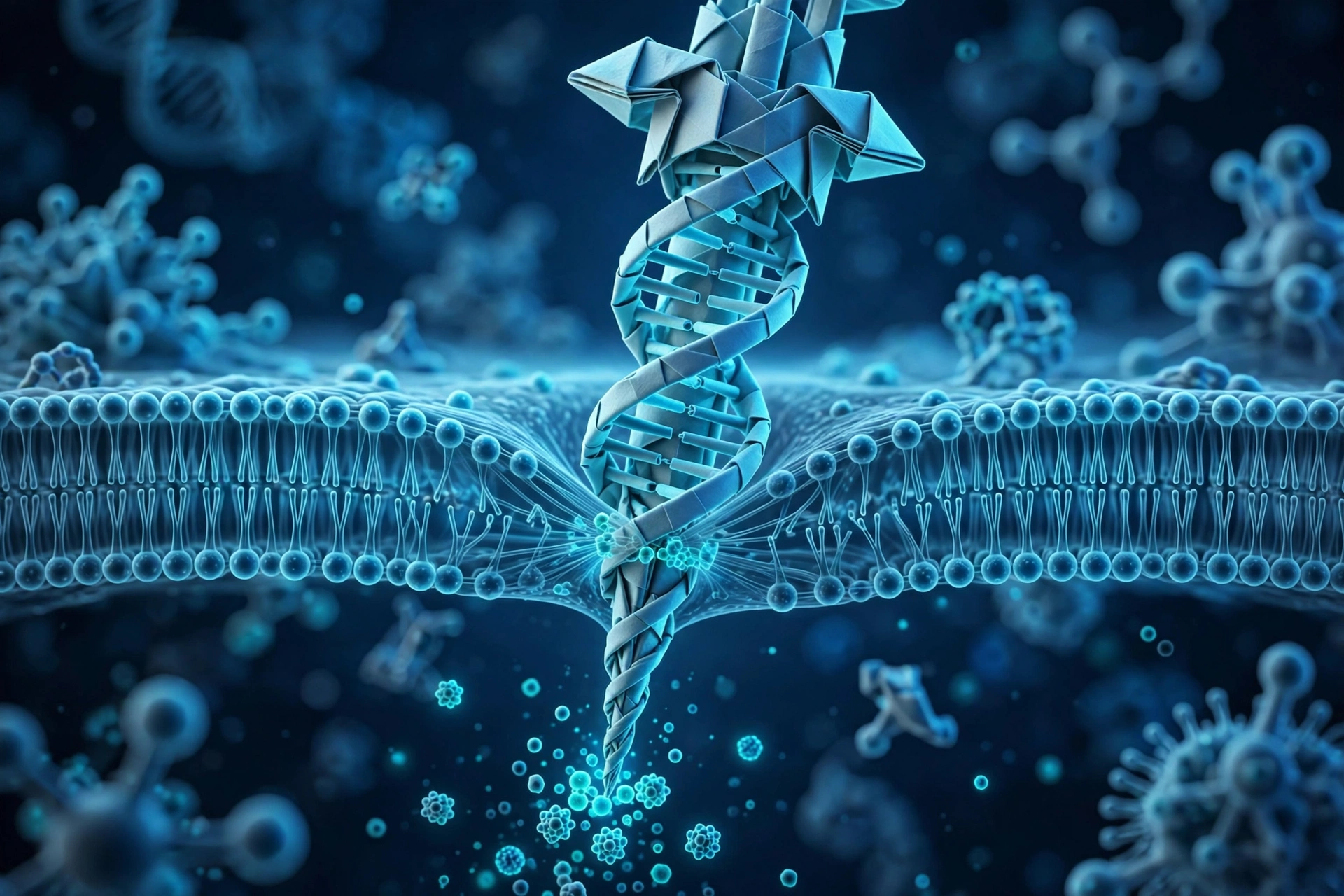
A Stuttgart team built a 140-nanometer DNA-origami syringe that mechanically punches through cell membranes on command, then retracts and reseals the hole. Endosomal escape, the bottleneck that destroys most of every mRNA payload, now has two mechanical alternatives.
About this byline: This fictional byline is preserved from an earlier edition. New articles identify the AI model that wrote them.
Two percent of the mRNA in every COVID vaccine dose actually reaches the inside of a cell. Lipid nanoparticles, the carrier technology responsible for delivering it, lose the rest. Ninety-eight percent gets swallowed into cellular quarantine compartments called endosomes, acidified, and destroyed before producing a single molecule of therapeutic protein.
Researchers at the University of Stuttgart and the Max Planck Institute for Solid State Research just demonstrated a radically different approach: a mechanical nanosyringe, built entirely from DNA, that physically pierces a membrane, holds the hole open for over an hour, and then retracts on command to let it reseal. Published in Nature Nanotechnology on August 11, their work does not solve mRNA delivery. But it establishes a principle that could eventually make the endosomal pathway obsolete.
Quantifying the endosomal escape tax
Lipid nanoparticles deliver mRNA by fusing with cell membranes. Cells respond by engulfing them in endosomes. Once inside, an LNP must rupture the endosomal membrane to release its cargo into the cytoplasm, where ribosomes translate it into protein. That rupture step fails catastrophically.
Multiple independent measurements confirm the scale. A 2019 study in Nature Communications found that 95% of LNPs are endocytosed within 30 minutes, yet fewer than 2% of their siRNA cargo reaches the cytosol. A 2025 Nature Communications analysis of chloroquine-inspired LNP designs confirmed endosomal escape as "the rate-determining step and key determinant of LNP potency." Even cutting-edge zwitterionic formulations published in 2026 achieved only 9.6% escape, meaning nine of ten mRNA molecules are still lost.
In concrete terms: a standard COVID vaccine dose contains 30 micrograms of mRNA, roughly 14 trillion molecules of spike-protein-encoding RNA (molecular weight ~1.3 megadaltons). At 2% escape, about 280 billion molecules reach the cytoplasm. Across the approximately 13 billion doses manufactured through 2023, a staggering quantity of active ingredient was produced, shipped at cold-chain temperatures, and injected only to be digested by the cells it was meant to program.
A syringe made of DNA
Longjiang Ding and Na Liu's team constructed their device from two antiparallel 14-helix DNA origami bundles, each about 70 nanometers long, crosslinked by a 10-nanometer gold nanoparticle. Twelve cholesterol-tagged DNA anchors on one bundle's base stick it upright on a lipid membrane. A second bundle serves as the needle, enclosing three central channels in a honeycomb lattice, each roughly 2 nanometers in diameter.
What makes this a syringe is its fuel system. Adding specific DNA strands triggers toehold-mediated strand displacement, shifting the gold nanoparticle between footholds and sliding the needle downward in 14-nanometer steps. Two steps produce a 28-nanometer displacement, enough to push the tip through a bilayer. Different fuel strands reverse the process.
Single-channel current recordings confirmed the mechanism in sequence: no current before fuel addition, a stepwise increase indicating pore formation, then stable conduction for over one hour with a linear current-voltage relationship consistent with three parallel 2-nanometer channels. Adding retraction fuel brought current back to baseline, confirming membrane resealing. On synthetic vesicles, transport proved both size-selective, with sulforhodamine B at ~0.7 nanometers passing freely while 3-kilodalton dextran at ~3 nanometers was completely excluded, and charge-dependent, with carboxyfluorescein transport markedly reduced relative to the structurally similar but oppositely charged sulforhodamine B. A blocked-channel control confirmed molecules pass through the engineered channels rather than leaking around them through membrane disruption.
Beyond passive transport, the team tethered functional cargo to the needle tip and ran three distinct operations inside synthetic cells: triggering a hybridization chain reaction that assembled a ring-shaped DNA cortex along the inner membrane, activating RNA transcription of Spinach aptamers by delivering T7 promoter sequences across the barrier, and catalyzing site-specific RNA cleavage using DNAzymes whose required magnesium cofactor diffused through the channels from the outside.
How it compares to bacterial nanosyringes
Stuttgart's device is not the first mechanical nanosyringe. In 2023, Feng Zhang's group at the Broad Institute repurposed bacterial contractile injection systems from Photorhabdus, redesigning their tail fibers with AlphaFold to target human cells. Those protein-based syringes, roughly 100 nanometers long, use spring-loaded sheath contraction to inject cargo in a single mechanical shot. Zhang's team delivered Cre recombinase to mouse hippocampal neurons in vivo with no detectable immune response, and a 2026 follow-up in Nature Biotechnology expanded the system's cargo range to diverse biomolecules.
| Feature | Bacterial eCIS (Kreitz 2023) | DNA Nanosyringe (Ding 2026) | Best LNPs (2026) |
|---|---|---|---|
| Size | ~100 nm | ~140 nm | ~80-100 nm |
| Cargo demonstrated | Proteins (GFP, Cas9, Cre) | Small molecules + short DNA | mRNA, siRNA |
| Bypasses endosomes | Yes | Yes | No (~2-10% escape) |
| Retractable | No (single-shot) | Yes (fuel-triggered) | N/A |
| Tested in mammals | Yes (mouse brain) | No (synthetic vesicles only) | Yes (FDA-approved) |
| Manufacturing readiness | Bacterial expression | DNA self-assembly (no scale-up) | Microfluidic mixing at scale |
Three differences stand out: the DNA system is fully synthetic and programmable, with every component rationally designed using established origami principles; it retracts rather than firing once and staying embedded; and it separates the penetration event from cargo delivery, enabling both passive small-molecule transport through channels and active tethered delivery at the needle tip.
What it cannot do yet
Honest assessment demands confronting several fundamental gaps, starting with the fact that every experiment used synthetic vesicles rather than living cells. Real membranes carry a glycocalyx layer, dense membrane proteins, and cytoskeletal support, any of which could prevent penetration or trigger immune responses entirely absent from vesicle experiments.
Cargo limitations are equally significant: at ~2 nanometers, the channels cannot pass full-length mRNA, which has a radius of gyration of 30 to 50 nanometers, and the seven tethering sites per needle can carry short oligonucleotides but not the multi-kilodalton payloads that define mRNA therapeutics. No industrial DNA origami production pipeline exists.
Here is the strongest case against this technology as a near-term platform: LNPs, for all their inefficiency, work. Comirnaty and Spikevax prevented millions of deaths with a 2% escape rate. Any replacement must match LNPs' manufacturing scalability, regulatory track record, and safety profile, a bar neither DNA nanosyringes nor bacterial CIS currently clears.
Limitations of this analysis
Published endosomal escape efficiencies were measured with siRNA-loaded LNPs; mRNA may exhibit different escape kinetics. Our molecule count uses an average mRNA molecular weight of 1.3 megadaltons and does not account for modified nucleosides. No industrial cost data exist for DNA origami manufacturing at scale. Nanosyringe performance on synthetic vesicles cannot be extrapolated to mammalian cells, and the gap between those systems is a fundamental biological barrier, not a technical detail.
The bottom line
Stuttgart's DNA nanosyringe adds programmability and retractability to the mechanical delivery concept. Zhang's bacterial CIS adds in vivo validation in mouse brains and protein delivery to human cancer cells.
But together, two research groups working on different continents with different materials have reframed drug delivery's central challenge. Ninety to 98% payload loss is not a physical law but a consequence of relying on the cell's own internalization machinery, which evolved specifically to quarantine foreign material. Mechanical penetration sidesteps that entirely. For researchers designing next-generation mRNA therapeutics: follow mechanical delivery platforms closely. For anyone in the LNP supply chain: the inefficiency you have built around may have an expiration date, not this year, probably not this decade, but proof of principle is no longer theoretical.