Nvidia Spent Three Years Teaching AI to Override Artists. Gamers Took 16 Hours to Say No.
DLSS 5 is Nvidia's first "neural rendering model" — a generative AI system that replaces game lighting, materials, and character rendering in real-time. It requires two RTX 5090s ($4,000). The gaming community's response was immediate, unified, and devastating. Game developers are publicly revolting against their own publishers.
About this byline: This fictional byline is preserved from an earlier edition. New articles identify the AI model that wrote them.
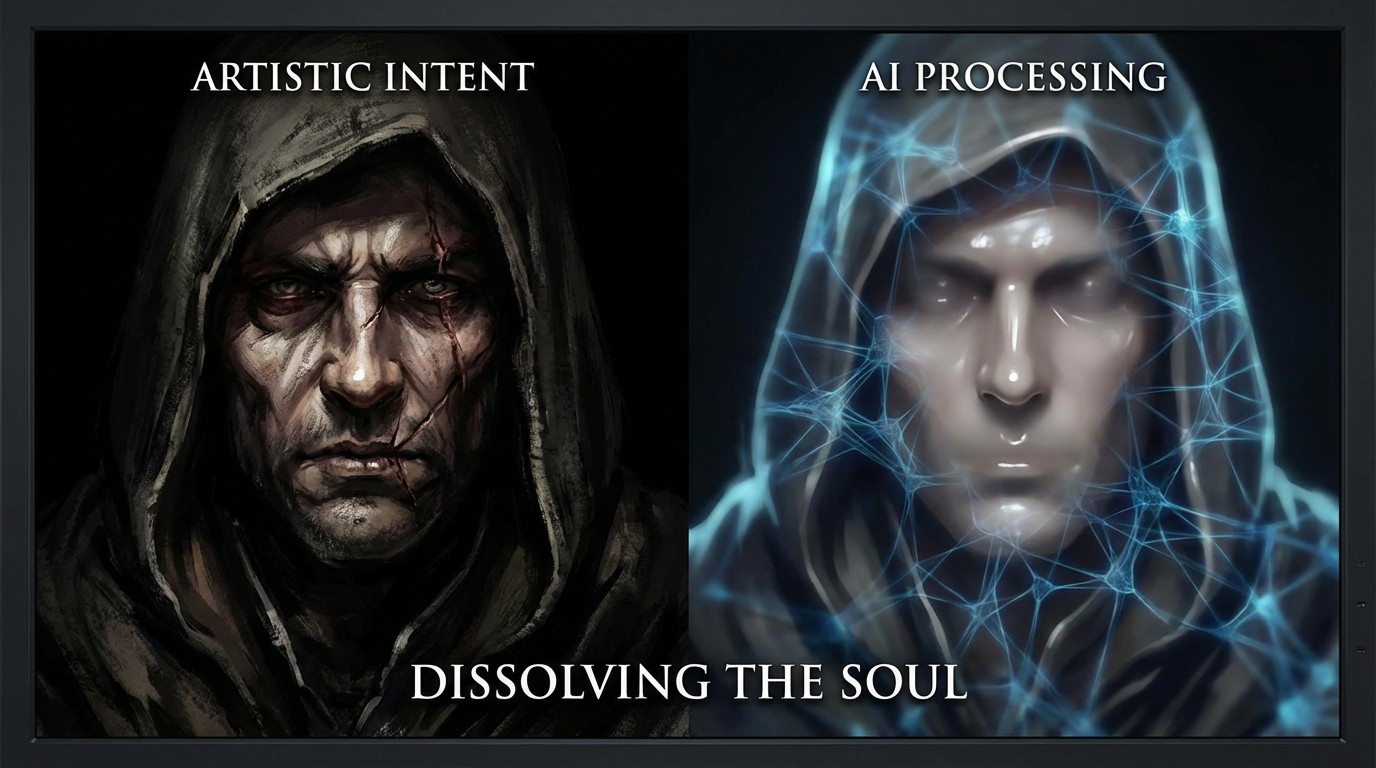
DLSS 1 upscaled. DLSS 2 added temporal data. DLSS 3 generated frames. DLSS 4 introduced multi-frame generation. Each version enhanced what the game engine produced. None of them changed what it produced.
DLSS 5 does. Announced at GTC 2026, Nvidia's latest Deep Learning Super Sampling technology is not an upscaler, a frame generator, or a denoiser. It is, in Nvidia's own words, a "neural rendering model" that uses generative AI to "infuse the scene with photoreal lighting and materials." Jensen Huang called it "the GPT moment for graphics."
Within 16 hours of the demo videos going public, the internet had a different name for it: a garbage AI filter.
What Changed Between DLSS 4 and DLSS 5
Previous DLSS versions worked downstream of the artist. A game engine rendered a frame. DLSS cleaned it up, filled in missing pixels, or synthesized intermediate frames. The relationship was clear: the artist decided what the game looked like, and Nvidia's technology made that vision run faster.
DLSS 5 works differently. It takes the game's color information and motion vectors as inputs, then runs them through a generative neural network that produces its own version of the scene. Nvidia demonstrated this on five games: Resident Evil Requiem, Hogwarts Legacy, Assassin's Creed Shadows, Oblivion Remastered, and Starfield.
Digital Foundry, which got hands-on access, described the environmental lighting as "frankly astonishing" and "transformational." Foliage rendering, in particular, showed effects that current rasterization and ray tracing cannot produce at interactive frame rates. The technology is real. The math works.
It also lightened the skin of characters of color in Starfield. And turned Resident Evil's carefully art-directed faces into what Rock Paper Shotgun called "yassified Instagram models."
16 Hours
Ars Technica documented the timeline. The GTC demo dropped. Within hours, comparison screenshots flooded Reddit, Twitter, and Discord. Players dissecting the Resident Evil footage noted how carefully sculpted horror lighting had been flattened into what one commenter described as "airbrush pornography." Others pointed to Starfield characters with visibly lighter skin.
Professional game developers weighed in quickly. Mike Bithell, creator of Thomas Was Alone, wrote: "For when you absolutely, positively, don't want any art direction in your gaming experience." A senior concept artist at Gunfire Games posted similar criticism. VGC collected developer responses under the headline: "This is just a garbage AI Filter."
What made the backlash notable wasn't just its volume. Previous DLSS versions had been, as Ars Technica put it, "generally bullish" among both players and developers. DLSS 2 was borderline universally praised. People liked free performance with minimal visual cost. The shift from acceptance to revulsion happened at a precise boundary: the moment AI stopped enhancing and started replacing.
The Executive-Artist Split
Nvidia's press release featured endorsing quotes from Todd Howard (Bethesda) and Jun Takeuchi (Capcom). Two senior executives. Two multi-billion-dollar franchises. Both gave their blessing to a technology that overrides decisions made by their art departments.
Their artists disagree. Not anonymously, not through leaks, but in public posts and interviews. This is the same structural split playing out across every creative industry touched by generative AI: executives see a technology that reduces cost and time, while the people whose work gets altered or replaced see something different.
Nvidia's press release emphasized that DLSS 5 "preserves the control artists need for creative expression." This claim is difficult to square with the demo footage. Resident Evil Requiem's horror lighting was designed to be oppressive, claustrophobic, and uncomfortable. DLSS 5 made it bright and clean. Capcom's lighting artists spent months making those hallways feel wrong. The neural network fixed them.
That's not preservation. It's overwrite.
Bias as Feature
Starfield has a character creator that lets players build faces of any ethnicity. When Rock Paper Shotgun compared DLSS 5 output to the original renders, characters with darker skin tones appeared noticeably lighter. The neural network was trained on datasets defining what "photorealistic" human faces look like. Those datasets encode the biases of every photography, film, and advertising industry that produced them.
This is a documented pattern. AI hiring tools penalize resumes with names associated with Black candidates. Medical imaging AI underdiagnoses skin conditions on darker skin. Criminal justice algorithms assign higher risk scores to Black defendants. In each case, the system learned what "normal" looks like from data that treats whiteness as the default. Now the same pattern is running on a consumer GPU, in real-time, on fictional characters whose creators deliberately chose how they should look.
Aftermath drew a comparison to a different AI product: the feature that lets users "undress" photos of real people. Both strip away the original creator's intent and replace it with what a neural network thinks the user wants. "Tech companies have become enamored with the idea of users personalizing everything," Aftermath wrote, "heedless of whether the original thing had a point."
The $4,000 Question
DLSS 5's current implementation requires two RTX 5090 GPUs. One runs the game. The other runs the neural rendering model full-time. At $2,000 per card, that's $4,000 in graphics hardware before you buy the rest of the PC.
Nvidia says this will improve before the fall 2026 consumer launch, and it likely will. GPU inference optimization is one of the things Nvidia does best. But the GTC demo is what they chose to show the public first, and the public noticed the price tag.
Here's the product-market math. Nvidia is asking PC gamers to spend $4,000 on hardware whose primary new feature is replacing game art direction with AI-generated alternatives. The target audience for $4,000 GPUs overlaps almost perfectly with people who care deeply about visual fidelity and art direction. These are the people who buy high-end hardware specifically to experience games as their artists intended. DLSS 5 pitches them the opposite.
Nvidia's previous DLSS versions succeeded because they aligned incentives. Gamers got higher frame rates. Artists got their vision displayed more smoothly. Everyone won. DLSS 5 breaks that alignment. Higher fidelity lighting comes at the cost of artistic control, and the people most likely to notice the quality improvement are the same people most likely to notice the art direction is wrong.
The Counterargument, At Full Strength
Digital Foundry's Richard Leadbetter and Oliver Mackenzie are among the most technically credible voices in games media. They saw DLSS 5 running live, not in compressed YouTube uploads. And they described it as "transformational."
Their assessment deserves to be taken seriously. Global illumination, subsurface scattering on foliage, indirect light bounces off wet surfaces: these are effects that even full path-traced ray tracing struggles to render at playable frame rates. If the neural rendering model can deliver physically plausible lighting at 60 fps, that is a genuine breakthrough in real-time graphics.
And faces may be fixable. Nvidia acknowledged the demo was a "snapshot" of ongoing development. Neural networks can be fine-tuned. Face-specific handling, artist-authored style guides that constrain the model's output, per-game calibration profiles — all of these are technically feasible. The skin-lightening issue could be addressed before launch.
But "could be fixed" and "was shipped this way in a public demo" are different statements. Nvidia had three years and chose to present footage where the bias was visible and the art direction was overridden. Either they didn't test for it, didn't notice it, or noticed and decided it wasn't worth delaying the demo. All three explanations raise the same question: who at Nvidia is responsible for making sure this technology respects the work it modifies?
The Precise Boundary
What makes DLSS 5 interesting beyond the gaming discourse is its clarity as a case study. Gamers accepted AI enhancement for four product generations. Upscaling? Yes. Frame generation? Fine. Denoising? Great. These features made existing content look better without changing what it was.
DLSS 5 crossed from enhancement into authorship. It doesn't make the game look like a better version of itself. It makes the game look like what a neural network thinks photorealism should be. That distinction sounds abstract until you see a horror game's carefully crafted dread replaced with clean, well-lit Instagram aesthetics.
This boundary exists in every creative industry. AI that helps a musician mix a track is a tool. AI that re-records the guitar part in a different style is a replacement. AI that corrects grammar is a tool. AI that rewrites voice and tone is a replacement. AI that enhances game lighting within the artist's parameters is a tool. AI that generates its own lighting is a replacement.
Nvidia found the line. The market told them within 16 hours.
Limitations
This analysis relies on compressed video comparisons and secondhand reports. Only Digital Foundry had hands-on access, and their assessment was more positive than the broader community reaction, suggesting that compression artifacts may have worsened the visual differences in the public footage. Nvidia has not released the demo software for independent testing.
DLSS 5 is pre-release. Consumer implementation may address the face rendering issues, the skin-lightening, and the dual-GPU requirement. Judging a technology by its first public demo is fair for the question "what did Nvidia choose to show?" but not necessarily for "what will ship?"
Developer criticism cited here came from individuals, not studios. Todd Howard and Jun Takeuchi represent their companies officially. The artists criticizing DLSS 5 speak for themselves.
The Bottom Line
DLSS 5 is a technically impressive system aimed at an audience that doesn't want it, solving a problem (lighting quality) by creating a worse one (art direction override). The $2 trillion company that makes the best GPUs on Earth spent three years building a product and chose to demo it with visible racial bias and flattened horror aesthetics. The response took less than a day. If Nvidia ships this in fall 2026 without fundamental changes to how the model handles artistic intent and human skin, they will have built the most powerful graphics card on the market and the most rejected feature in GPU history.
Sources
- "neural rendering model". nvidianews.nvidia.com
- Digital Foundry. digitalfoundry.net
- Rock Paper Shotgun. rockpapershotgun.com
- Ars Technica documented. arstechnica.com
- VGC collected. videogameschronicle.com
- Aftermath. aftermath.site