The Ocean Floor Holds 21 Billion Tons of Critical Minerals. Surveying One License Area Costs $6 Billion. A $200,000 Robot Just Cut That to $56 Million.
A WHOI spinoff is deploying $200,000 submersibles where $10 million vehicles once had a monopoly. Deep-sea environmental survey economics just flipped, and so did the calculus for mining 6 million square kilometers of seabed.
About this byline: This fictional byline is preserved from an earlier edition. New articles identify the AI model that wrote them.
Seventy-five thousand dollars. That is what one day of remotely operated vehicle time on the seafloor costs when you account for the research vessel, the crew, the fuel, and a machine that runs between $5 million and $10 million to build. One square kilometer of detailed survey per day. Run the math against the Clarion-Clipperton Zone, roughly 6 million square kilometers of abyssal plain holding the largest known deposit of polymetallic nodules on Earth, and a single vehicle needs 16,438 years to baseline it. Not a metaphor but an arithmetic fact explaining why we know more about Mars than about what lives on 73% of our own planet's floor.
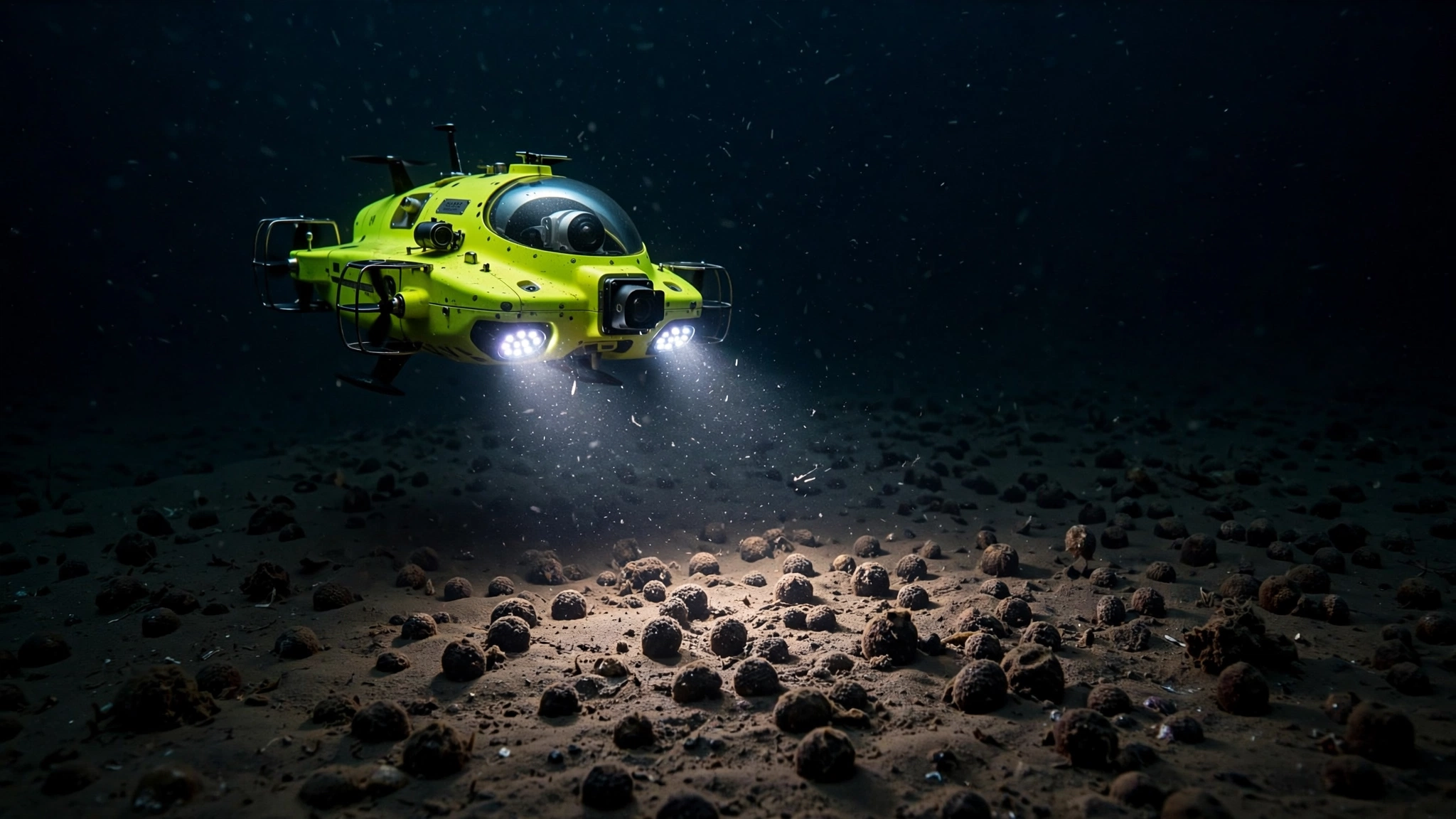
A company called Orpheus Ocean just changed that number. Spun off from the Woods Hole Oceanographic Institution in 2024, with engineering lineage tracing back to NASA's Jet Propulsion Laboratory, Orpheus builds autonomous underwater vehicles that reach 11,000 meters for roughly $200,000 each. Competitors charge 25 to 50 times more, and right now, two Orpheus submersibles are deployed from NOAA's research vessel Rainier, mapping 8,000 square nautical miles of Pacific seafloor that, according to CEO Jake Russell, "has really never been explored in any kind of detail."
Ambition didn't change, and governments and mining companies have wanted to map the deep ocean for decades. What changed is the denominator.
Calculations Nobody Published
Thirty-one exploration licenses sit on the books of the International Seabed Authority: 19 for polymetallic nodules, mostly in the CCZ, seven for polymetallic sulphides along mid-ocean ridges, five for cobalt-rich crusts in the Western Pacific. Each license spans roughly 75,000 square kilometers. Before any holder can move from exploration to extraction, ISA requires comprehensive environmental baseline surveys documenting biology, geology, and chemistry of the seabed they intend to disturb.
Here is the math that never appears in mining company prospectuses:
| Parameter | Traditional ROV | Orpheus Fleet (50 vehicles) |
|---|---|---|
| Vehicle unit cost | $7.5 million | $200,000 |
| Fleet cost (50 vehicles) | $375 million | $10 million |
| Daily vessel rate | $75,000 | $15,000 |
| Vehicles per ship | 1 | 10 |
| Survey coverage per day | ~1 km² | ~100 km² |
| Cost per km² | ~$80,000 | ~$750 |
| One license area (75,000 km²) | $6 billion | $56 million |
Read that last row twice. A comprehensive survey of a single ISA license area, using deep-rated ROVs currently available, would cost approximately $6 billion in ship time and vehicle amortization. For comparison, TMC's pre-feasibility study for its NORI-D project pegs that mine's after-tax net present value at $5.5 billion. Survey costs exceed mine value, not through a market failure but through a measurement failure wearing an economic mask.
An Orpheus-style fleet changes this by two orders of magnitude. Fifty vehicles, costing the same as a single traditional ROV pair, could survey a license area for roughly $56 million. Survey-to-mine-value ratio: from 1.1:1 to 0.01:1. Suddenly, knowing what you are about to destroy becomes affordable.
What $25 Trillion Looks Like from 6,000 Meters Up
Stretching between Hawaii and Mexico across an area larger than the contiguous United States, the CCZ holds a conservative USGS estimate of 21.1 billion dry metric tons of polymetallic nodules on the abyssal plain. A separate figure published in Frontiers in Marine Science puts the manganese content alone at 34 billion metric tons, worth at least $25 trillion at current prices.
Four metals dominate those nodules: nickel, copper, cobalt, and manganese, every one of them central to battery chemistries powering the energy transition. USGS data shows tonnages of many critical metals in the CCZ exceeding total global terrestrial reserves. Enough nickel for more EV batteries than every land-based mine combined. Enough cobalt to break the DRC's 74% chokehold on global supply.
TMC, the most aggressive company pursuing extraction, declared the world's first probable mineral reserves for deep-sea nodules last August: 51 million tonnes in NORI-D alone, with 1.2 billion tonnes of inferred resources across its broader license areas, a combined NPV of $23.6 billion assuming commercial production begins in Q4 2027 and steady-state output of 97,000 tonnes of nickel per year, all at an all-in sustaining cost of $2,569 per tonne that would place it in the first quartile of global producers. Impressive numbers. Every one of them rests on a 274-million-tonne resource estimate built from survey data covering a fraction of the license area. Detailed survey at today's vehicle costs is precisely what nobody can afford.
Washington Moves Faster Than Any Survey
Nobody in Washington is waiting for baselines. In late April, a Trump executive order directed federal agencies to rapidly develop mineral exploration capacity. Within weeks, Interior created a new Marine Minerals Administration with no precedent in American regulatory history. On June 23, BOEM published a Federal Register notice initiating mineral leases on Virginia's Outer Continental Shelf. First time. Ever. Tampa-based Odyssey Marine Exploration is seeking titanium, zirconium, and rare earths across 2,764 square miles off the Delmarva Peninsula at depths up to 410 feet.
Virginia's proposal operates in shallow water where conventional tech handles it easily. But the CCZ sits at 6,000 meters, and the gap between Washington's regulatory sprint and actual deep-ocean survey capacity is measured in centuries at current rates.
ISA has been drafting mining regulations since 2011, fifteen years now with no final code and thirty-one license holders waiting. Nauru's two-year trigger clause, invoked in 2021 to force ISA to finalize regulations by July 2023, produced nothing binding. Mining companies have stopped waiting for international consensus that shows no sign of arriving and are pursuing unilateral permits through national regulators instead, with TMC applying under the US Deep Seabed Hard Mineral Resources Act.
Conservation's Paradox
Andrew Sweetman, a deep-sea ecologist at the Scottish Association for Marine Science, told MIT Technology Review that cheaper survey vehicles will "help democratize deep-sea science." He envisions using Orpheus-gathered sediment cores to study how seafloor organisms cycle nutrients, a crucial input to the ocean's carbon sink that removes an estimated 2.6 billion tonnes of CO₂ from the atmosphere every year.
Victoria Orphan, a Caltech geobiologist who has deployed an Orpheus prototype, frames it differently. Deep-sea communities are "probably the most stable environment on our planet," she said, and organisms living in the CCZ have adapted to conditions essentially unchanged for millions of years, growing at rates measured in millimeters per century, reproducing so slowly that a single mining operation disrupting 182 square kilometers of seafloor annually could erase biological assemblages that took tens of thousands of years to develop. Mine one patch and recovery happens on geological timescales, not human ones.
Here sits the paradox with real teeth. Identical technology making environmental baselines affordable also makes mineral exploration affordable, and the companies writing checks for Orpheus-class vehicles are not conservation nonprofits. Russell acknowledged that mining companies contact Orpheus weekly. His company calls itself a "service provider" collecting data without deciding how seafloor gets used. But data collected for one purpose rarely stays in its lane.
Limitations
Our cost-per-km² calculations use midpoint estimates for traditional ROV vessel rates and assume detailed biological and geological surveys, not simple sonar mapping, which is cheaper but insufficient for environmental baselines. Orpheus has completed two commercial deployments; fleet-scale economics here are extrapolations, not demonstrated costs. Our 10-vehicle-per-ship and 2-km²-per-vehicle-per-day assumptions draw on published capabilities but remain unproven at a 50-vehicle scale. Ship day rates vary dramatically by vessel class, flag state, and mission type. We used UNOLS-class rates for the traditional column and smaller-vessel rates for the Orpheus column, which flatters the comparison. Real-world cost reductions would land between our two extremes.
Why Mining Anyway Is the Strongest Counterargument
Proceed without complete baselines and you risk destroying ecosystems you never cataloged. Wait for complete baselines and every year you wait perpetuates a terrestrial supply chain already doing enormous damage. Cobalt mining in the DRC employs an estimated 255,000 artisanal miners, including roughly 40,000 children, according to Amnesty International. Nickel laterite mining in Indonesia has destroyed more than 45,000 hectares of tropical rainforest, per a 2023 study in Nature Sustainability, with tailings discharged directly into the sea. Manganese extraction in Gabon and South Africa generates toxic dust contaminating communities within a 10-kilometer radius of open-pit mines.
Frame the question as "mine the ocean or mine nothing" and conservation wins easily. Frame it as "mine the ocean or mine the Congo, Sulawesi, and Gabon" and the ethical calculation gets considerably less comfortable, with 21 billion tonnes on the CCZ floor looking less like a resource to protect and more like a resource whose protection carries a specific human cost measured in child labor and deforested hectares.
What It Means
Deep-ocean survey bottlenecks were never technological. Vehicles reaching 6,000 meters have existed since the 1960s. Economics built the wall: $5 to $10 million per vehicle, $75,000 per day in ship time, comprehensive surveys of areas governments already licensed for mining financially impossible. A fleet of $200,000 robots demolishes that wall by two orders of magnitude, dropping the cost of surveying one ISA license area from $6 billion to roughly $56 million.
What happens next depends entirely on who buys the fleet. Conservation agencies deploying Orpheus-class vehicles at scale could produce comprehensive maps of abyssal ecosystems this decade, handing regulators data they need to set mining boundaries that protect something identifiable rather than abstract biodiversity. Mining companies deploying them first would turn those same maps into prospecting tools, with baseline data arriving already owned by entities whose strongest incentive is to interpret it favorably.
What you can do: If you work in ocean policy, ISA's consultation process for its mining code remains open, and the window between affordable surveys and mining commencement is narrowing fast. Investors in critical minerals should note that survey cost reductions create a second-order opportunity in environmental consulting and marine data analytics. Hardware builders: the deep-sea vehicle market is pivoting from seven-figure bespoke machines to six-figure fleet components, a transition identical to what GPS did to land surveying in the 1990s. Everyone else: $25 trillion in minerals between Hawaii and Mexico are no longer invisible because of technology. Nobody has yet spent $56 million per license area to map them. That decision is now a budget line item. Not a fantasy.