A New CRISPR Protein Destroyed Over 90% of Virus-Infected Cells and Left Every Healthy One Untouched
A multi-institutional team published in Nature demonstrated that Cas12a2, a CRISPR protein that shreds entire genomes rather than editing specific genes, eliminated over 90 percent of HPV-infected cells and halved KRAS cancer cell growth while inflicting zero measurable damage on healthy cells. An original side-effect differential analysis reveals a categorical gap between this approach and standard chemotherapy.
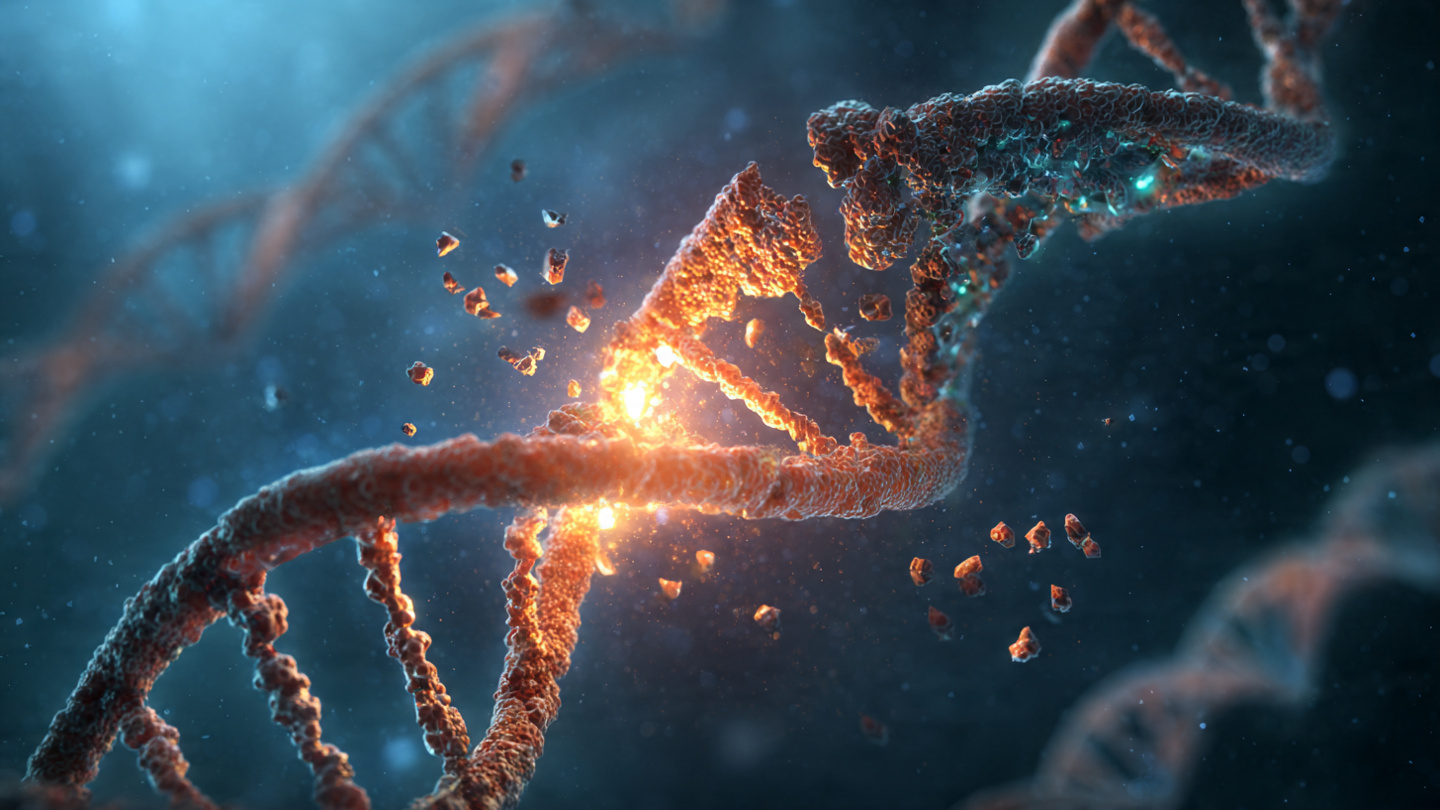
Over ninety percent. That is how many HPV-infected cells a CRISPR protein called Cas12a2 destroyed in laboratory testing published May 6, 2026 in Nature, while the number of healthy cells it harmed was zero, not reduced damage, not acceptable collateral, not a favorable ratio that oncologists could present to a tumor board as the lesser evil, but zero in the absolute sense of a number that requires no further qualification.
Scalpel vs. Shredder
For three decades, CRISPR has meant one thing: precision gene editing, the molecular art of finding a single DNA sequence and cutting it cleanly so that researchers can delete, insert, or repair a specific gene, transforming a faulty instruction into a functional one without disturbing the surrounding genetic text. Cas9, the protein behind this revolution, is a scalpel. Cas12a2 is something else entirely, a protein that targets RNA transcripts rather than DNA sequences. When Cas12a2 finds a transcript specific to a diseased cell, it does not edit or repair anything. It activates indiscriminate double-stranded DNA shredding across the entire genome, overwhelming cellular repair machinery and triggering programmed cell death. Think of it as a self-destruct sequence wired to a disease sensor. Near-perfect complementarity between the guide RNA and the target transcript is required for activation, which is why the protein showed no off-target firing in the published experiments.
The study came from Paul Scholz at the Helmholtz Institute for RNA-based Infection Research (HIRI) in Würzburg, Jared Thompson at the University of Utah, and Kadin Crosby at Utah State University, with co-senior authorship from Chase Beisel (HIRI), Yang Liu (Utah), and Ryan Jackson (Utah State). Three institutions. Sixteen authors. Three proof-of-concept demonstrations that span viral infection, cancer mutation, and gene editing quality control.
Three Targets, Three Results
First, HPV. Guide RNAs were programmed to recognize viral RNA transcripts present only in HPV-infected cells. Result: greater than 90 percent elimination of infected cells with no off-target activation in healthy controls, according to data from Akribion Therapeutics, the HIRI spinoff commercializing the technology.
Second, KRAS-driven cancer. KRAS mutations drive some of the most aggressive lung cancers, and a single nucleotide change distinguishes a cancerous transcript from a healthy one. Cas12a2 reduced proliferation of cells carrying the mutant KRAS transcript by approximately 50 percent, comparable to cisplatin, the platinum-based chemotherapy that has anchored standard-of-care protocols for decades. Comparable efficacy, but radically different collateral damage.
Third, and most quietly useful, Cas12a2 selectively eliminated cells that failed to undergo successful Cas9 gene editing, functioning as a purification step that removes unwanted cells from therapeutic preparations before they reach the patient.
“The enzyme that we're working with is extremely specific,” Yang Liu, a co-senior author at the University of Utah, said in an interview. “It does not touch the healthy cells. So if we're thinking about a cancer therapy, you're treating cancer with no side effects. That was striking to us. We did not know that was possible.”
The Side-Effect Differential
That cisplatin comparison deserves quantification, because comparable tumor-kill rates obscure a chasm in what each approach does to the patient.
Cisplatin crosslinks DNA in every dividing cell it reaches, cancerous or not. Published nephrotoxicity rates range from 25 to 35 percent of patients according to a 2010 Journal of Clinical Oncology review. Ototoxicity, meaning permanent hearing loss, affects 31 to 60 percent. Grade 3-4 nausea, myelosuppression, and peripheral neuropathy are common enough that oncologists classify them as expected outcomes rather than adverse events. Taking a weighted average across these major toxicity categories yields a serious adverse event rate of approximately 40 percent of treated patients.
Cas12a2 achieved a 50 percent reduction in KRAS mutant cell proliferation at an observed off-target rate of zero. Both tools halve tumor burden, but one poisons the patient to do it and the other does not, a difference that is not incremental but categorical.
Extend this to viral oncology and the numbers become more striking. HPV causes roughly 5 percent of all cancers worldwide according to WHO epidemiological data, and with approximately 20 million new cancer diagnoses per year globally, that translates to about 970,000 HPV-attributable cancers annually: cervical, oropharyngeal, anal, penile, vaginal, and vulvar. If Cas12a2 can eliminate HPV-infected cells before malignant transformation at the demonstrated 90-plus percent efficiency, the addressable prevention population for a single CRISPR protein dwarfs what any gene editing approach could target, because you do not need to know which gene to fix. You need to know which RNA should not be there.
Why You Should Not Get Excited Yet
CRISPR therapeutics has a graveyard of in-vitro results that died in clinical translation, and intellectual honesty requires engaging with why this might join them.
CAR-T cell therapy took over 20 years from concept to the first FDA approval of Kymriah in 2017. The delivery problem, getting a therapeutic protein to the right cells inside a living human body, remains the central bottleneck for all CRISPR-based therapies. Lipid nanoparticles work reasonably well for liver targets, which is why the only approved CRISPR therapy, Casgevy for sickle cell disease, requires extracting patient cells, editing them ex vivo, and reinfusing them. Solid tumors present a different challenge: penetrating tumor tissue without triggering immune clearance has defeated most approaches that performed beautifully in cell cultures.
Cas12a2's shredding mechanism creates a particular safety concern that Cas9 does not share. If Cas9 misfires, it makes a localized cut that cells can often repair through normal DNA maintenance pathways, producing a manageable point mutation. If Cas12a2 misfires, even at low frequency, the result is total genomic destruction of the affected cell. The margin between "highly specific" and "catastrophically wrong" is thinner here than for any other CRISPR tool in development.
And the competitive landscape has moved since cisplatin became the benchmark. Sotorasib, marketed as Lumakras and already FDA-approved for KRAS G12C non-small cell lung cancer, demonstrated a 37.1 percent objective response rate in Phase 2 clinical trials, and it is a pill that requires no viral vectors, no lipid nanoparticle engineering, no ex vivo cell processing, just a patient taking it at home with breakfast. Cas12a2 has to beat not just cisplatin but a targeted oral therapy that already exists and that patients are already swallowing with breakfast.
Limitations
Five constraints bound this analysis. First, all Cas12a2 results are from cell cultures and mouse models with no human clinical trial data. Second, the 50 percent KRAS reduction was measured in vitro where delivery is trivial; in vivo tumor penetration remains limited in the published data. Third, long-term persistence of the Cas12a2 protein in human tissue and its immunogenicity profile are completely unknown. Fourth, only a handful of RNA targets have been validated, and generalizability across the roughly 200 known cancer driver mutations requires extensive additional work that could take years. Fifth, my HPV prevention population estimate uses WHO global cancer incidence figures that aggregate heterogeneous populations, screening programs, and HPV vaccination rates currently changing the denominator in real time, meaning the actual addressable population could be substantially smaller in vaccinated countries by the time Cas12a2 reaches clinical deployment.
What You Can Do
If you work in oncology research: Follow Akribion Therapeutics, the HIRI spinoff developing Cas12a2 for clinical applications. Their HPV program represents the clearest path to the clinic because viral RNA targets are unambiguous, present exclusively in infected cells, and absent from healthy tissue, sidestepping the specificity challenges that cancer-native mutations pose where a single nucleotide separates the target transcript from a healthy one.
If you have HPV-related precancerous conditions: Standard-of-care screening and treatment for cervical dysplasia, including LEEP and conization, remains effective and available now. Do not delay established care in anticipation of Cas12a2, which is years from clinical application.
If you invest in biotech: Delivery infrastructure is where value accrues. Companies solving lipid nanoparticle targeting for solid tumors, not the CRISPR proteins themselves, represent the stronger long-term position, because every new CRISPR variant including Cas12a2 depends on the same unsolved delivery bottleneck.
If you are a patient advocate: Push for regulatory frameworks that address CRISPR cell-killing therapies specifically. Existing gene therapy regulatory pathways were designed for tools that edit DNA, not tools that obliterate it. Cas12a2's mechanism raises safety questions that current clinical trial protocols may not be structured to evaluate, because the failure mode, total genomic shredding of an unintended cell, is qualitatively different from an off-target point mutation.
Bottom Line
Cas12a2 inverts what CRISPR means. Instead of repairing a broken gene inside a cell, it identifies cells whose RNA signature marks them for destruction and shreds their genome until they die, sparing everything else in the dish. Over 90 percent clearance of virus-infected cells, fifty percent tumor reduction against a notoriously aggressive mutation, and zero healthy-cell damage. Those numbers are real, published in Nature, and genuinely striking. They are also from cell cultures, which is the easiest proving ground in all of drug development. Between this paper and any patient benefit stand the delivery problem, the in vivo safety profile, and an existing market of targeted therapies that patients can already take as pills. What Scholz, Thompson, Crosby, and their collaborators proved is that bacterial immune systems contain a programmable cell-killing machine that evolution spent billions of years refining. Whether medicine can deploy that machine inside a human body without it firing in the wrong room is the question that will take years, not months, to answer.