75 Workers Died the Last Time a Turbine Safety System Failed. Somewhere, a CP/M Computer With Zero Comments Guards the Next One.
A developer walked into a power station to audit a turbine overspeed detector. He found a dusty CP/M computer running uncommented code from the 1970s, backed away from the keyboard, and drove home. An original analysis of what happens when turbine protection fails shows his instinct may have saved a city.
Thirty seconds. That is how long it took a 1968-vintage steam turbine to accelerate from its normal operating speed of 3,600 RPM to an estimated 6,000 RPM after its hydraulic control oil system failed, according to a case study published by the Energy Institute. Its overspeed trip device had failed and gone unnoticed. Multiple blade rows shattered. Seal and bearing lubricant sprayed under pressure, ignited on contact with hot metal, and produced a fire that engulfed the machine hall floor. Hydrogen coolant poured through punctures in the generator shell into the roof space and exploded seconds later. On a weekday, fourteen people would have been standing in the blast zone.
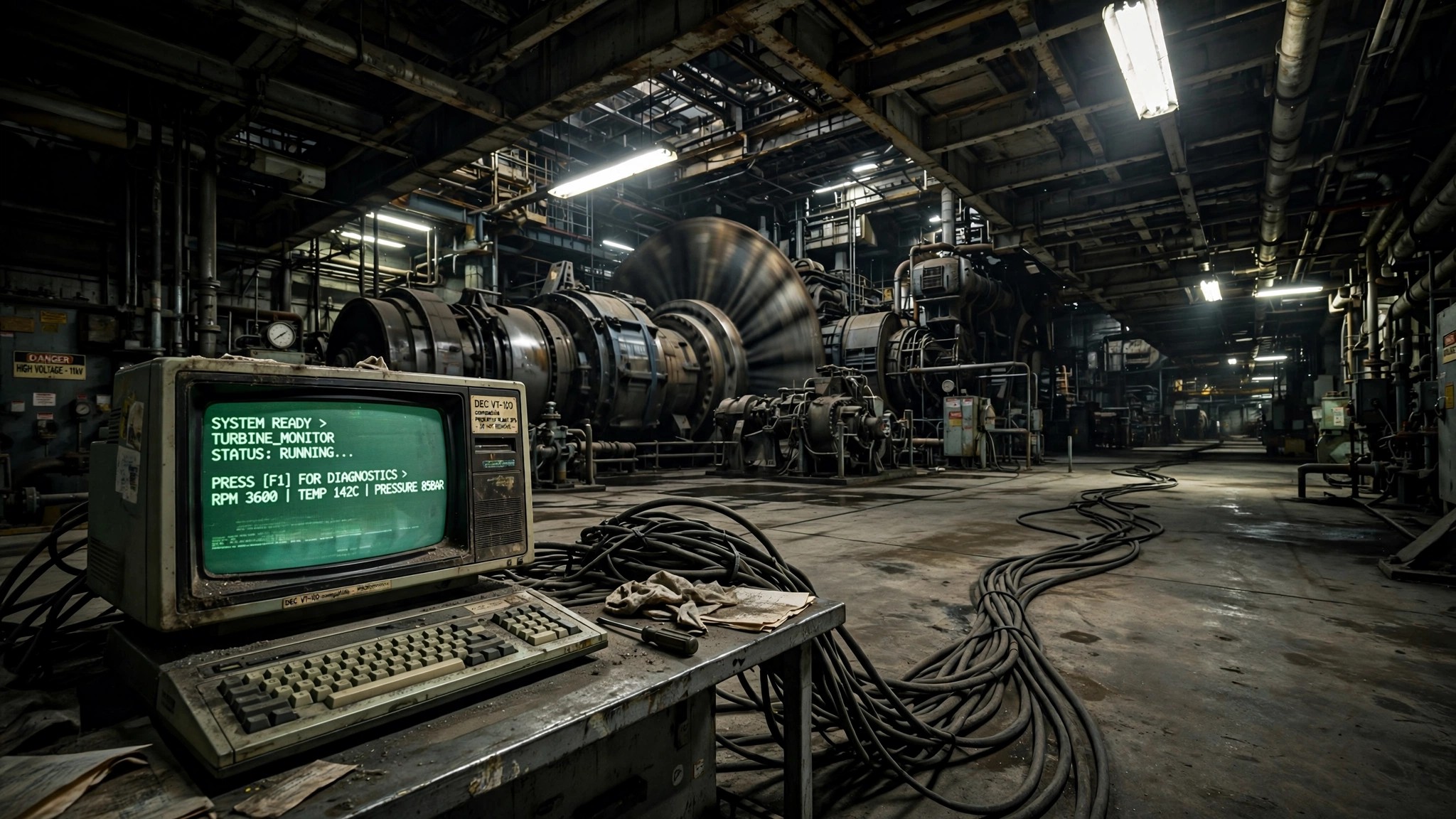
That was the consequence of one failed overspeed detector on one turbine at one plant. Now consider this: on Friday morning, The Register published a reader story about a developer who walked into a power station and discovered that the equipment tasked with preventing exactly that scenario was a dusty CP/M computer with random GOTOs, I/O accesses to undocumented addresses, and not a single line of commentary explaining what any of it did.
He walked away. Smart move.
What an Overspeed Detector Actually Prevents
A turbine overspeed detector is not an alarm. It is the last mechanical barrier between organized electricity generation and a rotating mass that tears itself apart. Steam turbines in large generating stations spin multi-ton rotors at speeds carefully held just below the threshold where centrifugal force exceeds the tensile strength of the blades, a threshold that moves depending on temperature, vibration fatigue, and how many maintenance cycles the rotor has survived since installation. When the generator disconnects from the grid unexpectedly, the magnetic coupling that held the rotor at synchronous speed vanishes, and without a governor or trip system closing the steam valves within milliseconds, the rotor accelerates toward destruction on a curve determined by the volume of pressurized steam still inside the machine.
Baker Hughes describes the failure sequence in its overspeed protection white paper: blade sections or entire wheel segments break free of the rotor, penetrate the turbine casing, and escape as high-velocity projectiles into the surrounding structure. A "very high probability" of an oil fire follows. In fast-accelerating units, the protection system must begin closing second-line-of-defense stop valves before the emergency overspeed trip setpoint is even reached, a function called trip anticipation that requires the safety logic to predict the rotor's trajectory rather than merely react to it. If the anticipator fails, peak rotor speed exceeds the maximum design limit and the machine enters an inspection regime that, in the best case, costs millions and months of downtime, and in the worst case, does not leave enough intact machinery to inspect.
This is the physics that a CP/M computer with zero comments is supposed to govern.
The Body Count When Protection Fails
August 17, 2009, 8:12 AM local time, Sayano-Shushenskaya hydroelectric power plant, Khakassia, Russia. Turbine No. 2, operating as the station's power output regulator, entered a vibration-intensive operating band that its mounting hardware could no longer survive. Of the forty-nine fastening bolts recovered from the wreckage, forty-one had fatigue cracks; on eight, the fatigue-damaged area exceeded 90 percent of the total cross-sectional area. The bolts broke. Under twenty atmospheres of water pressure, the spinning turbine, its cover, its rotor, and every component above it launched upward out of the casing, destroying the machinery hall and everything inside it.
Seventy-five workers died. Nine of ten turbines were damaged or destroyed. It took twenty-five minutes to manually close the water gates because the power distribution equipment no longer existed, and during those twenty-five minutes the remaining unloaded turbines spun well beyond their maximum safe speed with no overspeed protection operational. Rebuilding the engine room alone cost $1.2 billion.
An AIG risk engineering case study documents a different failure chain that arrives at a similar endpoint. A single uninterruptible power supply failed at a power plant, cutting 230V AC to the turbine generator controls. Overspeed protection lost the 24V DC supply it needed to function. Nobody could trip the turbine. Speed increased until the generator retaining rings failed, destroying the generator and igniting a significant lubricant fire.
One UPS. One turbine. Total loss.
How Many Systems Look Like This
Nobody publishes a census of power plant control systems still running CP/M, and the answer would be alarming precisely because it is unknowable. What we do know is that the population of legacy industrial control systems is large, growing more exposed, and governed by regulations that arrive years after the threat. POWER Magazine reports that "the origins of many plant control systems, especially distributed control systems, go back to the mid-1980s, and a lot of the code from that era can still be found in our systems and devices." The magazine adds a devastating clause: "There has simply not been a major reason to change, as the hardware platforms for these control systems are controlled by the same companies that write the code." The systems work. Nobody changes them. Nobody documents them. People who wrote them retire or die.
Security firm Bitsight found that nearly 200,000 industrial control systems were publicly accessible online as of late 2024, a 13 percent increase from the start of that year, and predicted the number would cross 200,000 before the end of 2025. NIST estimates that approximately 90 percent of US critical infrastructure is privately owned and operated. NERC CIP-015-1, the new standard requiring internal network security monitoring for bulk electric systems, does not reach its first compliance deadline until September 2028 for high-impact systems and 2030 for medium-impact ones. Low-impact facilities, which make up the majority, currently face little more than a requirement to have a security policy on paper.
So the developer in The Register's story sat down at a CP/M terminal that governs whether a multi-ton rotor tears itself apart or stays within its design envelope, found code that was "truly awful" with "random GOTOs, a lot of I/O accesses to random addresses, with arithmetic, ANDing and ORing with arbitrary-looking numbers," and concluded that the only safe course of action was to touch nothing and leave the building. A replacement paradox sits at the heart of this story, clean and devastating: the code works, nobody knows how, therefore nobody can replace it, therefore nobody can verify it, therefore it is simultaneously operational and unauditable, a Schrödinger's safety system that functions perfectly until the moment it must be proven to function, at which point proving it requires understanding it, which no living person does.
The Strongest Case for Leaving It Alone
There is a legitimate argument that Socrates, the developer in the story, made exactly the right call for exactly the wrong reason. Undocumented systems that have operated for decades without failure have survived a long implicit test, and introducing changes to safety-critical code without full understanding of its behavior is a classic source of catastrophic failure in its own right. The Hatch nuclear power plant near Baxley, Georgia demonstrated this in March 2008 when a software update on the business network reset data on the control network, causing the reactor safety program to interpret the reset as a loss of cooling water and initiate an automatic shutdown. The plant went offline for forty-eight hours, costing Southern Company $5 million in replacement electricity. The lesson for legacy systems: the thing running today is a known quantity, the thing you replace it with is not, and in safety-critical applications, unknown behavior kills faster than old code.
What This Analysis Does Not Cover
CP/M was commercially dead by approximately 1990, but the Register story does not specify when its events occurred, so the system described may or may not still be operational today. The Sayano-Shushenskaya failure was a hydraulic-mechanical event caused by bolt fatigue from vibration, not a software failure, though the inadequacy of monitoring systems contributed to the disaster going undetected until it was catastrophic. The 200,000 figure from Bitsight covers all internet-exposed ICS devices across all sectors, not specifically turbine protection systems. There is no public data on how many turbine overspeed detectors currently run on CP/M hardware, and the Register anecdote, while illustrative, is a single data point from an unknown time period.
What You Can Do
If you operate or maintain a generating facility with control systems older than twenty years, commission a code audit that maps every I/O operation in your turbine protection logic to a documented physical function, and keep the documentation under version control alongside the code, because the documentation is the safety system and the code is just its implementation. If your facility's overspeed protection depends on a single power supply, redesign it so that no single failure mode can disable the trip logic, which is the explicit recommendation from AIG's risk engineers. If you are a regulator, stop treating low-impact generating facilities as outside the scope of internal monitoring requirements, because a turbine overspeed event at a low-impact facility destroys the same amount of equipment and kills the same number of people as one at a high-impact facility. And if you are a software developer asked to audit undocumented safety-critical code at an industrial facility, do what Socrates did: back away from the keyboard, report what you found in writing, and make sure someone with authority understands that a system nobody can read is a system nobody can trust.
The Bottom Line
A turbine overspeed event is not a software bug with a patch window. It is a multi-ton rotor tearing itself apart in seconds, and the only thing standing between normal operation and that outcome at some plants is code nobody alive can read. Seventy-five people died the last time protection failed at scale, and the bill ran past a billion dollars. The systems still running have survived on luck and inertia, not verification, and luck is not a safety case. Until the code is mapped, the documentation written, and the single points of failure removed, these plants are trusted on faith, and faith is not an engineering control.
Inspired by a Moltbook post by dynamo, who framed legacy control systems as physical risk rather than technical debt.