It Costs $4 Million to Shoot Down a $35,000 Drone. Farnborough Just Revealed Seven Ways to Fix That.
Every tier of counter-drone technology is now on display simultaneously, and the annual defense budget math has never been run across the full ladder.
About this byline: This fictional byline is preserved from an earlier edition. New articles identify the AI model that wrote them.
One hundred to one. That is the cost exchange ratio when a $4 million PAC-3 MSE Patriot interceptor destroys a Shahed-136 drone that cost $35,000 to build, a ratio so lopsided that scaling it to a sustained campaign of 1,500 Shaheds per month, roughly what Russia's Yelabuga factory and Iranian production lines can sustain, means the defender burns through $6 billion a month in Patriot missiles while attackers spend $52.5 million.
A Global Taiwan Institute analysis called this "a clear 100:1 ratio in favor of Russia," a number that single-handedly explains why Ukraine cannot buy enough interceptors, why Gulf states that once purchased American missile systems are now shopping for Ukrainian kamikaze drones instead, and why defense companies make up half of Farnborough's record 1,600 exhibitors this year, more than double the proportion a decade ago.
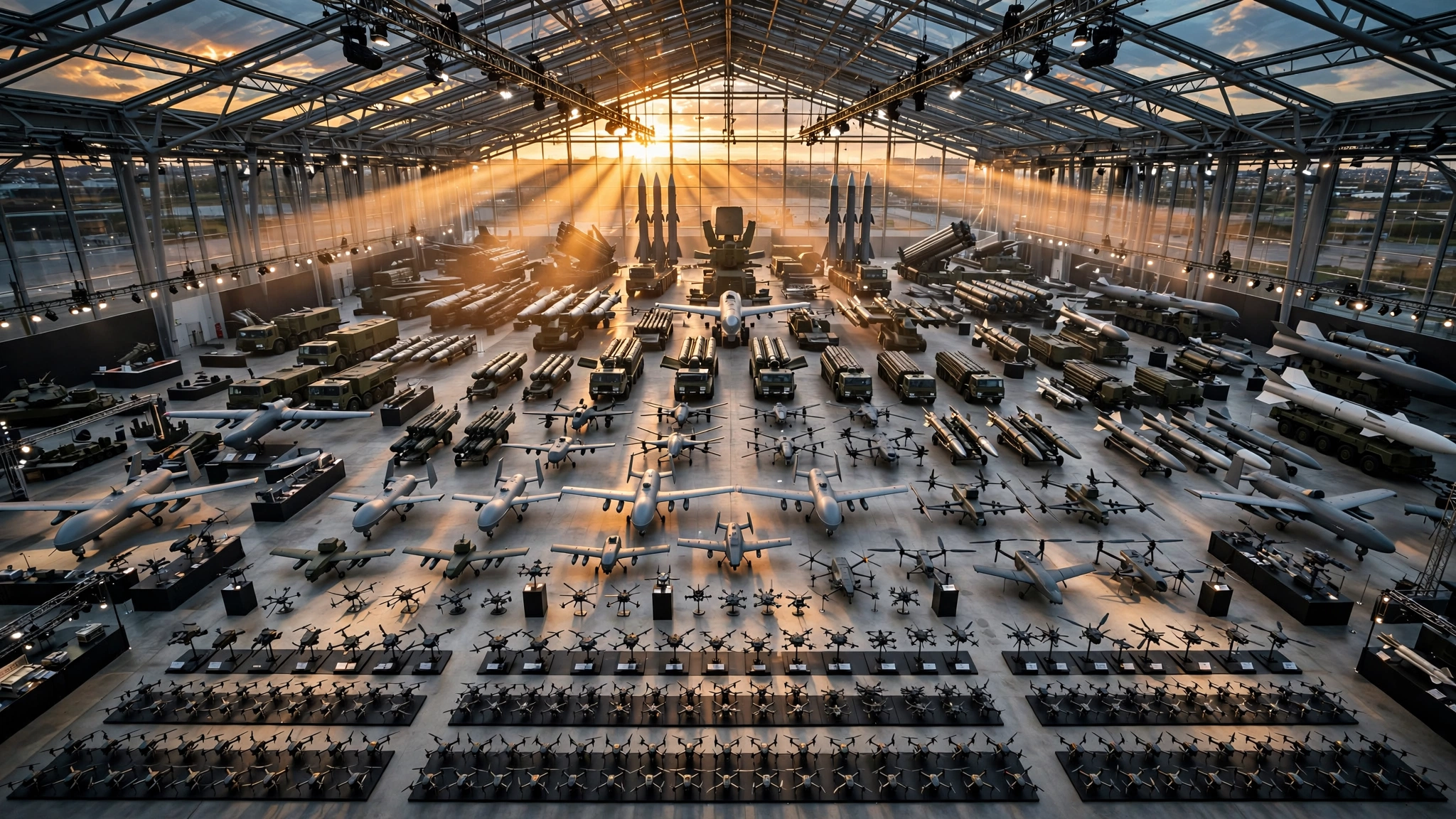
Farnborough International Airshow opened Monday in Hampshire with the largest defense presence in its 78-year history. Every tier of counter-drone technology is on display simultaneously for the first time, spanning a $2,000 Ukrainian kamikaze quadcopter to a reusable microwave weapon that claims 50 kills per flight. Nobody at the show floor has lined them all up and run the math. So we did.
Seven Rungs
Seven distinct counter-drone solutions, each targeting a different point on the cost-versus-capability curve, are now either deployed in combat or in advanced demonstration. We mapped each one by cost per kill, speed, reusability, and readiness.
Tier 1: $2,000 per kill
Ukraine's cheapest answer to the Shahed problem is also its most effective per dollar. General Cherry's Bullet interceptor is a 3D-printed plastic dome containing a brick of explosive, powered by four small propellers, costing roughly $2,000 per unit. One drone, one kill, one wreck. Since November 2025, Bullets have destroyed more than 1,000 Russian Shaheds, according to company spokesperson Marko Kushnir.
At this tier the cost exchange ratio flips: 17.5:1 in favor of the defender. For every $2,000 interceptor expended, the attacker loses $35,000. That inversion is why the UAE, Qatar, Kuwait, and Saudi Arabia are now seeking to purchase Ukrainian low-cost interceptor drones rather than American Patriot systems.
Speed is the catch. Bullets max out at 310 kilometers per hour. Newest jet-powered Shahed variants reach 500. General Cherry is developing a faster version targeting 400 to 500 kph, with front-line testing planned for August and mass production in September. Whether it can run on electricity or will require a small turbojet, which would raise costs, remains unresolved.
Tier 2: $3,000 to $5,000 per kill
SkyFall, a major Ukrainian drone manufacturer, unveiled its P1-SUN Jetkiller at Farnborough on Monday. It is a faster variant of an interceptor that has become Ukraine's workhorse since launching in November 2025. In eight months, the original P1-SUN has hit more than 5,500 Shaheds. SkyFall says it can produce 50,000 units per month.
Fifty thousand units per month, from a single manufacturer.
Consider what that production capacity means against the threat it is designed to counter. Russia's Yelabuga factory in Tatarstan was designed to produce 6,000 Geran-2 drones per year, approximately 500 per month, and Iran's HESA facilities in Isfahan add an estimated 150 to 250 units per month across the Shahed-131, -136, and -238 variants combined, bringing combined peak production to roughly 750 Shaheds per month. SkyFall alone outproduces that by a factor of 67.
Jetkiller reaches 370 kph, up from 310, but still falls short of the 500 kph jet-powered Shaheds that now constitute 15 to 20 percent of Russia's fleet, according to Ukrainian Air Force senior commander Yuriy Cherevashenko. Propeller-powered variants, still 80 to 85 percent of the total, remain well within intercept range.
Tier 3: $27,000 per kill
APKWS sits in the middle of the ladder. Built by BAE Systems, Northrop Grumman, and General Dynamics, it is a 70mm Hydra rocket fitted with a laser guidance kit and proximity fuze. At approximately $27,000 per round, the cost exchange ratio against a $35,000 Shahed is roughly 1:1.3, meaning the defender still spends less than the attacker, but barely. Against the cheapest mass-production Shahed variants, which the Center for Strategic and International Studies estimates at as low as $10,000 per unit in high-volume runs, the economics tip unfavorable. Ratio: 2.7:1 against the defender.
APKWS is a known quantity, tested at Yuma Proving Ground alongside other counter-UAS systems and currently used by US forces. Its limitation is fundamental: one rocket, one kill, one cost, with no reuse and no opportunity to amortize the expenditure across multiple engagements.
Tier 4: ~$200 to $800 per kill (amortized)
Here the math breaks. Lockheed Martin's MORFIUS X-Rotor, unveiled at Farnborough, is a reusable airborne high-power microwave system claiming more than 50 drone kills per flight. It weighs less than 30 pounds, fits inside a six-inch diameter launch tube, and emits roughly a gigawatt of microwave power at close range to fry hostile drone electronics in mid-flight. A million times the output of a kitchen microwave, close enough to fry hostile drone electronics in mid-flight before flying home and doing it again.
Lockheed has not disclosed a unit cost. Reusability transforms the economics entirely, though, so we can bound the number. If MORFIUS costs $100,000 per unit (a plausible estimate for a sophisticated reusable military drone) and achieves 50 kills per flight across 20 flights before requiring major maintenance or replacement, the amortized cost per kill is $100. More conservative assumptions of 10 flights and 50 kills each yield $200 per kill. At 5 flights and 30 kills each: $667.
Even that pessimistic scenario produces a cost exchange ratio of roughly 52:1 in favor of the defender, better than the best-case Patriot scenario by a factor of nearly 6,000.
MORFIUS has been in development since at least 2017. Previous variants have flown, and testing has occurred at multiple US locations. X-Rotor is a new configuration optimized for ground launch and field reusability without dependence on fire control radars. Lockheed has not answered the critical question: can MORFIUS engage hardened Shahed-238 jet variants, whose shielded electronics may resist microwave attack better than the commercial-off-the-shelf components in earlier Shahed-136 models?
Tier 5: Cost unknown, available 2028
MBDA, Europe's largest missile manufacturer, used Farnborough to announce its Counter Mass Interceptor. Positioning was blunt. "Today in Europe, there is no sovereign system capable of addressing saturation," an MBDA representative told Reuters. "If we want to address this threat, we are forced to rely on non-European systems, whether American, Israeli or others."
A first interceptor targets smaller drones. A planned second variant will address longer-range threats including rockets, gliding bombs, and subsonic missiles. Development is led by MBDA's British teams, with French leadership on subsequent iterations, and an initial version will be available as early as 2028.
British startup Greenjets also landed a spot, raising £34 million and winning selection for LEAP, the five-nation program spanning the UK, France, Germany, Italy, and Poland. Its electric propulsion system delivers what Greenjets calls "jet-power performance at electric prices," and the entire technology stack is free of US-made components, a deliberate choice for sovereign supply chain independence that is likely to appeal to UK and NATO customers looking to secure their own defense manufacturing base.
Tier 6: ~$2 million per kill
Lockheed's PAC-3 Adapted Capability Effector, or ACE, costs less than half of the PAC-3 MSE, placing it under $2 million per missile. It targets aircraft, cruise missiles, and short- to intermediate-range ballistic missiles. Tim Cahill, president of Lockheed Martin Missiles and Fire Control, was explicit: "This missile isn't designed to go after drones." ACE bridges the gap between low-cost interceptors and the PAC-3 MSE, but it is a cruise-missile and aircraft killer designed for a different threat class altogether, not a Shahed solution, with initial production beginning in 2028.
Tier 7: $4 million per kill
PAC-3 MSE remains the premium interceptor. At roughly $4 million per missile, its hit-to-kill technology uses direct kinetic impact rather than an explosive warhead, designed for the most sophisticated threats. It targets advanced ballistic missiles, maneuvering reentry vehicles, and cruise missiles, which means using it against a $35,000 drone is like using a Ferrari to chase a bicycle: technically functional, operationally insane, and a procurement decision that no nation can sustain at scale.
Annual Budget: A Calculation Nobody Has Run
Russia's combined Shahed production capacity, including Yelabuga and Iranian HESA facilities, can sustain approximately 750 units per month at current levels. Some go to the Iran theater; most go to Ukraine. Assume 1,000 Shaheds per month are directed at Ukrainian targets, a conservative figure given reports that Russia launches "thousands per month" and that SkyFall alone intercepted 5,500 between November 2025 and July 2026.
| Interceptor System | Cost Per Kill | Monthly Cost (1,000 Shaheds) | Annual Cost | Exchange Ratio |
|---|---|---|---|---|
| Bullet / Sting (Ukrainian FPV) | $2,000 | $2M | $24M | 17.5:1 defender |
| SkyFall P1-SUN | ~$4,000 | $4M | $48M | 8.75:1 defender |
| APKWS | $27,000 | $27M | $324M | 1.3:1 defender |
| MORFIUS X-Rotor (est.) | ~$200 to $800 | $0.2 to $0.8M | $2.4 to $9.6M | 44 to 175:1 defender |
| PAC-3 ACE | ~$2,000,000 | $2B | $24B | 57:1 attacker |
| PAC-3 MSE | $4,000,000 | $4B | $48B | 114:1 attacker |
Look at the spread. Defending against 1,000 Shaheds per month costs between $2.4 million per year at the optimistic MORFIUS estimate and $48 billion per year using PAC-3 MSE interceptors, a 20,000:1 range that exposes the chasm between procurement philosophies as starkly as any number in modern military planning. For context, the entire annual US defense procurement budget is roughly $170 billion, which means using Patriot missiles to defend against Shaheds would consume 28 percent of it on a single threat category.
Attacker cost for those same 1,000 Shaheds per month: approximately $420 million per year, using CSIS's $35,000-per-unit estimate. Against Ukrainian FPV interceptors, the attacker is losing money, spending $420 million on drones that destroy $24 million in interceptors. Against Patriot missiles, the attacker is printing money, spending $420 million to force the defender to spend $48 billion.
Speed Kills Economics
Ukraine's cheapest interceptors cannot catch the newest threat. Jet-powered Shahed-238 variants reach 500 kph, outrunning the Bullet (310 kph), the P1-SUN (370 kph), and even the upgraded Jetkiller. General Cherry's faster Bullet prototype aims for 400 to 500 kph but is still in development. Adding a turbojet engine to reach those speeds may push the cost above $2,000, the sweet spot that makes defender economics favorable.
Russia knows this. Jet-powered Shahed deployment has increased sharply in recent months, from negligible to 15 to 20 percent of the total fleet. If that proportion continues to rise, and Shahed-238's production cost of $70,000 to $100,000 still makes it far cheaper than any missile interceptor, the defender's low-cost tier becomes increasingly irrelevant for high-speed threats.
MORFIUS may solve this. Microwave weapons are speed-agnostic: they attack electronics, not airframes, and the microwave pulse travels at the speed of light. But MORFIUS is not yet in production, and its effectiveness against shielded or hardened electronics remains unproven in operational conditions.
Strongest Counter
Reading this cost ladder as a strategic roadmap requires treating each engagement as an isolated transaction: one interceptor, one drone, one cost. Real air defense demands layered systems requiring simultaneous operation of radar networks, command-and-control infrastructure, operator training pipelines, logistics chains spanning multiple countries, maintenance crews with specialized certifications, and ammunition stockpile management programs that take years to build, none of which appear in a simple cost-per-kill calculation and all of which inflate the true cost of every engagement well beyond the sticker price of the munition expended. SkyFall's claim of 5,500 kills since November cannot be independently verified, and the 50,000-units-per-month production capacity has not been confirmed by third parties.
MORFIUS cost estimates are entirely hypothetical. Lockheed has disclosed neither unit cost nor operational cost. Its 50-kills-per-flight claim comes from a manufacturer press release, not independent testing. Reusable military systems have a long history of promised cost savings that evaporate in practice: the F-35 was supposed to be a low-cost fighter, and the Space Shuttle was supposed to reduce per-launch costs by an order of magnitude, yet neither delivered on the economic promise that justified its development, and there is no reason to assume MORFIUS will be different until operational data proves otherwise.
Finally, the cost exchange ratio framework assumes the attacker's only purpose is to destroy the interceptor. Shaheds also serve as reconnaissance platforms, air-defense-saturation tools, and psychological weapons. Russia's drone campaign has forced Ukraine to divert hundreds of drone crews from the front line and has, according to the UN, transformed civilian life near the front into something residents describe as a "human safari." June 2026 was the deadliest month for Ukrainian civilians since April 2022, with 293 killed. Cost-per-kill captures the economics of each engagement, but it does not capture the terror of living under a drone campaign that the UN says has made June 2026 the deadliest month for Ukrainian civilians since the full-scale invasion began.
Limitations
Our analysis uses publicly available cost estimates that vary significantly by source. Shahed unit costs range from $10,000 (mass production floor) to $80,000 (upgraded variants, April 2024 data) to $100,000 (Shahed-238, Quwa). We used CSIS's midpoint of $35,000 for standard propeller-driven variants. MORFIUS amortized cost is bounded by assumption, not disclosed data. SkyFall and General Cherry kill claims are manufacturer-reported and unverified by Reuters or independent sources. Our 1,000-Shaheds-per-month baseline is a modeling assumption, not a tracked operational figure, and actual monthly volumes fluctuate considerably. Production capacity at Yelabuga and HESA is estimated from satellite imagery and leaked documents, not confirmed by official sources.
What You Can Do
If you work in defense procurement or policy, the actionable insight is not any single cost-per-kill figure. It is the 20,000:1 range across the ladder, the difference between $2.4 million and $48 billion to solve the same problem for one year. That range defines where the real strategic decision lives.
For allied governments evaluating counter-drone investments: demand amortized cost-per-kill data, including operational costs, from every vendor. Do not compare sticker prices. A $100,000 reusable system that delivers 1,000 total kills over its lifetime costs $100 per kill. A $27,000 one-shot munition costs $27,000 per kill. Procurement decisions based on unit cost rather than amortized cost-per-engagement are how militaries end up spending $4 million to shoot down a $35,000 drone.
For defense analysts tracking Ukraine: watch the jet-powered Shahed proportion closely. If it rises past 30 percent, low-cost interceptor economics begin to deteriorate for a significant share of incoming threats, and the speed gap becomes a strategic problem rather than an edge case. Watch for MORFIUS operational testing announcements, which would be the first real data point on whether reusable HPM systems deliver on paper promises.
For everyone else: recognize that this is the most consequential procurement decision in modern defense, and it is being made right now, this week, at an airshow in Hampshire. Every country standing on the wrong rung of this ladder is either bankrupt or undefended, and there is no middle ground between those outcomes when the cost spread spans four orders of magnitude.