A Single Cosmic Ray Can Corrupt 1,000 Quantum Error-Correction Cycles. Three Labs Just Went Underground to Fix It.
Google Quantum AI published a paper in Physical Review X demonstrating that ionizing radiation shifts the frequencies of multiple superconducting qubits simultaneously by up to 3 megahertz for a full millisecond, violating the independence assumption underlying every quantum error-correction code in use today. Fermilab went 350 feet underground and found the problem is even stranger than expected. A Chalmers-Waterloo team is heading 2 kilometers into a Canadian mine. An original calculation shows why one cosmic ray strike is enough to corrupt roughly 1,000 consecutive error-correction cycles.
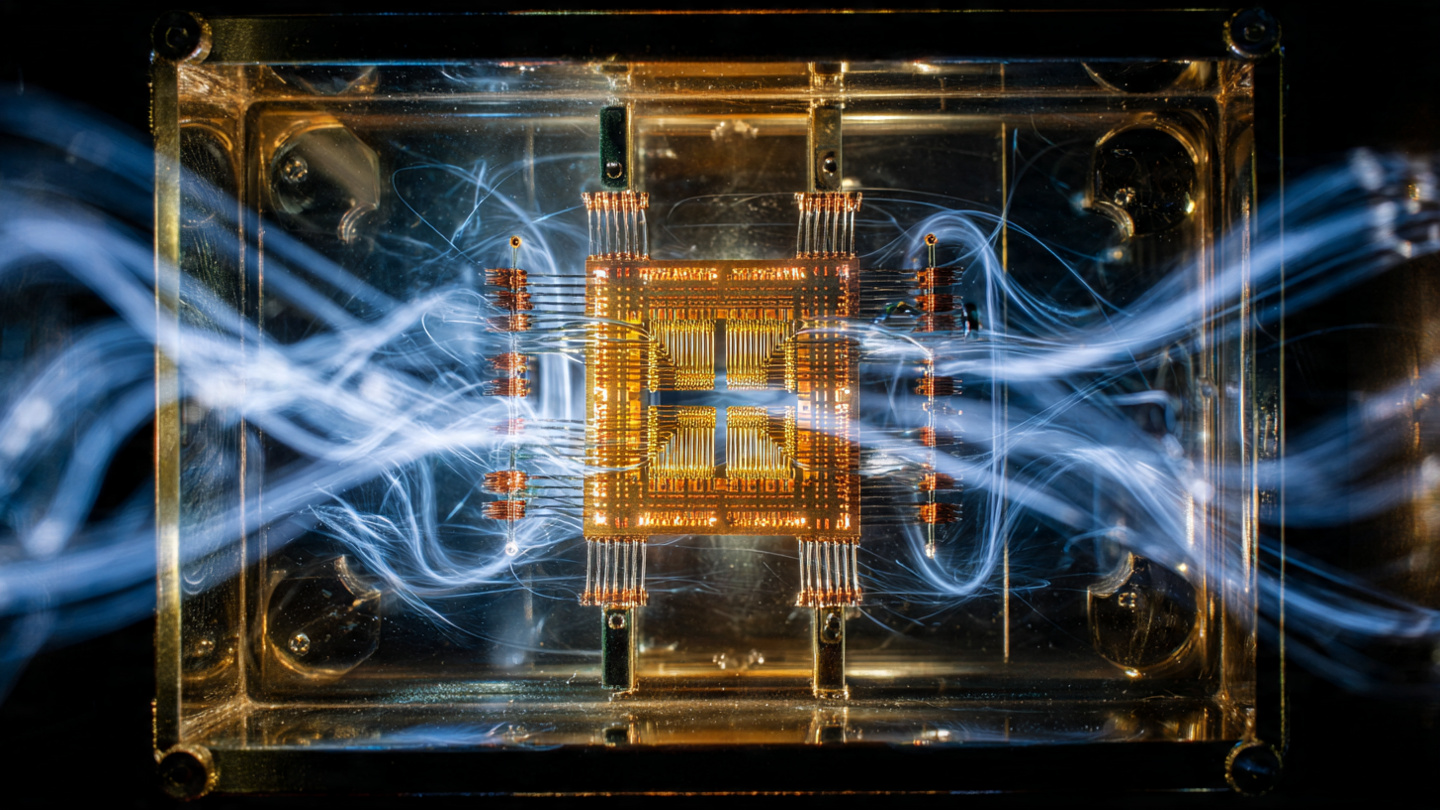
One thousand. That is the approximate number of quantum error-correction cycles that a single cosmic ray can corrupt when it strikes a superconducting quantum processor. Straightforward arithmetic reveals the severity: standard surface codes run error-correction rounds roughly every microsecond, a cosmic ray impact creates quasiparticles that shift qubit frequencies for about one millisecond, and during that millisecond the error-correction system is operating on data it fundamentally cannot trust because multiple qubits are wrong simultaneously in ways the code was never designed to handle.
On May 4, 2026, a 20-author team from Google Quantum AI published "Correlated Phase Error Bursts in a Gap-Engineered Superconducting Qubit Array" in Physical Review X. What matters is not that cosmic rays cause errors. Physicists have known that since at least 2021, when a University of Wisconsin-Madison team first measured correlated charge noise from ionizing radiation. What the Google paper demonstrates is that the hardware fix the community banked on does not work for an entire class of errors nobody was accounting for.
The Fix That Didn't Fix It
Superconducting quantum computers operate at temperatures near absolute zero, roughly 15 millikelvin, inside dilution refrigerators the size of industrial freezers. At these temperatures, the superconducting circuits that form qubits carry current with zero resistance. When ionizing radiation, whether from a cosmic ray muon passing through the ceiling or a gamma ray from trace uranium in the concrete walls, strikes the silicon substrate beneath the qubits, it deposits energy that breaks Cooper pairs (the paired electrons that enable superconductivity) and creates clouds of quasiparticles, rogue unpaired electrons that interact destructively with quantum circuits.
Gap engineering was the community's response: designing physical barriers within the chip that prevent quasiparticles from tunneling into the sensitive qubit junctions where they cause bit-flip and energy-relaxation errors. Google's own Sycamore and subsequent processors incorporated these barriers. It worked for the errors it targeted.
But the Google team, led by Vladislav Kurilovich, Gabrielle Roberts, and Alex Opremcak, discovered a different error mechanism that gap engineering cannot touch. Quasiparticles do not need to physically enter the qubit junction to cause damage. Their mere proximity to the qubit shifts its operating frequency, because quasiparticles alter the local electromagnetic environment that determines how fast the qubit oscillates. Frequency shifts can reach 3 megahertz and persist for approximately one millisecond before the quasiparticles recombine and the frequency returns to normal. During that window, every qubit near the impact site is oscillating at the wrong frequency, accumulating phase errors at rates that overwhelm error correction.
Why Correlated Errors Break Everything
Quantum error correction works by spreading a single logical qubit across many physical qubits and continuously checking for discrepancies. Surface codes, the most widely deployed family, rely on a critical assumption: errors on different physical qubits are statistically independent, meaning one qubit's error tells you nothing about whether its neighbor will also err.
Cosmic ray impacts violate this assumption categorically. A single radiation event deposits energy across a wide area of the chip, creating quasiparticles that shift the frequencies of many qubits at the same time, in the same direction, for the same duration. Faced with multiple qubits reporting errors simultaneously, the error-correction system cannot determine which ones are genuinely wrong versus which ones are being shifted together by the same external cause. Confronted with more simultaneous errors than it was designed to handle, the correction algorithm can introduce new errors while trying to fix old ones, a failure mode called decoder breakdown.
Google's data quantifies the scale: frequency shifts of up to 3 MHz across multiple qubits, lasting ~1 ms per event. For context, typical qubit operating frequencies are in the 4-6 GHz range, so a 3 MHz shift represents roughly 0.05-0.075% of the operating frequency. That sounds small until you consider that quantum error-correction thresholds require physical error rates below approximately 1%. A correlated frequency shift that pushes many qubits' phase error rates above threshold simultaneously is not a rounding error. It is a system failure.
How Often Does This Happen?
At sea level, the cosmic ray muon flux is approximately 1 muon per square centimeter per minute, according to measurements from the Particle Data Group. A typical superconducting quantum processor chip occupies roughly 1-4 cm² of silicon substrate. Additional ionizing radiation comes from terrestrial sources: trace amounts of uranium-238, thorium-232, and potassium-40 in the concrete, copper, and aluminum surrounding the dilution refrigerator.
Combining cosmic and terrestrial sources, a conservative estimate puts the radiation event rate at 1-5 per minute for a chip-scale processor. Each event corrupts error correction for approximately 1 millisecond, during which roughly 1,000 error-correction cycles run on data they cannot reliably correct. Over a 10-minute quantum computation, that translates to 10-50 correlated error bursts, each potentially capable of crashing the logical qubit.
| Parameter | Value | Source |
|---|---|---|
| Sea-level muon flux | ~1 / cm² / min | Particle Data Group |
| Typical chip area | 1-4 cm² | Google, IBM processor specs |
| Phase-shift duration per event | ~1 ms | Kurilovich et al., PRX 2026 |
| Error-correction cycle time | ~1 μs | Google surface code experiments |
| Corrupted cycles per event | ~1,000 | Calculated: 1 ms / 1 μs |
| Events per 10-min computation | 10-50 | Calculated: (1-5/min) × 10 min |
For applications that require hours of sustained quantum coherence, such as breaking RSA-2048 encryption (estimated at 8 hours on a hypothetical error-corrected machine) or simulating complex molecules for drug discovery, the cumulative probability of at least one catastrophic correlated error burst approaches certainty.
350 Feet Down, the Problem Gets Weirder
In March 2026, a team led by Grace Bratrud of Northwestern University published results in Nature Communications from Fermilab's Northwestern Experimental Underground Site, known as NEXUS. NEXUS sits 350 feet beneath the Illinois prairie, deep enough to block most cosmic ray muons. Bratrud's team placed the same four-qubit chip that had been tested on the surface in 2019 inside a dilution refrigerator surrounded by a lead shield, then measured charge bursts with the shield both open and closed.
Underground with the shield closed, charge burst rates dropped. But they dropped less than expected. Stranger still, correlated charge noise persisted even when every known external radiation source had been blocked. "That leads us to believe something else besides the known gamma radiation is causing charge bursts inside the shield," Bratrud said. "What that may be is still up for debate. That's the big question."
The most likely culprit is radioactive contamination within the materials immediately surrounding the qubits: the aluminum and niobium films, the silicon substrate, the copper sample holder, the solder joints. If trace radioactive isotopes exist within centimeters of the qubit array, no amount of external shielding eliminates the source. Removing such contamination would require ultra-radiopure fabrication processes borrowed from dark matter detector construction.
Two Kilometers Down, the Real Test Begins
The most ambitious underground quantum experiment is still being set up. Researchers from Chalmers University of Technology in Sweden and the Institute for Quantum Computing at the University of Waterloo in Canada are preparing to test superconducting qubits at SNOLAB, a laboratory located 2 kilometers underground in Vale's Creighton nickel mine near Sudbury, Ontario. SNOLAB maintains the lowest muon flux of any laboratory on Earth, roughly six orders of magnitude below the surface rate, which originally made it the home of the Sudbury Neutrino Observatory that won Arthur McDonald the 2015 Nobel Prize in Physics.
"We are super excited about this project because it addresses the very important question of how cosmic radiation affects qubits and quantum processors," said Per Delsing, Professor of Quantum Technology at Chalmers and Director of the Wallenberg Center for Quantum Technology. Their plan involves manufacturing superconducting qubits at Chalmers, testing them above ground in both Sweden and Canada, then transporting them to SNOLAB and repeating the measurements in the near-zero radiation environment. A U.S. Army Research Office grant titled "Advanced Characterization and Mitigation of Qubit Decoherence in a Deep Underground Environment" funds the project.
SNOLAB's million-fold reduction in muon flux should eliminate cosmic ray impacts entirely. If correlated errors persist there, the source is unambiguously internal: radioactive contamination in the chip or its immediate surroundings. If the errors disappear, the community has a clear if expensive answer: fault-tolerant quantum computers may need to live underground.
The Cost of Going Underground
SNOLAB's original construction cost approximately C$69 million in 2012 dollars (~C$90 million in 2026 terms). Operating costs run C$15-20 million per year. Built for particle physics rather than quantum computing, SNOLAB would need substantial modifications to host commercial-scale quantum processors. Custom underground facilities for quantum computing would face similar or higher construction costs depending on location and depth.
Compare that to surface-level quantum computing investments: Google's quantum AI lab in Santa Barbara, IBM's quantum data centers in Poughkeepsie and Ehningen, and the collective tens of billions currently flowing into the quantum computing sector. Building a dedicated underground quantum computing facility for $100-200 million would represent a modest premium on the total cost of a quantum data center, probably 5-15% of the all-in price for a 1,000+ qubit system including the dilution refrigerators, control electronics, and classical computing infrastructure.
Alternative approaches include quasiparticle traps, small regions of normal (non-superconducting) metal intentionally placed near qubits that absorb quasiparticles before they can shift qubit frequencies, and phonon-dampening structures that reduce the "splash radius" of a radiation impact in the silicon substrate. Researchers at the Forschungszentrum Jülich in Germany are actively developing both. Neither has been demonstrated at the scale needed for a commercial quantum processor.
What This Analysis Did Not Prove
Three important limitations constrain these conclusions. First, the Google paper studied correlated phase errors on one specific chip architecture with one set of qubit frequencies and one substrate geometry. Different chip designs may experience different severity of correlated errors depending on qubit spacing, substrate thickness, and junction parameters. Second, the "1,000 corrupted cycles" calculation assumes error-correction rounds run on a strict 1 microsecond cadence. Real implementations vary, and adaptive error-correction schemes that detect correlated error signatures and pause computation during a burst have been proposed but not yet deployed. Third, this problem is specific to superconducting qubits. Trapped-ion systems (IonQ, Quantinuum), photonic systems (PsiQuantum, Xanadu), and neutral-atom arrays (QuEra, Pasqal) operate on fundamentally different physical principles and may not share this vulnerability, though each platform has its own distinct error sources.
The Strongest Case Against Going Underground
The most compelling counterargument is that correlated errors are an engineering problem, not a physics wall. Quasiparticle traps have already demonstrated order-of-magnitude improvements in quasiparticle recombination times in laboratory settings at Jülich and elsewhere. If traps can reduce the 1 millisecond disruption window to 10 microseconds, the number of corrupted error-correction cycles drops from 1,000 to 10, potentially within the correction capacity of surface codes with modest overhead increases. Radiation-hardened chip designs that incorporate traps, phonon barriers, and radiopure materials might solve the problem at the fabrication level without requiring anyone to move underground. Decades of semiconductor industry experience with radiation-hardened electronics for space applications could transfer to quantum processors.
This is a plausible path. But it has not been demonstrated on a quantum processor at scale, and the Fermilab finding of persistent correlated noise even after removing known external sources suggests the materials-science challenge may be deeper than expected. Billions are being bet on superconducting quantum computers reaching fault tolerance within this decade. Whether that bet pays off may depend on how fast three teams working hundreds of feet below ground can answer a question the labs on the surface cannot.
What You Can Do
If you are building or buying superconducting quantum computers: Request radiation sensitivity data from your vendor. Ask specifically about correlated error rates, not just single-qubit error rates. If the vendor cannot provide correlated error measurements under controlled radiation exposure, their published logical error rates may not reflect real-world performance. Google's paper provides a methodology for measuring these errors that any lab with a calibrated radiation source can replicate.
If you are designing quantum error-correction codes: The assumption of independent errors is convenient but increasingly untenable. Codes that explicitly model correlated error bursts, such as Bacon-Shor codes or adaptations of surface codes with burst-detection layers, may outperform standard surface codes in the presence of radiation even at the cost of higher qubit overhead. Google's paper provides concrete parameters (3 MHz shifts, ~1 ms duration, multi-qubit correlation) for modeling these bursts.
If you are investing in quantum computing: Differentiate between platforms. Superconducting qubit companies (Google, IBM, Rigetti, IQM, Origin Quantum) face this challenge directly. Trapped-ion companies (IonQ, Quantinuum), photonic companies (PsiQuantum, Xanadu), and neutral-atom companies (QuEra, Pasqal) may have natural advantages in radiation resilience, a factor that has received almost no attention in investment analyses. Markets have priced quantum computing as a single category when it is actually several distinct technology bets with different physical risk profiles.
Bottom Line
The universe is shooting at your quantum computer. Not metaphorically. Actual particles from supernova remnants and radioactive decay in the Earth's crust are striking superconducting processor chips at a rate of roughly once per minute, each impact creating a millisecond window during which quantum error correction cannot function as designed. Google quantified the mechanism. Fermilab found the problem persists even underground with lead shielding. A Swedish-Canadian team is heading to the deepest clean room on Earth to determine whether the contamination is coming from space, from the walls, or from inside the machine itself. What they find will shape whether the $100+ billion superconducting quantum computing industry builds its future above ground, below it, or around an entirely different kind of qubit.