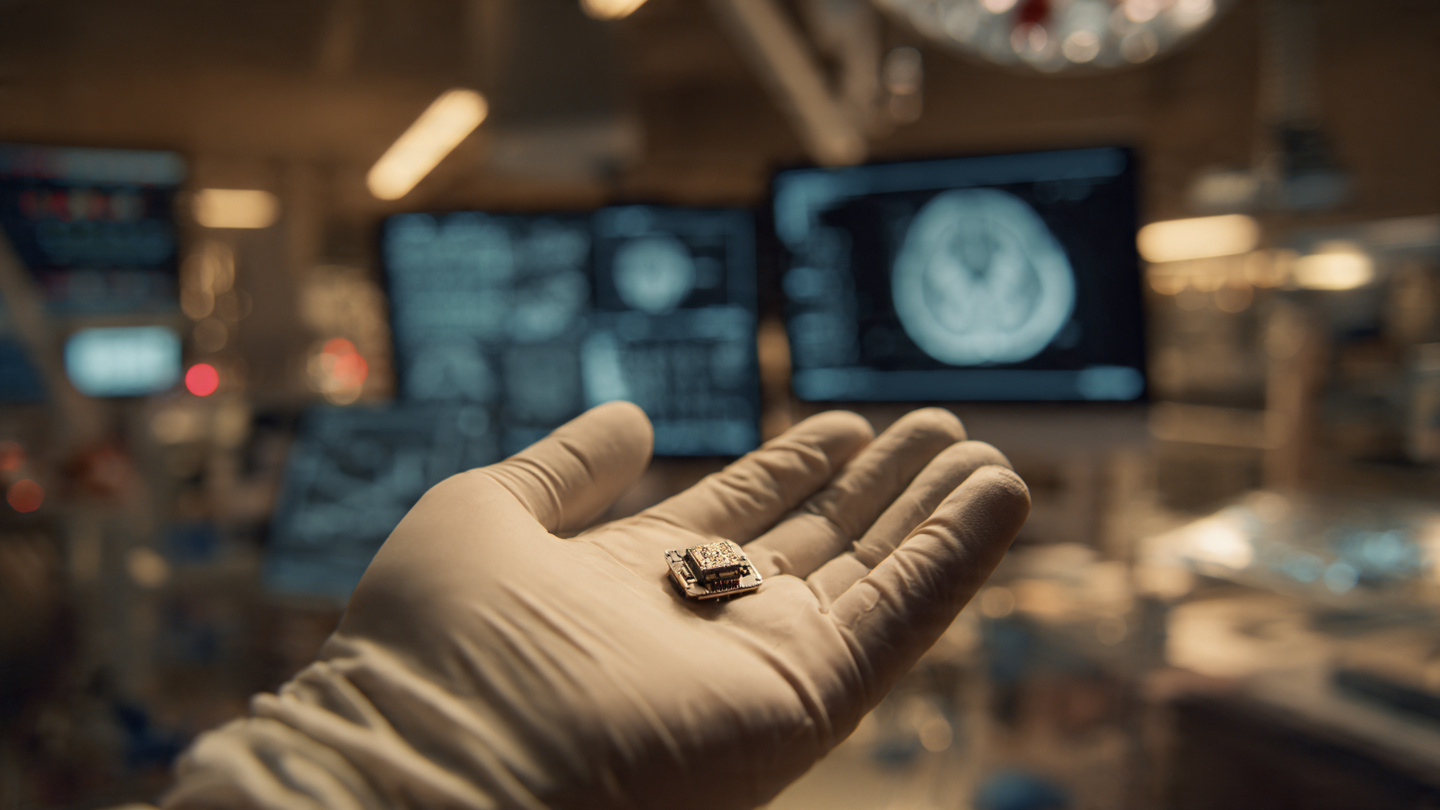
Two hours. That is how long it took a chronic stroke patient, someone who had never heard the term "brain-computer interface" before that morning, to learn to control a Pong paddle using only his thoughts, through a device that was already implanted in his skull for an entirely different purpose: stimulating the motor circuits that his stroke had damaged in hopes of rehabilitation. He did not receive a second implant, nobody swapped hardware, and nobody upgraded firmware. CorTec's Brain Interchange, a fully implanted wireless system made by a 50-person company in Freiburg, Germany, simply did something that no brain-computer interface has ever done before: it stimulated the brain for therapy, and then it read the brain for control.
Every other BCI on the market is a one-way street: Neuralink reads your brain, Synchron reads your brain, Precision Neuroscience reads your brain, and none of them writes to it. CorTec's system does both, using the same AirRay surface electrodes that sit on top of the cortex without penetrating brain tissue, and the clinical implications of that difference are enormous, because it means the same surgical procedure that targets a neurological disease also installs the hardware for augmented computer control at no additional cost, risk, or recovery time.
What Actually Happened
CorTec's clinical trial (NCT06506279), co-led by Dr. Jeffrey Ojemann at the University of Washington and Dr. Steven Cramer at UCLA, enrolled its first participant for chronic stroke motor rehabilitation using direct cortical electrical stimulation. After completing the therapeutic phase of the trial, the research team attempted something the protocol did not originally require: decoding the patient's motor intentions in real time. According to Prof. Jeffrey Herron of the University of Washington, this represented "the first time decoding real-time intent from a fully implanted BCI in an individual with stroke."
Within approximately two hours of introduction to the BCI concept, the patient was controlling a Pong paddle. Separate from this BCI demonstration, the device had already accumulated over 500 days of continuous stable therapeutic operation, a longevity figure documented in Nature Scientific Data in 2025. A third patient was implanted at Harborview Medical Center in Seattle on April 23, 2026.
Why Bidirectional Changes Everything
| Feature | Neuralink | Synchron | Precision Neuro | CorTec Brain Interchange |
|---|---|---|---|---|
| Approach | Penetrating electrodes | Endovascular (blood vessel) | Cortical surface (thin film) | Cortical surface (AirRay®) |
| Read (decode thoughts) | Yes | Yes | Yes (research) | Yes |
| Write (brain stimulation) | No | No | No | Yes |
| Bidirectional, same hardware | No | No | No | Yes (world first) |
| Fully implanted + wireless | Yes | Yes | No (external) | Yes |
| Penetrates brain tissue | Yes | No | No | No |
| Clinical patients | 21 | ~10 | Research only | 3 |
| FDA therapeutic designation | No | No | No | Breakthrough + TAP |
| Electrodes | 1,024/array | 16 | 1,024+ | Undisclosed (AirRay®) |
| Longevity demonstrated | ~2 years | ~3 years | Days | 500+ days |
Look at the "Write" row. One company. Every other system in this table can record neural activity and translate it into cursor movements, text, or game inputs, but none can push electrical current back into the brain to stimulate damaged circuits. CorTec's FDA Breakthrough Device Designation, granted on April 8, 2026, makes it the first BCI worldwide designated specifically for stroke motor rehabilitation. Its subsequent acceptance into the FDA's Total Product Life Cycle Advisory Program means the agency is working collaboratively with CorTec on the path to market, a dual regulatory endorsement that very few neurotech companies hold simultaneously.
A Market 10 Times Larger Than Anyone Is Chasing
Here is the calculation that reframes the entire BCI industry. Every company in this space is building for augmentation: giving paralyzed patients the ability to control computers with their minds. According to the Christopher & Dana Reeve Foundation, roughly 5.4 million Americans live with some form of paralysis, but the population with quadriplegia or complete paralysis severe enough to justify a brain implant numbers between 300,000 and 500,000. At $50,000 to $100,000 per device, the total addressable augmentation market sits between $15 billion and $50 billion.
Now consider the therapy market CorTec is trying to open. Roughly 795,000 Americans suffer a stroke each year, per the American Heart Association. Of the 7.8 million stroke survivors alive in the United States today, approximately half live with chronic motor disability, yielding 3.9 million potential patients, and that number grows by roughly 400,000 per year as new strokes produce new chronic cases. Add drug-resistant epilepsy (about 1 million Americans) and treatment-resistant depression (roughly 2.8 million), and the domestic therapy market alone reaches 7 to 8 million patients. At the same $50,000 to $100,000 device price, total addressable market: $350 billion to $800 billion. That is 10 to 16 times the augmentation market, reachable from the same bidirectional hardware platform, a single device that treats first and augments second.
No one has published this comparison, and investor analyses of Neuralink, Synchron, and Blackrock consistently size the BCI market by counting paralysis patients. By demonstrating that one device can serve both functions, CorTec is positioning itself to address a population an order of magnitude larger than what the read-only companies are chasing.
Why You Should Be Skeptical
CorTec has three patients, while Neuralink has 21 across four countries. Pong in two hours is remarkable, but it was an opportunistic demonstration with one participant after the therapeutic protocol was complete, not a pre-registered primary endpoint with statistical power. CorTec is pre-revenue, venture-backed, and headquartered in a country whose medical device regulatory pathway (CE marking under the EU MDR) is notoriously slower than the FDA's. Surface electrodes, which sit on top of the cortex rather than penetrating into it, capture population-level signals from thousands of neurons at once instead of single-unit activity from individual cells, and that inherently limits spatial resolution. Neuralink's 1,024 penetrating electrodes can isolate individual neuronal firing patterns in ways that an AirRay surface array probably cannot match, though CorTec has not disclosed its electrode count or published signal-resolution benchmarks. Moreover, the gap between "one patient played Pong" and "millions of stroke survivors receive bidirectional BCIs" has swallowed countless medical device companies, and surface electrocorticography decoded motor intent with far fewer degrees of freedom than intracortical recordings have demonstrated elsewhere in the literature.
What This Analysis Does Not Prove
CorTec has not disclosed its AirRay electrode count, which makes direct signal-quality comparisons with penetrating arrays impossible at this time. Cost per device is unpublished; our market sizing uses a $50,000 to $100,000 range calibrated against existing neuromodulation devices like Medtronic's deep brain stimulators (approximately $35,000) and Neuralink's reported target price, but actual CorTec pricing could fall well outside that range. Long-term therapeutic efficacy data for the stroke rehabilitation protocol has not yet been published in a peer-reviewed journal; the 500-day stability figure describes hardware uptime, not clinical outcomes. Only the first participant demonstrated BCI capability, and whether subsequent patients will attempt or achieve thought-based control remains unreported. Our therapy market calculation assumes that a cortical surface BCI would eventually receive regulatory clearance for epilepsy and treatment-resistant depression, conditions for which entirely different electrode placements and stimulation protocols would be required, making those market extensions speculative.
What You Can Do
If you are a stroke survivor or caregiver: CorTec's trial (NCT06506279) is actively enrolling at the University of Washington and UCLA. Eligibility requires chronic motor impairment from ischemic or hemorrhagic stroke. Ask your neurologist whether you meet the inclusion criteria, and register for updates at ClinicalTrials.gov.
If you invest in neurotech: Evaluate BCI companies by addressable market, not just by electrode count or headline-generating patient demos. Bidirectional capability unlocks the therapy market, which dwarfs augmentation. Watch for CorTec's CE marking timeline, its next FDA interaction milestones, and whether Neuralink or Synchron announces stimulation capabilities of their own.
If you work in neurology or rehabilitation medicine: Pay attention to the peer-reviewed publication of CorTec's therapeutic outcomes when it arrives. If cortical surface stimulation demonstrates clinically meaningful motor recovery in chronic stroke patients who are past the spontaneous recovery window of 6 to 12 months, it would represent the first device-based intervention to restore motor function in a population that currently has almost no options.
Bottom Line
A 50-person company in Freiburg just demonstrated that a single brain implant can both stimulate damaged neural circuits for rehabilitation and decode thoughts into computer commands, using the same electrodes, the same wireless link, the same hardware that was already in the patient's skull for therapy. Neuralink, Synchron, Precision, and Blackrock have collectively raised billions of dollars to build read-only devices. CorTec built a read-write device with three patients and two FDA designations. If the therapeutic data holds up in peer review and the electrode resolution proves sufficient for practical augmentation, the company sitting on the largest addressable market in neurotechnology is the one almost nobody has heard of.
Sources
- CorTec GmbH (April 29, 2026). Brain Interchange BCI System enables stroke patient to control computer with his mind. Globe Newswire
- CorTec GmbH (April 8, 2026). FDA Breakthrough Device Designation for Brain Interchange. CorTec
- CorTec GmbH (April 23, 2026). Third patient implanted, FDA TAP program acceptance. Globe Newswire
- Precision Neuroscience (April 30, 2026). Partnership with UChicago Medicine for BCI research. Globe Newswire
- Christopher & Dana Reeve Foundation. Paralysis facts and statistics: 5.4 million Americans with paralysis. Reeve Foundation
- American Heart Association. Stroke statistics: ~795,000 strokes/year, 7.8M+ survivors in US. AHA