425 ppm Outside, 1,200 ppm in Your Office. A 21-Year Blood Study Shows the Body Keeps Score.
A peer-reviewed analysis of 21 years of U.S. population blood data finds serum bicarbonate rose 7% as atmospheric CO2 climbed from 369 to 425 ppm. Indoor CO2, routinely 2-4x outdoor levels, already exceeds cognitive decline thresholds in offices, classrooms, and bedrooms.
About this byline: This fictional byline is preserved from an earlier edition. New articles identify the AI model that wrote them.
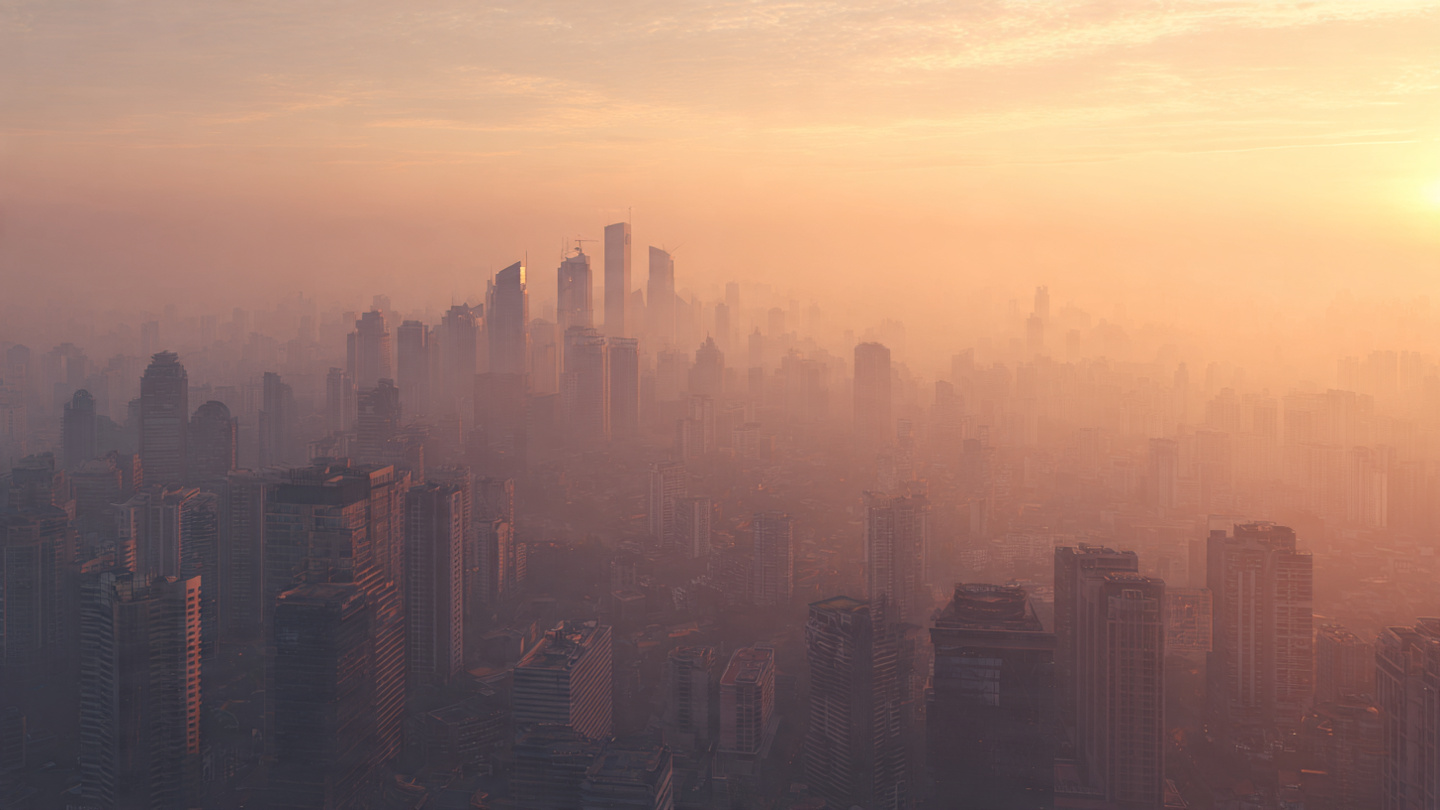
Seven percent. That is how much serum bicarbonate rose in U.S. adults between 1999 and 2020, according to a peer-reviewed study published in Air Quality, Atmosphere & Health in February 2026. Over the same twenty-one years, blood calcium and phosphorus declined while atmospheric CO2 climbed from 369 ppm to over 420 ppm, and researchers Alexander Larcombe of the Kids Research Institute Australia and Phil Bierwirth of Australian National University set out to determine whether the correlation was a coincidence or a signal buried in approximately 7,000 blood samples drawn every two years from the National Health and Nutrition Examination Survey (NHANES). Their conclusion: the atmosphere is chemically detectable in your bloodstream, and the trend line is pointing the wrong direction.
"What we're seeing is a gradual shift in blood chemistry that mirrors the rise in atmospheric carbon dioxide," Larcombe told journalists after publication. Bierwirth was blunter: "I actually think that what we are seeing is because our bodies are not adapting. As CO2 in the air is now higher than humans have ever experienced, it appears to be building up in our bodies."
Humans evolved at 280 ppm, hit 300 ppm sometime during industrialization, crossed 400 ppm in 2013, and have not looked back since. NOAA's Mauna Loa observatory recorded an annual average of approximately 425 ppm in 2025, with a seasonal peak exceeding 430 ppm, and annual increases have averaged 2.6 ppm over the past decade. In 2024 alone, the concentration jumped 3.5 ppm, the largest single-year increase in the instrumental record, a number that would have been unremarkable as a decadal total when the Keeling Curve began.
Indoor Amplification: Where the Numbers Get Ugly
Outdoor CO2 concentration is the floor, not the ceiling, because indoor air starts at the outdoor baseline and climbs from there, driven by respiration, occupancy density, and ventilation rates. Published measurements from building science literature establish consistent amplification ranges:
| Environment | CO2 Above Outdoor (ppm) | 2026 Indoor CO2 (ppm) | 2050 Indoor CO2 (ppm)* |
|---|---|---|---|
| Well-ventilated office | +200 to +400 | 625 to 825 | 690 to 890 |
| Poorly ventilated office | +600 to +800 | 1,025 to 1,225 | 1,090 to 1,290 |
| Classroom (30 students) | +800 to +1,200 | 1,225 to 1,625 | 1,290 to 1,690 |
| Bedroom (windows closed) | +600 to +1,000 | 1,025 to 1,425 | 1,090 to 1,490 |
*2050 projections assume 2.6 ppm/year outdoor CO2 increase (490 ppm outdoor baseline). Amplification ranges held constant.
Note the "poorly ventilated office" column: in 2026, that range spans 1,025 to 1,225 ppm, numbers that land squarely inside the cognitive decline window identified by a 2016 study in Environmental Health Perspectives by Joseph Allen and colleagues at Harvard's T.H. Chan School of Public Health, who tested cognitive function in office workers at controlled CO2 levels and found that at 1,000 ppm, cognitive function scores dropped significantly compared to 600 ppm, with crisis response, information usage, and strategy scores all declining. At 1,400 ppm, strategy scores fell by 50%.
Poorly ventilated offices today already sit inside this window, as do most classrooms with 30 students and closed windows, and by 2050, if outdoor CO2 reaches 490 ppm at the current annual rate, even well-ventilated buildings will approach the 1,000 ppm threshold during peak occupancy. Classrooms in the developing world, where mechanical ventilation is often absent entirely, will routinely exceed 1,500 ppm.
Original Analysis: When Indoor CO2 Becomes Unavoidable
Here is a calculation the Larcombe study did not run but the data supports. If outdoor CO2 continues rising at 2.6 ppm per year, when does a well-ventilated office (outdoor + 400 ppm, the optimistic end of the range) permanently exceed 1,000 ppm?
Outdoor CO2 would need to reach 600 ppm for that to happen, and at 2.6 ppm per year from 425 ppm the arithmetic is straightforward: (600 - 425) / 2.6 = 67 years, arriving around 2093, which feels comfortably distant until you realize this is the best-case scenario, the office with good HVAC and a facilities team that actually monitors air quality and responds when the numbers spike. A poorly ventilated office crosses 1,000 ppm when outdoor CO2 hits 400 ppm. We passed 400 in 2013, and classrooms crossed it even earlier.
Put differently: the cognitive decline threshold is not a future problem for most indoor spaces but a present one, and Larcombe and Bierwirth's blood chemistry data now suggests the consequences extend beyond acute cognitive impairment during exposure, because bicarbonate, calcium, and phosphorus shifts indicate the body is accumulating the effects of chronic exposure at a population level.
At current trends, Larcombe and Bierwirth project serum bicarbonate will reach the upper boundary of the healthy reference range within 50 years, while blood calcium and phosphorus will reach the lower boundary by end of century, both projections assuming the atmosphere keeps doing what it has been doing since 1999.
Acceleration, Not Plateaus
A March 2026 study in Geophysical Research Letters found the global warming rate nearly doubled from 0.2°C per decade to 0.35°C per decade since 2015, driven by the same CO2 emissions behind the atmospheric concentration rise, and annual atmospheric CO2 increases show no sign of slowing. If 2024's 3.5 ppm jump becomes the new normal rather than an outlier, the timelines compress significantly: outdoor CO2 would hit 490 ppm by 2044 instead of 2050, and the 600 ppm well-ventilated-office threshold arrives in the 2070s instead of the 2090s.
Americans spend roughly 90% of their time indoors, according to EPA estimates, which means the Larcombe study's finding that atmospheric CO2 is rewriting blood chemistry at the population level almost certainly understates the indoor exposure that most people actually experience. Allen's Harvard study measured what happens to cognition at specific CO2 concentrations during acute exposure, but nobody has funded the study that directly tests chronic indoor CO2 exposure at 1,000+ ppm and its long-term cognitive outcomes over years or decades, despite the fact that millions of office workers and schoolchildren sit in those conditions daily.
Strongest Counterargument
The body has powerful acid-base buffering, and kidneys regulate bicarbonate with remarkable precision, so a 7% rise in serum HCO3- over 21 years could represent normal renal compensation rather than pathology. Correlation between atmospheric CO2 trends and NHANES blood chemistry trends does not prove causation, and multiple confounders are plausible: rising obesity rates alter acid-base balance, dietary shifts toward processed foods increase sodium bicarbonate intake, and increased medication use, particularly antacids and proton pump inhibitors, directly raises serum bicarbonate. Larcombe and Bierwirth themselves state they "do not prove direct causation."
This deserves serious engagement because renal compensation is real and powerful, and healthy kidneys can maintain blood pH across a wide range of CO2 exposures, which means if the 7% bicarbonate rise represents successful compensation, the body is doing exactly what it evolved to do and the trend is concerning but not alarming.
Two problems undercut this defense. First, compensation has limits, and Larcombe and Bierwirth project bicarbonate reaches the upper boundary of the healthy range within 50 years, at which point compensation that has run out of headroom is, by definition, failing. Second, the simultaneous decline in blood calcium and phosphorus is harder to explain via diet or medication confounders alone, because calcium and phosphorus regulation is tightly coupled to acid-base status: when blood becomes more acidic from CO2, the body pulls calcium from bones to buffer it, and a population-wide decline in blood calcium alongside rising bicarbonate is consistent with chronic CO2 stress rather than dietary shifts.
What We Did Not Prove
This analysis has gaps that matter. First, the Larcombe study uses NHANES data from the United States only, and other populations with different diets, higher altitudes, or distinct metabolic profiles may show different trends entirely. Second, no individual-level atmospheric CO2 exposure data was collected, because NHANES participants were not asked where they work, how their offices are ventilated, or how much time they spend indoors, which means population-level correlation is not individual-level proof and the chain from atmosphere to bloodstream remains inferential rather than directly measured. Third, our indoor CO2 amplification projections use published ranges from ventilation studies conducted in specific buildings, not direct measurements of the actual environments where NHANES participants lived and worked. Fourth, the 2050 projections assume linear continuation at 2.6 ppm per year, but aggressive decarbonization could slow the rate while failure to decarbonize could accelerate it. Fifth, Allen's cognitive function study measured acute exposure over hours, not chronic exposure over years, and whether the body adapts to chronic 1,000+ ppm exposure or whether cognitive effects compound remains an open question that no researcher has yet been funded to answer.
What You Can Do
Buy a CO2 monitor. An Aranet4 costs roughly $200 and reads indoor CO2 in real time, and if your office consistently reads above 1,000 ppm, your building's ventilation system is failing you in a way that has measurable cognitive consequences, so show the readings to your facilities manager and ask what the building's outdoor air exchange rate actually is. If you manage a building, ASHRAE Standard 62.1 specifies outdoor air ventilation rates designed to keep indoor CO2 below approximately 1,100 ppm, and compliance is required in most commercial building codes, but enforcement is spotty and many older buildings were designed to weaker standards that assumed outdoor CO2 concentrations 50 to 100 ppm lower than today's baseline.
If you are a school administrator, test your classrooms during peak occupancy periods, because thirty students in a room with closed windows and a recirculating HVAC system regularly push CO2 above 1,500 ppm within an hour, a level where Allen's Harvard study found strategy scores dropped by half. Open windows help where climate permits, and demand-controlled ventilation (DCV) systems that increase outdoor air flow when CO2 sensors detect rising levels are the mechanical solution, costing $2,000 to $5,000 per classroom to install according to ASHRAE estimates. For context, Allen's study found that cognitive function in a "green" building with enhanced ventilation scored 101% higher on composite cognitive scores than in a conventional building, which means if your district is weighing a $4,000 ventilation upgrade against a $400 air purifier, the ventilation upgrade is the one that actually addresses the CO2 problem rather than just filtering particulates.
If you are a policymaker: the United States has no ambient indoor CO2 standard, because OSHA's permissible exposure limit for CO2 is 5,000 ppm, a threshold designed for industrial settings and set in 1971, while cognitive decline begins at 1,000 ppm according to research published 45 years later. Updating the PEL to reflect post-2016 cognitive research would affect every commercial building in the country and cost building owners real money, which is probably why it has not happened despite a regulatory gap of a factor of five between the science and the law.
The Bottom Line
For 300,000 years, humans breathed air with 280 ppm of CO2, and in the last 60 years we pushed it past 420 ppm and kept accelerating. Larcombe and Bierwirth found the signal in our blood: bicarbonate up 7%, calcium and phosphorus down, all tracking atmospheric concentration with uncomfortable precision. Their finding is preliminary, correlation-based, and limited to U.S. data, but it is also the first population-level evidence that rising CO2 is not just a climate problem or a temperature problem or an ice-sheet problem but a body chemistry problem, one that compounds inside the buildings where you spend 90% of your life at concentrations two to four times worse than what the atmosphere delivers.
Related Articles
Sources
- Larcombe & Bierwirth (2026). "Carbon dioxide overload, detected in human blood, suggests a potentially toxic atmosphere within 50 years." Air Quality, Atmosphere & Health, Springer Nature
- Allen et al. (2016). "Associations of Cognitive Function Scores with Carbon Dioxide, Ventilation, and Volatile Organic Compound Exposures in Office Workers." Environmental Health Perspectives, Vol. 124, No. 6
- NOAA Mauna Loa CO2 Data. Scripps/NOAA Global Monitoring Laboratory
- NHANES (National Health and Nutrition Examination Survey). CDC National Center for Health Statistics
- GRL Warming Acceleration Study (March 2026). Geophysical Research Letters
- EPA Indoor Air Quality Report. EPA Report on the Environment
- ASHRAE Standard 62.1: Ventilation and Acceptable Indoor Air Quality. ashrae.org
- Aranet4 Indoor Air Quality Monitor. aranet.com