⚡ Energy
China's 40 Million Electric Cars Could Displace 2.3 Million Barrels a Day. The Iran War Just Proved 7% Is Enough.
China imported 41% less crude oil in June without rationing anything. Travel demand hit all-time highs while Didi's 8-million-strong EV fleet absorbed the shock. A barrel-by-barrel displacement calculation reveals the country's EV infrastructure is operating at just 7% of its oil-substitution capacity.
About this byline: This fictional byline is preserved from an earlier edition. New articles identify the AI model that wrote them.
July 15, 2026
Seven-point-one-two million. That is how many barrels of crude oil China imported per day in June 2026, its lowest level since October 2016 and a 41.3% collapse from the same month last year, according to Chinese customs data released Tuesday. Refinery utilization cratered to 57.72%, a figure down thirteen percentage points year-on-year that signals refineries were essentially running on fumes. Middle Eastern shipments hit a decade-low. Iranian crude imports fell another 40% month-on-month to below 800,000 barrels per day.
And yet nobody rationed anything.
May Day weekend travel broke all-time records while road freight climbed 2%. Ride-hailing trips across Chinese cities hit 3.05 billion in May alone, up 6% since the Iran war began in late February, according to government data. People did not drive less or travel less or ship less — they just burned less oil doing it, with gasoline consumption dropping 10% and diesel falling 14%. The numbers refuse to make sense together unless you account for what the global oil market has been slow to price in: the largest electric vehicle fleet ever assembled, running at a fraction of what it could do, and still large enough to absorb a supply shock that would have crippled the country a decade ago.
The Displacement Math Nobody Is Running
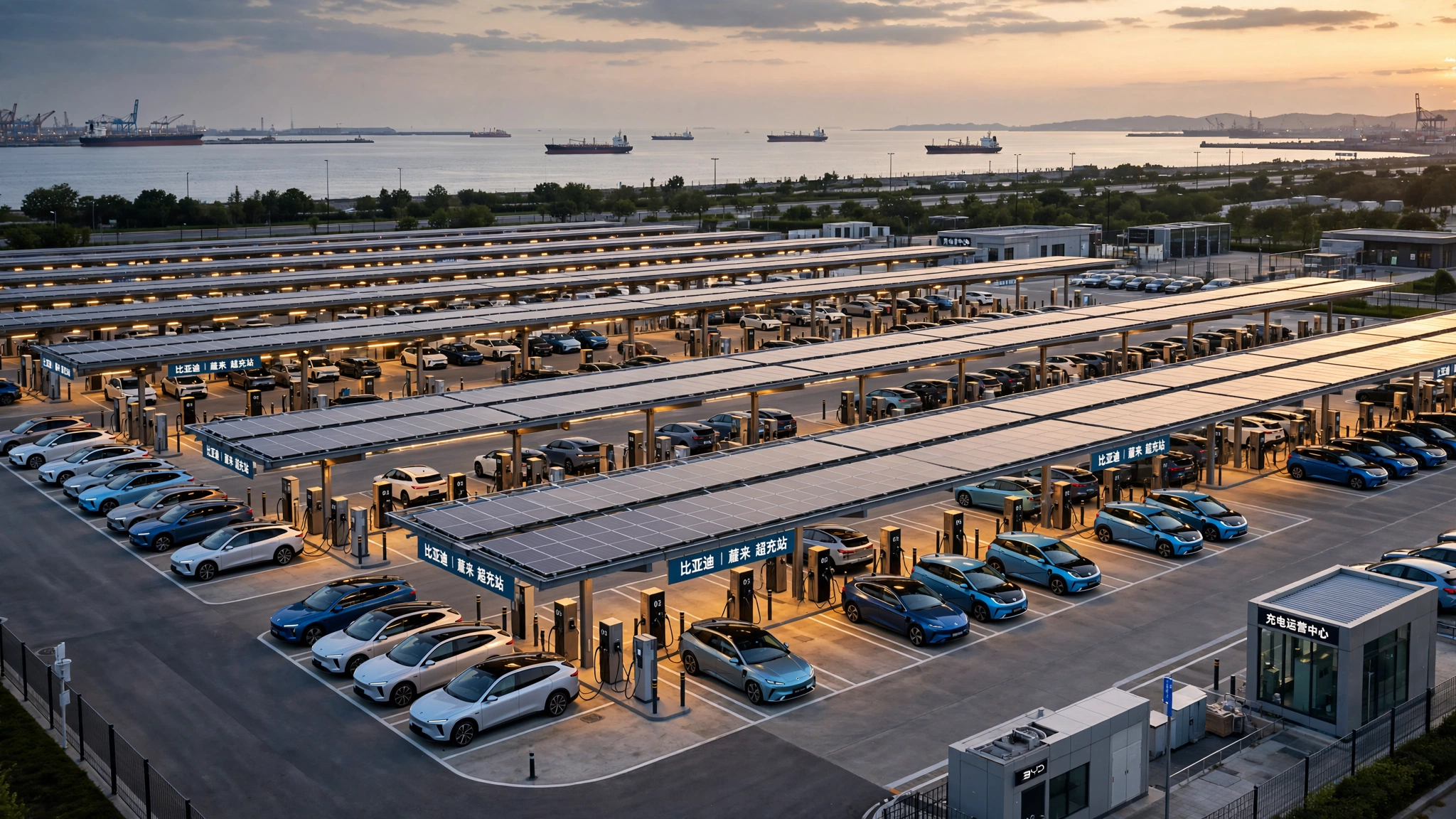
Start with the fleet. China had more than 40 million new energy vehicles on its roads by the end of 2025, supported by 21 million charging points, a network that grew 47.8% year-on-year through February 2026, according to the National Energy Administration. That fleet expanded by another 16.5 million units in 2025 alone.
Now run the barrel math. The average Chinese passenger car drives roughly 18,000 kilometers per year and burns 7.82 liters of gasoline per 100 kilometers, according to a transport energy study published in PLOS ONE using Ministry of Industry data. That works out to 1,408 liters of gasoline annually. A standard barrel of crude oil yields approximately 66.8 liters of gasoline at a 42% refinery yield, which means each internal combustion car on the road requires about 21 barrels of crude per year (0.058 barrels per day) just for its gasoline.
Multiply 40 million EVs by 0.058 barrels per day and you get a theoretical displacement capacity of 2.3 million barrels per day. For scale:
| Benchmark | Barrels per Day |
|---|---|
| China's EV fleet theoretical displacement | 2,300,000 |
| Kuwait's entire crude production | 2,405,000 |
| Nigeria's crude production | 1,520,000 |
| Algeria's crude production | 909,000 |
| Gabon + Congo + Equatorial Guinea combined | 540,000 |
| China's measured gasoline demand decline (2026) | 150,000 |
The measured decline, 150,000 barrels per day according to J.P. Morgan analyst Natasha Kaneva's July estimate, means the fleet is operating at roughly 6.5% of its theoretical displacement capacity. Call it 7%. China's electric vehicles are already displacing more crude than Equatorial Guinea produces in a year, while sitting idle on a latent capacity that rivals Kuwait's entire output.
Why the Number Is So Low, and Why That Is the Point
The gap between 7% and 100% is not a flaw; it is a feature, and the reasons reveal how much displacement capacity remains untapped. Not every EV replaced an internal combustion car one-for-one, as many joined households as second or third vehicles. Millions are plug-in hybrids that still sip gasoline on long trips and in cold weather. The newest 16.5 million units, sold in 2025, haven't yet accumulated a full year of driving. And the 18,000-kilometer annual mileage is an average that conceals enormous variance between a Shenzhen commuter and a Heilongjiang farmer.
But Didi's fleet reveals what happens when utilization climbs. The ride-hailing giant registered another two million hybrid or electric vehicles last year, bringing its non-fossil fuel fleet to eight million cars, with electric vehicles accounting for 75% of all mileage driven on its platform. Roughly half of China's 1.3 million traditional taxis are now electric too, and in major cities like Shenzhen, Beijing, and Guangzhou the share approaches 100%.
These commercial vehicles drive three to six times the annual mileage of private cars, and every one of those kilometers runs on grid electricity rather than imported crude. A single electric taxi driving 120,000 kilometers per year at the same 7.82 L/100km displacement rate removes 0.38 barrels per day from crude demand, and when you multiply that across several million full-time electric ride-hailing vehicles the displacement per vehicle is an order of magnitude higher than the private fleet average. This is why fares are falling 10 to 15% even as gasoline prices spike: the operating cost structure of China's ride-hailing industry has decoupled from the oil market entirely, and the decoupling accelerates with every new driver who shows up in a BYD rather than a Geely.
The Inversion Nobody Predicted
Every previous oil shock in history followed the same script: prices spike, economies contract, governments ration or subsidize, and consumers absorb the pain, adjust slowly, and eventually forget when prices normalize. The 1973 embargo. The 1979 Iranian revolution. The 1990 Gulf War. The pattern was so reliable that oil strategists built entire forecasting frameworks around the assumption that a major supply disruption would force the largest importing nation into a recession-or-rationing binary.
China just ran the experiment under live fire, and the binary broke. The Strait of Hormuz, through which more than 20% of global oil flows, saw its traffic devastated by the Iran war, and China's seaborne crude imports cratered to around six million barrels per day with Iranian shipments slashed. The standard playbook would predict economic pain, industrial contraction, rationing in major cities.
Instead, China used three tools simultaneously: it drew down the 1.2 to 1.3 billion barrels of strategic reserves it had been quietly stockpiling since early 2025 at rates near one million barrels per day; it cut refinery runs to ten-year lows to conserve feedstock; and it let its EV fleet passively substitute away demand that would have otherwise competed for scarce barrels. "The conflict may have accelerated behavioral changes that were already underway," Kaneva wrote, "leaving China structurally less dependent on oil than the market has historically assumed."
The behavioral acceleration is visible in real-time. Hundreds of social media posts since March describe how taking an electric taxi is now cheaper than driving a petrol car when gasoline prices are high. One 45-year-old Beijing car owner told Reuters she now prefers taxis to paying for gasoline and parking. The feedback loop is devastatingly simple: higher oil prices push more riders onto electric platforms, which pushes more drivers to buy EVs, which depresses fares, which pulls yet more riders off gasoline, each turn of the cycle permanently destroying a thin layer of crude demand that never comes back.
What Happens at 15%
J.P. Morgan projects the gasoline demand decline will continue into 2027 at a reduced rate of 50,000 barrels per day, bringing the two-year cumulative structural decline to 200,000 bpd, but the fleet is not holding still and will not hold still because China's automakers are building EVs faster than any country has ever built any vehicle technology. If China sells another 16 to 17 million EVs in 2026, consistent with its current trajectory, the total fleet will approach 57 million vehicles by year-end, with theoretical displacement climbing to roughly 3.3 million barrels per day.
At 15% utilization, that fleet would displace about 500,000 barrels per day, exceeding the combined output of Gabon, Congo, and Equatorial Guinea. At 25%, the number crosses 800,000 barrels per day, roughly the volume of crude that Iran was exporting to China before the war. The displacement capacity is compounding faster than the world's largest oil cartel can adjust its quotas, and the compounding is automatic because it runs on car purchases that individual Chinese consumers are making for economic reasons that have nothing to do with geopolitics.
Greenpeace projects 90% of taxi and ride-hailing mileage will be electric by 2035, while the Institute for Transportation and Development Policy notes that overall travel demand is still rising, with trips shifting from private petrol cars to electric public transport. The May Day record wasn't an anomaly. It was a preview.
Strongest Counterargument
The 41% import decline is overwhelmingly not an EV story, and anyone who claims otherwise is misreading the data. The bulk of it comes from stockpile drawdowns, refinery run cuts, and wartime export restrictions on refined products. China still imported 7.12 million barrels per day in June and still processed crude at 57.72% utilization, numbers that would have been unimaginable as "low" a decade ago but that now represent the floor of a country that can survive on less oil than the market assumed. The country's total oil demand, including petrochemicals, shipping fuel, aviation, and heavy industry, remains enormous and largely untouched by passenger EVs. Applying the 7.82 L/100km figure to a fleet that includes millions of plug-in hybrids overstates the per-vehicle displacement because those vehicles still consume gasoline on cold mornings and long highway trips. And the theoretical 2.3-million-barrel capacity assumes every EV on the road displaces a full-time ICE vehicle, which no serious analyst believes is the case today.
Limitations
The 7.82 L/100km fuel consumption rate comes from a 2018 study and may overstate current ICE efficiency as Chinese fleet standards have tightened to 4 L/100km targets. The 40 million EV figure includes plug-in hybrids, which still burn gasoline on highway trips and in cold weather. J.P. Morgan's 150,000 bpd number is a projection, not a direct measurement, and it conflates EV displacement with economic slowdown as a demand driver. The 42% gasoline yield per barrel of crude is an industry-standard average; Chinese refineries optimized for diesel may produce a different gasoline fraction. And China's strategic reserve volumes remain state secrets; the 1.2 to 1.3 billion barrel estimate comes from trade-flow calculations that carry significant uncertainty.
The Bottom Line
For the first time in history, a major oil-importing nation responded to a supply shock not by rationing or suffering, but by passively shifting demand onto infrastructure that was already built, charged, and waiting. The 7% displacement utilization rate means China has barely begun to tap the oil-substitution capacity it spent a decade constructing. The 21 million charging points, the 40 million vehicles, the eight million ride-hailing cars running three-quarters of their miles on electrons — all of it was in place before the first missile hit the Strait of Hormuz. The war did not create China's energy flexibility; it revealed it. If you're an oil-exporting nation, the question is no longer whether electric vehicles can displace crude demand at scale. The question is what happens when the world's largest importer decides to turn the dial from 7% to 15%, and discovers it doesn't need to ask OPEC's permission.