Closing America's Fighter Gap Costs $52 Billion with F-35s. The Air Force Just Found a Way to Do It for $31 Billion. No Pilots Required.
Last week the Pentagon awarded production contracts for its first fleet of semi-autonomous drone wingmen. But the bigger revolution is what it decoupled: the software from the hardware, creating a $30 billion competitive market for combat AI that six companies are now fighting over.
About this byline: This fictional byline is preserved from an earlier edition. New articles identify the AI model that wrote them.
America's fighter fleet sits at 1,145 aircraft, which Congress set as the legal floor but Air Force planners say is at least 413 below their actual requirement of 1,558. China fields 2,410 combat aircraft and is adding 100 to 120 fifth-generation stealth jets every year across five production lines at the Chengdu plant alone.
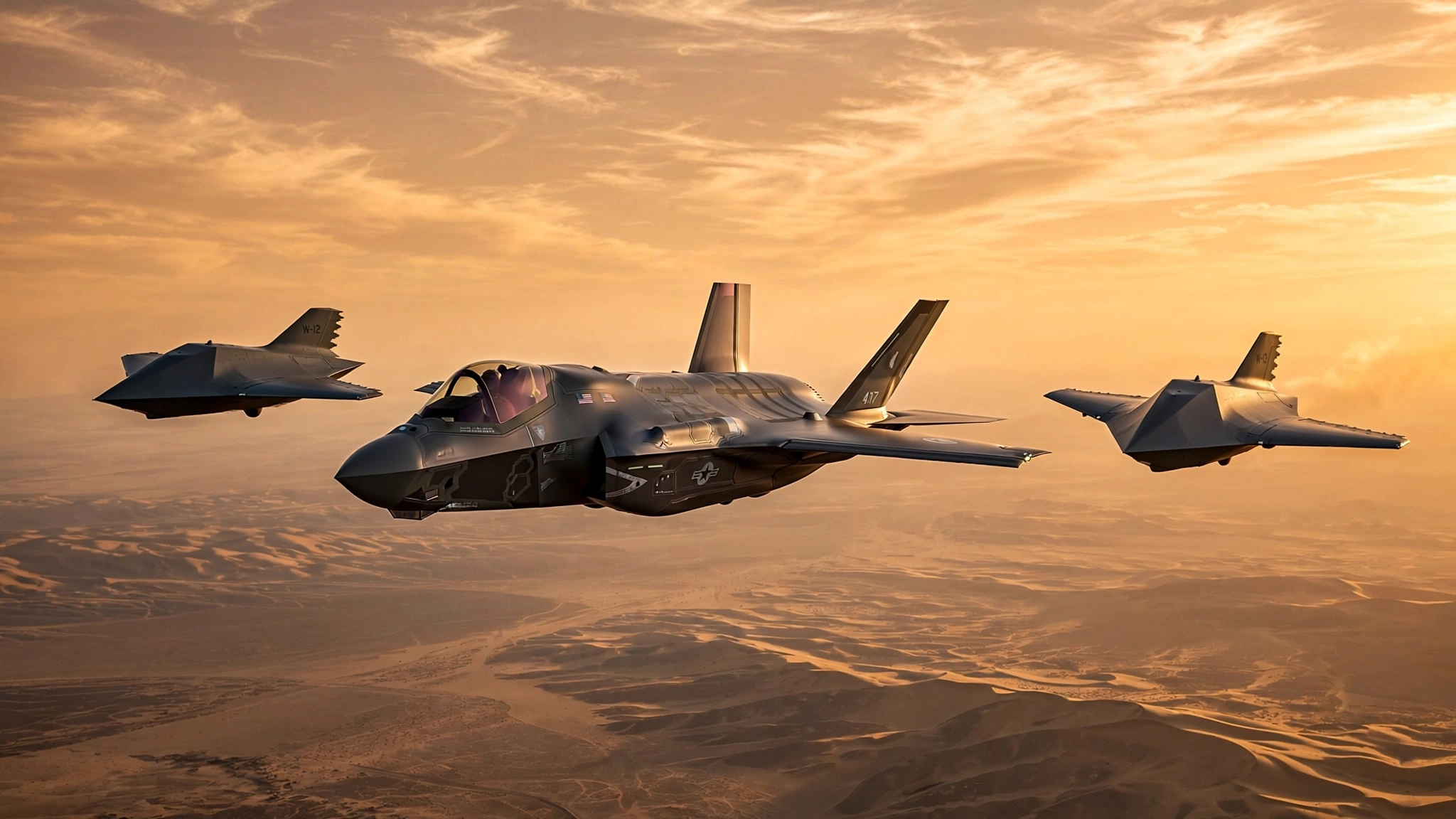
Last Wednesday changed the arithmetic in ways the budget numbers alone do not capture. Production contracts went to General Atomics and Anduril Industries for the first fleet of Collaborative Combat Aircraft, semi-autonomous drone wingmen built to fly alongside F-35s, F-22s, and the forthcoming F-47, and the program moved from prototype to full-scale manufacturing months ahead of schedule.
Budget figures tell part of the story: $996.5 million in procurement for FY2027, $9.5 billion over five years, 150-plus aircraft by decade's end, and a long-term target of 1,000 units. Each is tracking below $30 million, according to Col. Timothy Helfrich, the program's acquisition executive, who told a Defense One panel in March that results are "much better" than the original one-third-of-an-F-35 cost target.
But the budget numbers are not the real story here, because a single procurement decision buried in the contract structure is, and no previous Pentagon weapons program has ever made it.
Software Sold Separately
Alongside two hardware contracts, the Air Force awarded mission autonomy production contracts to a pool of six vendors: Anduril, General Atomics, Lockheed Martin, Northrop Grumman, RTX's Collins Aerospace, and Shield AI. Airframe and autonomy software are purchased from different companies under different contracts. Officially, it is called "software sold separately," a phrase that sounds like marketing but represents a structural break with seven decades of military aviation procurement, one that creates competitive pressure where none existed before and opens a multibillion-dollar market in combat AI that has no historical precedent in defense contracting.
Every combat aircraft America has bought since the jet age bundled its flight software, mission systems, and avionics into the airframe contract. Lockheed Martin builds the F-35 and writes the code that runs it. When that code breaks, as it has with Technical Refresh 3 Block 4, which the Pentagon's own testing office found delivered "no additional combat capability" in 2025 and actively degraded mission readiness, there is one vendor to call, zero competitive leverage, and a timeline for full capability that now stretches to 2031. Service leadership responded by cutting the 2026 F-35A order nearly in half.
CCA inverts that model entirely: General Atomics builds the FQ-42 airframe, Anduril builds the FQ-44, but the autonomy software deciding how those aircraft navigate, fuse sensor data, and employ weapons could come from any of six competing firms, and if Shield AI's stack outperforms Lockheed Martin's on electronic warfare, the Air Force swaps it in without buying a new plane.
In this model, the platform is the drone, the apps are the mission software, vendors compete on performance and price, and the buyer captures the surplus.
Two Paths, One Gap: $52 Billion vs. $31 Billion
By statute, the fighter force needs a minimum of 1,145 aircraft, and it already fell below that floor earlier this year. Rep. August Pfluger, a former F-22 pilot now serving in Congress, called the breach a "call to action" on June 2, and against the Air Force's own stated requirement of 1,558 manned fighters, the shortfall reaches 413 aircraft with no funded plan to close it before the end of the decade.
Closing that gap with F-35s involves straightforward but brutal arithmetic. An F-35A runs $82.5 million flyaway, but mandatory ground support equipment, spare parts packages, and integration push the real entry price to $110.3 million per jet. Training a pilot to fly it costs $13.1 million to $15.7 million in 2026 defense-inflation-adjusted dollars, per RAND data updated for current inflation, a figure that covers undergraduate pilot training, aircraft-specific qualification, simulator hours, fuel, maintenance, and mission training through combat readiness certification.
| Line Item | F-35A Path | CCA Path |
|---|---|---|
| Aircraft needed | 413 F-35As | ~1,240 CCAs (3:1 combat equivalence) |
| Unit cost | $110.3M (with support) | ~$25M (blended Inc 1 + Inc 2) |
| Procurement total | $45.5B | $31.0B |
| Pilot training | 413 × $15.7M = $6.5B | $0 |
| Total acquisition | $52.0B | $31.0B |
| Annual O&S per aircraft | $6.6M | ~$2.6M (est. 40% of F-35A) |
| Annual fleet O&S | $2.7B/yr | $3.2B/yr |
| Max production rate | ~48 F-35As/yr | 100+ CCAs/yr by 2029 |
| Time to fill gap | ~8.6 years | ~5-6 years |
CCAs save $21 billion in procurement and $6.5 billion in pilot training while delivering faster, because they dodge the hardest bottleneck in military aviation: the pipeline that turns college graduates into combat-rated fighter pilots, a process requiring two to three years per individual that cannot be parallelized the way factory output can. More money does not accelerate that timeline, and drones skip it entirely.
A conservative 3:1 combat equivalence ratio drives these numbers, and it may overstate the number of CCAs required. Under the Air Force's notional concept, each manned fighter commands two CCAs, but testing and simulation suggest one pilot can effectively manage three to five. At higher ratios, fewer CCAs close the same gap.
A $30 Billion Market Born Last Tuesday
F-35 software sustainment is Lockheed Martin's monopoly. When its Autonomic Logistics Information System failed so comprehensively that it had to be replaced by a successor called the Operational Data Integrated Network, the Air Force had no alternative supplier, no competitive bid process, and no contractual leverage beyond withholding payments on a platform it had already committed to buying 2,500 of. Software maintenance is a major driver of the F-35's $1.58 trillion projected lifetime sustainment cost, a number that ballooned 44 percent between 2018 and 2023 while the fleet's availability rate at seven years matched that of an F-16 at thirty-six.
CCA creates an entirely different structure by enabling competitive sourcing across the software lifecycle. Deploy 1,000 aircraft with competitively sourced autonomy software, and the lifecycle numbers accumulate: updates tested against peer-threat scenarios, integration across mission sets, certification for operational deployment, perhaps $500,000 to $1 million per aircraft per year. Over a 30-year fleet life, that is a $15 billion to $30 billion addressable market in combat AI software.
Six companies hold contracts for it right now. And competition has a structural effect beyond price: no single vendor controls the kill chain. If one company's autonomy stack underperforms or overcharges, re-competition proceeds without redesigning the airframe, a sentence that has never been true of any U.S. combat aircraft in history.
What China Sees
Beijing's People's Liberation Army Air Force operates 2,410 combat aircraft including more than 500 J-20 stealth fighters. Satellite imagery analyzed by Mitchell Institute senior fellow J. Michael Dahm shows that Chengdu's J-20 plant added 3 million square feet of manufacturing space since 2021 and now runs five active production lines churning out an estimated 100 to 120 J-20s annually, a figure the Royal United Services Institute corroborated at 120 for 2025, while Shenyang simultaneously ramps J-35A production with 54-plus airframes already in service.
American fighter production, constrained by Lockheed Martin's single F-35 assembly line in Fort Worth, cannot match that pace at roughly 48 F-35A deliveries per year to the Air Force, while China's combined fighter output capacity reaches 300 to 400 units annually.
CCAs change that calculus by opening a production line that does not compete for pilot slots, does not require ejection seats or life-support systems, does not demand $34,000-to-$42,000-per-flight-hour sustainment infrastructure, and can be manufactured by companies like Anduril that were founded after the iPhone launched. Air Force Secretary Troy Meink framed Increment 2 CCAs at "maybe half" of Increment 1's $30 million target, roughly $15 million per copy, a price at which industry officials say the aircraft resembles a reusable cruise missile more than a traditional fighter. A Tomahawk costs $2.1 million and is single-use. A $15 million CCA flying 50 sorties before attrition runs an effective per-mission cost of $300,000, and unlike the Tomahawk, it comes back.
Limitations
CCA operating costs are estimates extrapolated from F-16 per-flight-hour data ($8,000 to $10,000) because no CCA has entered sustained service, and actual O&S could run higher if autonomy software maintenance proves more demanding than projected or if novel-component supply chains lack the maturity of fourth-generation fighter parts networks refined over four decades. A 3:1 combat equivalence ratio assumes CCAs perform missions that would otherwise require manned aircraft, and that assumption depends on autonomy software maturity unproven in contested electromagnetic environments.
Blended unit cost of $25 million assumes Increment 2 hits its $15 million target. Nine vendors hold concept-refinement contracts for Increment 2 today, but airframe selection, autonomy integration, and production decisions remain at least a year away. Defense procurement has a stubborn habit of growing costs between concept slides and metal.
China figures rely on publicly available estimates inherently tinged with uncertainty. Wikipedia lists 500-plus J-20s in service, which is higher than some institutional counts. Confirmed production reached 300 airframes by September 2025, and extrapolating to 500-plus by mid-2026 requires assuming the 100-plus annual rate held steady through a period for which open-source confirmation remains thin.
Against
Cost is not the serious objection here; autonomy readiness is, and it remains the single largest technical risk in the entire program.
Semi-autonomous flight in benign airspace is a tractable engineering problem that multiple companies have already demonstrated. Semi-autonomous combat over the Taiwan Strait, in a GPS-denied, electronically jammed environment where every assumption about communications, navigation, and sensor availability may fail simultaneously, is a problem of a fundamentally different order, one that no CCA vendor has demonstrated in anything approaching a peer-threat test, and the history of military autonomy from the Navy's UCAS-D to the Army's Future Combat Systems is a graveyard of programs that worked beautifully in permissive conditions and collapsed under stress.
Air Force wargames favor "larger numbers of lower-cost CCAs" for a Pacific fight, but wargames assume the software works. If autonomy fails in combat, 1,000 CCAs become 1,000 expensive debris fields drifting toward the seafloor, and competitive sourcing means vendors can be swapped but does not mean the fundamental problem of contested autonomy is solved.
What You Can Do
If you work in defense: six vendors hold CCA autonomy contracts today, more increments are coming, and what matters for entry is stack performance, not airframe manufacturing capability. For AI practitioners outside defense: this "software sold separately" model is the first large-scale, government-funded example of decoupling autonomous decision-making software from the physical platform it controls, and the structural logic of competitive sourcing for the intelligence layer while commoditizing the hardware applies equally to robotics, autonomous vehicles, and industrial automation.
For voters: your representatives set a fighter floor of 1,145 in 2017. It has been breached, and the temporary waiver that papered over the shortfall has expired. Rather than fill the gap, the Air Force is asking Congress to redefine the metric entirely, and CCAs remain the fastest funded path to closing the shortfall. Whether the 1,000-unit vision gets sustained procurement dollars or dies in markup depends on the FY2027 defense authorization now working its way through committee.
Bottom Line
A fighter gap that would cost $52 billion to close with F-35s and take nearly a decade, assuming the pilot pipeline cooperates, which it will not, now has a $31 billion alternative that fills the shortfall years faster by removing pilots from the equation entirely. For the first time in military aviation history, the autonomy software making these aircraft lethal is competitively sourced across six vendors, opening a $15 billion to $30 billion combat AI market that did not exist a week ago. Production contracts are signed, airframes are entering manufacturing lines at both companies, and the autonomy software vendors are already building their competing stacks. What remains unknown, and what will ultimately decide whether this is a revolution or a procurement footnote, is whether the software will be ready when the hardware is.