Three minutes and forty-four seconds. That is how long CATL's new Shenxing III battery takes to charge from 10% to 80%, according to the company's April 21 Tech Day demonstration. From 10% to 98%, it takes 6 minutes 27 seconds. Even at negative 30 degrees Celsius, the pack reaches 98% in about 9 minutes, using a pulse self-heating system that works on any standard fast charger without specialized infrastructure. For a sustained 10C charge rate peaking at 15C in the early curve, the world's largest battery maker just built the cell that makes "charging takes too long" sound quaint.
Now here is the problem nobody at CATL's launch event mentioned. Nobody.
The Math Nobody Ran
A 10C charge rate on a 75 kWh battery pack means delivering 52.5 kWh of energy (the 70% from 10 to 80) in 3.75 minutes, or 0.0625 hours. Divide energy by time and you get the required power draw: 840 kilowatts. Factor in charging losses of 5-10% and the actual grid draw climbs to roughly 880-930 kW. For a 100 kWh pack, the number is 1,120 kW. A megawatt. For a sedan.
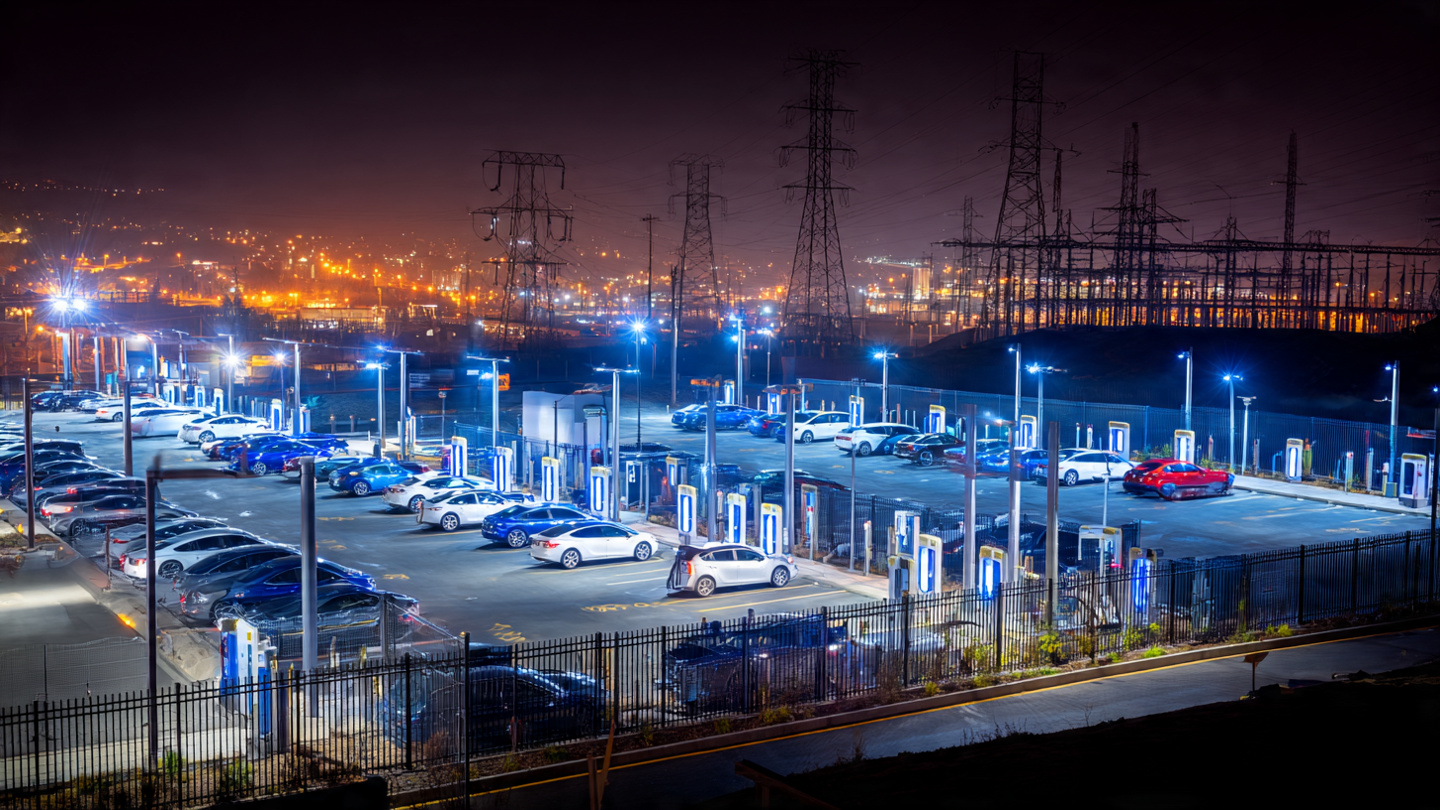
How many passenger-car charging stations on Earth can deliver 840 kW to a passenger car? Effectively zero in widespread deployment, because the charger market evolved around batteries that topped out at 3C or 4C, and nobody designed highway infrastructure for the power draw of a small industrial facility.
| Charger Type | Max Power (kW) | Time for 10-80% at 75 kWh | Speed vs. Battery Capability |
|---|---|---|---|
| CATL Shenxing III (battery limit) | 840 | 3 min 44 sec | 1.0x (reference) |
| Tesla Supercharger V4 | ~500 | ~6.3 min | 0.6x |
| Ionity HPC (CCS 2.0) | 350 | ~9 min | 0.42x |
| Tesla Supercharger V3 | 250 | ~12.6 min | 0.30x |
| Typical CCS Level 3 | 150 | ~21 min | 0.18x |
At the best widely deployed charger speed (350 kW Ionity), the same battery that CATL charges in 3 minutes 44 seconds takes about 9 minutes, which is better than it used to be but still 2.4 times slower than the cell can handle. At a typical 150 kW DC fast charger, the kind installed by the tens of thousands across America's highways, the gap balloons to 5.6x. Battery technology has not just pulled ahead of charging infrastructure; it has lapped it entirely, and the distance between what the chemistry can accept and what the wires can deliver grows wider with every product cycle.
What CATL Actually Announced
Shenxing III was the headline, but CATL unveiled six products at its 2026 Tech Day, and together they represent something more consequential than any single spec: a multi-chemistry portfolio designed to dominate every segment of the battery market simultaneously. According to Notebookcheck's detailed analysis, the Shenxing III LFP cell achieves an internal resistance of 0.25 milliohms, the lowest in the world for ultra-fast charging, 50% below the industry average. Cell shoulder cooling technology improves thermal management efficiency by 20%, which is what allows the battery to sustain 1,000 ultra-fast cycles while retaining above 90% state of health.
Beyond the LFP speed demon, CATL showed off the Qilin III Condensed Battery, which pushes energy density to 350 Wh/kg and 760 Wh/L using a non-flammable gel electrolyte. CATL's comparison: for an equivalent 125 kWh pack, the Qilin III weighs 255 kg less than conventional alternatives, or "three adult men" as they put it, a weight savings that translates directly into better handling, efficiency, and cabin space. At a claimed range of 1,500 km per charge, range anxiety becomes a memory for premium EVs, and critically, the Qilin III uses the same 10C charging architecture, which means a car that goes 1,500 km on a charge and refills to 80% in under four minutes is not an EV competing with gas cars but something gasoline powertrains fundamentally cannot replicate.
And then there is sodium, which may matter more for the grid than any fast-charging LFP cell. Six days after Tech Day, on April 27, CATL secured a 60 GWh sodium-ion battery order with HyperStrong, the largest Na-ion deal ever signed. Since 2016, CATL has invested approximately $1.5 billion in sodium-ion R&D. The new cells exceed 300 Ah, deliver roughly 160 Wh/kg, achieve over 15,000 cycles at 80% capacity retention, and operate from negative 40 to positive 70 degrees Celsius, all without cobalt, nickel, or copper foil, using aluminum current collectors instead. For grid-scale energy storage, where cost per cycle matters more than energy density, this chemistry shifts the equation from whether batteries can replace peaker plants to how fast they will.
A Two-Front Race: BYD Pushed First
CATL did not develop Shenxing III in a vacuum. In March, BYD launched its second-generation Blade Battery, capable of charging from 10-70% in 5 minutes and 10-97% in 9 minutes, alongside plans for 20,000 flash charging stations in 2026. BYD's approach is vertically integrated: build the battery and the charger network together, so customers actually experience the speed. CATL responded within weeks by beating BYD's times by roughly 30%, but CATL does not build cars or charging stations; it builds cells for other automakers, which means its 10C chemistry can only deliver a 10C experience if those automakers and their charging partners invest in the infrastructure to match.
CATL holds 48.3% of China's power battery market, surpassing 50% in Q1 2026 according to CPCA data, while BYD holds 17%. But BYD controls its entire stack from cell to vehicle to charger, while CATL depends on automaker customers and third-party charging networks to deliver the full experience. Building a 10C battery is a chemistry achievement; delivering a 10C charging experience to millions of drivers on public roads is an infrastructure achievement, and that is where the story gets expensive.
What Closing the Gap Actually Costs
Consider a highway charging station with 10 stalls, each capable of delivering 840 kW, which produces a peak simultaneous demand of 8.4 megawatts. A typical U.S. neighborhood distribution transformer serves 25-167 kVA. Ten charging stalls at full power would require dedicated high-voltage substation infrastructure, the kind of electrical service you find at a small factory or a hospital, not at a highway rest stop. Estimated cost per station upgrade: $500,000 to $2 million, depending on proximity to existing high-voltage lines and local permitting timelines.
Scale that number across America's roughly 150,000 gas stations. If 10% of those locations, just 15,000, need megawatt-class charging capability by 2035, the grid upgrade bill alone ranges from $7.5 billion to $30 billion. That excludes the charger hardware itself, the land, the permitting, and the operational costs. It also excludes the distribution grid reinforcements upstream of each site, which utilities must plan years in advance.
For context, the entire $7.5 billion allocated by the U.S. Bipartisan Infrastructure Law for EV charging deployment would cover the low end of grid upgrades at 15,000 stations, and that figure buys nothing but electrical backbone, not charger equipment, not installation labor, not a single kilowatt-hour of charging service delivered to a driver, just the wires to make the rest of it possible.
Strongest Counterargument
Most EV owners charge at home, overnight, at 7 kW. Ultra-fast charging is a road-trip use case, maybe 5-10% of all charging events. No one needs 840 kW at a suburban mall. If the grid only needs megawatt-class service at highway corridors, the problem shrinks from 150,000 locations to perhaps 5,000 to 8,000, and the cost drops from $30 billion to $2.5-8 billion, which is expensive but not paradigm-breaking. Battery-buffered charging stations, where a large on-site battery absorbs grid power slowly and dispenses it quickly, can smooth peak demand and reduce the required grid connection size significantly. Tesla already deploys Megapacks at some Supercharger sites for exactly this reason. And 350 kW charging in 9 minutes is already faster than the median gas station visit. Good enough, one could argue, beats perfect on schedule.
What This Analysis Does Not Show
CATL's 3-minute-44-second figure comes from a controlled demonstration, not a mass-production vehicle on a public charger in summer heat with a degraded pack at mile 80,000. Real-world performance will vary with ambient temperature, pack conditioning, state of health, and charger-side power delivery constraints that the battery itself cannot override. We also do not know what percentage of CATL's OEM customers will implement the full 10C-capable thermal management system versus capping charge rates below the cell's theoretical maximum to extend warranty life. And our grid upgrade cost estimates use U.S. infrastructure pricing, which varies enormously by region. In markets like China, where grid construction costs are lower and state-owned utilities can move faster on permitting, the timeline may compress significantly.
What You Can Do
If you are buying an EV in the next two years: do not pay a premium for a 10C-capable battery unless you live in China, where BYD's flash charging network will be the first to match the hardware. In North America and Europe, available charger power will bottleneck your real-world charging speed regardless of what the cell can theoretically accept. A good battery with 250-350 kW capability on today's infrastructure will charge nearly as fast in practice as a 10C cell on the same plugs.
If you work in utility planning or grid infrastructure: CATL and BYD have just made the demand forecast problem concrete. A single 10-stall megawatt station draws more than a city block of houses. Start planning distribution upgrades for highway corridor locations now, because permitting and transformer lead times are measured in years, not months. Battery-buffered station designs deserve priority evaluation: a 5 MWh on-site battery with a 1 MW grid connection can deliver 8+ MW of peak charging power and may cost less than the alternative grid reinforcement.
If you invest in energy infrastructure: the companies that build the medium-voltage switchgear, power electronics, and battery-buffered charging systems for megawatt stations are about to see demand inflect. Watch for utilities filing rate cases that include EV corridor upgrades, and for charging network operators announcing partnerships with grid-scale battery vendors. When the battery stops being the bottleneck, whoever controls the power delivery path captures the margin.
Bottom Line
For a decade, the EV industry chased the same goal: make the battery better. Denser, cheaper, faster to charge. CATL just built a cell that charges faster than most people can pump gas. Its internal resistance is the lowest ever measured in an ultra-fast charging battery. Its energy density, in the condensed variant, enables ranges that gasoline vehicles cannot match without a 90-liter tank. And its sodium-ion variant eliminates the critical minerals that make lithium supply chains a geopolitical liability. Battery chemistry is no longer the constraint. The wires are. Closing that gap requires not a breakthrough in materials science but a boring, expensive, years-long buildout of electrical infrastructure at tens of thousands of locations, the kind of project that never makes a Tech Day keynote but determines whether anyone actually experiences a 4-minute charge. CATL solved the hard problem. Now someone has to solve the tedious one.
Sources
- CarNewsChina (April 21, 2026). CATL unveils 3rd-gen Shenxing LFP battery: charging 10-80% in 3 min 44 seconds. carnewschina.com
- Notebookcheck (April 22, 2026). CATL batteries charge as fast as stopping for gas and weigh 'three adult men' less. notebookcheck.net
- ESS News (April 27, 2026). CATL secures world's largest sodium-ion battery order with Hyperstrong. ess-news.com
- CarNewsChina (March 5, 2026). BYD unveils Blade Battery 2.0: 10-70% in 5 mins, 10-97% in 9 mins. carnewschina.com
- ESS News (April 30, 2026). Batteries: The game has changed, and it's not what you think. ess-news.com
- CPCA Data (March 2026). CATL domestic EV battery share reaches 50.1% in Q1 2026. carnewschina.com