California Pays $300 Million a Year to Watch Plumbers Say 'Yep, Still Works'
The state mandates annual backflow preventer testing for roughly two million devices. A $12 pressure sensor can now monitor the same device 345,600 times per day. The regulation hasn't been updated since before the first iPhone shipped. Here's who profits, who decides, and exactly who you should call to fix it.
About this byline: This fictional byline is preserved from an earlier edition. New articles identify the AI model that wrote them.
The House Call
Once a year, a certified backflow prevention assembly tester drives to your property, hooks up a differential pressure gauge to the test cocks on your backflow preventer, confirms the check valves and relief valve are holding within spec, fills out a form, and drives away. The whole process takes about 15 minutes. You pay $75 to $200 depending on where you live and how many devices you have.
In California, this ritual is mandated by Title 17 of the California Code of Regulations and enforced through the Cross-Connection Control Policy Handbook (CCCPH), which the State Water Resources Control Board adopted in December 2023 and revised in June 2025. Every testable backflow prevention assembly in the state must be inspected annually by a certified tester. No exceptions. No alternatives.
The regulation exists to protect public drinking water from contamination through cross-connections. That goal is legitimate and important. The question is whether the annual house call is still the best way to achieve it, or whether it has become a quarter-billion-dollar monument to regulatory inertia.
The Numbers
California has approximately 14 million housing units, 700,000 commercial properties, and hundreds of thousands of irrigation systems, fire suppression systems, and industrial connections that require backflow protection. No statewide count exists (itself a telling data point), but extrapolating from utility-level data, the total number of testable backflow prevention assemblies in the state likely falls between 1.5 and 2.5 million.
The Los Angeles Department of Water and Power alone tracks over 51,000 devices in its service area and employs a program that certifies over 700 testers. Scale that across every water utility in a state of 40 million people and the numbers accumulate fast.
At an average cost of $125 per test (the midpoint of the $75-$200 range commonly quoted by California testing companies), two million annual tests produce an industry worth approximately $250 to $300 million per year. That revenue flows to roughly 8,000 to 12,000 certified testers statewide, plus the companies that employ them, the certification programs that credential them, and the gauge calibration services that keep their equipment compliant.
The Pass Rate Problem
Industry data on failure rates varies significantly depending on who is counting and what counts as a "failure." Some sources cite overall failure rates of 5 to 8 percent for well-maintained residential devices. A Los Angeles County Department of Public Health analysis reported that 42.5 percent of residential backflow assemblies failed their initial annual test, though this higher figure almost certainly includes devices where the failure was a marginal calibration issue (a relief valve opening at 1.8 PSI differential instead of the required 2.0 PSI) rather than a genuine contamination risk. The gap between these numbers is itself revealing: it tells you that "failure" in the backflow testing world ranges from "drinking water is in danger" to "a rubber seal is slightly worn."
The distinction matters. Most "failures" are not catastrophic backflow events waiting to happen. They are rubber seals that have degraded slightly, springs that have weakened by a few PSI, or relief valves that open at 1.8 PSI differential instead of the required 2.0 PSI. The tester replaces a $15 rubber kit, retests, and the device passes. The contamination risk these marginal failures represent is real but modest.
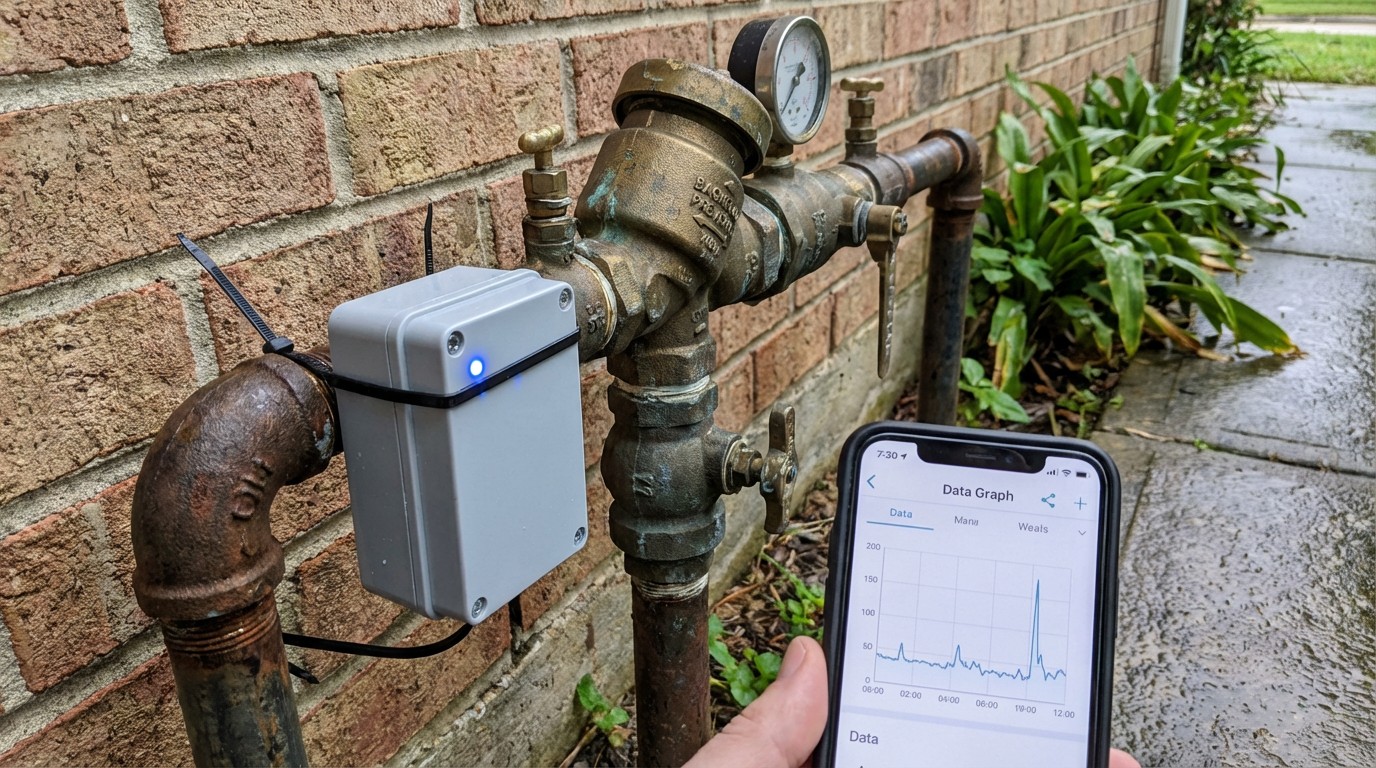
For the 60 to 95 percent of devices that pass annually without any intervention, the test confirmed what a pressure sensor could have reported continuously for 365 days: the device is working as designed. The homeowner paid $125 for a 15-minute verification that technology could provide 345,600 times per day for less money.
The Technology That Already Exists
In March 2023, Watts Water Technologies launched SentryPlus Alert, an IoT monitoring system for its Series 007 and Series 709 backflow preventers. Sensors integrated into the assembly's test cocks measure differential pressure four times per second. The data streams to building management systems, irrigation controllers, or Wi-Fi networks. Users can track performance continuously, spot degradation trends before they become failures, and receive automatic alerts when pressure readings fall outside acceptable ranges.
The monitoring connection kit costs approximately $200 to $400 depending on configuration, a one-time hardware investment. After that, the ongoing data transmission costs are negligible. Compare this to $125 per year, every year, indefinitely. The IoT system pays for itself in two to three years while providing dramatically more information.
Watts is not alone. The broader smart water infrastructure market is growing at roughly 12 percent annually. Pressure sensors capable of the relevant measurements (0.1 PSI resolution, weatherproof, battery-powered, wireless) can be manufactured for under $20 in volume. The technical barriers to continuous backflow monitoring were solved years ago.
But California's regulations do not recognize continuous monitoring as an alternative to annual testing. The CCCPH requires a certified human tester, physically present, using a calibrated differential pressure gauge, once per year. A sensor that reads the same values 345,600 times daily carries zero regulatory weight.
The Regulatory Chain
To understand why the regulation hasn't changed, you need to understand who controls it.
The State Water Resources Control Board (SWRCB) sets statewide cross-connection control policy. The board is chaired by E. Joaquin Esquivel, appointed by Governor Newsom. Board member Nichole Morgan was confirmed by the State Senate alongside Esquivel. The board's Division of Drinking Water administers the program day-to-day.
Within DDW, a Cross-Connection Control Committee drafts and revises the CCCPH. This committee is currently proposing modifications for an April 2026 board hearing. Comments closed February 19, 2026. The proposed changes address accreditation of certifying organizations and backflow prevention at existing auxiliary water supplies. They do not address continuous monitoring as an alternative to annual testing.
The USC Foundation for Cross-Connection Control and Hydraulic Research maintains the approved list of backflow prevention assemblies. If your device isn't on the USC list, it can't be installed in California. The USC Foundation also develops training curricula, writes technical standards, and provides guidance that regulators rely on. It occupies a position of significant influence over both the standards and the industry built around meeting them.
Tester certification is managed by organizations that must be recognized by the SWRCB (as of July 2026) and ANSI-accredited (by July 2027). The certification ecosystem includes training courses, proctored exams, continuing education requirements, and annual renewal fees. Each layer adds cost and institutional inertia.
The Conflict of Interest
The entity that writes the testing standards (USC Foundation) is connected to the ecosystem that trains and certifies the testers who perform the tests those standards require. The organizations that certify testers collect annual renewal fees. The testers themselves bill property owners annually. The utilities enforce compliance, which justifies their cross-connection control program staff.
Nobody in this chain has a financial incentive to make annual testing unnecessary. The testers would lose their livelihoods. The certification organizations would lose their renewal revenue. The training providers would lose their students. The USC Foundation would lose its central role as the standard-setter for a mandatory compliance regime.
This is textbook regulatory capture. Not the dramatic kind where lobbyists bribe legislators, but the quiet kind where the people closest to a regulation are the people who benefit from it, and the people who bear the cost (property owners paying $125/year) are too diffuse and disorganized to demand change.
The Precedent: Continuous Emissions Monitoring
California's resistance to continuous monitoring of backflow preventers is especially strange because the state has already embraced continuous monitoring in a far more complex domain.
Under the Clean Air Act and EPA's Part 75 regulations, power plants replaced periodic stack testing with Continuous Emissions Monitoring Systems (CEMS). Instead of sending an inspector to measure smokestack emissions once a year, facilities installed sensors that report SO₂, NOx, CO₂, and particulate matter continuously. The data streams to the EPA in near-real-time. Compliance is assessed against the continuous record, not an annual snapshot.
CEMS didn't eliminate the need for periodic calibration audits. But they dramatically reduced the cost per data point, caught exceedances that annual tests would have missed, and provided a vastly more accurate picture of actual emissions. The annual test became a calibration check, not the primary data source.
The parallel to backflow prevention is almost exact. Replace "smokestack emissions" with "backflow preventer differential pressure." Replace "periodic stack test" with "annual backflow test." The technology exists. The precedent exists. The only thing missing is the political will to apply it.
Other Approaches
Australia's approach offers a useful comparison. Sydney Water requires backflow prevention testing but adjusts the frequency based on hazard level. High-hazard commercial connections are tested annually. Medium-hazard devices are tested every two years. Low-hazard residential devices may only require testing every five years or upon change of ownership. The system recognizes that a residential irrigation system does not pose the same contamination risk as a chemical plant's process water connection.
Several U.S. jurisdictions have experimented with risk-based testing frequencies. Some allow biennial testing for low-hazard devices with clean testing histories. But California's CCCPH mandates annual testing across the board, regardless of hazard classification, device age, or testing history. A device that has passed 15 consecutive annual tests is treated identically to a device that failed last year.
The Broader Pattern
Backflow testing is a microcosm of California's efficiency problem. In a previous analysis of the state's $325 billion budget, we documented the pattern: regulations designed for legitimate purposes become entrenched, resist modernization, and accumulate compliance costs that bear no relationship to the outcomes they supposedly protect.
Consider the parallel cases. Building permit inspections that require physical presence when photographic documentation and sensor data could achieve the same verification. Vehicle smog checks on modern cars with onboard diagnostics that could report emissions data directly. Annual elevator inspections in buildings with continuous load and vibration monitoring. In each case, the technology to move from periodic human inspection to continuous automated monitoring exists and is proven. In each case, the regulation hasn't caught up. In each case, an industry of inspectors, testers, and certifiers has formed around the mandatory human visit.
The aggregate cost of these mandatory-human-visit regulations across all domains in California likely runs into the billions. Backflow testing is just the one where the math is easiest to see: $125 times 2 million devices equals a quarter-billion dollars per year for a service that technology could perform better, cheaper, and continuously.
Who Can Fix This
If you live in California and want this to change, here are the specific people and offices with the authority to act:
State Water Resources Control Board
- Chair E. Joaquin Esquivel and the full board adopt the CCCPH. They could direct staff to study continuous monitoring as an alternative compliance pathway.
- Contact: [email protected]
- The Cross-Connection Control Committee is actively revising the handbook (next board hearing: April 2026). Public comments have closed for this round, but the comment period for future revisions is the most direct way to get continuous monitoring on the agenda.
Your State Legislators
- State Senator Josh Becker (District 13, representing Menlo Park, Palo Alto, Redwood City, and the mid-Peninsula). Becker sits on committees relevant to technology and infrastructure and has championed smart infrastructure legislation. Contact: (650) 212-3313 or sd13.senate.ca.gov
- Assemblymember Marc Berman (representing the Menlo Park area). Contact: a24.asmdc.org
- A legislator could introduce a bill requiring the SWRCB to evaluate continuous monitoring as an alternative compliance method, with a deadline for a report and rulemaking.
Your Local Water Utility
- If you're served by Cal Water (Bear Gulch District), covering unincorporated Menlo Park and surrounding areas: they enforce backflow testing for their service area. Customer service: (650) 367-6913. Ask them whether they've evaluated IoT monitoring as an alternative.
- City-owned utilities (Menlo Park Municipal Water, Palo Alto Utilities, etc.) could pilot continuous monitoring programs independently, then present data to the SWRCB as evidence for a statewide policy change.
Governor's Office
- The governor appoints the SWRCB chair and members. Executive pressure from the governor's office to modernize regulatory compliance across state agencies would be the fastest path to systemic change.
The Proposal
The fix doesn't require eliminating backflow testing. It requires modernizing it. A reasonable approach:
- Recognize continuous monitoring as an alternative compliance pathway. Devices equipped with approved IoT sensors that report pressure differentials continuously should be exempt from annual testing, provided the sensor data is transmitted to the water utility or a designated third party.
- Adopt risk-based testing frequencies. Low-hazard residential devices with clean testing histories should move to biennial or triennial testing if they're not continuously monitored. High-hazard industrial connections can keep annual testing.
- Require a periodic calibration audit, not an annual full test. Following the CEMS model, continuously monitored devices would still receive a physical inspection every 3 to 5 years to verify sensor accuracy. This preserves the role of certified testers while dramatically reducing the testing burden.
- Fund a pilot program. The SWRCB could partner with a utility like Cal Water or SFPUC to deploy IoT-monitored backflow preventers in a test district, compare detection rates against annual testing, and publish the data.
The technology is commercially available today. The regulatory framework just needs to acknowledge that 2026 is not 1996.
The Bottom Line
A $12 pressure sensor can read a backflow preventer's differential pressure four times per second, 345,600 times per day, 126 million times per year. It can detect degradation trends weeks before a failure occurs and alert the property owner and the utility simultaneously.
California law requires you to ignore all of that data and pay a human $125 to show up once a year with a gauge that takes a single reading.
The regulation protects a legitimate public health interest. The implementation protects a $300 million annual industry that has no incentive to modernize itself. The people who write the standards, train the testers, and certify the equipment are the same people whose revenue depends on the continued necessity of the annual house call.
That's not a conspiracy. It's just how regulatory capture works when nobody is paying attention. The fix is straightforward, the technology is proven, and the precedent from continuous emissions monitoring shows exactly how to do it. All that's missing is someone with authority who decides that protecting drinking water and protecting a testing monopoly are not the same thing.